When an Oklahoman dies without a spouse, children, or a will, 84 O.S. § 213 sends the estate first to surviving parents, then to siblings and their descendants, then to grandparents or their descendants, and finally to more distant next of kin. If no relatives can be found, the estate escheats to the state.
Losing a family member is hard enough without also sorting out who is legally entitled to their property. When the person who died left no spouse, no children, and no will, Oklahoma’s intestate succession statute decides the answer, not the family’s own sense of fairness.

Oklahoma’s Order of Intestate Succession
Oklahoma’s intestate succession law sets a strict order of priority. When there is no surviving spouse and no children (or other descendants), the estate passes in this sequence:
- Surviving parents, in equal shares if both are living
- If no parent survives, the decedent’s siblings, in equal shares
- If no parent or sibling survives, the decedent’s grandparents or their descendants
- If none of the above survive, more distant next of kin in equal degree of relation
If a sibling died before the person whose estate is being settled, that sibling’s children (the decedent’s nieces and nephews) step into their parent’s place and inherit that share “by right of representation.” If no relatives at all can be located, Oklahoma law provides that the property escheats to the state, a rare outcome and only a last resort.



Do Half-Siblings and Adopted Siblings Inherit the Same Share?
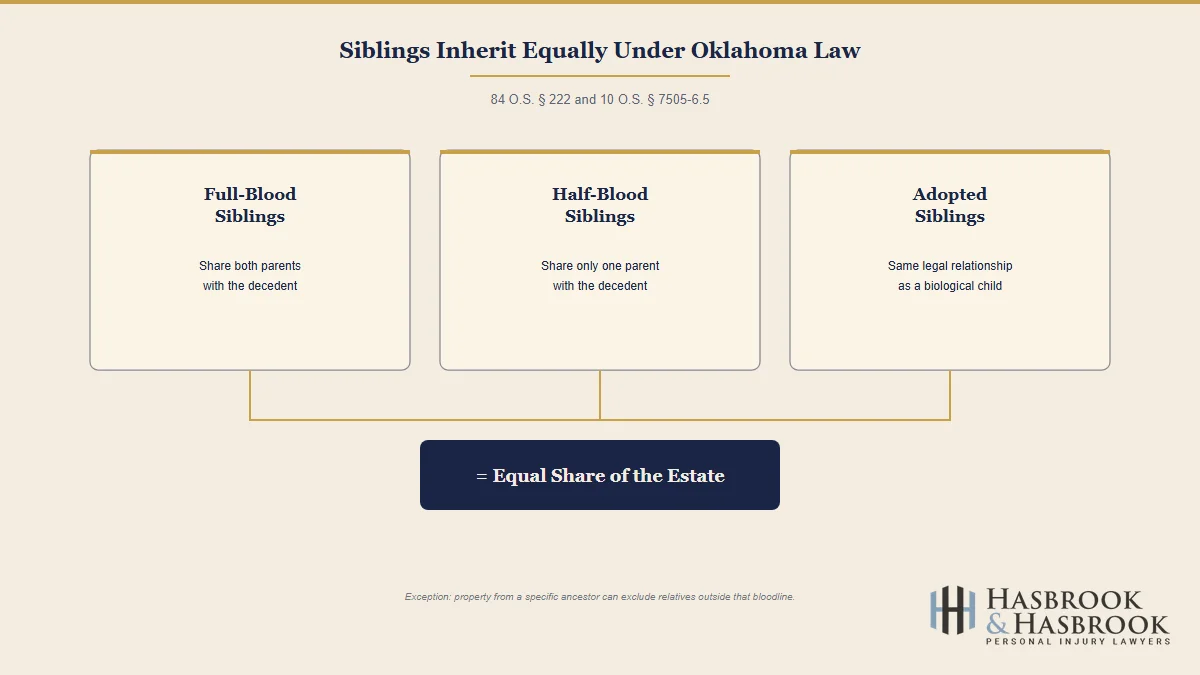
Under 84 O.S. § 222, half-blood siblings (siblings who share only one parent) inherit equally with full-blood siblings in the same degree. There is one narrow exception: if the specific property came to the decedent by descent, devise, or gift from a particular ancestor, relatives who are not of that ancestor’s blood are excluded from that specific property, but this exception does not reduce a half-sibling’s share of the estate generally.
Adopted siblings are treated the same as biological siblings for inheritance purposes. Once a final decree of adoption is entered, 10 O.S. § 7505-6.5 gives the adopted child the same legal relationship to the adoptive parents, and to the adoptive parents’ other children, as a biological child would have.
Common Questions About Inheriting Without a Spouse, Children, or Will
My sibling died without a spouse, children, or a will, and our parents are already gone. Are we heirs?
Yes. Under 84 O.S. § 213, when a person dies unmarried, without children, and without a will, the estate goes to surviving parents first. If no parent survives, it passes in equal shares to the decedent’s siblings, with a deceased sibling’s own children inheriting that sibling’s share by representation.
What if a sibling who is entitled to inherit is a minor?
A minor heir (under 18) cannot take direct control of inherited property. The probate court typically appoints a guardian or conservator to manage that heir’s share until the minor reaches the age of majority.
Can siblings contest how the estate is distributed?
Yes. Heirs can challenge a proposed distribution in probate court on grounds such as undue influence, lack of mental capacity at the time a will was signed, or the discovery of a more recent will. These disputes are typically resolved through mediation or, if necessary, litigation.


Estate Planning Can Prevent This Outcome
A will lets a person direct exactly who inherits, rather than leaving the outcome to Oklahoma’s default statutory order. Trusts, beneficiary designations, payable-on-death accounts, and joint ownership can also move specific assets outside of probate; the Consumer Financial Protection Bureau’s explanation of revocable living trusts is a useful starting point for how that particular tool works.
Sorting out heirship and opening a probate estate without a will can be confusing during an already difficult time. Our overview of the probate petition steps for opening an estate and our explainer on who the court appoints to administer an estate cover the mechanics in more detail. Hasbrook & Hasbrook can help families confirm their status as heirs and work through the probate process.