In 2023, Oklahoma recorded 107 motorcyclist fatalities, a 12% increase over the prior year and one of the highest per-capita motorcycle death rates in the country, according to the Oklahoma Highway Safety Office. National data from the NHTSA 2022 Traffic Safety Facts report shows motorcyclists are 29 times more likely to die in a crash per vehicle mile traveled than passenger car occupants, and the Insurance Institute for Highway Safety reports motorcycle riders made up 15% of all traffic deaths nationally in the most recent reporting year. If you or someone you love was hurt in a motorcycle wreck on an Oklahoma road, the decisions you make in the first days after the crash will shape your financial recovery for years.



Key takeaways
- Oklahoma recorded 107 motorcyclist fatalities in 2023, a 12% year-over-year increase (Oklahoma Highway Safety Office data).
- Motorcyclists are 29 times more likely to die per vehicle mile traveled than passenger car occupants (NHTSA, 2022 Traffic Safety Facts).
- Oklahoma’s modified comparative fault rule under 23 O.S. § 13 allows recovery as long as your fault does not exceed 50%.
- The standard deadline to file a personal injury lawsuit in Oklahoma is two years from the crash date under 12 O.S. § 95.
- Oklahoma’s noneconomic damages cap under 23 O.S. § 61.3 is $500,000, though the updated statute has not yet been tested by the Oklahoma Supreme Court.
- Hasbrook & Hasbrook Personal Injury Lawyers represent injured riders on a 25% contingency fee with no payment due unless we recover.
Motorcycle accidents in Oklahoma City: what the numbers show
Key statistics for Oklahoma riders
Oklahoma’s motorcycle fatality rate ranks among the worst in the nation. In 2023, 107 riders died on Oklahoma roads, according to the Oklahoma Highway Safety Office crash data portal. National figures from NHTSA confirm the scale of the risk: motorcyclists account for roughly 3% of registered vehicles but nearly 14% of all traffic fatalities. The Oklahoma DPS SafeRiders program tracks annual trends, with rural two-lane highways and urban intersections accounting for the majority of serious crashes statewide.
In Oklahoma City, the most dangerous corridors include I-35, I-40, and I-44, where higher speeds amplify the severity of any collision. The urban street grid adds intersection risk from turning vehicles, which is the most common crash scenario in the state. Our interactive crash map tracks reported crashes across the metro by location and severity.
Where motorcycle crashes most often occur in OKC
Crash patterns in the Oklahoma City metro cluster around a few high-volume traffic environments. Knowing where the highest-risk locations are helps riders ride defensively and helps an attorney evaluate the liability picture quickly when a crash happens.
| Location type | Typical crash mechanism | Why riders are vulnerable |
|---|---|---|
| Interstate corridors (I-35, I-40, I-44, I-240) | Lane-change strikes, rear-end at slowing traffic, debris | Speed differential between motorcycles and merging traffic |
| Major intersections (NW Expressway, May, Memorial, NW 23rd) | Left-turn-across-path collisions, red-light running | Drivers misjudge motorcycle approach speed |
| Downtown grid & Bricktown | Distracted driving, sudden stops, parked-car door strikes | Heavy pedestrian and stop-and-go traffic |
| Rural state highways outside OKC | Curve runoff, animals, head-on crossover | Higher posted speeds and limited shoulder |
| Construction zones & ODOT work sites | Loose gravel, uneven pavement, missing signage | Motorcycles cannot absorb pavement irregularities the way cars can |
Who is most at risk
Riders ages 25 to 54 account for the largest share of motorcycle fatalities in Oklahoma. Nearly half of all fatal crashes involve alcohol. Unhelmeted riders suffer fatal head injuries at significantly higher rates than helmeted riders, even though Oklahoma does not require adult riders to wear a helmet. Male riders represent roughly 90% of motorcycle fatalities statewide. Sport bike riders face higher per-mile fatality rates than cruiser or touring bike riders, largely due to speed-related crashes. The NHTSA’s motorcycle road-safety topic page documents how unhelmeted riders incur substantially higher hospital and lifetime medical costs than helmeted riders.
Oklahoma law that governs motorcycle accident claims
Comparative fault (23 O.S. § 13)
Oklahoma follows a modified comparative negligence rule under 23 O.S. § 13. You can recover compensation as long as your fault does not exceed 50%. At exactly 50% fault, you still recover. If a jury assigns you 20% fault on a $400,000 verdict, you receive $320,000. If your fault exceeds 50%, you recover nothing. Insurance companies routinely push motorcycle riders toward inflated fault percentages, arguing about speed, lane position, or helmet use. Our motorcycle accident attorneys challenge those arguments with physical evidence, traffic camera footage, and expert analysis. Read our deeper explanation of how shared blame is apportioned at trial under § 13 in Oklahoma personal injury cases.
How bias against motorcyclists affects fault percentages
Adjusters and jurors often start with an unspoken assumption that motorcycle riders are reckless or partly responsible for being on a bike at all. That bias translates directly into higher fault assignments at the negotiation table. We counter this with safety data, ride-history evidence, and crash reconstruction that focuses jurors on the physical facts rather than stereotypes about riders. Detailing rider gear, training, and lawful lane position before the at-fault driver’s failure to yield often shifts perceived fault back where the physical evidence places it.
Noneconomic damages cap (23 O.S. § 61.3)
Effective September 2025, Oklahoma enacted a $500,000 cap on noneconomic damages in personal injury cases under 23 O.S. § 61.3. The cap does not apply when the defendant acted with gross negligence, recklessness, or intent, and it has no effect on economic damages. The Oklahoma Supreme Court has not yet ruled on the constitutionality of the updated cap, so its enforceability in litigation remains an open question. Defendants in motorcycle cases involving drunk drivers or extreme speeding may also face a punitive damages claim that operates outside the cap.
Statute of limitations (12 O.S. § 95)
You have two years from the crash date to file a personal injury lawsuit under 12 O.S. § 95. Miss that deadline and the court will dismiss your case regardless of the evidence. Narrow exceptions exist for minors and for defendants who left Oklahoma, but contact an attorney immediately rather than relying on them. If a government entity bears any responsibility for the crash, a one-year notice of claim deadline applies under the Governmental Tort Claims Act, 51 O.S. § 156, before you can proceed with a lawsuit. Read our deeper explanation of Oklahoma’s filing deadlines for personal injury cases.
Helmet law and required equipment (47 O.S. § 12-609)
Oklahoma requires helmets only for riders under 18 under 47 O.S. § 12-609. Adult riders face no legal obligation to wear a helmet. However, if you were unhelmeted and suffered a head injury, the defense will argue that choice contributed to the severity of those injuries. Oklahoma courts have allowed this argument under comparative fault, which can reduce your head-injury damages. Not wearing a helmet does not bar your claim, but discuss it with your attorney before making statements to any insurer. Our explainer on how § 12-609 interacts with comparative-fault arguments at trial walks through how courts handle this issue at each stage of your claim. For broader rules of the road for two-wheeled travel, see our reference page on Oklahoma motorcycle laws.
How motorcycle accident claims differ from car accident claims
A motorcycle case is not just a car case on two wheels. Three structural differences matter at every stage:
- Injury severity skews catastrophic. Without crumple zones or restraints, even a 30 mph impact often produces orthopedic, spinal, or head injuries. Demand packages need detailed life-care projections that simple passenger-car wreck claims handled at our broader auto-injury practice rarely require.
- Liability disputes start higher. Adjusters apply implicit anti-rider bias before the file is even opened, so the comparative fault percentage proposed against the rider is usually inflated and must be litigated down with evidence.
- UM/UIM coverage is more often the real source of recovery. Liability minimums in Oklahoma frequently fall short of catastrophic motorcycle injury values, putting the rider’s own underinsured motorist policy at the center of the negotiation.
How we investigate motorcycle accident cases
Evidence collection and preservation
Evidence in a motorcycle accident case disappears fast. Skid marks fade within days. Debris is removed from the roadway. Surveillance footage is overwritten on a 24-to-72-hour loop at most businesses and intersections. When you hire our firm, we move immediately to preserve what matters.
Our investigation typically includes:
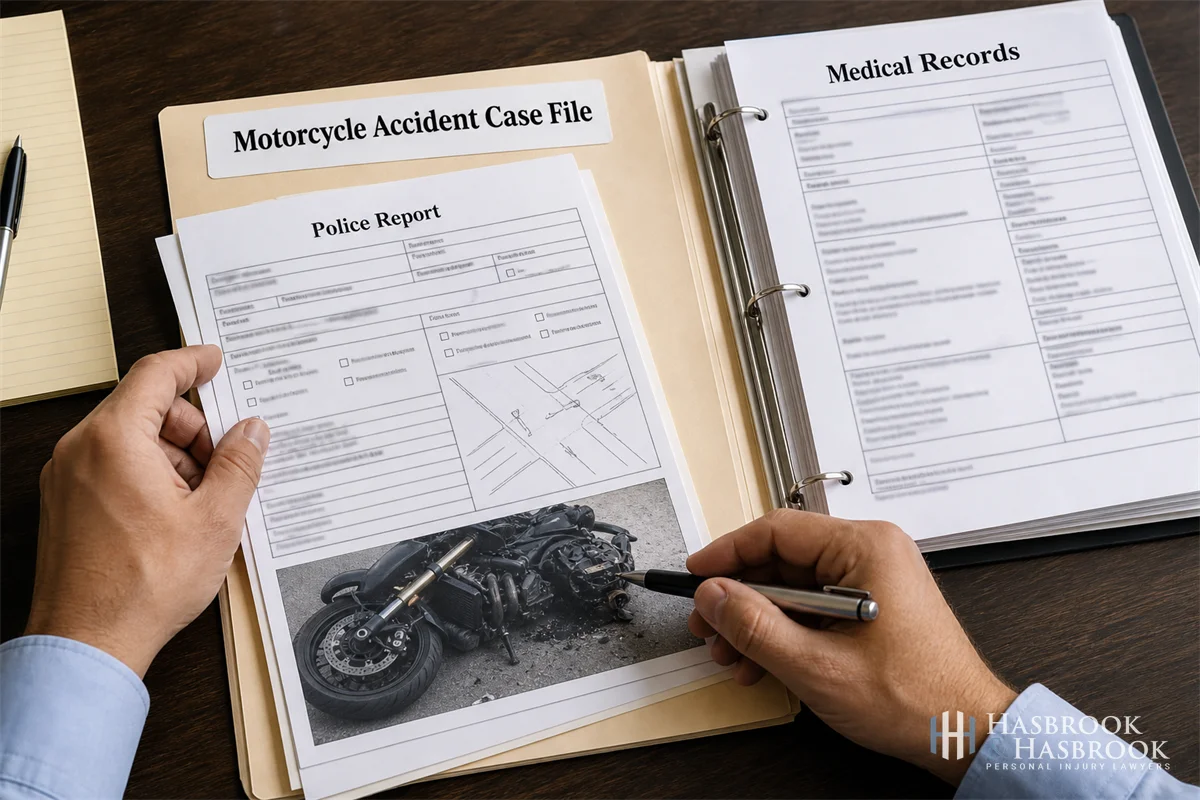
- Obtaining the police report and crash reconstruction data from OKCPD or Oklahoma Highway Patrol
- Requesting traffic camera, dashcam, and business surveillance footage from the surrounding area
- Photographing the scene, road conditions, vehicle positions, and debris patterns
- Collecting license plate information for all vehicles involved or observed near the crash
- Interviewing eyewitnesses before recollections shift
- Preserving your helmet and riding gear as physical evidence of impact force
- Sending a spoliation letter to the at-fault driver’s insurer to prevent destruction of vehicle data
- Subpoenaing phone records and infotainment system data when distracted driving is suspected
Medical documentation is equally important. We coordinate with your treating physicians to gather records that connect your injuries directly to the crash and project future care costs accurately. A gap in treatment is the insurer’s primary argument that your injuries were not serious. For practical guidance on documenting income loss after a crash, see our page on pay-stub, tax-return, and self-employment-income evidence rules.
Working with expert witnesses
Serious motorcycle accident cases require expert testimony. Accident reconstructionists determine speed, point of impact, and pre-crash maneuvers from physical evidence alone. Biomechanical engineers explain how crash forces caused specific injuries. Life care planners project the full cost of future medical treatment for permanent disabilities. Vocational economists calculate lost earning capacity when your injuries prevent you from returning to your prior work. Our network of Oklahoma-qualified experts supports cases at the negotiation table and before juries.


Types of motorcycle accidents we handle
Left-turn collisions
A driver turns left at an intersection, fails to see an oncoming motorcycle, and strikes the rider in the travel lane. Left-turn crashes are the single most common fatal motorcycle collision type nationally, per NHTSA data. The driver’s failure to yield is the primary liability theory. Insurers will scrutinize the rider’s approach speed and lane position in response, which is why physical evidence and camera footage are critical from the start.
Rear-end and highway crashes
An inattentive driver rear-ends a motorcycle stopped at a light or slowing in traffic. Because the motorcycle offers no rear crumple zone, the rider absorbs the full impact force. At highway speeds, rear-end collisions between motor vehicles and motorcycles are often fatal. Distracted driving, including phone use and infotainment interaction, is the leading cause in this crash category. Vehicle event data recorders and phone records frequently provide the key liability evidence.
Lane-change and blind-spot crashes
Motorcycles fit entirely within a vehicle’s blind spot. When a driver changes lanes without checking mirrors or signaling, the rider has almost no time to react. These crashes occur most frequently on I-35, I-40, and I-44 in the Oklahoma City metro. Dashcam footage or adjacent vehicle infotainment records often capture the lane-change sequence. Where electronic evidence is unavailable, accident reconstruction specialists establish fault from the physical damage pattern.
Road hazard cases
Potholes, loose gravel, uneven pavement, missing signage, and construction debris are far more dangerous to motorcycles than to four-wheeled vehicles. When a government entity fails to maintain a road, a one-year notice of claim deadline applies under the Governmental Tort Claims Act, and a shorter filing deadline may govern the claim. If a road defect contributed to your crash, contact an attorney immediately so the notice window does not close. Our overview of how § 156 notice deadlines and § 154 damages caps reshape claims against city or state defendants walks through how the GTCA changes deadlines, defendants, and damages caps.
Head-on and sideswipe crashes
Head-on collisions between a motorcycle and an oncoming vehicle are among the most catastrophic crash types, frequently causing fatalities or permanent disability. Sideswipe crashes occur when a vehicle drifts into a motorcycle’s lane, often at highway speed. Both types generate high-severity injury claims that require detailed medical and engineering expert testimony to quantify losses accurately.
Drunk and impaired driver crashes
Alcohol and drug impairment is a leading cause of fatal motorcycle crashes in Oklahoma. When the at-fault driver was impaired, your motorcycle case may include a punitive damages claim under 23 O.S. § 9.1 and, in some cases, a separate dram shop claim against the bar or restaurant that overserved the driver. Our Oklahoma City drunk driving accident attorneys handle these alcohol-involved cases alongside the core motorcycle negligence claim.
Common motorcycle accident injuries in Oklahoma City
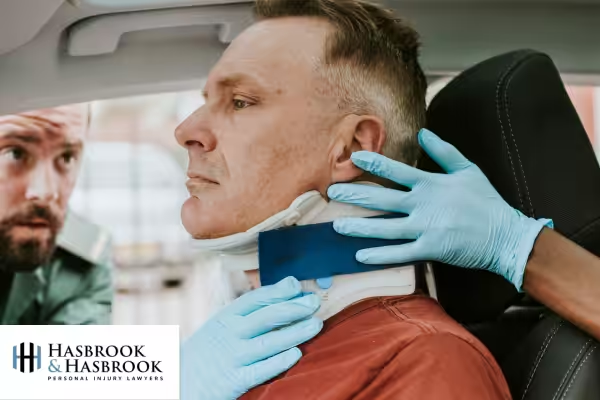
Motorcycles provide none of the protective features that enclosed vehicles offer: no steel frame, no airbags, no seatbelts, no crumple zones. In a collision, the rider’s body absorbs the full force of impact. NHTSA data confirms motorcyclists are five times more likely to suffer a serious injury per mile traveled than passenger car occupants. The injuries common to motorcycle crashes are severe, often permanent, and generate substantial future care costs.
Traumatic brain injuries
TBI ranges from concussions to diffuse axonal injury and skull fractures. Even helmeted riders can sustain TBI from rotational forces. Cognitive, emotional, and physical impairments may not fully manifest for days or weeks after the crash. Our Oklahoma City brain injury team handles TBI claims alongside the core motorcycle negligence case and can coordinate the medical expert evidence needed to document long-term impacts. The CDC’s TBI data center documents how concussion symptoms can persist for months and how repeated head injuries compound long-term cognitive risk. For lower-severity head injuries, our reference on mild TBI litigation in Oklahoma walks through the evidence challenges.
Spinal cord injuries
Herniated discs, fractured vertebrae, and partial or complete paralysis are common in high-speed crashes. Spinal cord damage may require lifelong medical care, adaptive equipment, and home modifications. Accurately projecting lifetime care costs requires a life care planner working alongside treating physicians. Our paralysis-and-cord-damage litigation team handles these claims as part of the overall motorcycle accident case, including quadriplegia and paralysis claims that drive the highest case values.
Road rash and burns
Road rash results from the rider’s skin sliding across pavement at speed. Deep third-degree road rash damages muscle and bone, requires skin graft surgery, and leaves permanent scarring. Fuel fires in motorcycle crashes can also cause severe burn injuries requiring extended inpatient care. Scarring, disfigurement, and permanent skin damage are separately compensable under Oklahoma law as non-economic damages. See our overview of Oklahoma City burn injury claims for additional detail on damages models and treatment timelines.
Broken bones and orthopedic injuries
Leg, arm, wrist, collarbone, rib, and pelvis fractures are among the most frequent motorcycle accident injuries. Compound fractures may require surgical hardware such as pins, plates, and rods, followed by months of physical therapy. Loss of range of motion, chronic pain, and need for future surgery are economic damages your attorney must document thoroughly before any settlement is reached. Many of these claims overlap with our broken bones practice, where the orthopedic expert workup is similar.
Compensation available under Oklahoma law
Economic damages
Economic damages cover measurable financial losses caused directly by the crash. Oklahoma law allows recovery for:
- Past and future medical expenses: emergency care, surgery, hospitalization, physical therapy, prescriptions, prosthetics, home health care
- Lost wages and income during recovery
- Loss of earning capacity when injuries permanently limit your ability to work
- Property damage: motorcycle repair or replacement, damaged riding gear and equipment
- Out-of-pocket expenses: transportation to appointments, home modifications, assistive devices
Oklahoma follows a paid-not-incurred rule under 12 O.S. § 3009.1. You recover the amount actually paid in medical bills, not the higher amount billed before insurance adjustments. Documenting every out-of-pocket dollar, including co-pays and deductibles, is essential. For a breakdown of what motorcycle cases have settled for and what drives those numbers, see our analysis of typical motorcycle settlement ranges by injury type.
Non-economic damages
Non-economic damages cover losses that do not appear on a receipt but are legally compensable under Oklahoma law:
- Physical pain and suffering during and after recovery
- Emotional distress, anxiety, PTSD, and depression related to the crash and injuries
- Loss of enjoyment of life and inability to participate in previously enjoyed activities
- Permanent disfigurement and scarring
- Loss of consortium (impact on your spousal relationship)
Punitive damages (23 O.S. § 9.1)
When a driver’s conduct was grossly reckless or intentional, a court may award punitive damages beyond your compensatory losses under 23 O.S. § 9.1. Drunk driving, deliberate road rage, and street racing are examples of conduct that can support a punitive damages claim. These awards require clear and convincing evidence of the defendant’s conscious disregard for others’ safety and are separate from the noneconomic damages cap.

How insurance companies handle motorcycle accident claims
The adjuster’s playbook
Most motorcycle accident claims begin with a demand to the at-fault driver’s liability insurer. Adjusters will make low offers early, before your injuries are fully documented, and request a recorded statement to find inconsistencies. You are not required to give a recorded statement to the other driver’s insurer. Our motorcycle accident attorneys send a formal demand package after you reach maximum medical improvement: a complete account of liability, documented damages, supporting medical records, and a settlement figure. For guidance on managing your own claim before hiring an attorney, see our page on walking the early adjuster steps without representation.
How to read a low first offer
An early lowball offer is rarely the insurer’s actual reserve number. Use this checklist before responding:
- Have you reached maximum medical improvement? If not, the offer cannot account for future care. See why MMI is the gating point before any settlement number is reliable.
- Are all liens identified? Hospital and ERISA liens reduce your net recovery and reset what counts as a “fair” gross figure.
- Has the adjuster received a complete demand? Pre-demand offers are anchoring tactics, not valuations.
- Does the offer reflect the full UM/UIM stack? Many adjusters quote only the at-fault liability layer.
- Is there a punitive damages claim in play? Drunk-driver crashes and other gross-negligence facts move the case beyond the noneconomic cap.
For a deeper discussion of valuation, read how to negotiate a personal injury settlement and avoid lowball offers.
UM/UIM coverage and stacking
If the at-fault driver has minimum-limit insurance and your injuries are catastrophic, your own uninsured/underinsured motorist (UM/UIM) policy frequently becomes the largest single source of recovery. Oklahoma requires insurers to offer UM/UIM coverage on motorcycle policies under 36 O.S. § 3636. Stacking provisions may allow you to combine coverage from multiple policies with the same insurer or across household vehicles. The Oklahoma Insurance Department’s auto coverage brochure explains the consumer rules around UM/UIM in plain language. Review every available policy with your attorney immediately after the crash, and read our resource on why every Oklahoma rider should carry UM/UIM.
Bad-faith conduct by insurers
Adjusters who delay payment without justification, refuse to evaluate clear evidence, or make offers far below documented damages may be engaging in bad faith. A bad-faith claim is separate from the underlying motorcycle case and can produce damages beyond your policy limits. See our page on Oklahoma City bad faith insurance claims for the elements and timing.

What to expect during your motorcycle accident claim
Phase-by-phase timeline
Most riders want to know how long the case will take and what each step looks like. Timelines vary by injury severity and disputed liability, but the structure is predictable.
| Phase | Typical duration | What happens |
|---|---|---|
| 1. Treatment to MMI | 3-18 months | You complete medical treatment until reaching maximum medical improvement; we collect records and gather liability evidence. |
| 2. Demand | 30-90 days after MMI | Attorney sends a written demand package; insurer evaluates and responds with offer or denial. |
| 3. Negotiation | 30-120 days | Counter-offers exchanged; many cases resolve at this stage. |
| 4. Filing suit | Day 1 of litigation | If negotiation fails, attorney files in Oklahoma district court. |
| 5. Discovery | 6-12 months | Depositions, interrogatories, document requests, expert disclosures. |
| 6. Mediation | 1 day, scheduled mid-litigation | Neutral mediator helps the parties find resolution before trial. |
| 7. Trial | 2-5 days | Jury hears liability and damages evidence; verdict entered. |
For specifics on how long a motorcycle case takes from crash to resolution, read our guide on how long a motorcycle case takes. For an attorney-side reference on early case strategy, see our section-by-section template for a presuit demand package.
Filing a lawsuit
If negotiation does not produce a fair offer, your attorney files suit in Oklahoma district court. Discovery follows: depositions of the at-fault driver, witnesses, and experts; document requests from the insurer; and subpoenas for phone records and vehicle data. Filing suit significantly increases pressure on insurers, who prefer to avoid juries. Many cases settle during the depositions-and-document-exchange phase of litigation or in the weeks immediately before trial.
Trial
When an insurer refuses a fair offer, the case goes before a jury. Motorcycle accident trials in Oklahoma typically span two to five days and turn on expert testimony quality and the attorney’s ability to address anti-rider bias directly with jurors. Our firm tries cases before Oklahoma juries, and insurers know it. That willingness to go to trial is what converts reasonable demands into accepted offers.
What steps should you take after a motorcycle accident
The first 72 hours
Decisions made in the first three days shape the entire arc of the case. Use this checklist:
- Call 911 and accept ambulance transport. Adrenaline masks pain, and TBI symptoms can be invisible for hours. The ER record creates the legal foundation for the injury timeline.
- Do not move your motorcycle until police document the scene, unless it is unsafe to remain. Final position is critical reconstruction evidence.
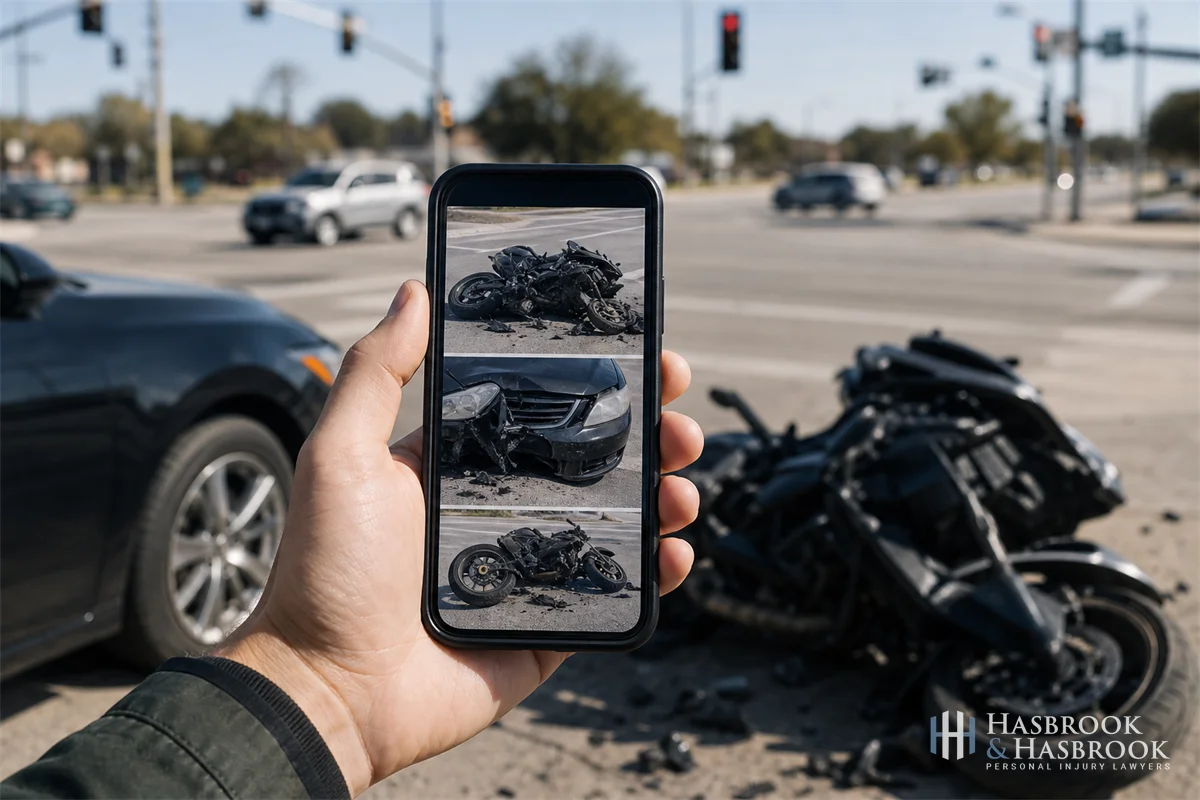
- Photograph everything. Bike position, debris field, road conditions, gear damage, weather, traffic signals, and your visible injuries. Every angle helps.
- Get witness names and phone numbers before they leave. Police reports often miss bystanders who saw the actual impact.
- Exchange insurance information. Photograph the other driver’s license, insurance card, and license plate.
- Do not apologize or speculate about fault. Anything you say can be used against you, even informally.
- Do not give a recorded statement to any insurance company before consulting an attorney. The first call is recorded; the questions are scripted to limit your claim.
- Follow up with your doctor within 48 hours. Internal injuries, soft-tissue trauma, and concussion can present late.
- Preserve your gear. Helmet, jacket, gloves, and boots are physical evidence of impact force; do not throw any of it out.
- Call a motorcycle accident attorney. The earlier counsel is involved, the more evidence is preserved.
Reporting an Oklahoma City motorcycle accident
Oklahoma law requires drivers and riders to report any crash involving injury, death, or significant property damage to law enforcement. The OKCPD or Oklahoma Highway Patrol officer who responds will complete a crash report; you can request a copy from the Oklahoma City Police records office a few days after the crash. Get this report; it is the single most influential document in early settlement evaluations.
Why our motorcycle accident attorneys handle these cases differently
Oklahoma-focused experience
We are a family-run Oklahoma personal injury firm. Our attorneys have represented injured riders across the state for decades and understand the anti-rider bias that adjusters exploit at every stage of a claim. We know how Oklahoma juries evaluate motorcycle cases and how to counter bias with safety data, crash evidence, and expert testimony.
We handle claims throughout the metro and across Oklahoma, including through our rider representation in Edmond, our Midwest City-area bike-crash counsel, and our Tulsa motorcycle-injury practice. Motorcycle injuries frequently overlap with other serious injury categories. If you suffered a life-changing high-severity injury, our attorneys have specific experience building those claims alongside the motorcycle negligence case. When a crash results in a fatality, our Oklahoma City wrongful death attorneys help surviving family members pursue the full range of available damages.
How our fees work
Our 25% rate is one of the lowest in Oklahoma personal injury law. You owe nothing upfront. We advance all case expenses, including expert witness fees, court costs, and medical record retrieval. If we do not recover money for you, you owe us nothing. Read our broader explanation of contingency-fee tiers and how case costs are advanced and recouped.
Want to understand what your case is worth? Call (405) 605-2426 for a free case review with an Oklahoma City motorcycle accident attorney.
Frequently asked questions about motorcycle accidents in Oklahoma
What is the deadline to file a motorcycle accident lawsuit in Oklahoma?
The filing deadline is governed by 12 O.S. § 95 and runs from the crash date. Miss it and the court will dismiss your case regardless of the evidence. Narrow exceptions exist for minors and for defendants who left Oklahoma, but contact an attorney immediately rather than relying on those exceptions. For a fuller treatment, see our page on exceptions to the Oklahoma statute of limitations.
Can I recover compensation if I was partly at fault?
Yes, under Oklahoma’s modified comparative negligence rule. Your damages are reduced by your assigned percentage of responsibility. If a jury finds you 25% responsible and your losses total $200,000, you receive $150,000. Insurance companies push riders toward inflated percentages, particularly when a helmet was not worn or speed was involved. An attorney challenges those assignments with physical evidence and expert testimony.
How much is a motorcycle accident case worth in Oklahoma?
Case value depends on injury severity, future medical costs, lost income, available insurance coverage, and the strength of the liability evidence. Minor injuries with full recovery settle in the low tens of thousands. Permanent injuries with ongoing care needs can reach hundreds of thousands or more. Our breakdown of typical settlement ranges (linked above) walks through how injury type and circumstances drive case value.
What if the at-fault driver has no insurance?
If the at-fault driver carries no insurance or insufficient coverage, your own uninsured/underinsured motorist (UM/UIM) policy may cover the gap. Stacking provisions may allow you to combine coverage from multiple policies with the same insurer. Review all available policies with your attorney immediately after the crash. See our explanation of how UM/UIM claims trigger when liability limits are exhausted for the procedural specifics.
How do I prove the other driver was at fault?
Liability typically rests on the police report, eyewitness accounts, traffic and surveillance camera footage, dashcam video, phone records, and physical evidence from the scene. In left-turn and lane-change cases, accident reconstruction experts establish speed, sight lines, and timing from skid marks and damage patterns. The sooner an attorney gets involved, the better the chance of preserving that evidence before it disappears. Read our overview of the preponderance-of-evidence standard juries apply in civil cases for the legal standard.
Do passengers injured on a motorcycle have a claim?
Yes. A passenger injured in a motorcycle accident can file a claim against the at-fault driver and, depending on circumstances, against the motorcycle operator. Passengers are generally not considered at fault for the crash, which simplifies comparative fault analysis. An attorney identifies all available sources of recovery for an injured passenger, including the operator’s liability coverage and any UM/UIM coverage on the motorcycle policy. The minimum age to be a motorcycle passenger in Oklahoma is also a separate analysis covered in our age requirement to ride on the back of a motorcycle reference.
Does delayed medical treatment hurt my claim?
It can. A gap in treatment gives insurers grounds to argue your injuries were not serious or that something unrelated caused your condition. Get examined the day of the crash even if symptoms seem minor. Adrenaline masks pain, and serious conditions like TBI and internal bleeding may not produce obvious symptoms for hours or days. Follow up with your doctor within 48 hours and continue treatment as directed.
What should I do immediately after a motorcycle accident?
Call 911 and request emergency medical services. Do not move your motorcycle until police document the scene. Exchange insurance information with the other driver. Photograph the scene, road conditions, vehicle positions, and your injuries. Get witness names and phone numbers. Do not apologize or admit fault. Do not give a recorded statement to any insurance company before consulting an attorney. Call (405) 605-2426 for a free consultation.
Does not wearing a helmet affect my claim?
Oklahoma does not require adult riders to wear a helmet under 47 O.S. § 12-609, but if you suffered a head injury without one, the defense will argue comparative fault to reduce your head-injury damages. Courts have allowed juries to consider the absence of a helmet in assessing how much the rider’s own choice contributed to the severity of head injuries. Your overall claim and all non-head-injury damages are unaffected. See our breakdown of how unhelmeted-rider arguments are limited to head-injury damages for more detail.
How long does a motorcycle accident case take to resolve?
Simple claims with clear liability and limited injuries can settle in three to six months. Cases with severe injuries, disputed fault, or government defendants typically take 12 to 24 months. See the timeline guide referenced earlier for stage-by-stage specifics.

Ready to talk to an Oklahoma City motorcycle accident lawyer?
Motorcycle cases reward early action. Evidence vanishes within days, the GTCA notice clock starts immediately, and adjusters open files with low reserves on rider claims. Bring an experienced Oklahoma motorcycle attorney into the case as soon as you can. The motorcycle accident lawyers at Hasbrook & Hasbrook handle each step from preservation letters through trial.
Call (405) 605-2426 or submit your motorcycle-crash details through the intake form for a free case review.