You step through the entrance of a grocery store in Oklahoma City, and your foot hits a puddle of spilled liquid that no one bothered to clean up. In an instant, you are on the ground with a fractured wrist and a throbbing back. The manager rushes over, not to help, but to tell you they are “not responsible.” If you have been injured on someone else’s property because a hazard was ignored, you may have a premises liability claim. An Oklahoma City premises liability lawyer at Hasbrook & Hasbrook can help you recover compensation and hold careless owners accountable. Call (405) 605-2426 anytime for a free consultation.
- Property owners owe different duties of care depending on whether you entered as an invitee, licensee, or trespasser. Invitees receive the highest protection.
- Oklahoma’s comparative negligence rule allows recovery as long as your share of fault is at or below 50% under 23 O.S. § 13.
- You have two years to file under 12 O.S. § 95. Claims against government property have a one-year notice deadline.
- Noneconomic damages are capped at $500,000 under 23 O.S. § 61.3, with exceptions for intentional acts, reckless conduct, and severe physical injuries.
- Hasbrook & Hasbrook charges 25% for pre-litigation settlements. No upfront cost. No fee unless we win.
Premises liability in Oklahoma: what the numbers show
Key statistics
Premises liability injuries happen more often than most people realize, and the consequences can be life-altering:
- Falls are the leading cause of traumatic brain injuries (TBIs) in the United States, responsible for approximately 47% of all TBI deaths and hospitalizations (CDC, 2023), according to the Centers for Disease Control and Prevention.
- More than 36 million falls occur among older adults in the U.S. each year, resulting in over 32,000 deaths and millions of hospitalizations, per CDC fall data (2023).
- Workplace falls alone cause more than 800 deaths annually and account for nearly 20% of all occupational fatalities, according to the Bureau of Labor Statistics Injuries, Illnesses, and Fatalities program (2023). Many of these deaths are legally compensable premises liability claims, especially when a property owner failed to maintain a safe environment.
Who is most at risk
Older adults, children, and workers face the greatest exposure to premises liability injuries in Oklahoma. Seniors are particularly vulnerable because reduced mobility and balance make recovery from a fall more difficult and the resulting injuries more severe. Children who wander onto unfenced pools, construction sites, or properties with dangerous equipment trigger heightened legal duties for property owners under Oklahoma’s attractive nuisance doctrine. Delivery workers, contractors, and customers who enter commercial properties as invitees receive the strongest protections under Oklahoma law and are the most common claimants in walkway slip injuries and premises negligence cases.



What is premises liability under Oklahoma law?
Premises liability is the legal principle that property owners and occupiers must keep their property reasonably safe for visitors and face financial responsibility when they fail. In Oklahoma, this duty applies to any person or business that controls a property, whether they own, lease, or manage it. If a dangerous condition on someone else’s property caused your injury, you may be entitled to compensation for medical bills, lost income, and pain and suffering.
To succeed in a premises liability case, you generally must prove that a dangerous condition existed, the owner knew or should have known about it, and the property owner failed to fix it or warn you. These liability issues arise across a wide range of settings, from retail stores and restaurants to apartment complexes and parking garages. Under 76 O.S. § 1, every person in Oklahoma has a legal obligation not to injure another or infringe upon their rights, the foundational principle that underlies all premises liability claims.
Do you have a premises liability claim?
A premises liability claim requires four elements. You can use this framework to assess your own situation before speaking with an attorney:
- Duty: The property owner or occupier owed you a duty of care. Your legal status as an invitee, licensee, or trespasser determines the level of duty owed. If you were a customer, tenant, or invited visitor, you are an invitee and receive the highest protection.
- Breach: The owner breached that duty by failing to inspect for hazards, repair a known dangerous condition, or warn you of a risk you could not reasonably see. A wet floor with no warning sign, a broken stair railing, or inadequate security lighting are examples of breach.
- Causation: The breach directly caused your injury. If you slipped on a wet floor that had been reported three times and never cleaned, the connection between the owner’s failure and your fall is clear.
- Damages: You suffered actual harm: medical bills, missed work, physical pain, or permanent impairment. A close call with no injury does not support a claim, but documented medical treatment does.
If all four elements are present, you very likely have a compensable premises liability claim. For more on hurdles unique to slip and fall claims and what property owners argue in their defense, see our dedicated resource on defenses commonly raised by property owners.
Types of premises liability cases we handle
Our premises liability attorneys handle cases involving a broad range of property types and accident scenarios throughout Oklahoma City and the surrounding area. The duty of care a property owner owes depends on the type of property and the nature of the hazard, but when that duty is breached, the results can be devastating.
Slip and fall accidents
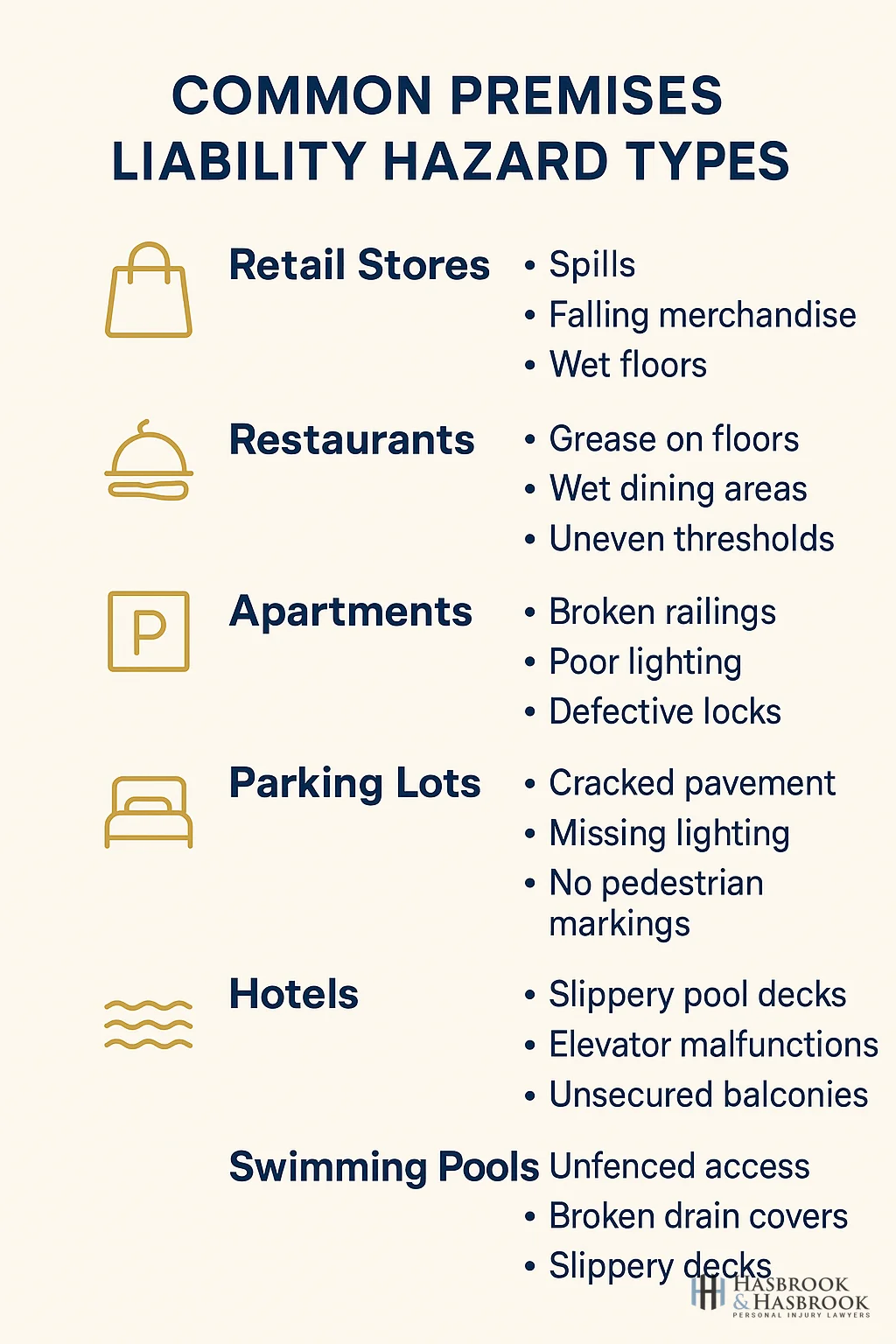
Wet floors, icy walkways, torn carpeting, and uneven surfaces are the leading cause of premises liability claims in Oklahoma City, including at high-traffic locations like Penn Square Mall, Bricktown entertainment venues, and Classen Curve. These incidents produce serious injuries including fractured arms, wrists, and hips, head and brain trauma, and spinal injuries from falls. If you were hurt in a slip and fall on someone else’s property, our attorneys can help you gauge what your slip and fall claim is worth and post-fall steps that protect a future claim.
Retail store and grocery store injuries
Retailers and grocery chains are among the most common defendants in Oklahoma premises liability cases. Spilled liquids, merchandise that falls from shelves, wet produce sections, and inadequate floor maintenance routinely cause customer injuries at stores across the Oklahoma City metro, from major chains along Northwest Expressway to smaller local retailers. Businesses like Walmart and Target are held to high standards of care because customers enter as invitees. Our firm has specific experience with slip and fall cases on Walmart property and Target slip and fall liability claims in Oklahoma City, as well as fall injuries at Braum’s locations.
Restaurant and food service premises
Grease-covered kitchen floors, wet dining room surfaces, unmarked threshold changes, and outdoor patio hazards frequently lead to serious customer injuries at Oklahoma City restaurants, including locations in the Stockyards City district and the Plaza District. Restaurants owe the highest standard of care to patrons and must conduct regular inspections and maintenance to prevent foreseeable hazards.
Apartment buildings and residential properties
Landlords and property managers in Oklahoma are required to maintain safe conditions in common areas, stairwells, parking lots, and shared facilities. Broken railings, inadequate lighting, defective locks, and unrepaired structural hazards expose residents and guests to injury, particularly in high-density apartment complexes along NW Expressway and the OKC metro area, and expose property owners to premises liability claims. Tenants injured by their landlord’s negligence have the same right to pursue compensation as a customer injured in a retail store.
Parking lot accidents
Parking lots present hazards that property owners routinely ignore: broken pavement, unmarked speed bumps, inadequate lighting, and lack of pedestrian safety markings. Injuries in parking lots, whether from slip and falls, vehicle-pedestrian collisions, or dog bite injuries, may give rise to premises liability claims against the property owner.
Hotel and hospitality premises
Hotels owe guests a high duty of care throughout the entire property, including rooms, hallways, elevators, pools, and fitness centers. Wet pool decks, unsecured balcony railings, defective hotel room door locks, and improperly maintained fitness equipment can result in serious injuries that carry significant liability for the hospitality business.
Negligent security
When a property owner fails to install adequate lighting, working security cameras, or functioning locks, people who are assaulted or robbed on the premises can seek compensation for their injuries. Negligent security claims arise in apartment complexes, parking garages, hotels, and commercial properties where the owner knew criminal activity was foreseeable but took no reasonable steps to prevent it.
Swimming pool accidents
Unfenced pools, broken drain covers, slippery pool decks, and missing safety equipment create hazards that lead to drowning and near-drowning incidents every year. Oklahoma’s attractive nuisance doctrine holds property owners to a heightened standard when children are foreseeably at risk. Both public and private pool operators have a duty to maintain safe conditions and proper supervision. For more on pool drowning and near-drowning cases, see our dedicated subpage. For injuries involving minors, see our injury claims involving children page.
Elevator and escalator injuries
Mechanical failures in buildings where the property owner must maintain equipment regularly can trap, crush, or throw occupants. Elevator drop injuries, escalator entrapment, and malfunctioning doors cause serious harm and often result from years of deferred maintenance that property owners prioritize over safety.
Toxic exposure
Mold, asbestos, lead paint, and chemical leaks in buildings where owners fail to maintain a safe environment put tenants, workers, and visitors at risk of serious long-term health consequences. If you suffered health injuries after exposure to hazardous substances on someone else’s property, our premises liability team can evaluate whether negligence contributed to your condition.
Common injuries in Oklahoma City premises liability cases
Property-related injuries range from soft tissue sprains to life-altering catastrophic harm. The most common injury types we see in Oklahoma premises liability cases include:
- Traumatic brain injuries (TBI): Falls are the leading cause of TBIs in the U.S. A single impact from a slip or trip can produce concussions, hemorrhage, and permanent cognitive impairment. See our brain injury page for more.
- Spinal cord and back injuries: Landing on a hard surface or falling down stairs can fracture vertebrae, herniate discs, or damage the spinal cord, sometimes resulting in partial or complete paralysis. See our spinal cord injury page.
- Broken bones and fractures: Wrists, hips, ankles, and shoulders are the most commonly fractured body parts in fall accidents. Hip fractures in elderly individuals frequently require surgical repair and extended rehabilitation. See our broken bones page.
- Soft tissue injuries: Torn ligaments, strained muscles, and cartilage damage often produce chronic pain and limited mobility that can persist for years after the initial incident.
- Burns: Exposure to hot surfaces, electrical hazards, or chemical substances in poorly maintained properties can cause serious burns requiring hospitalization and reconstructive surgery. See our serious burn injuries page.
- Lacerations and scarring: Broken glass, exposed metal, and falling debris cause deep cuts that may require stitches and can leave permanent scars.
The severity of your injuries directly affects the value of your claim. For life-altering injury claims that permanently change your ability to work or care for yourself, economic damages alone can reach seven figures with no statutory cap.
Oklahoma law that governs premises liability claims
76 O.S. § 1: duty of care
Oklahoma’s foundational negligence statute, 76 O.S. § 1, establishes that every person is bound not to injure the person or property of another. This general duty of care forms the legal backbone of every premises liability claim in Oklahoma. When a property owner allows a dangerous condition to exist on their property without warning or correction, they breach this duty, and injured visitors may pursue compensation for every loss that results.
23 O.S. § 13: comparative negligence
Oklahoma follows a modified comparative negligence rule under 23 O.S. § 13. If you are found partially at fault for your injury, your compensation is reduced by your percentage of responsibility. If you are more than 50% at fault, you lose your right to any recovery. For example, if a jury determines your total damages are $200,000 but you were 20% responsible for the incident, your payout drops to $160,000. Insurers routinely argue that visitors should have “watched where they were walking” to inflate your share of fault. An experienced premises liability attorney fights back against these tactics. For a deeper explanation, see our guide on how comparative fault rules work in Oklahoma.
12 O.S. § 95: statute of limitations
Under 12 O.S. § 95, you have two years from the date of injury to file a premises liability lawsuit in Oklahoma. Missing this deadline eliminates your right to any recovery, regardless of how strong your evidence may be. Evidence in premises liability cases weakens quickly: surveillance footage gets overwritten in days, hazards get repaired, and witnesses forget details. Contacting an attorney within 48 hours of your injury dramatically improves the strength of your case.
The insurance company handling your claim is not on your side. The adjuster’s call after an accident is strategy, not courtesy. Anything you say in an on-the-record interview to the carrier can be twisted to reduce or deny your claim. Speak with a premises liability attorney before giving any statement.


What do property owners owe you under Oklahoma law?
Property owners owe different duties of care depending on why you were on their property. Invitees, including customers, clients, and tenants, receive the highest protection, including a duty to inspect for and fix hidden hazards. Licensees such as social guests must be warned of known dangers, and even trespassers receive limited protection, especially children under the attractive nuisance doctrine.
| Visitor Classification | Examples | Property Owner’s Duty |
|---|---|---|
| Invitee | Customers, tenants, delivery workers, clients | Inspect for hidden dangers, repair unsafe conditions promptly, warn of risks a careful inspection would reveal |
| Licensee | Social guests, door-to-door solicitors | Warn of known dangers that are not obvious; no duty to inspect |
| Trespasser | Unauthorized entrants | Refrain from willful or wanton injury; heightened duty for child trespassers under the attractive nuisance doctrine |
When a property owner violates these obligations, for example by ignoring a broken railing that a simple walkthrough would have revealed, their failure forms the backbone of your premises liability claim. The distinction between visitor categories matters because it directly determines the standard of care the owner owed and whether that standard was met.
How do you prove fault in a premises liability claim?
You prove fault by showing that a dangerous condition existed, the property owner knew or should have known about it, the owner failed to repair it or warn you, and that failure directly caused your injury. Evidence like surveillance footage, maintenance logs, incident reports, and witness statements help build a strong foundation for your case.
Property owners owe a duty of care to anyone lawfully on their property. They must take reasonable care to inspect for dangers, repair unsafe conditions, and warn visitors about risks they cannot immediately fix. When they breach this duty, the injured party has grounds for a claim. You can read more about the burden of proof a plaintiff must meet and what establishing it requires in Oklahoma.
Constructive notice is a critical concept in premises liability cases. A property owner can be held liable even if they did not personally know about a hazard, if the dangerous condition existed long enough that a reasonable owner should have discovered and corrected it. A puddle of liquid that has been present for four hours is very different from one that was spilled five minutes before you fell. Your attorney investigates maintenance logs, prior incident reports, and inspection schedules to establish how long the hazard existed. For more on defenses property owners use and how to counter them, see our dedicated resource.
What types of compensation can you recover in a premises liability case?
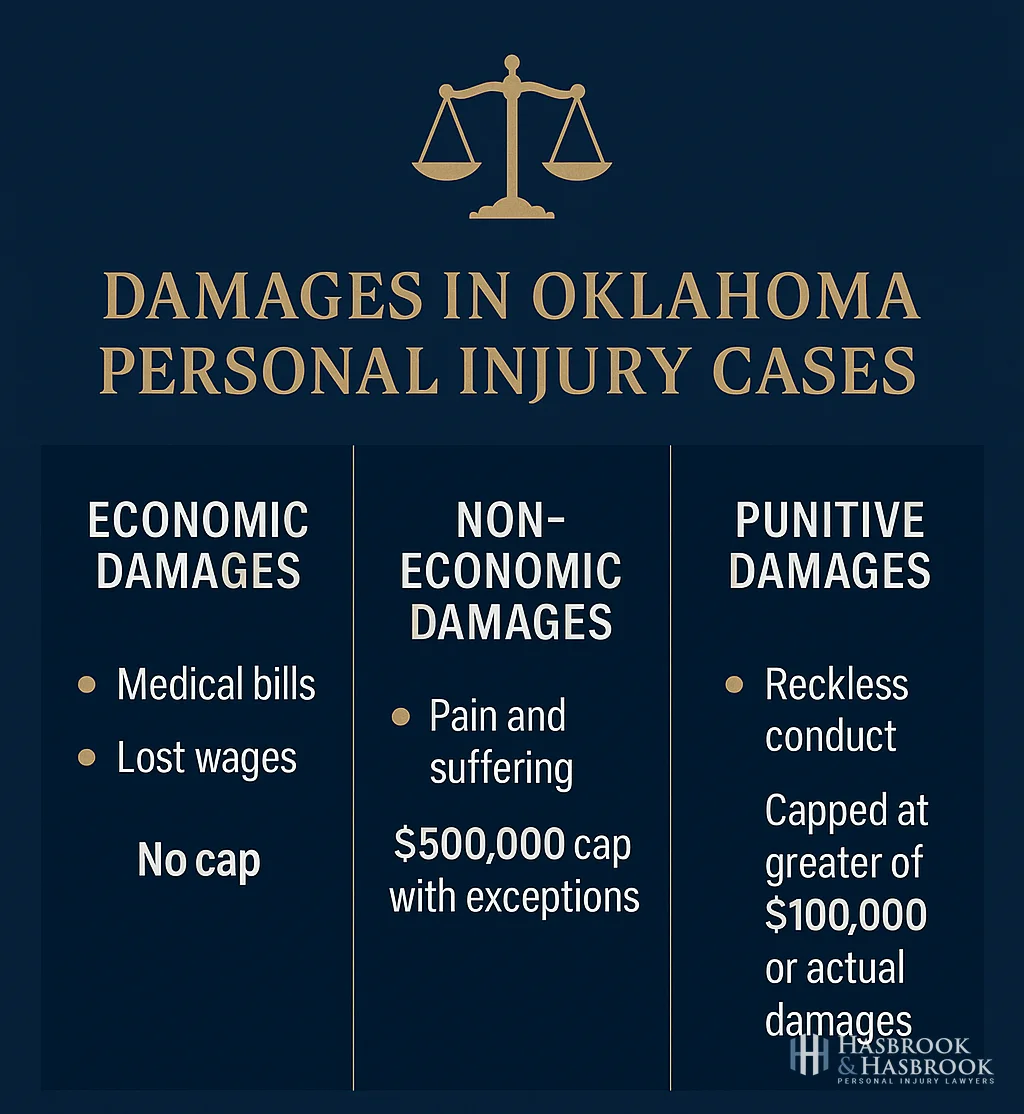
You can recover economic damages for medical bills and lost wages, noneconomic damages for pain and suffering, and punitive damages when the property owner’s conduct was reckless or intentional. Economic damages have no statutory cap, making full recovery possible even in cases involving long-term care or permanent disability.
| Damage Category | What It Covers | Oklahoma Cap |
|---|---|---|
| Economic Damages | Medical bills, lost wages, rehabilitation, diminished earning capacity, out-of-pocket costs | No cap |
| Noneconomic Damages | Pain and suffering, emotional distress, loss of enjoyment of life, disfigurement | $500,000 (23 O.S. § 61.3); exempt for severe physical injury, reckless conduct, fraud, or intentional harm |
| Punitive Damages | Punishment for reckless or intentional misconduct; deterrence | Greater of $100,000 or actual damages awarded (23 O.S. § 9.1). See notable Oklahoma punitive damage verdicts. |
Economic damages cover quantifiable costs: medical bills, rehabilitation expenses, lost wages during recovery, diminished earning capacity, and any out-of-pocket costs tied to the incident. Learn more about damages recoverable in a slip and fall case.
Non-economic damages address pain and suffering, emotional distress, loss of enjoyment of life, and lasting impairment. People who suffer permanent disability or disfigurement often receive compensation that reflects the true scope of their daily limitations. Our attorneys evaluate the total compensable value of your case during a free consultation.
Punitive damages may be available when the defendant’s conduct was reckless or intentionally harmful. Unlike many other states, Oklahoma allows punitive damages in premises liability actions involving extreme misconduct, designed to punish the wrongdoer and prevent future injuries to others.
Injured on government-owned property in Oklahoma?
Injuries on public property, including city sidewalks, state parks, public school buildings, and government-owned buildings, involve a separate set of rules under Oklahoma’s Governmental Tort Claims Act (GTCA). While the state and local governments can be held liable for negligence under certain conditions, the notice requirements are strict and the deadlines are shorter than in standard civil cases.
- Notice requirement: Under the GTCA (51 O.S. § 151), you must file a formal notice of tort claim with the appropriate government entity within one year of the injury, not two years like standard premises liability claims.
- Immunity exceptions: Government entities have limited immunity, but injuries caused by negligent maintenance of public property, failure to repair known hazards, and dangerous conditions on government land can support claims.
- Damage caps apply: Oklahoma law limits GTCA recoveries, which makes it essential to retain an attorney who understands these special rules.
Our firm handles the Governmental Tort Claims Act process, including injuries on public premises. If you were hurt in a government building, park, school, or on a public sidewalk, contact us immediately. The one-year notice window can eliminate your claim if you miss it.
How insurance companies handle premises liability claims
Property owners carry general liability insurance precisely because they expect accidents. When you are injured on their property, the insurer’s goal is to pay as little as possible, and they use a well-worn set of tactics to accomplish that.
Quick lowball offers. Within days of your accident, before you know the full extent of your injuries or understand what your claim is worth, the adjuster calls with a settlement offer. The number sounds significant. It is not. It is calculated to cover your current bills and not a dollar more. Signing before you have reached maximum medical improvement means you give up your right to recover for future treatment you do not yet know you will need.
Recorded statement traps. The adjuster will ask you to describe the accident in a recorded statement. Questions like “did you see the floor was wet?” and “were you looking where you were going?” are designed to get you to admit a measure of fault. Under Oklahoma’s comparative negligence rules, every percentage of fault they can assign to you reduces your payout. Do not give a recorded statement without first consulting an attorney. For guidance, see our resource on responding to a lowball settlement offer.
“Open and obvious” arguments. Property owners frequently argue that the hazard was visible and you should have avoided it. Oklahoma courts apply this defense on a case-by-case basis, weighing whether the owner had reason to expect the danger despite its visibility. An experienced attorney challenges this by showing the hazard was not apparent from a reasonable walking path or that other distractions made it non-obvious.
Surveillance. If you report a significant injury, the insurance company may hire investigators to film you going about your daily activities. A single moment of you bending down or carrying a bag, taken out of context, can be used to dispute your injury claims. Following your doctor’s treatment plan and being honest about your limitations is both the right thing to do and the right legal strategy.
Medical records fishing. Insurers request broad medical authorizations to search your history for pre-existing conditions they can blame your injuries on. Your attorney should negotiate authorization scope to limit this to relevant records only, never sign a blanket release.

How a premises liability lawyer builds your case
Evidence collection and preservation
A successful premises liability outcome requires thorough investigation before evidence disappears. Surveillance footage gets overwritten in days, hazards get repaired, and maintenance records can vanish. At Hasbrook & Hasbrook, our experienced premises liability attorneys handle every step of evidence preservation:
- Inspecting the scene and documenting every hazard before it gets repaired
- Gathering video recordings, maintenance records, and prior incident reports
- Requesting preservation letters to prevent property owners from destroying evidence
- Calculating the full value of your claim, including future care and reduced earning potential
- Negotiating aggressively with insurers and taking your case to trial if necessary
Working with expert witnesses
Proving that a property owner was negligent often requires more than eyewitness accounts. At Hasbrook & Hasbrook, we work with qualified expert witnesses, including civil engineers, property safety consultants, and medical professionals, who can explain to a jury exactly why a specific hazard violated building codes or industry safety standards, and how that violation caused your specific injuries. Expert testimony bridges the gap between technical facts and the jury’s understanding of what a reasonable property owner should have done. In catastrophic cases involving spinal cord injuries or post-concussive symptoms families should watch for, this testimony is often the deciding factor.
Our firm handles premises liability injuries of every severity, including burn injuries, catastrophic injuries, and injuries to children. When a hazardous condition leads to a fatality, we also represent surviving families in fatal premises liability cases.
What to expect during your premises liability claim
A premises liability claim in Oklahoma typically follows five steps over 8 to 18 months: evidence preservation and investigation, medical treatment, demand letter submission, negotiation or mediation, and trial if necessary. The speed of your claim depends largely on how quickly you reach maximum medical improvement and how cooperative the property owner’s insurer is during discovery.
| Phase | What Happens | Typical Duration |
|---|---|---|
| 1. Evidence Preservation | Photograph hazard, obtain surveillance footage, secure maintenance logs before they disappear | Immediate (first 48 hours critical) |
| 2. Treatment | Medical care and documentation of all injuries | 1 to 6 months |
| 3. Investigation and Demand | Attorney investigates ownership, prior incidents, code violations; demand letter sent | 1 to 3 months |
| 4. Negotiation / Mediation | Settlement discussions with property owner’s insurer | 1 to 3 months |
| 5. Trial (if needed) | Case presented to jury with evidence of negligence | 3 to 6 months |
Premises liability claims require fast evidence preservation. Contacting an attorney within 48 hours of your injury dramatically improves the strength of your case. Our team acts immediately to secure the evidence you need. Learn more about medical documentation for your claim and what evidence matters most.
Steps to take after being injured on a property
The moments after an incident on someone else’s property can determine the strength of your entire claim. Follow these steps to protect your rights:
- Get medical attention immediately. Even if you feel fine, some premises liability injuries, like traumatic brain injuries or internal bleeding, may not show symptoms for hours or days.
- Document the scene. Photograph the hazard, the surrounding area, your injuries, and any warning signs (or lack of them). Note the date, time, and weather.
- Report the incident. Tell a manager, landlord, or property owner about what happened. Ask for a written copy of the incident report.
- Collect witness information. Get names and phone numbers from anyone who saw what happened or the condition that caused it.
- Do not give a recorded statement. The adjuster may contact you quickly, but anything you say can be used against you later.
- Contact a lawyer right away. A member of our team can begin preserving evidence immediately and advise you on how to protect your claim.
Why choose Hasbrook & Hasbrook for your premises liability case

Hasbrook & Hasbrook is a family-run Oklahoma personal injury firm that has fought for injured people across this state for decades. When you hire our firm, you get a team that knows Oklahoma courts, Oklahoma insurance adjusters, and Oklahoma juries.
- Family legacy: Clayton’s parents built this firm fighting for injured Oklahomans. This is not a career pivot or a franchise operation. It is a family that chose this work because they believe you deserve someone in your corner who genuinely cares about the outcome.
- Oklahoma roots: We know the courts, the judges, the adjusters, and the communities where these injuries happen. Local knowledge translates to better strategy and stronger results.
- Depth over volume: We limit our caseload so every client gets personal attention. Your case will never be handed off to a junior associate or lost in a pile of files.
- Trial readiness: Insurance companies know which firms will actually go to trial and which will fold. Our willingness to take cases to a jury consistently produces better settlement offers for our clients.
Our premises liability attorneys serve clients throughout Oklahoma City and the surrounding metro area, including injury attorneys serving Edmond, attorneys serving Midwest City, Moore-area injury claims, and Norman-area injury claims. For Oklahoma City nursing home neglect claims, we have a dedicated practice area covering facility negligence claims.
How do our fees work?
Hasbrook & Hasbrook works on a contingency fee basis, which means you pay nothing upfront and owe no attorney fees unless we win your case. Our fee is 25% for pre-litigation settlements, which is lower than the 33% industry standard, because we believe injured Oklahomans should keep more of their recovery.
- No upfront cost: You pay nothing to hire us. We advance all case expenses including filing fees, medical records, expert witnesses, and court costs.
- 25% contingency for pre-litigation settlements: If we resolve your case before filing a lawsuit, our fee is 25% of the recovery. Most firms charge 33% or more at this stage.
- No hidden charges: We explain our fee agreement clearly before you sign anything. No hourly rates, no retainers, and no surprise bills.
- You keep more: Our lower contingency rate means more money in your pocket. On a $100,000 settlement, you save $8,000 compared to a firm charging the 33% industry standard.
- If we do not win, you owe nothing: Not for our time, not for the expenses we advanced, not for anything. The risk is on us.
Learn more about how personal injury contingency fees work and why contingency representation is the right choice after a premises liability injury.

Common questions about premises liability cases in Oklahoma
How much is a premises liability case worth in Oklahoma?
The value depends on your injury severity, the evidence connecting the property owner’s negligence to the hazard, your total medical expenses, lost income, and whether you suffered permanent limitations. Premises liability claims range from modest settlements for minor slip and fall injuries to six- and seven-figure recoveries for catastrophic harm. We evaluate your case during a free consultation. See our guide on how much a personal injury lawsuit is worth for the factors involved.
How long do I have to file a premises liability lawsuit in Oklahoma?
Oklahoma gives you two years from the date of injury under 12 O.S. § 95. Evidence weakens quickly: surveillance footage gets overwritten, hazards get repaired, and witnesses forget details. Contacting an attorney within days of the incident gives your case the strongest foundation. Read more about Oklahoma’s two-year filing deadline for injury claims.
Can I recover compensation if I was partially at fault for the accident on someone else’s property?
Yes. Oklahoma’s comparative fault system under 23 O.S. § 13 allows recovery as long as your share of responsibility stays at or below 50%. Your award is reduced by your fault percentage. Insurers routinely argue that visitors should have “watched where they were walking” to inflate fault. An experienced attorney counters this tactic. Learn more about how Oklahoma’s fault-apportionment rule works.
What does it cost to hire a premises liability lawyer in Oklahoma City?
Nothing upfront. We handle premises liability cases on contingency. Our fee is 25% for pre-litigation settlements, lower than the 33% industry standard. We advance all case expenses and you owe us nothing if we do not recover for you. Contact us for our guide to hiring a personal injury lawyer in Oklahoma.
What must I prove to win a premises liability case in Oklahoma?
You must establish four elements: a dangerous condition existed on the property, the owner knew or should have known about it through reasonable inspection (constructive notice), the owner failed to repair the condition or warn you, and the dangerous condition directly caused your injuries. Evidence like surveillance footage, maintenance logs, prior incident reports, and witness statements strengthens each element. See more on the burden of proof in personal injury cases.
What types of accidents fall under premises liability in Oklahoma?
Premises liability covers any injury caused by unsafe property conditions. Common claims involve slip and fall accidents (wet floors, icy walkways, uneven surfaces), negligent security leading to assault, falling objects, swimming pool incidents, elevator and escalator malfunctions, toxic exposure (mold, asbestos, lead paint), and structural collapses. The property owner’s duty depends on the visitor’s classification; invitees receive the highest protection.
Can I file a premises liability claim against a government property in Oklahoma?
Yes, but claims against government property (public buildings, parks, sidewalks) follow special rules under Oklahoma’s Governmental Tort Claims Act (51 O.S. § 151). You must notify the government entity within one year, and certain immunities may apply. Our firm handles Oklahoma City governmental tort claims. An experienced premises liability attorney can navigate these requirements.
What if I was injured but did not report it immediately?
You can still pursue a claim, but delayed reporting makes it harder to prove the hazard existed at the time of the incident. Photograph the scene, save any receipts or medical records, and contact our team as quickly as possible. The sooner you act, the more evidence is available to support your position. Read about filing deadline for slip and fall lawsuits in Oklahoma.
Want to understand what your case is worth? Call (405) 605-2426 for a free case review for a free consultation with an Oklahoma City premises liability lawyer. We review your case at no cost and no obligation. We also handle claims in Edmond, Midwest City, Moore, and Norman.