Under 47 O.S. § 6-113, Service Oklahoma, working with the Department of Public Safety, can add restrictions to a driver’s license for vision, a medical condition, or limited driving ability, such as corrective lenses, an ignition interlock device, daylight-only driving, or a specific vehicle type. Driving outside those restrictions is a misdemeanor.
Types of Driver’s License Restriction Codes in Oklahoma
Service Oklahoma, the agency that now issues driver licenses, has the authority under 47 O.S. § 6-113 to add restrictions “whenever good cause appears,” working with the Department of Public Safety. A restriction can limit the type of vehicle a person may drive, require a mechanical device on the vehicle, or set another limit needed to keep the person driving safely. Driving outside a restriction is a misdemeanor, and Service Oklahoma can suspend or revoke the license for a violation.
 According to Oklahoma Administrative Code § 260:135-5-31, Oklahoma’s driving restriction codes include:
- Corrective lenses: glasses or contacts required while driving.
- Left outside mirror: the vehicle must have a left outside rearview mirror.
- Restriction 1 or 2: either corrective lenses or a left outside mirror satisfies the restriction.
- Automatic transmission: no manual-transmission vehicles.
- Turn indicators, power steering, or steering knob: typically required for a driver with limited use of a hand.
- Food, fruit, or candy within reach: for insulin-dependent diabetics who may need fast access to sugar.
- Adequate artificial limbs: required to operate the vehicle safely.
- Detailed restriction: used when no other code fits; a written explanation goes on the license file.
- Learner’s permit: a licensed driver at least 21 must sit up front, and driving is limited to 5:00 a.m. to 10:00 p.m.
- Motorcycle only: for a driver under 16, limited to a motorcycle no larger than 300cc, 4:30 a.m. to 9:00 p.m., under Oklahoma’s motorcycle licensing rules. No passengers are allowed unless the required passenger age is met, and a helmet is legally required.
- Motorcycle learner’s permit: regardless of the rider’s age, a licensed motorcyclist at least 21 must stay within view.
Service Oklahoma can also limit a license to daylight hours only, a specific geographic area, or work-related driving.
How Are Restrictions Determined?
Service Oklahoma and the Department of Public Safety base a restriction on a driver’s demonstrated ability, medical history, or other safety factors, sometimes after a medical evaluation or a new driving test.



Other Types of Restricted Licenses
Beyond the restriction codes above, Oklahoma issues license types built around specific driving limits.
Provisional License
A provisional license lets a person whose license is suspended or revoked keep driving, generally between 6:00 a.m. and 11:59 p.m., while paying at least $5 a month toward outstanding fees, which can include the standard $25 per-suspension reinstatement fee, under 47 O.S. § 6-212. Overnight driving, from midnight to 5:59 a.m., is limited to specific purposes: commuting to work, school, a child’s daycare, a place of worship, or a court-ordered treatment program.
Intermediate (Graduated) License
A driver between 16 and 18 must hold an intermediate license, under 47 O.S. § 6-105, before qualifying for an unrestricted one. Driving is limited to 5:00 a.m. to 10:00 p.m. unless it is for work, school, or church, or a licensed driver at least 21 is in the vehicle, and the intermediate driver generally cannot carry more than one passenger from outside their own household. See Service Oklahoma’s teen driving requirements for the full checklist.
Farm Permit
A farm permit lets a person as young as 14 who lives or works on a farm drive for farm-related work, school, or worship. The allowed hours and passenger limits loosen once the permit holder turns 16, and after six months of compliant driving at 16, most restrictions drop away entirely.
Medical Conditions and License Restrictions
Service Oklahoma’s Driver License Medical Advisory Committee, created under 47 O.S. § 6-118, recommends standards for evaluating an applicant’s physical, mental, and emotional fitness to drive. Service Oklahoma can require a medical evaluation, vision test, or new driving test whenever a driver’s condition changes in a way that could affect safety.
A driver whose medical condition changes should notify Service Oklahoma directly, the same way a driver would report points added to a license.
A driver with a physical impairment can still qualify for a commercial license, but must meet the federal physical standards in 49 C.F.R. § 391.11 and may need a Skill Performance Evaluation certificate from the Federal Motor Carrier Safety Administration confirming the person can safely operate a commercial vehicle despite the impairment.


Ignition Interlock Devices
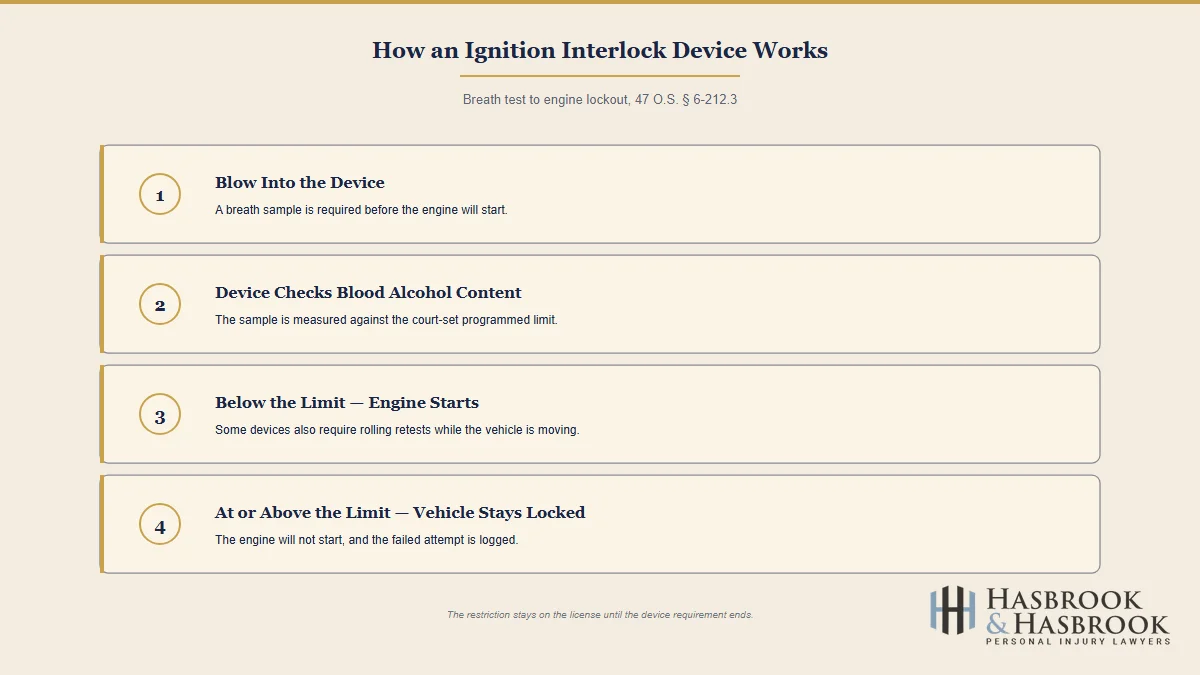
An ignition interlock device is a breathalyzer wired into a vehicle’s ignition. The driver must blow into it before the engine will start, and the device blocks the vehicle from starting if the driver’s blood alcohol content is above the programmed limit; some devices also require breath samples while the vehicle is moving. Under 47 O.S. § 6-212.3, a driver required to install one pays a $50 restricted-license fee, and the restriction stays on the license and driving record until the device requirement ends.
An ignition interlock restriction usually follows a conviction connected to an alcohol-related crash, and driving without the required device is its own separate offense.
A license restriction violation, driving without required lenses, past a curfew, or without an interlock device, can support a negligence claim if it contributed to a crash. If a restricted driver caused your accident, Hasbrook & Hasbrook can review what a restricted-license violation means for your Oklahoma City crash claim, or send us the details for a free case review.