A survival action recovers the harm the decedent personally suffered before death. A wrongful death claim recovers the losses the surviving family members suffer because the decedent is gone. Both are filed together by the personal representative in most Oklahoma fatal-injury cases, but the damage categories, the recipients of the money, and the way creditors reach the recovery are completely different.
our Oklahoma City injury law firm handles fatal-injury matters as a coordinated probate-and-tort process so the survival count and the wrongful death count each carry the right damage categories and the recovery flows the right direction at settlement.

This page is the side-by-side breakdown of damage categories under 12 O.S. § 1051 (survival) and 12 O.S. § 1053 (wrongful death). For the procedural primer on how survival actions work, read our piece on Oklahoma survival claims explained. For the wrongful death damage categories in depth, see what damages are available in an Oklahoma wrongful death case.
The core distinction: whose loss is being paid
Every damage category in a fatal-injury case answers one question first: whose loss is the money compensating?
Survival = the decedent’s loss. What the injured person personally suffered between the moment of injury and death. Simultaneous death shrinks the survival recovery to property damage and final medical care; a decedent who lingered for hours, days, or weeks generates a survival recovery that grows with that conscious-pain interval.
Wrongful death = the surviving family’s loss. What the spouse, children, and parents lost when their loved one died. These damages did not exist before death and continue accruing into the future (lost financial support, lost companionship across decades).
Both counts are pleaded in one civil action filed by the personal representative; juries return separate verdicts on each. Neither claim has a plaintiff until the probate court issues Letters Testamentary or Letters of Administration. See our pieces on how the personal representative is appointed in Oklahoma probate and how the estate is opened in probate for a wrongful death claim.
Survival damages under 12 O.S. § 1051
The survival statute keeps the decedent’s pre-death tort claim alive. The cause of action passes to the estate, and Oklahoma juries consider four categories.
- Pre-death pain and suffering. Conscious physical pain, fear, and mental anguish from injury until death. Proven through hospital records, paramedic narratives, eyewitness testimony, and consciousness experts when contested.
- Pre-death medical expenses. Ambulance, ER, surgery, ICU, hospital, and physician bills incurred between injury and death. Capped at amounts actually paid under 12 O.S. § 3009.1.
- Pre-death lost earnings. Wages and self-employment income the decedent would have earned between injury and death. The decedent’s own lost income, not the family’s lost support.
- Property damage and out-of-pocket loss. Vehicle damage, personal property destroyed in the incident, pre-death uninsured costs.
Punitive damages attach in a survival count when the conduct meets 23 O.S. § 9.1 (reckless disregard, gross negligence, intentional misconduct). Drunk driving, hit-and-run, and willful safety violations typically clear the threshold. See Oklahoma fact patterns where juries have awarded punitives under § 9.1.



Wrongful death damages under 12 O.S. § 1053
Section 1053 compensates statutory beneficiaries (surviving spouse, children, parents, next of kin) for losses that begin at the moment of death.
- Loss of consortium and companionship. Spouse’s loss of marital society, sexual relationship, and household partnership. Children’s loss of parental guidance and affection. Parents’ loss of an adult child’s companionship in qualifying cases.
- Loss of financial support. Earnings, benefits, and household services the decedent would have provided to dependents over the rest of their working life. Calculated by economists using earning history, work-life expectancy, and personal-consumption offsets.
- Mental anguish and grief. Survivors’ grief and emotional distress. Distinct from the decedent’s pre-death pain (survival count).
- Funeral and burial expenses. Reasonable funeral, burial, and final-disposition costs.
- Last-illness medical expenses. Section 1053 expressly authorizes recovery to avoid double recovery disputes at settlement.
For how Oklahoma juries calculate the financial-support component, see how juries decide pain and suffering amounts in Oklahoma and the multiplier and per-diem methods Oklahoma practitioners use to value pain and suffering.
Side-by-side comparison of damage categories
| Damage category | Survival action (§ 1051) | Wrongful death (§ 1053) |
|---|---|---|
| Pain and suffering | Decedent’s pre-death conscious pain and fear of dying | Mental anguish of survivors recovered separately |
| Medical bills | Recoverable for the period from injury to death | Last-illness medical expenses recoverable per § 1053 |
| Lost earnings | Wages lost between injury and death (decedent’s own loss) | Future financial support dependents would have received over the decedent’s work-life |
| Loss of consortium | Not available | Spouse’s loss of marital society and sexual relationship |
| Loss of companionship | Not available | Children’s loss of parental guidance; parents’ loss of an adult child’s companionship |
| Mental anguish | Decedent’s pre-death anguish only | Survivors’ grief and emotional distress |
| Funeral and burial | Not available (loss arose post-death) | Recoverable |
| Punitive damages | Available under 23 O.S. § 9.1 | Available under 23 O.S. § 9.1 |
| Property damage | Recoverable | Not available |
| Where the money goes | Through the probate estate; subject to creditors and liens | Direct to statutory beneficiaries; largely shielded from estate creditors |
| Filing deadline | Two years from injury (12 O.S. § 95) | Two years from death (§ 1053) |
Where the money goes after recovery
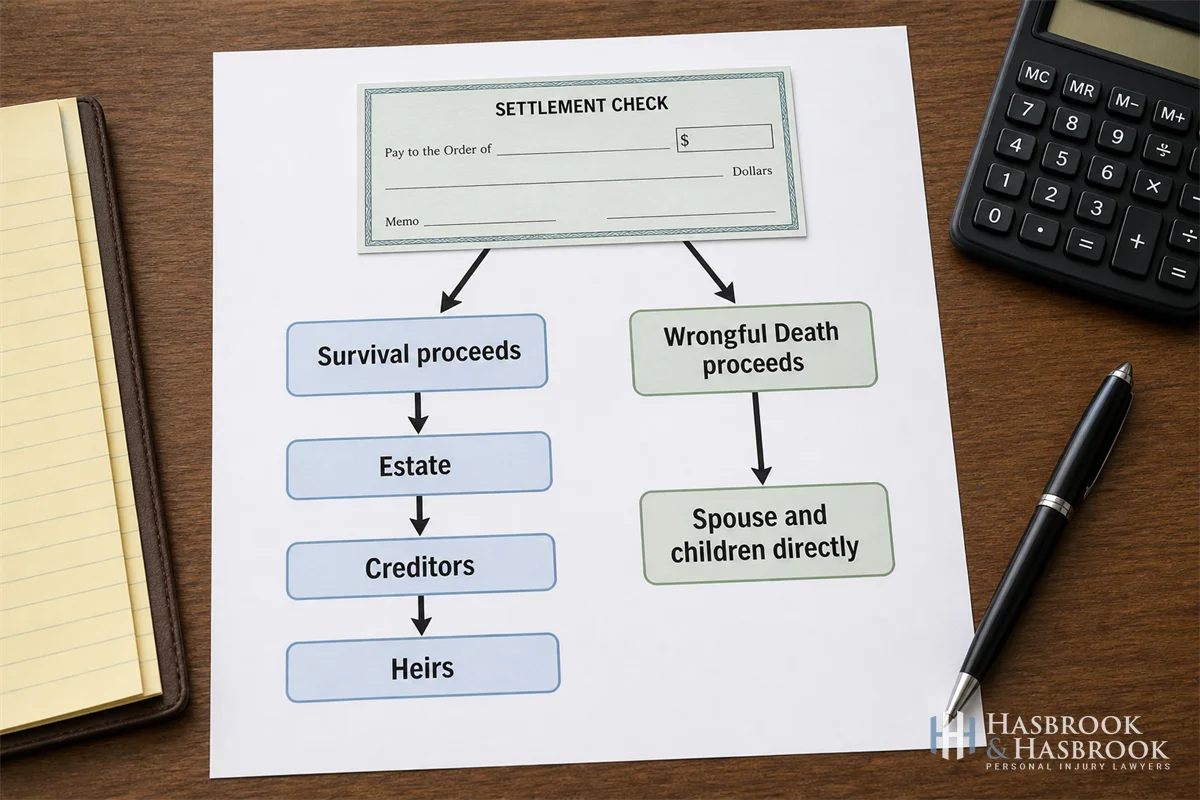
Survival proceeds become estate assets. They flow into the probate estate; administration costs, attorney fees, and creditors get paid first. Hospital and medical liens under 42 O.S. § 43 attach to the medical-bills component. What remains passes by the will (or by intestate succession) to the heirs.
Wrongful death proceeds bypass the estate. Section 1053 directs the recovery to surviving spouse, children, and parents directly, not subject to general estate creditors. They reach the family on a shorter timeline than estate distributions.
Federal programs still touch the recovery. Medicare conditional payment recovery generally attaches to survival proceeds where Medicare paid for last-illness care. Tort recoveries are largely excluded from gross income under IRS Publication 4345, though pre-judgment interest and any portion allocated to lost wages can be taxable. SSA survivor benefits are administered separately and do not offset the tort recovery.

Why settlement allocation between the two counts matters
When a fatal-injury case settles, the parties allocate the gross settlement between the two counts. Defense counsel prefers a higher survival allocation because survival proceeds are exposed to medical liens and estate creditors, partly satisfying third-party bills before reaching the family. Plaintiffs’ counsel pushes for a higher wrongful death allocation because those proceeds reach the spouse and children directly.
The allocation must be defensible against the facts. A simultaneous-death case cannot support a heavy survival allocation; the survival column is small. A lingering-death case (weeks of ICU care, conscious pain, growing medical bills) can support a substantial survival allocation if the family wants to retire medical debt before dividing the rest. The court reviews the apportionment among beneficiaries under § 1053. See how Section 1054 ranks the spouse, children, parents, and next of kin who share in a wrongful death recovery and minor beneficiaries in wrongful death cases.
The Oklahoma noneconomic damages cap and why wrongful death is exempt
Oklahoma generally caps noneconomic damages in personal injury cases at $350,000 under 23 O.S. § 61.3. The cap reaches pain and suffering, mental anguish, and loss of consortium in standard injury suits. Wrongful death actions are expressly excluded by § 61.3(C)(1), so Section 1053’s noneconomic categories (loss of consortium, grief, mental anguish of survivors) are not subject to the $350,000 ceiling. The 2019 Oklahoma Supreme Court decision in Beason v. I.E. Miller Services struck down the prior cap as unconstitutional special legislation precisely because it had treated injury and wrongful death plaintiffs differently.
The cap question matters at the allocation stage. Survival noneconomic damages (the decedent’s pre-death pain and suffering) sit on the personal-injury side of § 61.3 and are subject to the cap. Wrongful death noneconomic damages are not. A case with substantial pre-death conscious-pain damages and substantial survivor-loss damages can run into the cap on the survival side while the wrongful death side recovers without limit.
One more piece of allocation arithmetic affects both counts the same way: comparative fault. Oklahoma’s modified comparative negligence regime (23 O.S. § 13) reduces both survival and wrongful death recoveries by the decedent’s percentage of fault. If the jury assigns the decedent 30% of the fault, both counts pay out at 70 cents on the dollar. Recovery is barred entirely when the decedent’s share exceeds 50% (the fixed-number rule). The comparative negligence doctrine applies uniformly; juries do not allocate fault separately. See how Oklahoma’s modified-comparative regime reduces a verdict by the decedent’s percentage of fault and bars recovery above 50% and the discovery rule in wrongful death cases.
Common questions about survival and wrongful death damages
Can a family recover both survival damages and wrongful death damages from the same defendant?
Yes. Both counts are pleaded in a single civil action and tried together. The jury returns separate verdicts. There is no double recovery problem because the two counts compensate different losses (decedent’s pre-death loss vs. survivors’ post-death loss). Most Oklahoma fatal-injury petitions plead both counts.
What if death is instantaneous? Is the survival claim worth anything?
The survival count still exists as a legal vehicle, but the recovery shrinks. Without conscious pain, without pre-death medical bills, without an interval of lost earnings, the survival column is limited to property damage and any final-care costs. The wrongful death count carries most of the value in instantaneous-death cases.
Are wrongful death proceeds subject to the deceased’s debts?
Generally no. Section 1053 directs wrongful death proceeds to the surviving spouse, children, and parents directly. They do not pass through the probate estate and are not exposed to general estate creditors. Survival proceeds, by contrast, are estate assets and reach creditors first.
Does Oklahoma’s $350,000 noneconomic cap reduce wrongful death awards?
No. Section 61.3(C)(1) expressly exempts wrongful death actions from the cap. Survival action noneconomic damages (the decedent’s own pre-death pain and suffering) are subject to the cap. Wrongful death noneconomic damages (survivors’ grief, loss of consortium, lost companionship) are not.
Who decides how the wrongful death money is split among family members?
The court approving the wrongful death settlement allocates the recovery among the statutory beneficiaries under § 1053’s apportionment provision. Allocation is fact-driven: a surviving spouse with three minor children typically receives a different share than a surviving spouse with adult children long out of the household. Counsel proposes an allocation; the court reviews and approves.
How long does a personal representative have to file both claims?
The survival action’s deadline runs from the date of injury under 12 O.S. § 95 (typically two years). The wrongful death deadline runs from the date of death under § 1053 (same length). For a quick-death case, both clocks effectively coincide. For a lingering death, the survival clock can expire first if the family delays. Counsel files both counts before the earlier of the two filing deadlines.


Talk to a lawyer about your family’s claim
Survival and wrongful death damages decide how an Oklahoma fatal-injury recovery actually reaches the family. At our firm, we coordinate the probate appointment, build both counts in the petition, allocate damages to match the facts, and manage settlement allocation so the recovery reaches the family the right way. Call (405) 605-2426 for a free consultation.