An Oklahoma wrongful death case is fundamentally a damages case. Liability often resolves at the demand stage; what gets fought over is the value of the survivors’ losses. The governing statute, 12 O.S. § 1053, allocates categories of recovery to specific beneficiaries, and each category requires its own evidentiary record. This checklist walks through every category of recoverable damages, the documents needed to support each, and the experts who anchor the larger numbers at trial. Hasbrook & Hasbrook Personal Injury Lawyers uses a version of this list as a working file in every wrongful death intake.

Why a damages checklist matters in Oklahoma wrongful death cases
Wrongful death damages span more categories than a typical injury case and accrue across a longer timeline. Lost financial support is computed from death to projected retirement, sometimes 30 to 40 years out. Medical bills incurred between injury and death belong to the decedent’s estate, which means a survival action runs in parallel with the wrongful death claim under survival damages vs wrongful death damages. Each beneficiary in the family unit has their own statutory entitlements. Without a methodical inventory, the practitioner risks under-pleading damages, missing a beneficiary, or failing to retain the experts whose testimony moves a jury from a six-figure number to a seven-figure one.
The Oklahoma noneconomic damages cap at 23 O.S. § 61.3 does not apply to wrongful death claims. Subsection (C)(1) carves out actions for wrongful death, so the noneconomic categories below are uncapped.
Statutory framework: who recovers what under 12 O.S. § 1053 and § 1054
Two statutes set the structure. The general statute (12 O.S. § 1053) creates the cause of action and lists damage categories; subsection (B) divides the recovery between the estate and the surviving spouse and children. The companion 12 O.S. § 1054 addresses claims by the widow or next of kin when no personal representative is appointed. A separate provision, 12 O.S. § 1051, authorizes survival of the decedent’s claims through the estate, permitting recovery of pre-death medical expenses, conscious pain and suffering, and lost earnings between injury and death.
Before drafting damages allegations, confirm the following:
- Is a personal representative appointed? If not, is an application pending? See appointment of an Oklahoma personal representative for the probate mechanics.
- Has an estate been opened in the county of the decedent’s residence? See starting the estate before filing suit.
- Who are the statutory beneficiaries (surviving spouse, children, parents of an unmarried adult, parents of a minor under 12 O.S. § 1055)?
- Are there minor children, and if so, has a guardian ad litem been appointed for settlement-allocation purposes? See minor beneficiaries in wrongful death cases.
The two-year limitations period for the wrongful death claim runs from the date of death; the companion survival action runs from the date of injury. Where the decedent suffered injury and survived for some period, the two clocks start at different points and may expire at different times. Confirm both deadlines before any tolling-rule analysis.



Economic damages: lost financial support and household services
The largest category in most wrongful death cases is the financial contribution the decedent would have made across the rest of their working life. Computing it requires four inputs:
- Earnings base. Actual earnings at time of death plus projected raises and promotions. Pull the last three to five years of W-2s or 1099s; for self-employed decedents, five years of Schedule C or K-1 returns and an IRS tax-return transcript.
- Work-life expectancy. The years the decedent would have remained in the labor force, adjusted for age, gender, education, and occupation. BLS work-life expectancy data is the standard reference.
- Personal-consumption deduction. The percentage of earnings the decedent would have spent on themselves rather than the family. Economists typically use 20 to 30 percent for a married decedent with children, higher for a single decedent without dependents.
- Discount rate. The future-value stream is reduced to present value at trial. Economists usually apply a real (inflation-adjusted) discount rate of 1 to 3 percent, citing Treasury yield data.
Beyond wages, the decedent’s household services have measurable economic value. A spouse who handled childcare, home maintenance, transportation, and meal preparation provided services with a market replacement cost. Multiply the economist’s hours-per-week estimate by the relevant occupational wage from BLS Occupational Employment Statistics. Document the decedent’s actual contribution in family declarations.
For retired decedents, the analysis shifts to Social Security survivor benefit offsets and any pension or annuity stream the family would have received.
Funeral, burial, and survival-overlap medical expenses
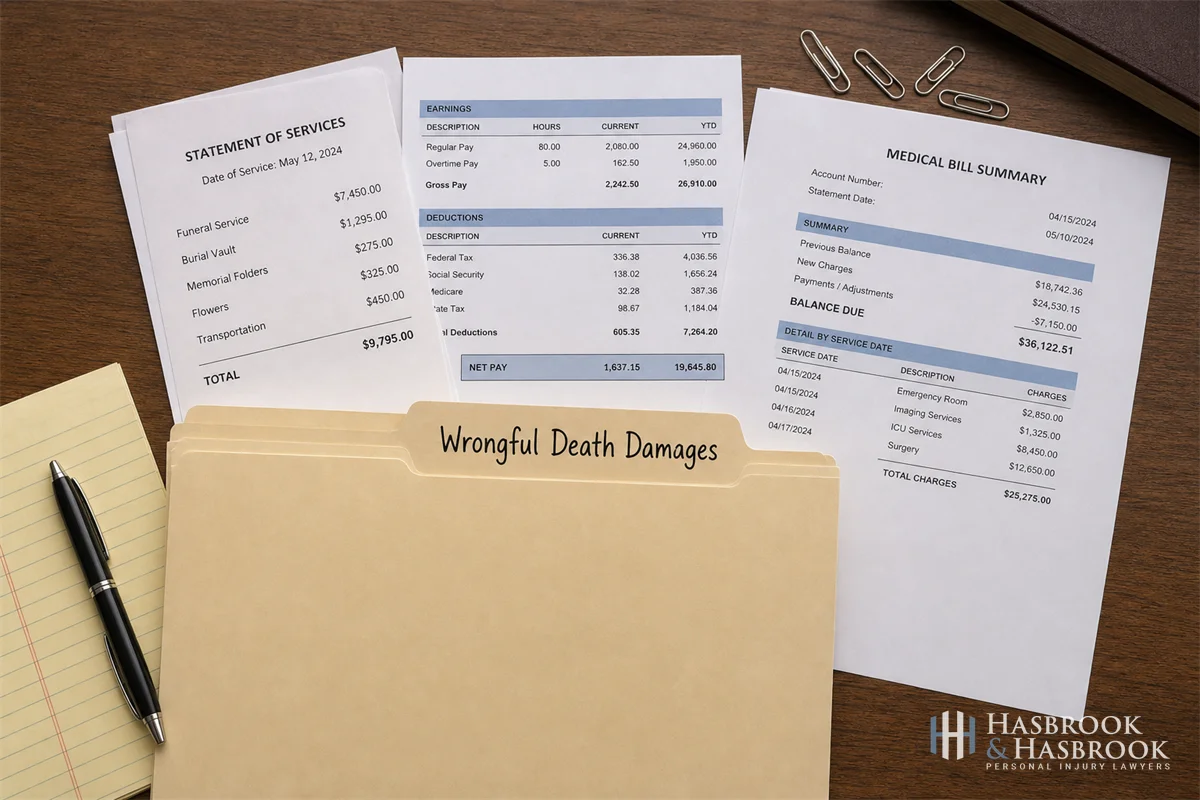
Two cost categories accrue at or near the moment of death and are often under-documented. Funeral and burial expenses are recoverable under 12 O.S. § 1053 as a separate line item, paid to whoever bore the cost. Itemize every component: funeral home services, casket, burial plot, headstone, cemetery fees, transportation of the body, obituary publication, and reasonable travel for immediate family. Pull invoices, paid receipts, and credit-card statements showing actual out-of-pocket expense.
Medical expenses incurred between injury and death belong to the survival action, not the wrongful death claim. If the decedent lingered before dying, the bills run through the estate under 12 O.S. § 1051. Pull every billing record from EMS, the ER, the ICU, transferring or receiving hospitals, and treating physicians during the survival period. Apply the paid-not-incurred rule under 12 O.S. § 3009.1: only amounts actually paid (after insurance write-offs) are admissible. If the family received hospital lien notice under 42 O.S. § 43, document the lien amount and any reduction negotiations.
Conscious pain and suffering during the survival period is recoverable as part of the survival action. Document duration and intensity through medical records, nursing notes, family declarations, and first-responder accounts. Even a 30-minute conscious survival period can support a meaningful pain-and-suffering award if properly documented.
Noneconomic damages: grief, loss of consortium, parental care
Section 1053 enumerates several categories of noneconomic damages, each tied to a specific beneficiary:
- Loss of consortium. The surviving spouse recovers for loss of the decedent’s love, companionship, society, comfort, and sexual relations. The concept is defined at Cornell Legal Information Institute’s consortium entry. Duration runs through the spouse’s projected life expectancy.
- Loss of parental care, training, and guidance. Minor children recover for loss of the parent’s role in their upbringing. Recovery runs at least through age of majority.
- Grief and mental pain. The surviving spouse, children, and parents (of an unmarried decedent) recover for grief and emotional distress. Oklahoma juries are not given a per-day formula; testimony from survivors and treating providers carries the number.
- Loss of companionship for parents of a minor child. Under 12 O.S. § 1055, parents of a deceased minor child recover for loss of the child’s companionship and the parents’ grief.
- Loss of consortium for adult children. Available in limited circumstances tied to dependency or ongoing relationship. Document frequency and depth of contact.
The record for noneconomic damages is built from family declarations, photographs, home video, social-media history (chain-of-custody preserved), and testimony from grief counselors or treating mental-health providers. Photo timelines of the decedent’s role in family events translate the loss for a jury better than verbal description.

Punitive damages under 23 O.S. § 9.1
Punitive damages are available when the defendant’s conduct meets the threshold under 23 O.S. § 9.1. The statute provides a tiered structure:
- Category I (reckless disregard). Cap of the greater of $100,000 or actual damages. Most drunk-driving fatality cases plead at this tier.
- Category II (intentional or malicious). Cap of the greater of $500,000, actual damages, or twice the actual damages. Requires proof of malice in fact or intentional and malicious conduct.
- Category III (life-threatening conduct). No cap when conduct constituted a felony with significant risk of death or serious harm. Trial proof of the felony elements is required.
Punitive damages require clear and convincing evidence of the threshold conduct. Trial bifurcates into a compensatory phase and a separate punitive phase under 23 O.S. § 9.1(D). Evidence of the defendant’s wealth is admissible in the punitive phase but not the compensatory phase. Subpoena tax returns, financial statements, and deposition testimony in advance so the punitive phase can proceed without continuance. For broader context, see Oklahoma jury awards in DUI, fleet-safety, and concealment cases and when punitive damages apply in Oklahoma car accident cases.
Expert witnesses to retain (and when to retain them)
Three experts handle the bulk of damages testimony. Retain them early; their reports drive settlement valuation and cannot be assembled in the final 60 days before mediation.
Forensic economist. Computes lost financial support, household-services value, present value, and (for retired decedents) lost pension or annuity streams. Provides a written report itemizing every input. Retain at intake, send a complete employment and tax-return file, and get a preliminary report before sending the demand letter. Preliminary numbers anchor the demand; the final report updates after discovery.
Vocational expert. Used alongside the economist when earnings trajectory is contested. Opines on realistic career path, promotion probability, and earnings ceiling. Useful when defense argues no upside (a young adult killed before establishing a career, or a self-employed decedent with variable returns).
Life-care planner / medical-cost expert (survival-action overlap only). If the decedent survived in critical condition for a meaningful period, a life-care planner can document the medical-care trajectory had treatment continued. Narrower in wrongful death than in catastrophic-injury cases, but valuable when the survival period was extended. See a life-care planning analysis.
A grief counselor or treating psychologist is a fourth common witness. Treating providers are usually preferable to retained experts because their testimony is grounded in ongoing care.
Document and evidence checklist
Assemble the following inventory within the first 60 days of representation. Every damages presentation rests on these source documents.
Decedent identity and family structure
- Certified death certificate (multiple copies, via Oklahoma State Department of Health Vital Records)
- Marriage certificate, prior divorce decrees, last will and testament, trust instruments, and beneficiary designations
- Birth certificates for all children (biological and adopted) and the decedent’s birth certificate and Social Security number
Earnings and economic-loss documentation
- Last five years of federal tax returns (IRS Form 4506 transcripts when family copies are unavailable; see IRS Get Transcript)
- Three to five years of W-2s, 1099s, K-1s, or Schedule C returns; current year-to-date pay stubs through date of death
- Employment file (job description, performance reviews, promotion and salary history)
- Pension, 401(k), profit-sharing, and deferred-compensation plan documents; Social Security earnings statement
- Self-employment records where applicable: bank statements, A/R, profit-and-loss
Medical, survival-period, and funeral records
- Complete medical records from injury to death, including EMS run reports; autopsy and toxicology if performed
- Itemized bills with paid amounts (not just charges) for every provider; health-insurance EOBs
- Hospital lien notices and any reduction correspondence
- Itemized funeral home invoice and paid receipt; cemetery, burial-plot, and headstone invoices; obituary and family-travel receipts
Family declarations and supporting media
- Written declarations from the surviving spouse, each adult child, and the decedent’s parents (where applicable) describing the decedent’s family role, daily contributions, and the impact of the death
- Photo and video timeline showing the decedent in family settings: birthdays, holidays, vacations, school events
- Cards, letters, social-media archives (downloaded with metadata intact, chain of custody preserved)
- School records for minor children showing pre- and post-loss trajectory
Liability and case-development documents
- Police or crash report, OHSO records, and investigating-agency files (FOIA where applicable)
- Insurance policy declarations pages (UM/UIM, liability, excess, umbrella) for the decedent and the at-fault parties
- Comparative-fault evidence under 23 O.S. § 13 (the modified-comparative regime allows recovery so long as the decedent’s fault did not exceed 50 percent)

Allocation, settlement, and probate considerations
Once damages are quantified, allocation becomes its own project. Section 1053(B) directs the recovery first to the estate (for medical and funeral expenses), then to the surviving spouse and children, then to parents or next of kin where applicable. When minor children are beneficiaries, the probate court approves any allocation involving their share, usually requiring a guardian-ad-litem report and sometimes a structured settlement. Tax treatment is generally favorable: compensatory recoveries for personal physical injury are excluded from gross income, and that exclusion extends to wrongful death proceeds. Punitive damages are taxable. The line-item allocation in the settlement agreement matters for tax purposes and should be drafted with care.
For broader questions clients ask early on, see the categories of recoverable wrongful death damages in Oklahoma and the Oklahoma City wrongful death overview. At our firm, the damages inventory above runs as a parallel track from intake through resolution; nothing is left to assemble in the 30 days before mediation.