When a spinal cord injury case reaches a courtroom or a settlement table, the most important medical fact is rarely the cause of the crash. It is the level of the injury. Neurological level decides which limbs work, whether the person breathes on a ventilator, how many hours of attendant care are reasonable, and what a life-care plan should cost over a 40-year horizon. Two clients with the same diagnosis label can have very different futures depending on whether the injury is at C4 or T10, complete or incomplete. This guide explains the paralysis types you will see in spinal cord injury claims, how level drives function, and how function drives damages.
What is paralysis after a spinal cord injury?
Paralysis is the loss of voluntary muscle control below an injury to the central nervous system. After a spinal cord injury, the signal between brain and muscles is interrupted at the damaged segment, and anything served by spinal nerves below that segment loses some or all of its motor and sensory function.
Two facts shape every spinal cord case medically:
- Level of injury: where on the cord the damage happened (cervical, thoracic, lumbar, or sacral).
- Completeness: whether any signal still passes through the injured segment. A complete injury means no motor or sensory function remains below the level; incomplete preserves some function. See our explainer on incomplete vs complete spinal cord injuries.
The National Spinal Cord Injury Statistical Center reports roughly 18,000 new traumatic spinal cord injuries in the United States each year, with incomplete tetraplegia the most common functional category at discharge. Paralysis after a spinal cord injury is a spectrum, not a single condition.
How injury level determines the type of paralysis
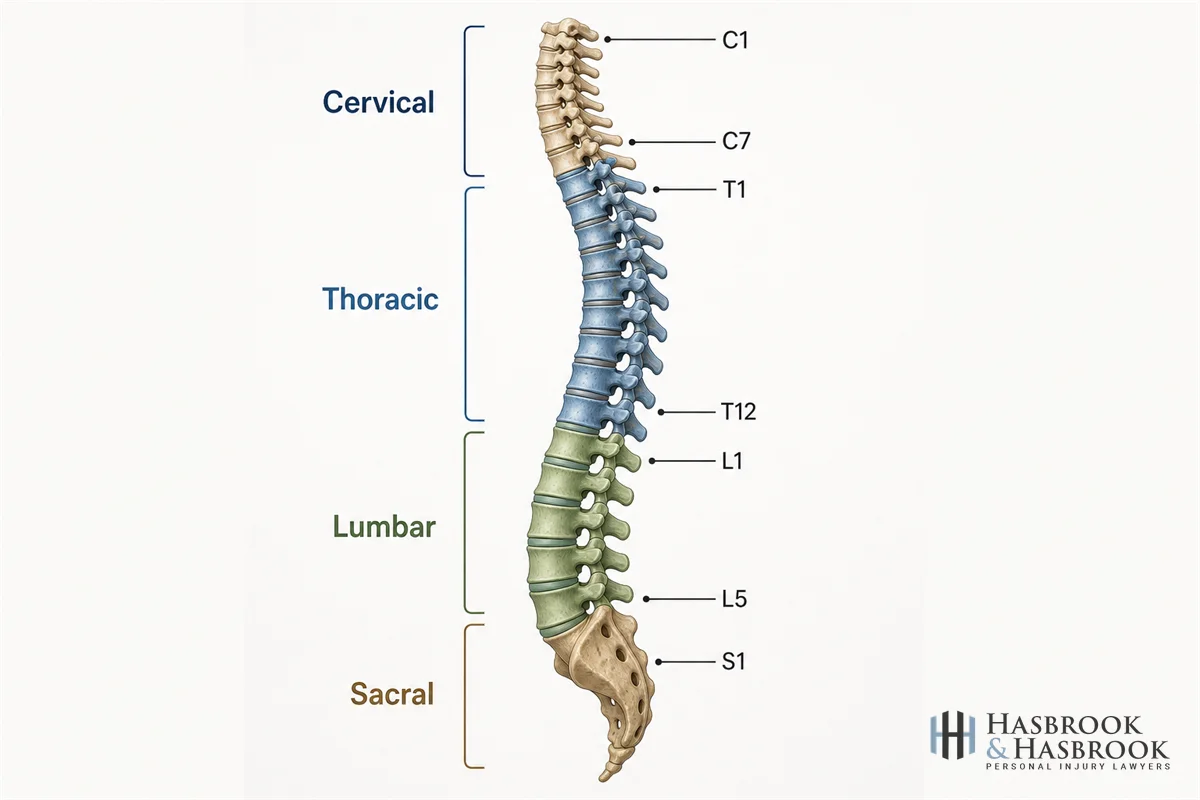
Spinal nerves exit the cord at predictable segments. Each segment controls a known group of muscles and receives sensation from a known patch of skin. The higher on the cord the injury sits, the more of the body falls below it, and the more extensive the paralysis. The cord has four major regions, each producing a different paralysis pattern:
- Cervical (C1 through C8): injuries to the neck, producing quadriplegia (also called tetraplegia).
- Thoracic (T1 through T12): injuries to the upper and mid-back, producing paraplegia with arms preserved.
- Lumbar (L1 through L5): lower back injuries, producing paraplegia with variable hip and leg function.
- Sacral (S1 through S5): low cord injuries, often involving bowel, bladder, and sexual function with limited leg involvement.
For clinical overviews see Cleveland Clinic and Mayo Clinic.
Quadriplegia (tetraplegia): cervical injuries C1 through C8
Quadriplegia (tetraplegia) results from injury to the cervical cord. All four limbs and the trunk lose function, and bowel, bladder, and sexual function are affected. Within the cervical range, small differences in level produce large differences in independence.
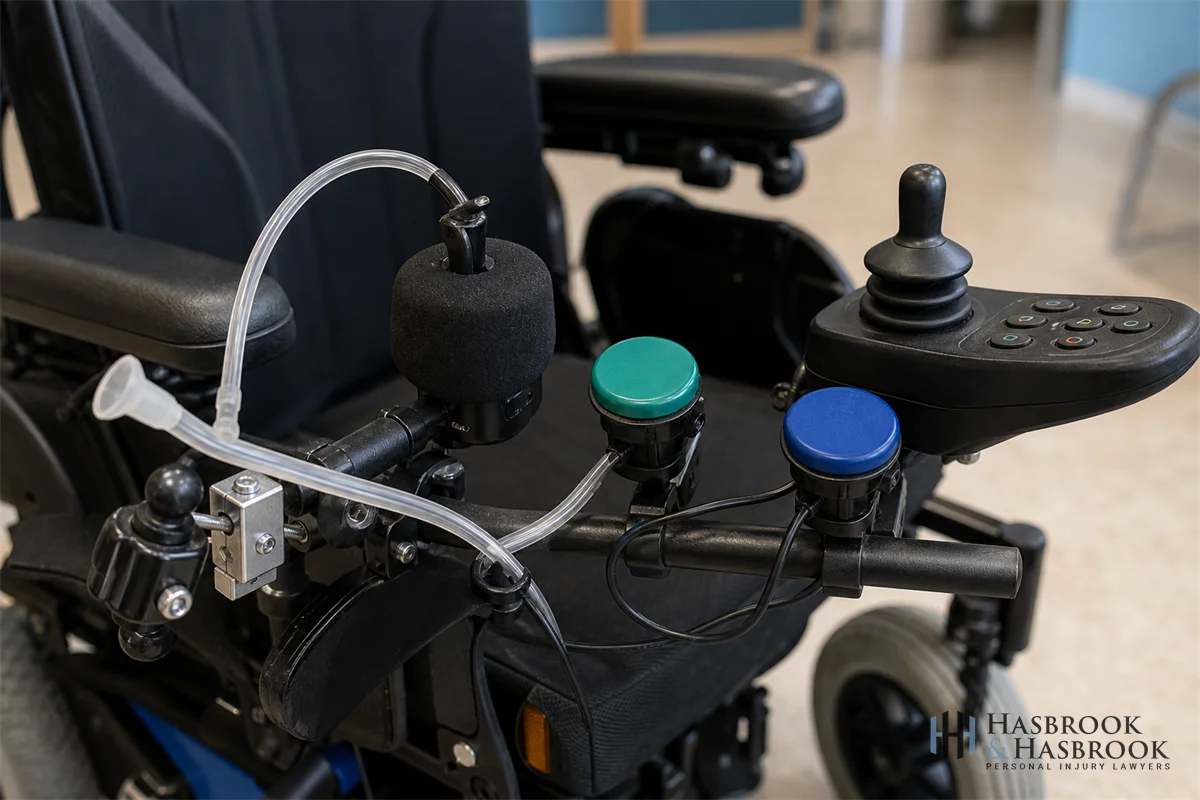
High cervical (C1 through C4): the most catastrophic spinal cord injuries. The diaphragm (innervated mainly by C3 to C5) can be partially or completely paralyzed. Many people with C1 to C3 injuries depend on a mechanical ventilator and need 24-hour attendant care for life. Power wheelchairs operated by chin, breath, or head controls are the primary mobility tool.
Mid cervical (C5 through C6): diaphragm function is usually preserved. Shoulder and biceps function returns at C5, allowing a hand-to-face motion with adapted equipment. C6 adds wrist extension, enabling a key grip for self-feeding, grooming, and limited transfers. Independence with adaptive technology is realistic, but assistance is still needed for bowel, bladder, dressing, and most transfers.
Low cervical (C7 through C8): triceps function returns at C7, the threshold for independent transfers and self-catheterization. C8 adds finger flexion. Many people at this level live alone in an accessible home with part-time attendant care, drive a hand-controlled vehicle, and return to a desk-based career.
For research on cervical injury outcomes, see PubMed indexed studies and the NIH StatPearls reference. Locally, our Oklahoma City quadriplegia page covers how these claims are handled in state court.



Paraplegia: thoracic, lumbar, and sacral injuries
Paraplegia is paralysis of the lower body with the arms and hands fully functional. It results from spinal cord injuries at or below T1.
Upper thoracic (T1 through T6): the trunk is partially paralyzed, so seated balance is reduced and respiratory volume is decreased. Arm and hand function is intact. Most people achieve full independence in a manual wheelchair, drive with hand controls, and live independently in an accessible home.
Lower thoracic (T7 through T12): trunk control is largely preserved, which dramatically improves seated balance, transfers, and manual wheelchair handling on uneven terrain. Standing with knee-ankle-foot orthoses and forearm crutches is feasible for some, mostly for therapy rather than community ambulation.
Lumbar (L1 through L5): hip flexion typically returns at L2, knee extension at L3, and ankle dorsiflexion at L4 and L5. Many people walk with leg braces for short distances and use a manual wheelchair for longer ones. Bowel and bladder function is still affected.
Sacral (S1 through S5): leg muscle function is largely preserved. The signature impact is on bowel, bladder, and sexual function. Walking is typically possible, often without an assistive device, but the loss of continence and intimacy carries its own substantial damages component.
For the long-term medical course, see the Reeve Foundation level-of-injury guide and Johns Hopkins spinal cord injury overview.
Monoplegia, hemiplegia, triplegia, and diplegia
Several less common paralysis patterns turn up in practice. Treating an unusual pattern as a standard quad or para injury can lead to missed damages or a wrongly framed life-care plan.
Monoplegia: paralysis of a single limb. True monoplegia from a spinal cord injury is rare because the cord supply to one limb crosses several segments. Most monoplegia cases trace to peripheral nerve damage (such as a brachial plexus injury) or to a focal stroke, not traumatic spinal cord injury. When you see a monoplegia diagnosis after a crash, look hard at whether the lesion is in the cord or in a peripheral nerve.
Hemiplegia: paralysis of one entire side of the body, both arm and leg. Hemiplegia is the classic stroke pattern; after trauma it points to a brain injury, not a typical spinal cord injury. Brown-Séquard syndrome, which results from damage to one half of the spinal cord, can produce a one-sided motor deficit, but the classic sensory pattern (loss of pain and temperature on the opposite side from the motor weakness) sets it apart from a stroke-style hemiplegia. See Cleveland Clinic on Brown-Séquard syndrome.
Triplegia: paralysis of three limbs. Usually reflects an incomplete cervical spinal cord injury where one upper limb retains substantial function while the other three do not. Triplegia is uncommon and typically signals an asymmetrical cord lesion that an experienced rehabilitation physician should classify carefully.
Diplegia: paralysis of symmetrical parts of the body, usually both legs. Most often associated with cerebral palsy and other developmental conditions. After adult trauma, what looks like diplegia is almost always paraplegia from a thoracic or lumbar cord injury. The terms get used interchangeably in lay writing, but they are not the same in a medical record.
The practical lesson for referring attorneys: when the diagnosis is anything other than the standard quad or para pattern, the case needs an early read by a physiatrist or rehabilitation specialist before a demand goes out.
Functional independence by injury level
This table summarizes typical functional outcomes after rehabilitation for a complete injury at each common level. Incomplete injuries can perform substantially better. Use it as a starting screen, not a verdict.
| Level | Type | Breathing | Independent self-feeding? | Independent transfers? | Realistic mobility | Typical attendant care |
|---|---|---|---|---|---|---|
| C1 to C3 | High quadriplegia | Ventilator-dependent | No | No | Sip-and-puff or chin-controlled power chair | 24 hours per day, skilled care |
| C4 | High quadriplegia | Often partial ventilator support | No | No | Power chair with chin or head controls | 24 hours per day, skilled or trained attendant |
| C5 | Quadriplegia | Independent breathing | With adaptive equipment | No | Power chair, manual chair on flat surfaces | 10 to 16 hours per day |
| C6 | Quadriplegia | Independent breathing | Yes, with built-up utensils | With sliding board | Manual chair primarily | 6 to 10 hours per day |
| C7 to C8 | Low quadriplegia | Independent breathing | Yes | Yes, independent | Manual chair, hand-controlled vehicle | 0 to 4 hours per day for household tasks |
| T1 to T6 | High paraplegia | Reduced volume, independent | Yes | Yes, independent | Manual chair, hand-controlled vehicle | 0 to 2 hours per day |
| T7 to T12 | Paraplegia | Normal | Yes | Yes, independent | Manual chair, hand controls, limited bracing | None to minimal |
| L1 to L5 | Low paraplegia | Normal | Yes | Yes | Mix of bracing-assisted walking and chair | None for most people |
Complete vs incomplete: the ASIA classification scale
Beyond level, every spinal cord injury is graded on completeness using the American Spinal Injury Association (ASIA) Impairment Scale:
- ASIA A: complete. No motor or sensory function through sacral segments S4 to S5.
- ASIA B: sensory incomplete. Sensation preserved through S4 to S5, no motor function below injury.
- ASIA C: motor incomplete. More than half of key muscles below injury graded under 3 of 5.
- ASIA D: motor incomplete. At least half of key muscles graded 3 of 5 or better.
- ASIA E: normal motor and sensory function on examination.
Two clients with C5 injuries can land at very different ASIA grades, and the grade drives projected recovery, life-care plan content, and likely future medical costs. Always confirm the ASIA grade in the rehabilitation discharge summary, not just the level. The NIH StatPearls reference on ASIA grading walks through the examination.

Why the type of paralysis drives the life-care plan and damages
Case value is built on the medical level. A C2 ASIA A case with permanent ventilator dependence is not the same case as a T10 ASIA A case where the injured person returns to independent living. Both are catastrophic; they produce very different demand letters.
The components that move with injury level include:
- Attendant care hours per day: from 24 hours of skilled nursing for a C1 to C3 injury to zero for many low-thoracic injuries.
- Home modifications: ramped entries, widened doorways, roll-in showers, ceiling lifts, and backup generator capacity for ventilator-dependent clients.
- Adaptive equipment: power vs manual chair, environmental control units, modified vehicles, transfer aids, pressure-relieving cushions and mattresses.
- Lifetime medical care: respiratory, urological, neurogenic bowel management, pressure-injury prevention, durable equipment replacement on a fixed cycle.
- Lost earning capacity: the gap between pre-injury vocation and realistic post-injury work.
A complete case build-out runs through our pages on life-care plans in Oklahoma catastrophic injury cases, future medical costs, adaptive equipment, and loss of earning capacity. For an Oklahoma value-range overview, see spinal cord injury value in Oklahoma City and spinal injury compensation ranges.
Return-to-work prospects also vary sharply by level. National Spinal Cord Injury Statistical Center data show post-injury employment around 13 percent at one year and 31 percent at twenty years, higher with paraplegia than tetraplegia, higher with incomplete injuries than complete, and strongly correlated with pre-injury education. A C2 ventilator-dependent client almost never returns to gainful work; a T10 paraplegic engineer often does. The vocational expert’s report turns on these distinctions. See vocational rehabilitation and how lost income is proved.
Screening checklist for referring attorneys
If you are evaluating a referral with possible paralysis, run this fast screen before sending the file out:
- Pull the rehabilitation admission and discharge summaries. The neurological level and ASIA grade should be stated explicitly.
- Confirm the injury is to the spinal cord, not a peripheral nerve, the brain, or a combined pattern.
- Identify ventilator dependence (yes or no, full or partial). Ventilator dependence single-handedly changes case value.
- Identify the attendant-care hour estimate from the rehabilitation team or a board-certified life-care planner.
- Pull every imaging study (MRI, CT, X-ray) and the operative reports.
- Identify all comorbidities, including any concurrent closed head injury that complicates rehabilitation prognosis.
- Confirm pre-injury occupation, earnings, and education for the vocational analysis.
- Check the SOL clock under 12 O.S. § 95; spinal cord cases sometimes sit at a rehabilitation hospital for months while the clock runs.
For the full intake protocol used inside our office, see the spinal cord injury referral guide.
Oklahoma legal rules that interact with paralysis cases
Oklahoma’s comparative fault rule under 23 O.S. § 13 bars recovery only when the injured person’s fault exceeds 50 percent. At 50 percent or less, recovery proceeds with the award reduced in proportion to fault. In a catastrophic spinal cord case the carrier’s defense will work hard to push fault past the 50 percent line because the damages number is so large. See our overview of comparative fault in Oklahoma and structured settlements for how proceeds are typically paid out.
Talk to an Oklahoma City spinal cord injury attorney

A spinal cord injury reshapes a family’s finances, housing, work life, and daily medical reality. The legal claim has to capture all of that and present it in a way a carrier and a jury can understand. Hasbrook & Hasbrook Personal Injury Lawyers has handled catastrophic claims for two generations, building case strategy from the rehabilitation discharge summary forward, not from a generic template. If you or a family member is dealing with paralysis after a crash in Oklahoma, our firm is ready to review the records and the claim in detail. Call (405) 605-2426 or use the secure intake form on our website to schedule a no-cost case review.

Frequently asked questions
What is the difference between quadriplegia and tetraplegia?
They are the same condition. Tetraplegia is the term preferred by clinicians; quadriplegia is the older term still common in lay and legal writing. Both describe paralysis affecting all four limbs and the trunk after a cervical spinal cord injury.
Can paralysis improve over time?
Yes, especially in incomplete injuries. The largest gains usually happen in the first 6 to 12 months. Recovery slows after that but can continue for years. A life-care plan should be built on the most recent rehabilitation evaluation.
Does the type of paralysis change the statute of limitations in Oklahoma?
No. Oklahoma’s two-year statute of limitations under 12 O.S. § 95 applies regardless of injury severity. Narrow tolling rules exist for minors and people under legal disability. See our SOL exceptions overview.
Can a person with paralysis still work?
Many can, particularly with incomplete or thoracic and lumbar injuries. Return-to-work rates are higher with more education, knowledge-economy jobs, and employer accommodations. A vocational expert builds the post-injury earning-capacity figure.