Whether a spinal cord injury is complete or incomplete is one of the most important questions an injury claim has to answer. The classification drives prognosis, lifetime care projections, and the dollar value the defense assigns to a case. Two clients with the same crushed vertebra can have radically different futures depending on this distinction.
Hasbrook & Hasbrook Personal Injury Lawyers handle catastrophic spinal cord injury cases across Oklahoma. This page explains how doctors classify these injuries using the ASIA Impairment Scale, the clinical syndromes within “incomplete,” and how the medical reality translates into damages and defense valuation arguments.
The ASIA Impairment Scale: How Doctors Classify Severity
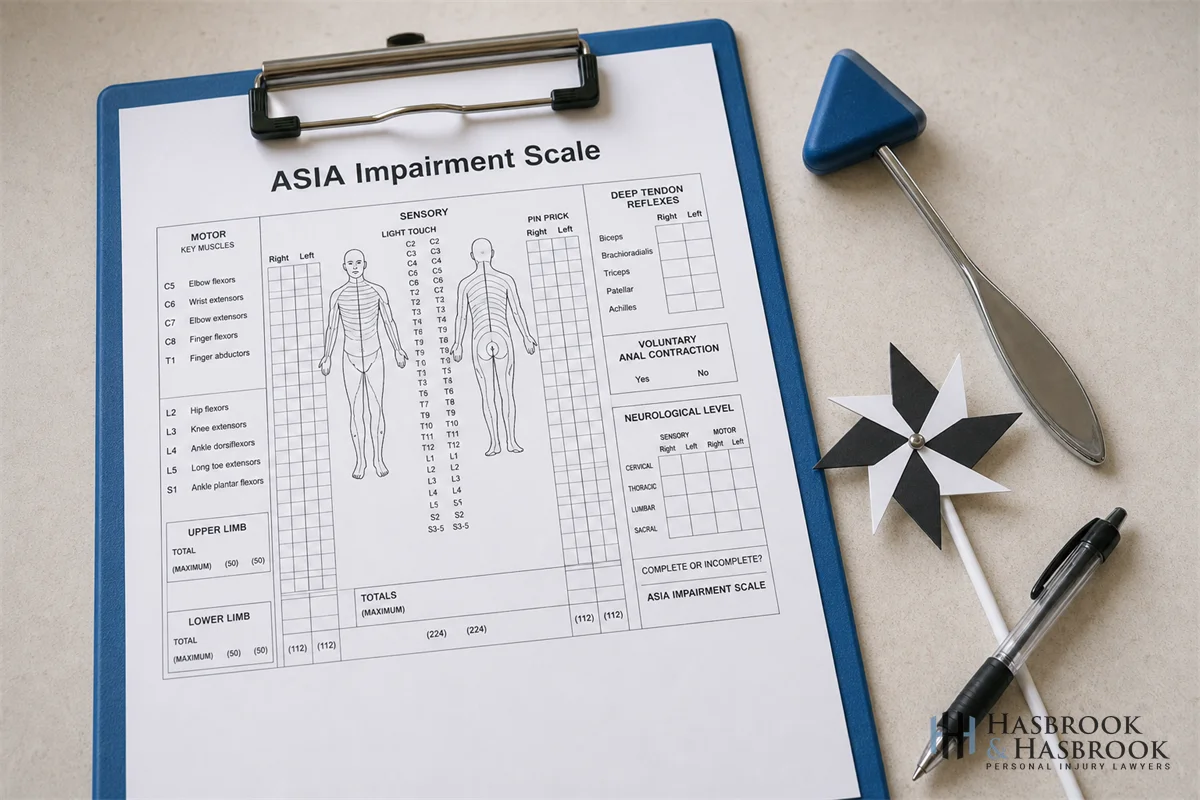
The American Spinal Injury Association Impairment Scale (AIS), maintained by the American Spinal Injury Association, is the international standard for grading spinal cord injury severity. A single letter, A through E, describes motor and sensory function below the neurologic level of injury.
| Grade | Classification | What It Means |
|---|---|---|
| ASIA A | Complete | No motor or sensory function preserved in the lowest sacral segments (S4-S5). |
| ASIA B | Sensory Incomplete | Sensory but not motor function preserved below the injury level, including S4-S5. |
| ASIA C | Motor Incomplete | Motor function preserved; more than half the key muscles below the level grade less than 3 of 5. |
| ASIA D | Motor Incomplete | Motor function preserved; at least half the key muscles grade 3 of 5 or greater. |
| ASIA E | Normal | Sensation and motor function are normal after a documented prior deficit. |
“Complete” and “incomplete” are not subjective descriptions. They come from a structured neurologic exam performed once spinal shock resolves, usually 24 to 72 hours after injury. The documented score becomes a key evidentiary record in any later claim.



Complete Spinal Cord Injury: ASIA A
A complete injury means no sensory or motor function below the neurologic level, including no function in the lowest sacral segments. The cord is not necessarily severed; in most ASIA A injuries it is intact but functionally disconnected by crushing, contusion, or hemorrhage.
The neurologic level matters as much as the completeness grade. A complete C4 injury produces tetraplegia with respiratory involvement and almost total dependence for daily activities. A complete L1 injury leaves arm and trunk function intact and produces paraplegia with variable bowel, bladder, and lower-extremity loss. Our page on paraplegia, tetraplegia, and other paralysis classifications walks through cervical, thoracic, lumbar, and sacral level distinctions.
Incomplete Spinal Cord Injury and Clinical Syndromes
Incomplete injuries (ASIA B, C, and D) preserve some signal transmission across the injury level. Clinicians recognize several recurring patterns based on which tracts of the cord are damaged. A reference summary at the National Library of Medicine describes these syndromes and their prognoses.
- Anterior cord syndrome. Damage to the front two-thirds of the cord. Motor and pain/temperature loss with proprioception preserved. Worst prognosis of the named syndromes.
- Central cord syndrome. The most common pattern, typically a hyperextension injury in an older adult with pre-existing cervical stenosis. Upper-extremity weakness exceeds lower-extremity weakness. Many patients regain ambulation; fine hand function often does not return.
- Brown-Sequard syndrome. Damage to one side of the cord, with ipsilateral motor and proprioceptive loss and contralateral pain/temperature loss. Most favorable prognosis of the named syndromes.
- Posterior cord syndrome. Rare. Loss of proprioception and vibration sense with preserved motor function; unsteady gait.
- Cauda equina syndrome. A peripheral nerve injury below the cord termination at L1-L2 that presents like a cord injury. Saddle anesthesia, bowel/bladder dysfunction, and leg weakness require emergency surgical decompression. Diagnostic delay is a recurring source of malpractice exposure.
Prognosis Differences Between Complete and Incomplete Injuries

Data from the National Spinal Cord Injury Statistical Center at the University of Alabama-Birmingham, the federally designated SCI registry, shows ASIA A patients rarely convert to incomplete status, and when they do, gains are modest. ASIA B, C, and D patients far more often gain neurologic levels and ambulatory capacity, with most recovery in the first six months.
- Most spontaneous recovery occurs in the first three to six months; gains beyond 12 months are slower and incremental.
- Central cord patients have a meaningful chance of regaining household ambulation; complete cervical patients almost never walk again.
- Bowel, bladder, and sexual function rarely return after a complete injury but may improve after an incomplete injury.
- Secondary complications (pneumonia, pressure injuries, autonomic dysreflexia, urinary tract infections) drive much of the long-term mortality difference.
- Life expectancy is reduced for both groups, more so for complete cervical injuries.
The Model Systems Knowledge Translation Center publishes plain-language patient handouts on recovery patterns at MSKTC, which we reference when counseling families.


How Classification Drives Lifetime Damages
NSCISC publishes average direct costs by injury severity. First-year and recurring annual costs for high tetraplegia (C1-C4 ASIA A) are several times those for incomplete motor function, and the lifetime differential at age 25 runs into the millions. A defensible damages model addresses:
- Acute care and inpatient rehab: trauma admission, surgical stabilization, ICU days, rehab admission.
- Lifetime medical care: physician visits, urology, neurology, physiatry, pulmonary care, equipment maintenance, hospitalizations. The Cleveland Clinic’s SCI overview outlines the recurring components a life-care planner inventories.
- Home modifications: ramps, widened doorways, roll-in showers, lift systems.
- Attendant care: frequently the largest single cost. High tetraplegia can require 16 to 24 hours daily.
- Durable medical equipment: manual or power wheelchairs (roughly five-year cycle), cushions, transfer boards, hospital beds.
- Adaptive equipment: hand controls, lift-equipped vans, transfer seats. See adaptive equipment and life-care planning.
- Vocational impact: lost wages and earning capacity. Higher injury levels reduce return-to-work rates; low paraplegics return more often in sedentary roles.
Our pages on a certified life care planner’s report, future medical costs, and future wage-earning capacity losses walk through how these categories are proven and discounted to present value.
Life Expectancy and Defense Valuation Arguments
Life-care plans are projected over the injured person’s actuarially adjusted life expectancy, not the standard population table. A complete C1-C4 injury may reduce life expectancy substantially; a low-level ASIA D injury produces only a modest reduction. The defense presses for the largest plausible reduction because it shrinks the multiplier on every cost. See our FAQ on post-injury life-expectancy projections. Beyond life expectancy, carriers run a predictable playbook:
- Recovery probability. If the injury is incomplete, the defense argues the patient may recover further and that future-care projections overstate the need. We anchor projections on the ASIA grade after spinal shock and on serial exams.
- Older NSCISC tables. Defense economists apply older tables reflecting cohorts injured before modern pulmonary, urologic, and skin-care advances. Newer data and treating-physician testimony often support a longer life span.
- “Secondary complications fault” allocations. The defense argues pressure injuries, urinary infections, or rehospitalizations are the patient’s fault. We document the actual care plan and the foreseeability of these complications.
- Pre-existing degenerative disease. Older central cord patients often have pre-existing cervical stenosis, and the defense argues any neck trauma would have caused the injury. Treating spine surgeons can distinguish acute traumatic deficit from baseline radiographic findings.
- Comparative-fault inflation. Under 23 O.S. § 13, a plaintiff recovers only if their share of fault is less than 50%. Carriers routinely assert seat-belt nonuse, speed estimates, or “should have seen it” theories. See our comparative negligence page.
How a Spinal Cord Injury Case Gets Built
A credible damages case starts with the medical record. We ask the trauma surgeon, physiatrist, and rehabilitation physician for documentation of the injury level, ASIA grade, and expected outcome. We retain a board-certified life-care planner to inventory projected costs and a forensic economist for present value and lost earning capacity. Concurrent brain injury, common in high-energy trauma, brings in a neuropsychologist.
The clock matters. Oklahoma’s personal injury statute of limitations under 12 O.S. § 95 is two years from the date of injury, with limited tolling for legal disability under 12 O.S. § 96. Our explainer on the two-year filing window for injury claims covers the deadlines. See also our our spinal cord injury intake guide for referring counsel and broader Oklahoma City spinal cord injury resources.

Common Questions About Complete vs Incomplete Spinal Cord Injuries
How do doctors decide if a spinal cord injury is complete or incomplete?
Through a structured ASIA International Standards exam done once spinal shock resolves, usually 24 to 72 hours after the injury. The exam tests motor strength and sensation in key muscles and dermatomes on both sides of the body and assigns a grade A through E.
Can an injury classified as complete improve to incomplete?
It happens but is rare for ASIA A injuries, and when conversion occurs functional gains are usually modest. The strongest predictor of future recovery is the ASIA grade documented after spinal shock has resolved.
Which incomplete syndrome has the best prognosis?
Brown-Sequard syndrome has the most favorable prognosis among the named clinical syndromes; anterior cord syndrome has the worst.
What is cauda equina syndrome and how is it different?
Cauda equina syndrome involves the lumbar and sacral nerve roots below where the cord ends near L1-L2, not the cord itself. It causes saddle anesthesia, bowel/bladder dysfunction, and leg weakness and requires emergency surgical decompression. Diagnostic delays are a recurring source of medical malpractice claims.
How much does a spinal cord injury case typically settle for?
Value depends on the ASIA grade, neurologic level, age and pre-injury earning capacity, available insurance coverage, and the strength of liability evidence. Lifetime costs for a young person with high tetraplegia routinely run into seven and eight figures before lost earnings. See SCI value in Oklahoma City and spinal injury compensation.
Does the plaintiff’s age affect damages projections?
Significantly. A 25-year-old has more years of attendant care, equipment replacement, lost earning capacity, and projected medical care than a 65-year-old with the same injury. The economist’s discount rate translates those streams into present value at trial.