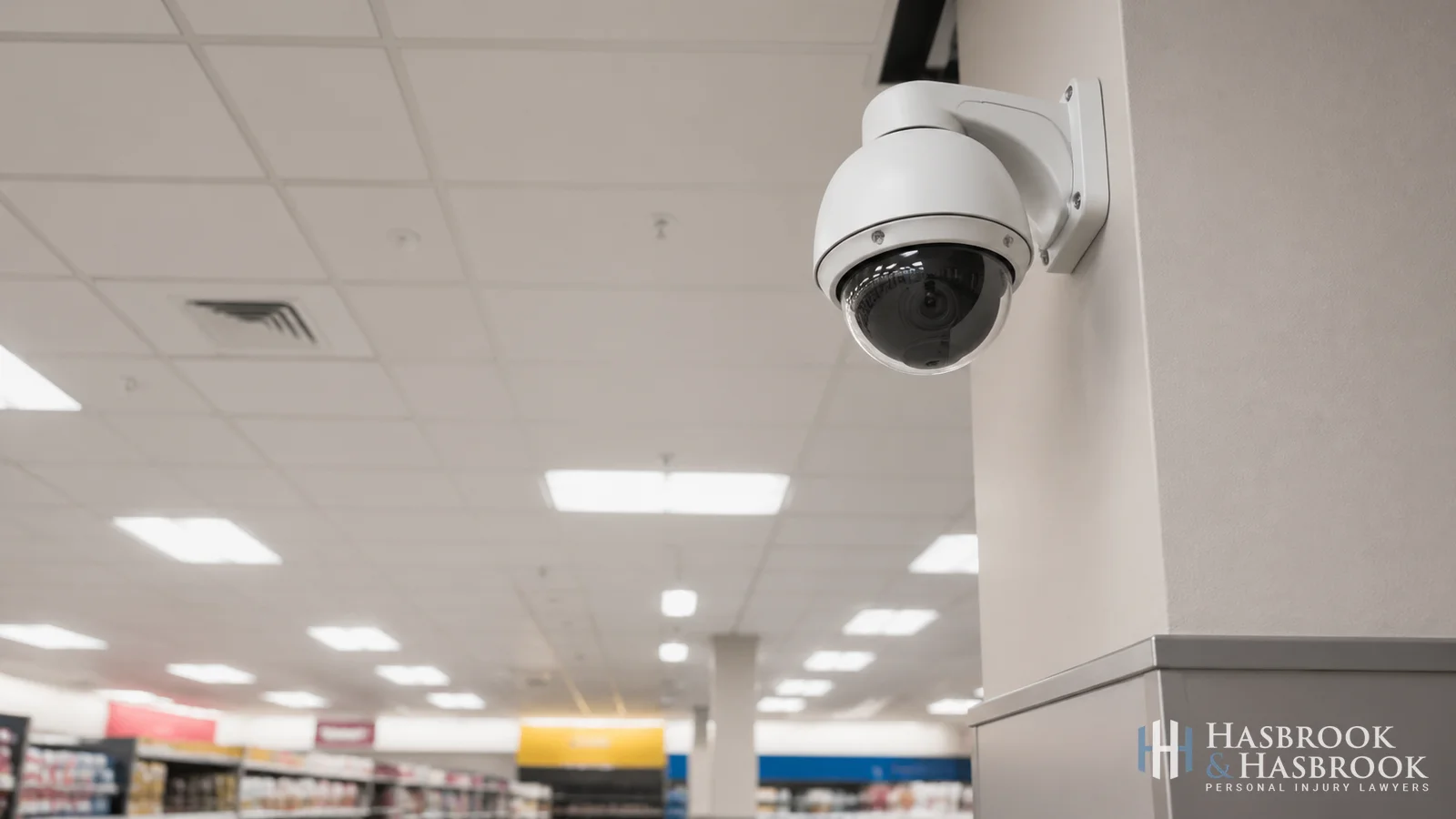
After a slip and fall in a grocery store or big-box retailer, the central question is whether the store knew about the hazard before you fell. Oklahoma premises liability law gives you two ways to prove it: actual notice and constructive notice. Understanding the difference is the foundation of any retail slip-and-fall claim.
reach our oklahoma intake team represent people injured in store slip and falls throughout Oklahoma. This page explains both notice theories, the evidence used to prove them, and the defenses retailers typically raise.
What Oklahoma Premises Liability Law Requires
Oklahoma courts treat store customers as invitees, the highest-protection category under premises liability law. A retailer owes invitees a duty to exercise ordinary care to keep the premises safe. To prevail, you must prove:
- The store owed you a duty of care as an invitee.
- A hazardous condition existed on the premises.
- The store had actual or constructive notice of that hazard.
- The hazard caused your injuries and damages.
Notice is almost always the contested element. Our Oklahoma City premises liability page covers the full invitee duty framework.
The Difference Between Actual and Constructive Notice
These two doctrines are distinct, and conflating them can undermine a claim.
Actual notice means the store or an employee had direct knowledge the hazard existed before your fall. Evidence of actual notice includes an employee who saw the spill and walked past it, a logged customer complaint made before your accident, or surveillance video showing staff near the hazard.
Constructive notice means the hazard existed long enough that a reasonably attentive store should have found and corrected it through proper inspections. No proof that any specific employee saw anything is required. The test is objective: would a store exercising ordinary care have discovered this condition? Courts look at the hazard’s age and the store’s inspection patterns to answer that question.



Looking at Store Maintenance Records
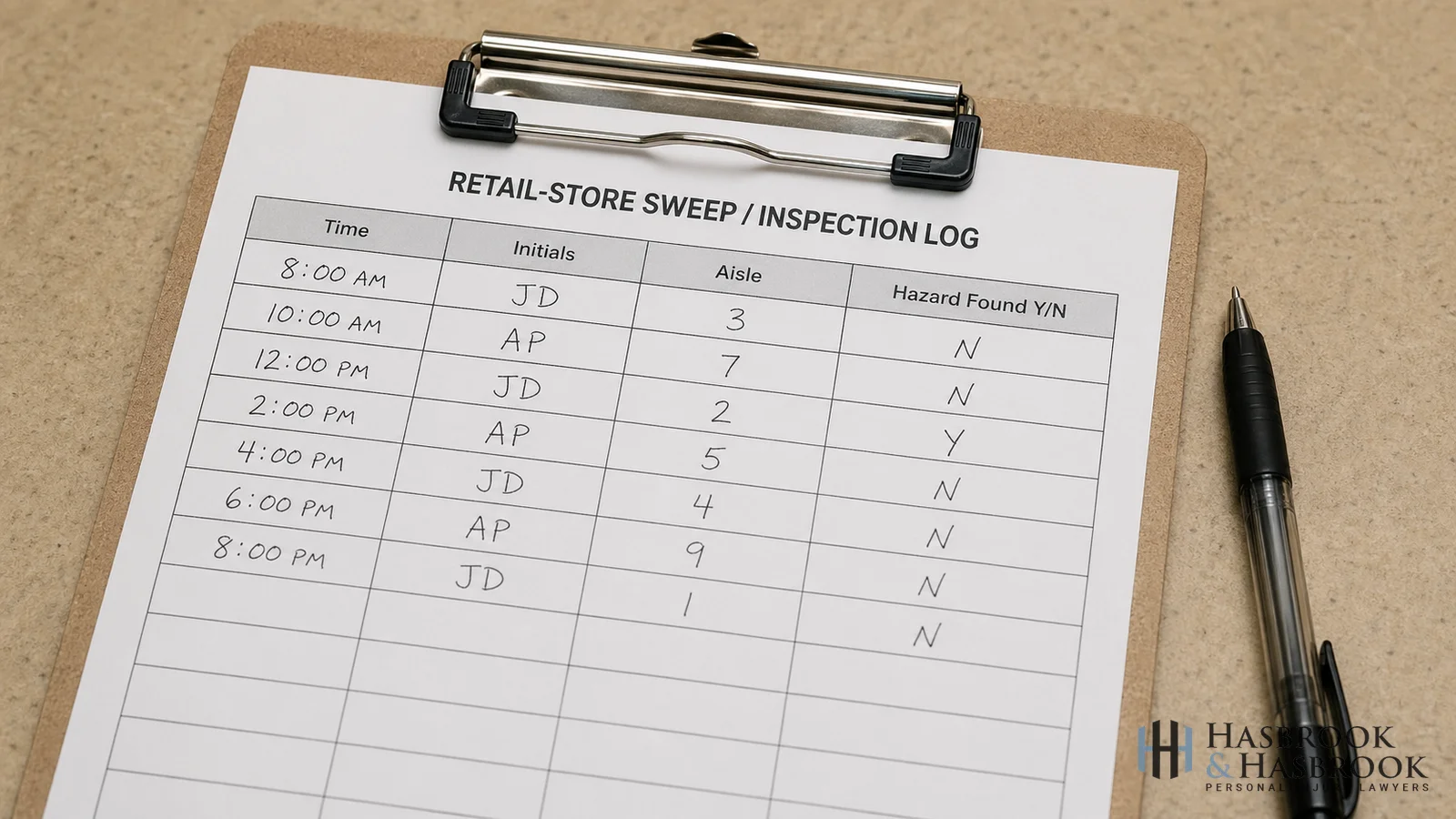
Sweep and inspection logs are among the most valuable documents in a retail slip-and-fall case. When we request these records, they either reveal a gap in inspections before your fall (supporting constructive notice) or an entry that conflicts with surveillance footage (which creates its own evidentiary problems for the defense). Retailers sometimes argue they have no duty to inspect continuously, but Oklahoma courts expect reasonable programs, particularly in known high-spill zones like produce sections and deli counters.
Maintenance records, prior incident reports for the same area, and employee training documents are all subject to civil discovery. We issue a litigation hold letter immediately to prevent destruction.
How to Gather Evidence After a Store Fall
The strongest evidence starts at the scene. Photograph the hazard, the surrounding floor, any warning cones, and your injuries before the store cleans up. Then pursue:
- Surveillance footage: Retailers overwrite video within 30 to 90 days. A written preservation demand stops deletion. See steps to take after a slip and fall for the full checklist.
- Incident report: Request one from the manager before leaving and photograph it on the spot.
- Witness information: Names and contact details for anyone who saw the hazard or the fall.
- Prior incident reports: Falls in the same location are discoverable and directly relevant to both actual and constructive notice.
Common Defenses Retailers Use Against Notice Claims
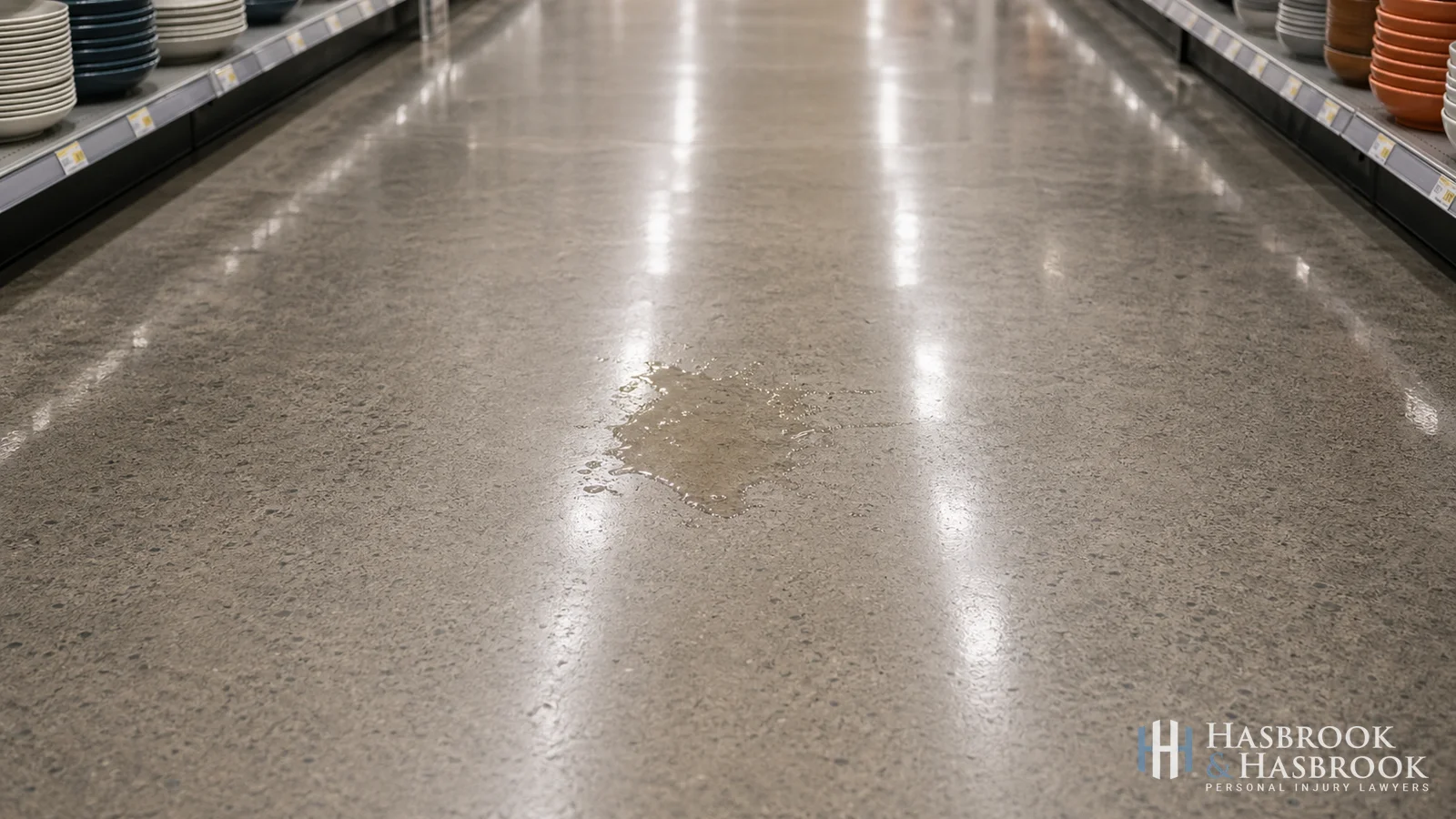
Retailers raise predictable defenses. Understanding them clarifies what evidence matters most:
- “We had no knowledge of the hazard.” The store denies actual notice, arguing the spill just happened. Counter with physical evidence of aging or video showing the hazard existed before your fall.
- “Our inspections were adequate.” The store produces sweep logs. Counter with video that contradicts those entries or expert testimony on reasonable inspection frequency for that specific area.
- “The hazard was open and obvious.” If a reasonable person should have seen and avoided the danger, the store may escape liability. Lighting, distractions in the aisle, and sightlines all affect how this argument holds up.
- “You were not watching where you were going.” This shifts a portion of fault to you. Oklahoma’s comparative fault rule determines whether and how much that affects your recovery.
See valid defenses in slip-and-fall cases for how these arguments play out.


How Comparative Fault Affects Your Recovery
Under 23 O.S. § 13, Oklahoma’s modified comparative fault rule, you can recover damages as long as your own fault is less than 50%. If a jury assigns you 20% of the fault, you recover 80% of your total damages. Retailers routinely inflate plaintiff fault to minimize payouts. See how much a slip-and-fall case is worth in Oklahoma and how partial fault affects compensation under state law.
Time Limits for Filing Your Claim
Oklahoma’s general personal injury statute of limitations is two years from the date of injury under 12 O.S. § 95. Missing this deadline ends your right to recover regardless of notice strength. Our page on how long after a slip and fall you can sue explains the narrow tolling exceptions. Do not wait: surveillance footage and maintenance logs disappear well before the two-year window closes.
How We Build the Notice Case Against a Retailer
Proving notice requires methodical discovery. We request surveillance footage covering the fall area, sweep logs for the incident date and prior 30 days, prior incident reports for the same location, and spill-response training records. This documentation establishes constructive notice even without proof any employee saw the hazard.
See types of recoverable damages in an Oklahoma slip-and-fall. Contact Hasbrook & Hasbrook for a free consultation on a contingency basis; learn how contingency fees work.

Frequently Asked Questions
How do I prove a store knew about the hazard?
Through actual notice (showing an employee directly knew before your fall) or constructive notice (showing the hazard existed long enough that a store exercising ordinary care would have found it). Surveillance footage, sweep logs, and physical evidence of the hazard’s age are the key tools. Our Oklahoma City slip-and-fall lawyer page covers the claims process.
How long does a spill need to be on the floor before the store is liable?
There is no fixed time under Oklahoma law. Courts look at whether the condition existed long enough that a store exercising ordinary care would have discovered it. Physical signs of aging, such as dried edges, tracked footprints, or discoloration, help establish the hazard was not fresh.
Can I still file a claim if there were warning signs near the hazard?
Yes. A cone placed far from the slick area, or placed after your fall, may not satisfy the store’s duty. Whether a warning effectively put a customer on notice of the specific danger is a jury question. See how to maximize your slip-and-fall case value.
How do I get the security footage from the store?
Send a written preservation demand to the store’s risk management department immediately. Retailers overwrite footage within 30 to 90 days; once litigation begins it can be formally subpoenaed. Waiting risks permanent loss of the most critical evidence in a notice case.
Does a property owner have to inspect their building every day?
Not necessarily daily, but inspections must occur at a frequency reasonable for the area and its foot traffic. High-spill zones require more frequent checks than low-traffic corridors. Oklahoma courts assess whether the store’s program met ordinary care standards for that specific context. Our page on why slip-and-fall cases are difficult to win explains the evidentiary challenges.
What if I was partly at fault for the fall?
Under 23 O.S. § 13, you can still recover as long as your fault is less than 50%. A 25% fault finding on a $100,000 verdict means you recover $75,000. Insurers routinely inflate plaintiff fault, and attorney representation makes a measurable difference in how that number is allocated.