Car insurance rates jump an average of 42 to 50 percent after an at-fault accident, which translates to roughly $872 more per year, according to a U.S. News & World Report analysis. In Oklahoma, the average rate increase after an at-fault collision is 43 percent — and Oklahoma drivers with a recent at-fault accident pay about $160 more per month. These premium hikes add financial stress on top of medical bills, vehicle repairs, and lost wages. If another driver caused your crash, recovering compensation from the at-fault driver can offset these rising costs and protect your insurance record at the same time.
Key Findings
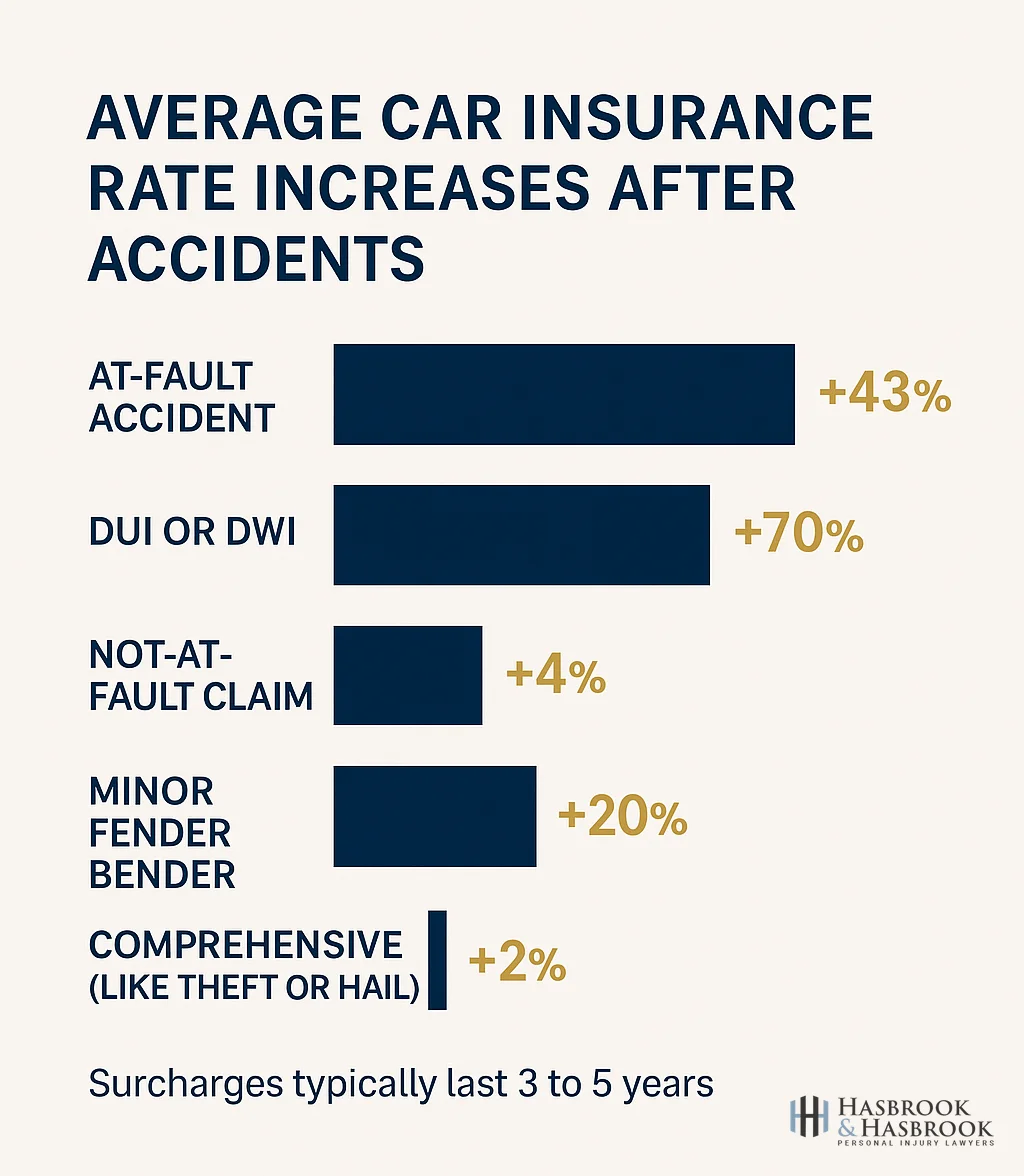
- Oklahoma at-fault accident rate increase: 43% — Oklahoma drivers pay about $160 more per month after an at-fault collision.
- National average: 42–50% — The typical driver pays roughly $872 more per year after an at-fault accident.
- Surcharge duration: 3–5 years — Most Oklahoma insurers apply the surcharge at each renewal during this window.
- Not-at-fault increase: ~4% nationally — Oklahoma law provides additional protection for not-at-fault drivers under 36 O.S. § 941.
- DUI/reckless driving: 70–100%+ increase — Serious violations can double premiums or result in policy non-renewal.
- Switching insurers works — Because each insurer prices accident history differently, shopping quotes after an accident consistently yields lower rates.



The Data Behind Car Insurance Increases After an Accident
How Fault Determines the Size of Your Rate Increase
Insurance companies are for-profit businesses that price policies based on risk. After a car accident, insurers view you as more likely to file another claim in the future. They adjust your premium to offset that increased risk, and the change appears at your next policy renewal.
Fault determination is the single biggest factor in how much your insurance rate increases. Drivers who cause accidents face the steepest premium hikes. The national average sits between 42 and 50 percent for at-fault accidents, while Oklahoma drivers see an average increase of 43 percent — about $872 more per year for a typical driver.
Drivers who are not at fault see much smaller increases. The national average is about 4 percent after a not-at-fault accident. Oklahoma law provides additional protections for these drivers: state insurance rules prohibit insurers from raising rates, canceling policies, or refusing to renew auto insurance coverage solely because a driver filed a claim after a not-at-fault accident. However, filing multiple not-at-fault claims over time can still flag you as a higher risk with some insurance companies.
Factors That Determine How Much Your Rate Increases
No two rate increases are the same. Several variables combine to determine the size of your insurance surcharge after a car accident:
- Accident severity — Property-damage-only claims trigger smaller increases. Claims involving bodily injury, serious injury, permanent disfigurement, or fatalities lead to larger insurance payouts — and steeper premium increases.
- Your driving history — A clean record often results in a more moderate increase, while prior accidents or traffic violations can trigger sharper hikes and a possible “high-risk” classification.
- Total claims cost — Larger payouts mean bigger surcharges on your policy.
- Driver age and demographics — Young drivers, teen drivers, and those with prior violations face the steepest hikes.
- Your insurance company’s policies — Each insurer uses a different algorithm. Rate hikes for the same accident can vary significantly from one company to the next.
- Location and ZIP code — Oklahoma ranks above the national average for insurance costs because severe weather risks and higher claim frequency drive up costs across the state.
| Scenario | Average Rate Increase | Oklahoma-Specific Notes |
|---|---|---|
| At-fault accident (national avg) | 42–50% (~$872/year) | U.S. News & World Report analysis |
| At-fault accident (Oklahoma) | ~43% (~$160/month more) | Oklahoma above national baseline due to weather/claim frequency |
| Minor fender bender (property damage only) | 20–30% | Lower payout = smaller surcharge |
| Bodily injury claim | 40–73% | Serious injuries or totaled vehicles push hikes higher |
| DUI / reckless driving | 70–100%+ | May trigger SR-22 requirement; possible non-renewal |
| Not-at-fault accident (national avg) | ~4% | Oklahoma law restricts rate increases for not-at-fault drivers |
| Multiple accidents (2+ in 3 years) | Premiums may double | High-risk classification; possible cancellation |
Sources: U.S. News & World Report insurance analysis; Insurance Information Institute fact statistics. Data reflects national and state-level averages for privately insured passenger vehicles.
What This Means for Oklahoma
How Oklahoma Compares to Other States
Oklahoma consistently ranks above the national average for auto insurance costs. The state’s combination of severe weather events (hail, tornadoes, ice storms), higher-than-average vehicle theft rates, and geographic claim frequency drives up baseline premiums — which means post-accident surcharges are applied to an already elevated base rate. An Oklahoma driver paying $150/month before an at-fault accident may see that jump to $215 or more, while the same increase in a lower-cost state hits a smaller baseline.
Oklahoma also has above-average rates of uninsured and underinsured motorists on the road. If you’re in an accident with an uninsured driver, you may need to file through your own uninsured motorist coverage — which can trigger a rate review even for not-at-fault accidents.
Oklahoma-Specific Legal Implications
Comparative negligence: Oklahoma uses a modified comparative negligence system under 23 O.S. § 13. If you are less than 51% at fault for an accident, you can still recover damages from the other driver. Your percentage of fault reduces your recovery, but does not eliminate it. This matters for insurance purposes: the more fault assigned to the other driver, the less exposure your own policy faces.
SR-22 requirements: Oklahoma drivers convicted of DUI, driving without insurance, or certain serious traffic violations may be required to file an SR-22 certificate with the state — a document from your insurer confirming you carry the minimum required coverage. SR-22 filing itself does not increase your rate, but the underlying violation that triggered it typically causes significant premium hikes. SR-22 status is generally required for three years in Oklahoma.
Oklahoma’s minimum insurance requirements: Oklahoma requires drivers to carry at minimum 25/50/25 liability coverage: $25,000 per person for bodily injury, $50,000 per accident, and $25,000 for property damage. Drivers with only minimum coverage who cause a serious accident face the largest gap between what their policy pays and what the victim can recover — a situation that often results in lawsuits and potential policy non-renewal.
Why These Numbers Matter for Injury Victims
Filing Against the Right Policy Protects Your Own Rates
If another driver caused your accident, recovering full compensation can help offset rising insurance costs and other financial losses. Filing a claim against the at-fault driver’s insurance — not your own — can help you avoid triggering rate increases on your policy. This distinction matters for your long-term financial health.
Oklahoma personal injury law allows accident victims to pursue compensation for medical expenses, lost wages, pain and suffering, and vehicle repair or replacement costs. Oklahoma’s comparative negligence rule lets you recover damages as long as you are less than 51 percent at fault.
How to Minimize Insurance Rate Increases After an Accident
Rising insurance costs do not have to overwhelm your budget. Several strategies can reduce the financial impact:
- Accident forgiveness programs — Some insurers offer programs that prevent rate increases after a first at-fault accident. These programs may require a clean record or an additional premium. Progressive Accident Forgiveness and similar products can save hundreds of dollars per year.
- Shop for new quotes — Each insurer prices accident history differently. Comparing quotes from multiple insurers can reveal significant savings, even with a recent at-fault accident on your record.
- Increase your deductible — This lowers your monthly premium, though it raises your out-of-pocket cost per claim.
- Bundle home and auto policies — Combining home and auto insurance often unlocks discounts that offset rate increases.
- Complete a defensive driving course — Some Oklahoma insurers offer discounts for drivers who finish approved courses.
- Pay out of pocket for minor damage — If repair costs fall near your deductible amount, skipping the insurance claim avoids a potential premium hike that could last for years. See our guide to Oklahoma car insurance premiums for more detail.
Your case is more than a statistic. If another driver caused your accident, you may be entitled to compensation that covers your losses — including rising insurance costs. Call Hasbrook & Hasbrook at (405) 605-2426 for a free consultation.


Oklahoma’s Statute of Limitations and Protecting Your Rights
Under 12 O.S. § 95, you have two years from the date of the accident to file a personal injury lawsuit in Oklahoma. Missing this deadline eliminates your right to compensation. Acting quickly preserves critical evidence, including police reports, witness statements, surveillance footage, and medical records.
An attorney can handle negotiations with the at-fault driver’s insurance provider so you do not have to face their tactics alone. Insurance companies use delays, lowball offers, and blame-shifting to minimize payouts. We fight back against these strategies on your behalf.
If the at-fault driver was uninsured, your own underinsured motorist coverage may provide a path to compensation. Our attorneys handle both types of claims.
Methodology and Sources
Data Sources
The rate increase figures in this article are drawn from:
- U.S. News & World Report — Analysis of average premium increases by fault status and state. National and Oklahoma-specific averages cited in the opening and data table.
- Insurance Information Institute (III) — ZIP code, age, gender, and credit score factors in premium calculation. The III is a non-profit industry research organization.
- Oklahoma Insurance Code — State-specific rules on not-at-fault rate increases, SR-22 requirements, and minimum coverage levels.
- 12 O.S. § 95 — Oklahoma statute of limitations for personal injury claims.
- 23 O.S. § 13 — Oklahoma comparative negligence statute.
Limitations
Rate increase percentages are industry averages and will vary based on your individual insurer, driving record, vehicle type, coverage levels, and specific ZIP code. Oklahoma-specific figures reflect state average premium data as of the most recent available reporting period. Contact your insurer directly for a quote specific to your situation. This article is for general information and does not constitute legal or insurance advice.
Frequently Asked Questions About Car Insurance Increases After an Accident
Will my insurance go up if the accident wasn’t my fault?
In Oklahoma, insurers cannot raise your rates solely for filing a not-at-fault insurance claim. 36 O.S. § 941 provides this protection. However, filing multiple claims over time may still affect your premium at renewal, as insurers track your overall claims history. The protection is strongest for isolated incidents where fault clearly lies with the other driver.
How much does car insurance increase after an at-fault accident in Oklahoma?
Oklahoma drivers see an average rate increase of about 43 percent after an at-fault accident. The exact amount depends on your insurance provider, driving history, and the severity of the collision. Accidents involving medical claims or totaled vehicles tend to result in the largest premium increases.
How long will an accident affect my insurance rates?
Most insurers apply surcharges for three to five years after an accident. Maintaining a clean driving record during that period helps rates return to normal faster. Accidents involving DUI charges can affect your rates for a decade or longer. See our overview of Oklahoma car insurance laws for more.
Should I file an insurance claim for a minor accident?
If repair costs fall close to your deductible, paying out of pocket may save money over the long term. Filing a claim can trigger a premium increase that lasts several years. Weigh the immediate payout against the total cost of higher premiums before you decide. For damage assessment help, see our guide on getting your car repaired after an accident.
Can I switch insurance companies after an accident to get a lower rate?
Yes. Each insurance provider prices accident history using a different formula. Shopping around and comparing quotes from multiple insurers can help you find a more affordable rate — even with a recent accident on your record. This is one of the most effective ways to reduce your post-accident premium costs.
Can a personal injury lawyer help reduce the financial impact of an accident?
Yes. Recovering compensation from the at-fault driver covers medical bills, lost wages, and other losses — which helps offset insurance increases and out-of-pocket expenses. Personal injury lawyers work on contingency, meaning you pay nothing unless they win. At Hasbrook & Hasbrook, we fight to maximize every dollar our clients recover.


Injured in a Car Accident? Talk to an Oklahoma City Car Accident Lawyer Today
Rising insurance rates are just one of many financial consequences of a car accident. Medical bills, lost wages, vehicle damage, and pain and suffering can overwhelm your finances. If another driver was at fault, pursuing compensation from their insurer — rather than your own — protects both your wallet and your insurance record.
Do not let an insurance company’s lowball offer determine your future. At Hasbrook & Hasbrook, we help accident victims across Oklahoma recover the money they deserve. We offer a free consultation and charge no fee unless we win your case.
Call us at (405) 605-2426 or contact us online to schedule your free case review. The sooner you act, the stronger your claim becomes.