Car accident shoulder injuries usually come from direct impact with the door or dashboard, the pull of a shoulder belt during a crash, bracing against the steering wheel, or whiplash that forces the neck and shoulder through a sudden, violent motion. These forces can fracture bone, tear the rotator cuff or labrum, or dislocate the joint.



Common Causes of Shoulder Injuries in Car Accidents
The shoulder is not built to absorb the forces of a collision, yet it takes on several of them at once in almost every crash. Four mechanisms explain most car accident shoulder injuries.
- Direct impact. As the body is thrown forward or sideways, the shoulder can strike the door, dashboard, steering wheel, or window. Blunt force like this can fracture bone, dislocate the joint, or tear soft tissue on its own.
- Seat belt restraint. The belt keeps the body in the seat, but the sudden load it places across the shoulder and chest during a hard stop can bruise, strain, or tear the rotator cuff.
- Bracing on impact. Many drivers and passengers instinctively throw an arm toward the wheel or dashboard. That force travels up the arm and jams into the shoulder joint, which can pinch tendons or damage the cartilage inside the joint.
- Whiplash. The rapid snap of the head and neck in a rear-end collision can radiate pain and dysfunction into the shoulder complex, sometimes lingering after the neck itself has healed.
Types of Shoulder Injuries from a Car Accident
Because the shoulder is the most mobile joint in the body, a single crash can damage it in more than one way.
Rotator Cuff Tears
The rotator cuff is made up of four muscles and tendons that hold the arm bone in its socket. According to the Mayo Clinic, these injuries range from a mild strain to a complete tear, and rotator cuff damage caused by the crash often needs months of physical therapy or, in more severe cases, arthroscopic repair.
Dislocation and Labral Tears
 The shoulder can dislocate when the ball of the joint is forced out of its socket, an injury the American Academy of Orthopaedic Surgeons notes is common in high-force trauma like a car crash. A dislocation can be partial or complete, and it often tears the labrum, the ring of cartilage around the socket, including a SLAP tear at the top of the labrum (an injury the Cleveland Clinic frequently ties to car accidents) or a Bankart lesion at the front.
Fractures
 A crash can break the clavicle (collarbone), scapula (shoulder blade), or proximal humerus (top of the upper arm bone). Depending on how the break is displaced, claims involving a fractured collarbone or shoulder blade may include the cost of surgical plates, screws, or rods used to hold the bone in place while it heals.
Frozen Shoulder
 When an injured shoulder stays immobile for too long while it heals, the joint capsule can thicken and tighten into what is known as frozen shoulder, or adhesive capsulitis, leaving the joint stiff and painful long after the original injury.

Diagnosing and Treating a Shoulder Injury After a Crash
A physical exam checks range of motion, strength, stability, and tenderness, then imaging confirms what the exam suggests. An X-ray shows fractures and dislocations, an MRI shows soft tissue damage like a torn rotator cuff or labrum, and a CT scan maps out a complex fracture in more detail.
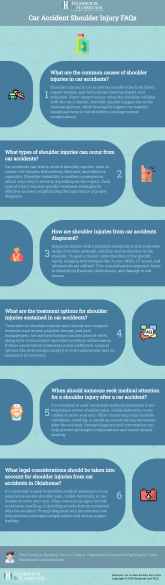 Most shoulder injuries start with conservative care: rest, ice or heat, over-the-counter or prescription pain relief, and physical therapy to rebuild strength and range of motion. A corticosteroid injection can calm inflammation in a stubborn case. When conservative treatment does not resolve the problem, an orthopedic surgeon may recommend arthroscopic repair of the rotator cuff or labrum, open surgery to fix a displaced fracture, or, for severe arthritis or a badly damaged joint, a shoulder replacement. How long recovery takes depends heavily on which of these paths a patient needs, and skipping physical therapy after surgery is one of the more common reasons a shoulder never regains its full strength.
When to Seek Medical Attention
Some symptoms after a crash call for immediate medical care rather than a wait-and-see approach:
- Severe or worsening shoulder pain
- A visible deformity in the shoulder
- Inability to move the arm
- Numbness or tingling in the arm or hand
- Significant swelling or bruising
- Grinding or clicking with movement
Getting checked out quickly does two things at once: it gives a shoulder injury the best chance at a full recovery, and it creates the medical record that will later support an injury claim.


Legal Considerations for a Shoulder Injury Claim in Oklahoma
A shoulder injury from a car accident can mean months of medical bills, lost income, and pain a settlement should account for. When another driver’s negligence caused the crash, Oklahoma law allows the injured person to pursue compensation from that driver. Oklahoma follows a modified comparative negligence rule. You can still recover damages as long as your share of fault does not exceed 50 percent, though the final award is reduced by your percentage of fault (23 O.S. § 13). A closer look at how shared fault can reduce a payout explains how insurers apply that percentage in practice.
Detailed records make or break a shoulder injury claim. Save every diagnostic image, physical therapy note, and pay stub showing missed work, and keep a simple log of how the injury affects daily activities. Showing the insurer exactly how the injury played out is often what separates a fair settlement from a lowball offer. Oklahoma gives most car accident injury claims two years from the date of the crash to file a lawsuit (12 O.S. § 95), so it makes sense to talk to an attorney well before that window closes.
The value of a shoulder claim depends heavily on the type of injury, whether surgery was needed, and how much work was missed. That is why what a shoulder injury claim may be worth can vary so widely from case to case. In a serious wreck, medical bills can also outrun the other driver’s policy limits, which changes how the claim needs to be handled. What not to do in the hours after a crash can also protect both your health and your claim. The attorneys at Hasbrook & Hasbrook represent injured Oklahomans in these claims; tell us about your shoulder injury and we will walk you through the options.