A personal injury plaintiff’s best mediation strategy is preparation: agree on a bottom-line settlement number with your lawyer beforehand, expect a low opening offer from the defense, and let the numbers move in stages rather than reacting to any single offer. Everything said during mediation is privileged and confidential under Oklahoma’s Dispute Resolution Act, 12 O.S. § 1805.
Mediation is a formal settlement conference that gives most personal injury plaintiffs their best chance to resolve a case before trial. This guide walks through who attends, what a mediator actually does, and how negotiations typically move from a lowball opening offer to a number both sides can live with. There is no “winner” or “loser” at mediation, and unlike a sworn deposition, you will not be questioned under oath. Your only job is deciding whether to accept a number.



Meet With Your Lawyer Before Mediation

Before mediation, your Hasbrook & Hasbrook attorney will meet with you to explain the process and get authority to settle at a specific number, sometimes through a written authorization to accept any offer at or above a set amount. It is important that your lawyer knows your bottom-line figure in advance, since attorney’s fees, costs, and any liens against your settlement have to come out of whatever you settle for. Ask for realistic estimates on all three before you walk in the door.
Who Attends a Personal Injury Mediation
At minimum, mediation includes you, your lawyer, defense counsel, an insurance adjuster, and the mediator. The defendant rarely controls the settlement number, the insurance company does, so the defendant may not even attend. On the plaintiff’s side, you personally hold final authority to settle, not your attorney.
What Is a Mediator?
A mediator is a neutral attorney with no stake in either side’s outcome, agreed upon by both lawyers (or appointed by the court if they can’t agree). Many mediators still practice as plaintiff or defense attorneys elsewhere, including some who are on friendly terms with the lawyer on the other side from other cases; that background does not make them biased in your case. Mediators typically charge by the hour, split between the parties whether or not the case settles. The American Bar Association’s dispute resolution section maintains standards for mediator training and conduct.

Where Mediation Happens and How It Starts

Mediation is usually held at the mediator’s office, though video-conference mediations are increasingly common. If you arrive before your attorney, it is fine to say hello to the defense side, but keep small talk light and avoid discussing your case. About a week beforehand, your attorney will prepare a mediation statement, similar to a personal injury demand package, that goes only to the mediator, not the other side.
The Joint Session and Opening Statements

Some mediations start with a “joint session,” where everyone sits at one table while the mediator explains the process and each attorney gives an opening statement, usually starting with the plaintiff’s side. Joint sessions have become less common; many mediations now go straight to separate rooms. Either way, your attorney’s opening number will be higher than what you would actually accept, which is normal and simply leaves room to negotiate.
Confidentiality Protects What You Say

Communications made during mediation are privileged and cannot be used against you at trial; opposing counsel cannot cross-examine you later about what you said at the table. That said, if you mention a new treating doctor or witness, the defense can still track that person down independently afterward. Federal courts recognize a similar principle for settlement talks generally, discussed in Federal Rule of Evidence 408.


Why Mediation Tends to Work
A few dynamics, also covered by general mediation industry resources, explain why cases tend to resolve there rather than going all the way to trial:
- Neutral facilitation. The mediator does not take sides or give legal advice, and often helps each side see the other’s perspective.
- Shared risk. Mediation lets both sides weigh the risk of trial directly, instead of leaving the outcome entirely to a judge or jury.
- Compromise. Neither side gets everything it would want at trial; the goal is a number both sides can tolerate.
- Speed. A settlement at mediation typically pays out within a couple of weeks to a month, once any liens are resolved, instead of years of waiting on a trial verdict.
- Control. You decide the outcome of your own case, rather than a jury deciding it for you.
Personal Injury Mediation Strategy: Offers, Brackets, and the Mediator’s Proposal

The defense’s opening offer will almost always be far lower than what the insurance company is actually willing to pay, sometimes as little as $500 or $1,000 on a case worth far more. That is a negotiating tactic, not an insult. Real numbers usually don’t emerge until at least an hour in, sometimes not until after lunch.
From there, mediation becomes a process of “moving the middle,” the point between the plaintiff’s and defendant’s latest offers. If you offer $300,000 and the defense offers $100,000, the middle is $200,000; each new round of offers shifts it. A mediator sometimes proposes a “bracket,” such as agreeing to come up to $100,000 if you come down to $600,000, to speed up a slow-moving negotiation. Late in mediation, either side may make a “drop-dead” or final offer, and if the numbers still won’t meet, the mediator can make a mediator’s proposal: a recommended number each side accepts or rejects privately, so a rejected proposal is never disclosed to the other side.
If Your Case Settles

When a case settles at mediation, the mediator prepares a settlement agreement for everyone to sign, and you keep a copy. It typically includes an agreement to sign a full release once the paperwork is finalized. Payment usually follows within a couple of weeks to a month, depending mostly on how quickly any medical liens are resolved.
Once you sign, the case is over and there is nothing left to do but wait on payment.

If Mediation Ends in Impasse
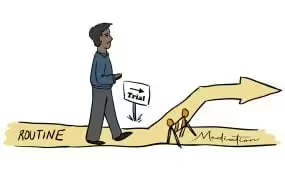
If mediation does not produce a settlement (an “impasse”), your case simply continues as if it never happened. Many cases still settle after a failed mediation, sometimes within days, sometimes right before trial, since both sides often revisit the numbers as a trial date gets closer. Do not treat mediation lightly just because you expect the case to settle eventually. It is usually your best chance to resolve the case, since it is the only time before trial that everyone is in the room together.
If you are preparing for mediation and want help setting a realistic settlement number, Hasbrook & Hasbrook can walk through what to expect before you sit down at the table, including how contingency fees affect what you take home from any settlement.