A crash that fractures your C5 vertebra happens in seconds. What follows takes a lifetime to understand. Quadriplegia from a traumatic injury means paralysis in all four limbs, often with permanent loss of sensation, bladder and bowel control, and in some cases the ability to breathe independently. If someone else’s negligence caused that outcome, Oklahoma law gives you the right to pursue compensation that reflects the full reality of what you are facing.
At Hasbrook & Hasbrook, our Oklahoma City paralysis injury attorneys handle quadriplegia and high-level spinal cord injury claims. These cases involve medical, economic, and legal complexity that ordinary injury cases do not. We work with life-care planners, vocational experts, and medical economists to account for every cost you will carry for the rest of your life.
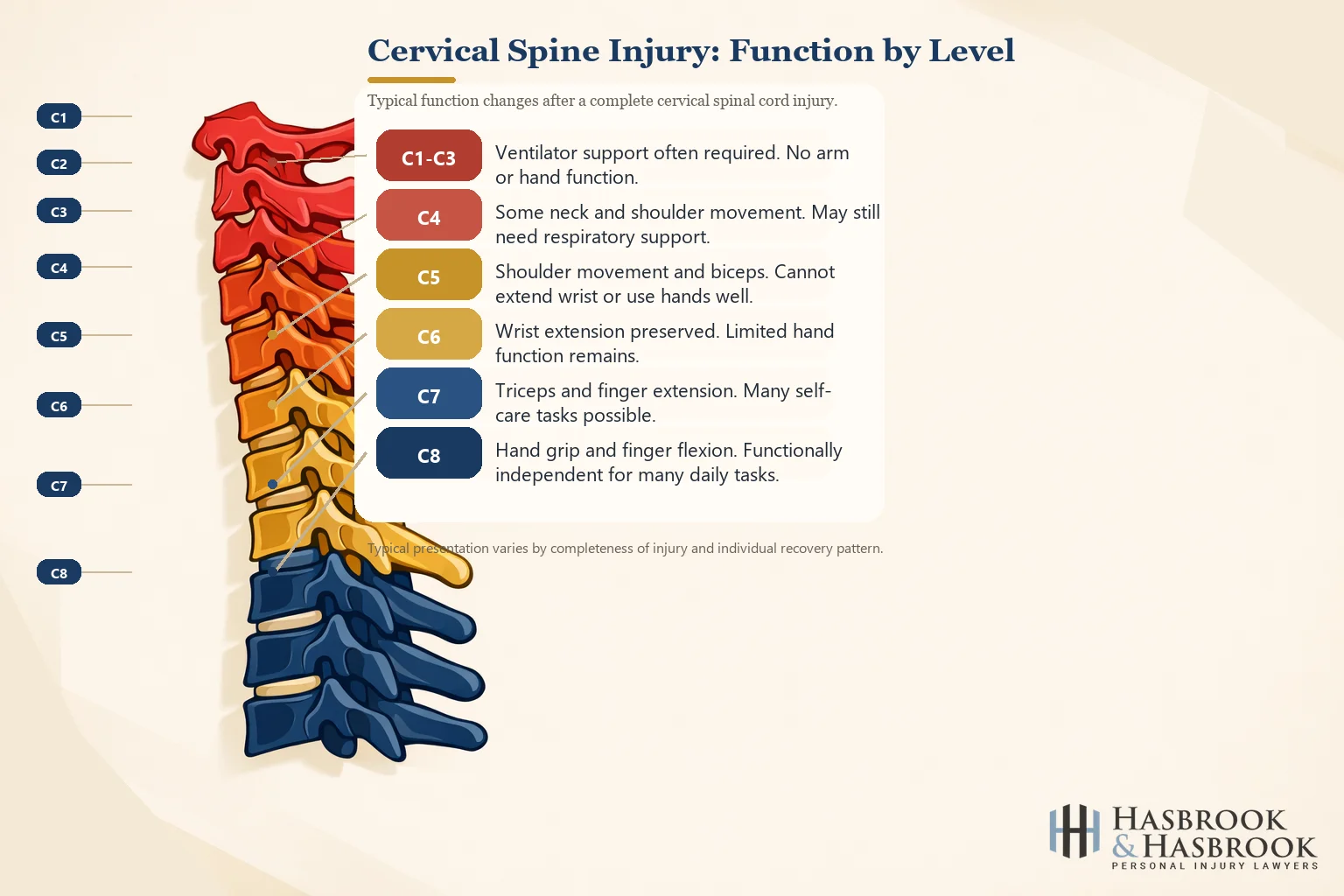
What Paralysis Looks Like After a Traumatic Injury
Paralysis is not a single condition. Where the spinal cord is injured determines what function you lose, what care you will need, and what your legal claim is worth.
Quadriplegia vs. Paraplegia: Understanding the Difference
Quadriplegia (also called tetraplegia) results from damage to the cervical spine (C1-C8, the neck region). It affects both arms and both legs, along with varying loss of respiratory, bowel, and bladder function. The higher the injury, the more function is lost. Damage at C1-C4 often requires ventilator support; damage at C5-C8 may preserve limited arm and hand movement.
Paraplegia results from thoracic, lumbar, or sacral injuries. It affects the legs and lower trunk while leaving upper body and arm function intact. The spinal cord injury overview page covers how injuries are classified across all spinal levels in detail. This page focuses on cervical cord injuries and the specific legal and medical issues that quadriplegia cases involve.
Complete vs. Incomplete Injuries: What the Classification Means for Your Case
A complete injury severs all nerve pathways at the site, eliminating all motor and sensory function below that point. An incomplete injury preserves some pathways, which may allow partial movement, sensation, or both.
For legal purposes, the distinction between complete and incomplete quadriplegia directly affects case value. A complete C4 injury may require around-the-clock attendant care and ventilator support for the rest of a person’s life. The lifetime economic burden of that outcome differs fundamentally from an incomplete C6 injury with preserved hand function. Any attorney evaluating your claim must understand this distinction before calculating damages.



How Oklahoma Accidents Cause Quadriplegia
Cervical cord damage requires force delivered to the neck region of the spine. Not every serious accident produces it, but several common accident types in Oklahoma regularly do.
Motor Vehicle Crashes and High-Velocity Impact
Car accidents, truck crashes, and motorcycle collisions are the leading cause of traumatic quadriplegia. When a vehicle stops suddenly, rolls over, or is struck from the side, the neck absorbs force that can fracture or dislocate cervical vertebrae. The spinal cord may be damaged directly, or it may be injured by bone fragments, swelling, or bleeding inside the spinal canal.
High-speed car accidents and commercial truck collisions are particularly associated with cervical cord injuries. The weight and speed involved in these crashes delivers the kind of force to the neck and upper back that produces the most catastrophic outcomes.
Falls, Diving Accidents, and Workplace Incidents
Falls from height, including construction site falls, falls from ladders, and falls down stairs on poorly maintained property, account for a significant share of cervical cord injuries in Oklahoma. Diving accidents in shallow water are a common cause of quadriplegia among younger adults.
Workers in construction, oil and gas, and roofing industries face elevated risk from high falls. These incidents may produce claims under both workers’ compensation and civil negligence law if a third party’s conduct contributed to the accident.
If you or someone you love is facing quadriplegia from a traumatic accident in Oklahoma, call Hasbrook & Hasbrook at (405) 605-2426 for a free consultation. You do not have to work through the financial and legal picture alone.
The Real Lifetime Cost of Quadriplegia
Quadriplegia is one of the most expensive traumatic injuries a person can sustain. Building a claim that actually covers your future means understanding what those costs look like over time, not just what the hospital bill says today.
First-Year Medical Costs
According to the National Spinal Cord Injury Statistical Center (NSCISC) 2026 data sheet, first-year costs for high tetraplegia (C1-C4) average approximately $1.4 million in 2025 dollars, covering emergency care, surgical intervention, intensive rehabilitation, and initial adaptive equipment. Lower cervical injuries (C5-C8) carry first-year costs averaging approximately $1 million. These figures reflect direct expenses (medical care and SCI-attributable living costs) and exclude indirect losses such as wages, fringe benefits, and productivity.
Annual Costs and Long-Term Financial Impact
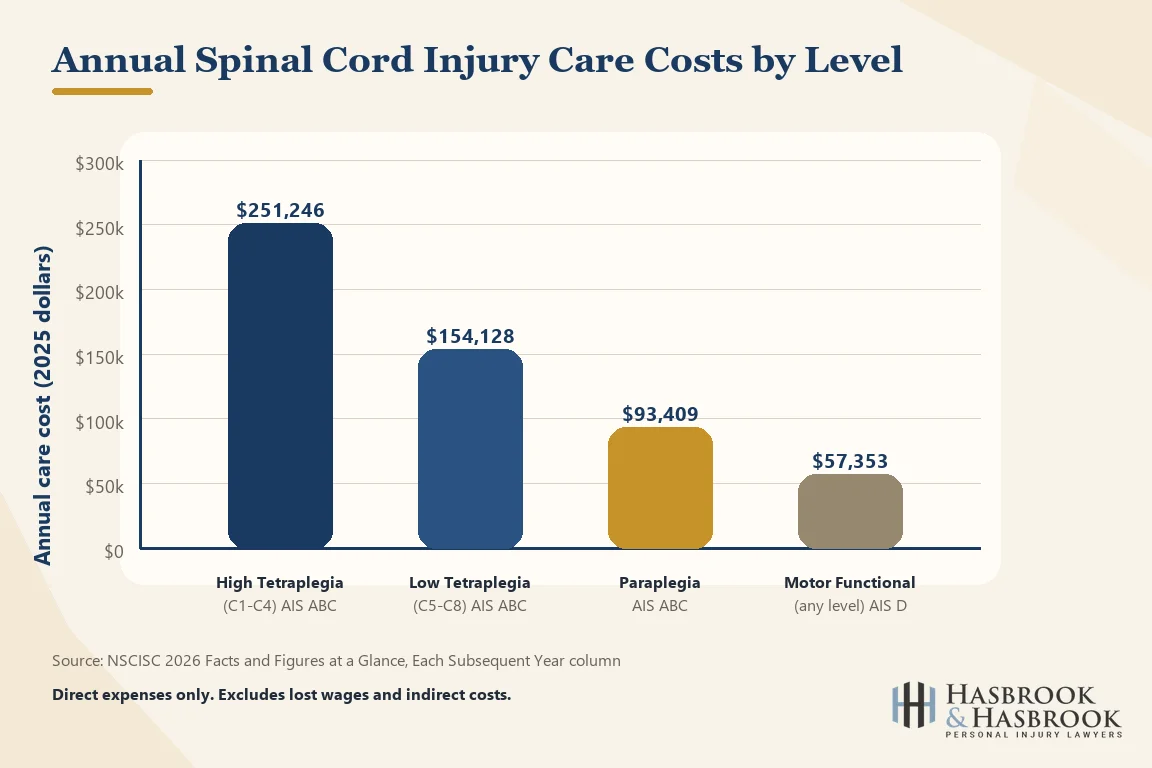
After the first year, annual care costs for high tetraplegia average approximately $251,000 per year in 2025 dollars, according to NSCISC data. Estimated cumulative lifetime costs for a person injured at age 25 exceed $6.4 million; for a person injured at age 50, the figure is approximately $3.5 million (discounted at 2%). These are not speculative estimates. They are documented by life-care planners who specialize in projecting the medical and support needs of people with permanent cervical cord injuries.
Home modification to accommodate a wheelchair, roll-in shower, and automated entry may cost $50,000 to $150,000. Attendant care (someone to assist with bathing, dressing, transfers, and daily tasks) often runs $50,000 to $80,000 per year depending on injury level. Both categories belong in your legal claim and are regularly undercounted in early settlement offers.


Oklahoma Law That Governs Paralysis Injury Claims
The Two-Year Filing Deadline
Under 12 O.S. § 95, you have two years from the date of your injury to file a civil lawsuit in Oklahoma. In quadriplegia cases, the investigative workload is substantial: accident reconstruction, medical expert retention, and life-care planning all require time. Contacting an attorney immediately after the injury preserves your legal options and prevents evidence from disappearing. For a broader explanation of Oklahoma’s personal injury statute of limitations and its exceptions, see our statute of limitations exceptions page.
The Damages Cap and Why It Usually Does Not Apply to Quadriplegia
Oklahoma’s noneconomic damages cap under 23 O.S. § 61.3 limits pain and suffering and similar intangible losses to $500,000 in most civil cases. However, the statute contains a clear exception: the cap does not apply to cases involving permanent and severe physical injury that causes lasting loss of function or severe disfigurement. Quadriplegia falls within this exception in nearly every case. An injury that eliminates the use of all four limbs, may require ventilator support, and prevents independent living is precisely what the legislature intended to exempt from the ceiling. Cases involving reckless conduct by the defendant are also exempt from the cap under the same statute. This is not an argument your attorney has to win on your behalf; it is language in the statute itself that distinguishes catastrophic physical injuries from ordinary claims.
Comparative Fault and High-Value Claims
Under 23 O.S. § 13, Oklahoma’s modified comparative fault rule reduces your recovery by your percentage of fault and bars recovery entirely if your fault is more than 50 percent. In quadriplegia cases, the opposing insurer has a strong financial incentive to assign fault to you, because even a modest shift in the fault percentage saves the insurer hundreds of thousands of dollars. Expect detailed scrutiny of your driving behavior, safety equipment use, and conduct before the accident. For a deeper explanation of how comparative negligence works in Oklahoma, see our dedicated page on that topic.
Why Quadriplegia Claims Require Specialized Legal Work
The Life-Care Plan: Documenting Decades of Future Needs
A life-care plan is a formal document prepared by a certified life-care planner, usually a nurse or rehabilitation specialist with forensic training, that itemizes every medical and support expense projected for the rest of your life. For a quadriplegia claim, a thorough plan covers:
- Acute rehabilitation and transition to home or long-term care
- Ventilator maintenance and respiratory therapy supplies (for high cervical injuries)
- Power wheelchair replacement on a 5-7 year schedule
- Attendant care hours and projected hourly rates
- Home modification for accessible living
- Recurring medical visits, anticipated surgeries, and medications
- Communication devices and environmental controls
This document is the evidentiary foundation of your demand. Without it, the insurer can characterize your future cost projections as speculative. With it, you have a line-by-line accounting that a qualified expert can defend at deposition or trial.
Vocational Experts and Lost Earning Capacity
For working-age claimants, a vocational expert assesses what jobs you could realistically perform after quadriplegia, compares that to your pre-injury earning capacity, and produces a calculation of lifetime lost earnings. This is not simply multiplying your current salary by remaining work years. The vocational assessment accounts for your career trajectory, inflation, benefits, and the specific functional limitations of your injury level. For a a life-altering injury like complete tetraplegia like complete tetraplegia, the lost earning capacity figure alone can reach seven figures for a working adult.
When to Settle and Why Early Offers Fall Short
Insurers often make early offers on catastrophic injury cases before the life-care plan is complete. Accepting one can leave you millions short of what you will need. Our attorneys do not recommend settlement until every future cost is documented. For a detailed discussion of what Oklahoma spinal cord injury cases are worth, see our page on spinal cord injury settlement values.

Frequently Asked Questions About Paralysis Injury Claims in Oklahoma
What is the difference between quadriplegia and paraplegia?
Quadriplegia involves paralysis or loss of function in all four limbs, caused by damage to the cervical spine (C1-C8 vertebrae in the neck). Paraplegia involves paralysis in the legs and lower body, caused by injuries to the thoracic, lumbar, or sacral spine. Both can be complete (total loss of function below the injury site) or incomplete (some preserved function). Quadriplegia cases involve higher lifetime costs and greater care complexity than paraplegia cases.
How long does a quadriplegia injury claim take to resolve?
Most quadriplegia cases take two to four years from injury to resolution. Life-care planning, vocational assessment, and economic analysis all take time, and settling before these reports are complete typically produces an inadequate result. The two-year statute of limitations is a filing deadline, not a reason to accept a quick settlement offer. Your attorney should advise you on timing based on where your documentation stands.
Can I recover compensation if I was partly at fault for the accident?
Yes, in most cases. Under Oklahoma’s modified comparative fault rule (23 O.S. § 13), your recovery is reduced by your percentage of fault but is not eliminated unless your fault is more than 50 percent. If you are found 20 percent at fault in a $4 million quadriplegia case, you would recover $3.2 million. Because the financial stakes are so high in paralysis cases, insurance companies push harder to assign fault to the injured person, making experienced legal representation particularly important.
What does a life-care plan include?
A life-care plan itemizes all projected medical, rehabilitative, and support needs for the rest of your life. For quadriplegia, a plan typically covers hospitalization and acute rehabilitation, home health and attendant care, adaptive equipment (power wheelchair, communication devices, environmental controls), home modification, recurring medical visits, anticipated procedures, and medications. Each item is assigned a current and projected cost, and the plan is signed by a qualified expert who can testify about it in court.
Can my family file a wrongful death claim if paralysis complications lead to death?
Yes. If a paralysis injury caused by another party’s negligence contributes to death, the family may have a claim for a death caused by negligence under Oklahoma law. High cervical injuries carry elevated risk of respiratory failure, sepsis from pressure ulcers, and cardiovascular complications. If those complications result in death within the applicable legal timeframe, surviving family members may be entitled to compensation.
Hasbrook & Hasbrook has represented injured Oklahomans for decades. If you or a family member has been paralyzed by a traumatic injury in Oklahoma City, call us at (405) 605-2426 for a free case review. We work on contingency; you owe nothing unless we recover compensation for you.
Treating neurologists assign an ASIA grade to every patient, so plaintiffs’ counsel should understand ASIA Impairment Scale classification in spinal cord cases.