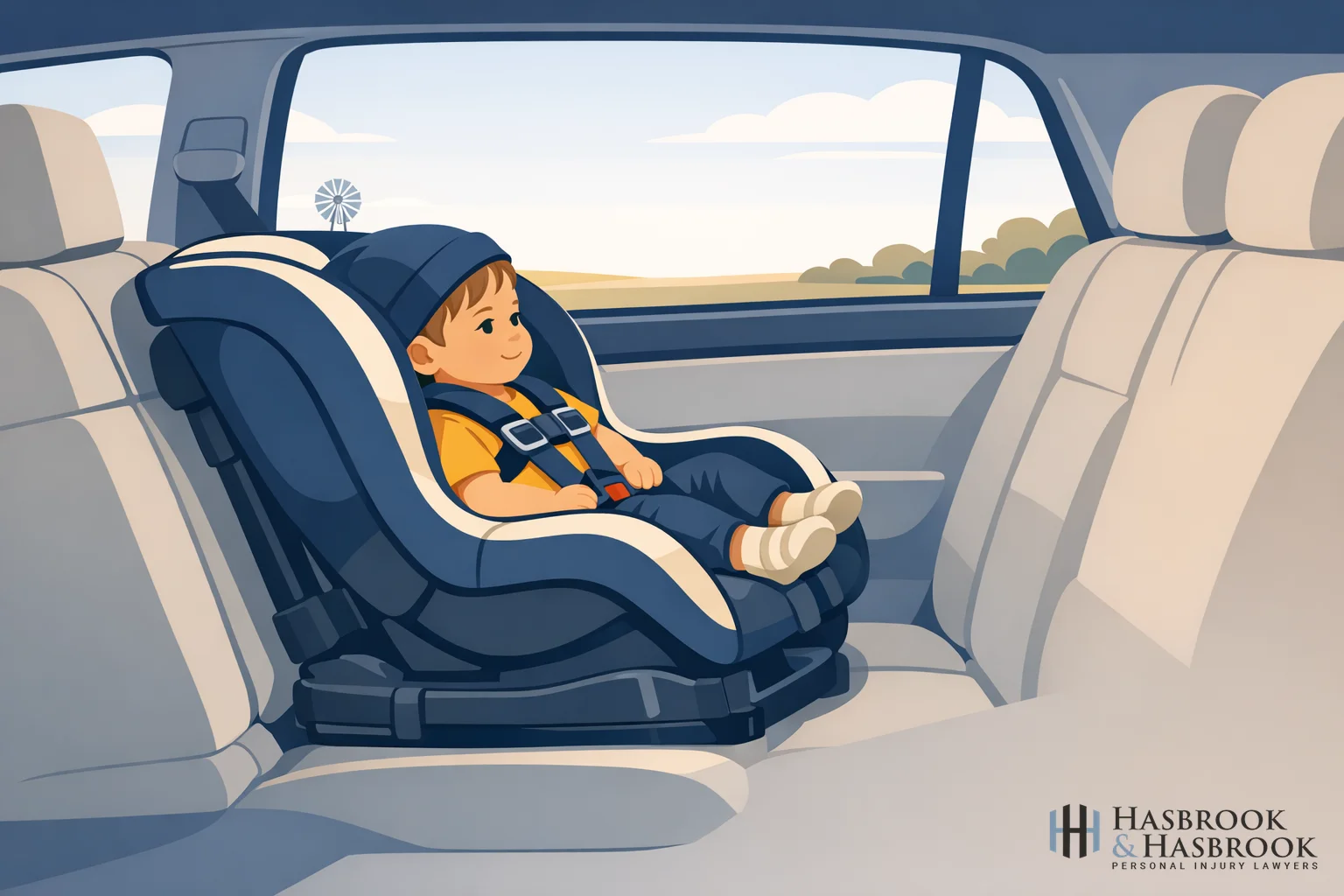
Where a child sits in a car, and what restraint they ride in, is one of the most consequential safety decisions a parent makes. It is also a decision that carries legal weight when a crash happens. Oklahoma law sets specific age-based requirements, NHTSA recommendations extend those requirements further, and how well either was followed can affect what an insurer or a court does with a personal injury claim.
If your child was hurt in a crash, call 405-605-2426 to speak with our Oklahoma City child injury attorneys for a free consultation.



What Oklahoma law requires
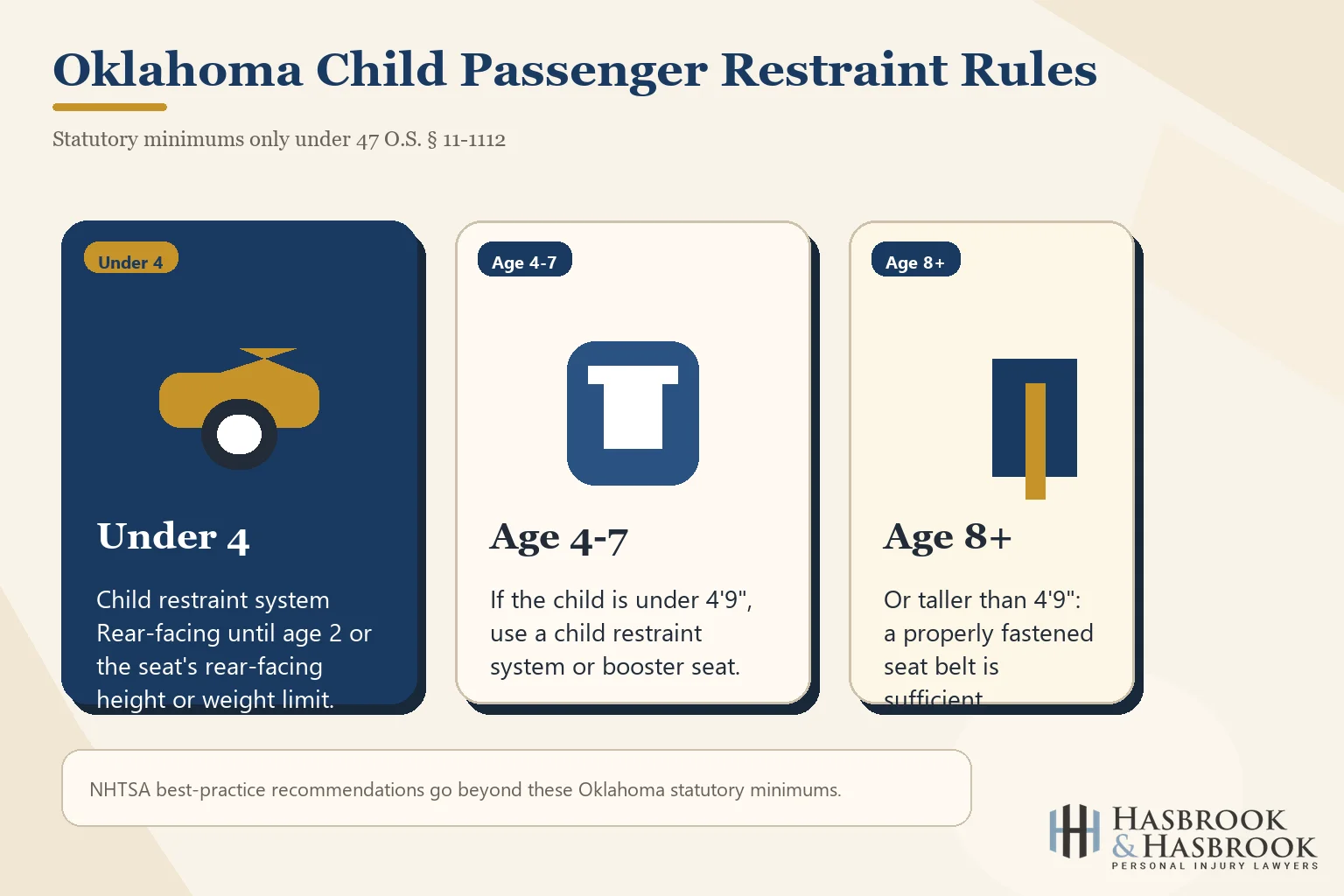
Under 47 O.S. § 11-1112, every driver transporting a child under 8 must use a child passenger restraint system appropriate for the child. The statute sets these minimum standards:
- Under age 4: child passenger restraint system, rear-facing until the child reaches age 2 or until the child reaches the rear-facing seat’s manufacturer weight or height limit, whichever comes first
- Age 4 through 7 and not taller than 4 feet 9 inches: child passenger restraint system or booster seat
- Age 8 or taller than 4 feet 9 inches: a properly fastened seat belt is sufficient under the statute
The statute applies to vehicles operated on Oklahoma roadways, streets, and highways. Limited exceptions apply for ambulances, school buses, taxicabs, and certain other vehicles. Our complete guide to Oklahoma child car seat law covers each stage and seat type in more detail.
NHTSA recommendations go beyond the statute
The National Highway Traffic Safety Administration (NHTSA) recommends safety practices that extend beyond Oklahoma’s statutory minimum. NHTSA recommends keeping children rear-facing as long as possible, up to the maximum height and weight the seat’s manufacturer allows (often well past age 2), then forward-facing with a harness until reaching that seat’s limit, then a belt-positioning booster until the child is at least 4 feet 9 inches tall (often between ages 8 and 12). NHTSA also recommends all children under 13 ride in the back seat. These are best-practice recommendations, not Oklahoma legal requirements, but they reflect what crash data shows produces the best safety outcomes.
These stages exist because crash forces act differently on a child’s body depending on how the restraint distributes impact. Rear-facing seats spread energy across the back, neck, and head. Forward-facing harnesses hold the torso. Booster seats position the seat belt across bone rather than soft tissue. A child in the wrong restraint for their size can sustain injuries that the correct restraint would have reduced significantly.

How seating position affects a crash injury claim
Oklahoma uses a comparative fault system under 23 O.S. § 13. If a child was not properly restrained at the time of a crash, the at-fault driver’s insurance company may argue that the seating decision contributed to the injury severity. That argument can reduce what you recover.
The threshold: if your share of fault is found to be more than 50 percent, you cannot recover. If it is 50 percent or less, your recovery is reduced by your fault percentage. A $100,000 jury award with a 20 percent fault finding on the parent’s side would yield an $80,000 recovery. Insurers know this system and use it to push fault assignments upward as early as possible. Having an attorney involved early can challenge those assignments before they become fixed in the insurer’s file. Our page on Oklahoma comparative and contributory negligence covers how this plays out in different claim situations.
The traffic fine and the civil claim are separate
A violation of Oklahoma’s child restraint statute carries a civil fine. That fine does not automatically create liability in a personal injury case. The civil standard asks whether the seating choice fell below reasonable care and whether it was a proximate cause of the injury, both fact-specific questions that depend on the crash type, the restraint used, and the injuries sustained. Getting cited for a seat belt violation at the scene is a data point in the civil file, not a judgment on it.


You still likely have a claim
Many parents assume that if a child was not in the right restraint, the injury claim is gone. That is usually not accurate. Oklahoma’s comparative fault rule allows partial recovery in most cases. The other driver’s conduct, whether it was speeding, running a light, or distracted driving, remains central to the fault calculation. Comparative fault reduces what you can recover; it does not erase the at-fault driver’s responsibility for causing the crash.
Our Oklahoma City car accident attorneys can evaluate the circumstances and explain how fault would likely be allocated in your case. We handle these cases on a contingency basis, meaning no fee unless we recover.
Frequently asked questions about child seating and crash claims
What does Oklahoma law require for child car seats?
Under 47 O.S. § 11-1112, children under 4 must be in a child passenger restraint system (rear-facing until age 2 or until reaching the seat’s manufacturer weight/height limit). Children age 4 through 7 who are not taller than 4 feet 9 inches must use a child restraint or booster seat. Children age 8 or taller than 4 feet 9 inches may use a properly fastened seat belt. NHTSA recommends additional safeguards beyond these statutory minimums, including keeping children rear-facing longer and seating all children under 13 in the back seat.
Can the insurance company use our car seat choice to reduce the claim?
Yes. If a child was not properly restrained, the insurer for the at-fault driver may argue that the seating decision contributed to the injury. Under Oklahoma’s comparative fault system, this can reduce recovery proportionally. It generally does not bar recovery unless the parent’s share of fault exceeds 50 percent.
Does getting a traffic citation affect our civil case?
A child restraint citation is separate from the civil injury claim. The fine does not create automatic liability. In the civil proceeding, the question is whether the seating decision was a proximate cause of the injury and what weight fault, if any, carries in the overall allocation.
My child was hurt in a crash. What should we do first?
Get medical attention right away, even if your child appears unhurt at the scene. Injuries from crash forces, including soft tissue damage and head trauma, can take hours or days to show clear symptoms. Contact an attorney before giving any recorded statements to adjusters. Early involvement protects the claim from being shaped by the insurer’s initial investigation.
Is there a deadline to file a claim for a child’s crash injury?
Under 12 O.S. § 95, Oklahoma’s general personal injury deadline is two years from the date of the crash. For injuries to minors, there are separate tolling rules that may extend that deadline. Contact an attorney early to preserve all available options.

Schedule a free consultation with our Oklahoma City child injury attorneys
If a child in your family was injured in a car crash, call 405-605-2426 or use the contact form on this page to speak with Hasbrook & Hasbrook. We represent families throughout Oklahoma City and the surrounding areas, and we can help you understand what your claim is worth and how to protect it.