A child slips under the surface of a backyard pool while adults are distracted. A swimmer’s arm is pulled into an uncovered drain. A guest at a neighborhood pool party breaks an ankle on a slick deck that the HOA has ignored for three seasons. Swimming pool accidents in Oklahoma happen at private homes, apartment complexes, HOA community centers, and public facilities. When a pool owner’s negligence caused your injury or the death of someone you love, Oklahoma premises liability law gives you the right to pursue compensation.
At Hasbrook & Hasbrook, we represent people injured in swimming pool accidents throughout Oklahoma City and the surrounding area. These cases involve distinct legal frameworks depending on who owns the pool and who was injured. The duty of care a public pool operator owes to swimmers differs from the duty a homeowner owes to a neighbor’s child. Understanding those differences before you file a claim shapes everything about how a case is built and what it can recover.

Types of Swimming Pool Accidents in Oklahoma
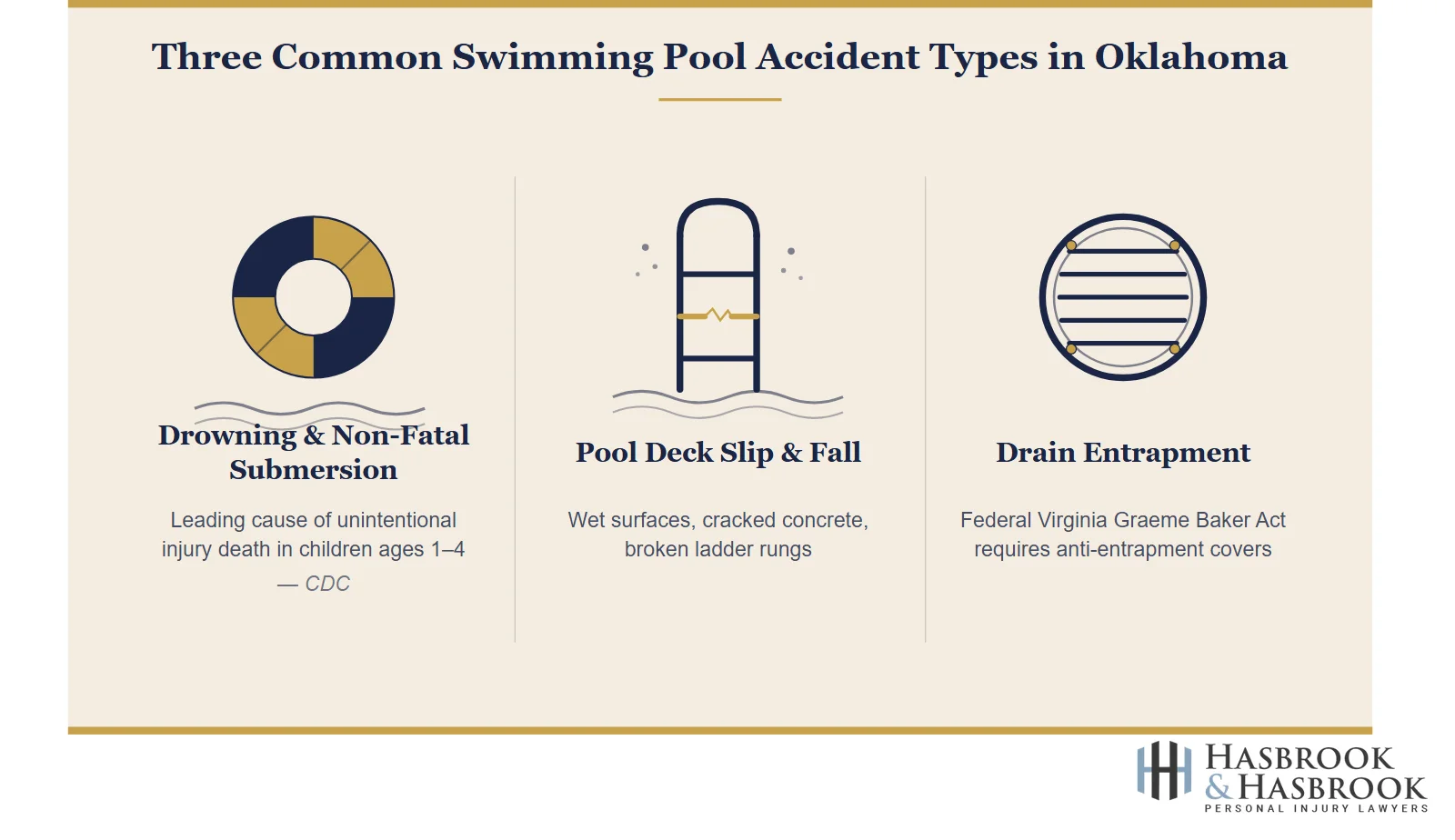
Pool accidents cause several distinct categories of injury, and each raises different questions about how the negligence occurred and who bears responsibility.
Drowning and Non-Fatal Submersion
Drowning is the leading cause of unintentional injury death in children ages one through four in the United States, according to the Centers for Disease Control and Prevention. Non-fatal submersion injuries, where a person is pulled from the water alive, can leave lasting neurological damage from oxygen deprivation. The legal questions in these cases center on supervision, barriers, fencing, and whether the pool owner’s failure to maintain safe conditions allowed the incident to occur.
Slip-and-Fall on Pool Decks and Surrounding Areas
Pool decks, ladders, and diving boards are high-traffic areas where wet surfaces and deferred maintenance create fall hazards. Cracked concrete, algae buildup, missing anti-slip materials, and broken ladder rungs contribute to fractures, spinal injuries, and head injuries. For an overview of how premises liability law applies to fall injuries on another person’s property, see our Oklahoma City slip-and-fall page.
Defective Pool Equipment and Drain Entrapment
The Virginia Graeme Baker Pool and Spa Safety Act, a federal law that took effect in 2008, requires anti-entrapment drain covers on public pools and spas. When a pool operator installs noncompliant drain covers or allows compliant covers to deteriorate, swimmers, particularly children, face a serious risk of hair and limb entrapment. Drain entrapment can trap a swimmer underwater within seconds. Entrapment injuries often support both negligence claims against the property owner and product liability claims if the drain hardware itself was defective.
Who Is Responsible for a Swimming Pool Accident
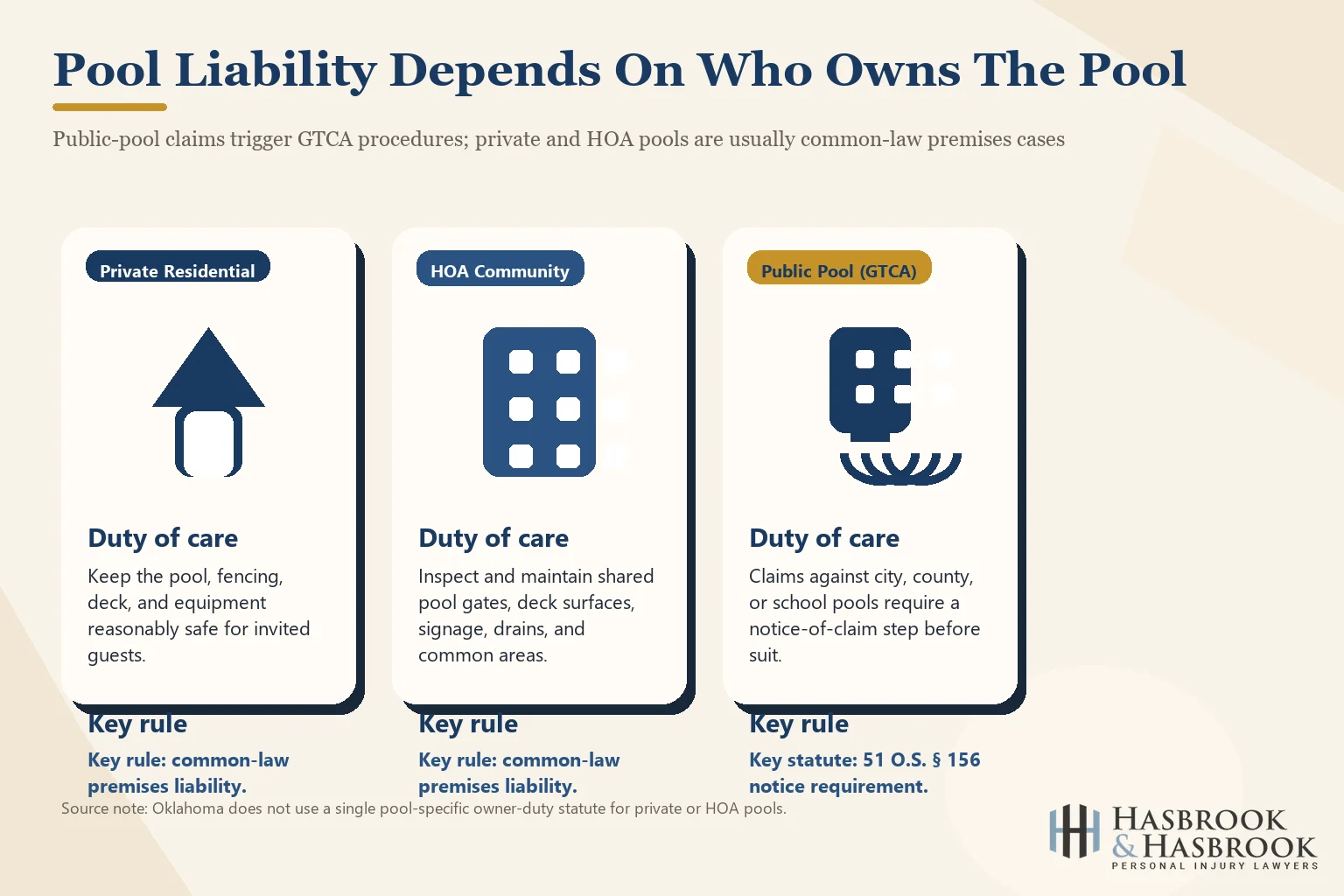
The identity of the pool owner determines which body of law applies and what procedural rules govern your claim. Oklahoma distinguishes sharply between private pools, HOA-operated pools, and government-owned facilities.
Private Residential Pools
A homeowner who maintains a pool owes invited guests a duty to keep the premises reasonably safe and to warn about hazards the guest would not discover on their own. That duty extends to the pool deck, diving equipment, fencing, and the pool itself. A homeowner who knows a drain cover is broken, that the pool lacks required fencing, or that a ladder is unstable has an obligation to repair the hazard or warn guests before anyone is injured.
HOA Community Pools
Homeowners associations that operate shared pools for residents and their guests carry the same duty of care as any commercial property owner. HOA boards are responsible for regular inspection and maintenance of pool equipment, fencing, deck surfaces, signage, and drainage systems. When an HOA defers maintenance it knows about, or fails to inspect a facility it controls, injured residents and guests may have a claim against the HOA directly. Some HOA cases also implicate the management company under contract to maintain the facility.
Public Pools and the Oklahoma Governmental Tort Claims Act
If a swimming pool is owned by a city, county, school district, or other government entity, your claim is governed by the Oklahoma Governmental Tort Claims Act (GTCA). Under 51 O.S. § 151 et seq., governmental entities have waived immunity for certain negligent acts of their employees within the scope of employment. GTCA claims require a written notice of claim under 51 O.S. § 156 filed with the governmental entity before you can sue. Missing that deadline bars your claim entirely. If a city-operated pool or school aquatic center caused your injury, contact an attorney immediately.
If you or your child was injured at a swimming pool in the Oklahoma City area, call Hasbrook & Hasbrook at (405) 605-2426 for a free consultation. The type of pool and the age of the person injured both affect your claim, and the deadlines vary. Do not wait.
The Attractive Nuisance Doctrine and Child Injuries at Pools
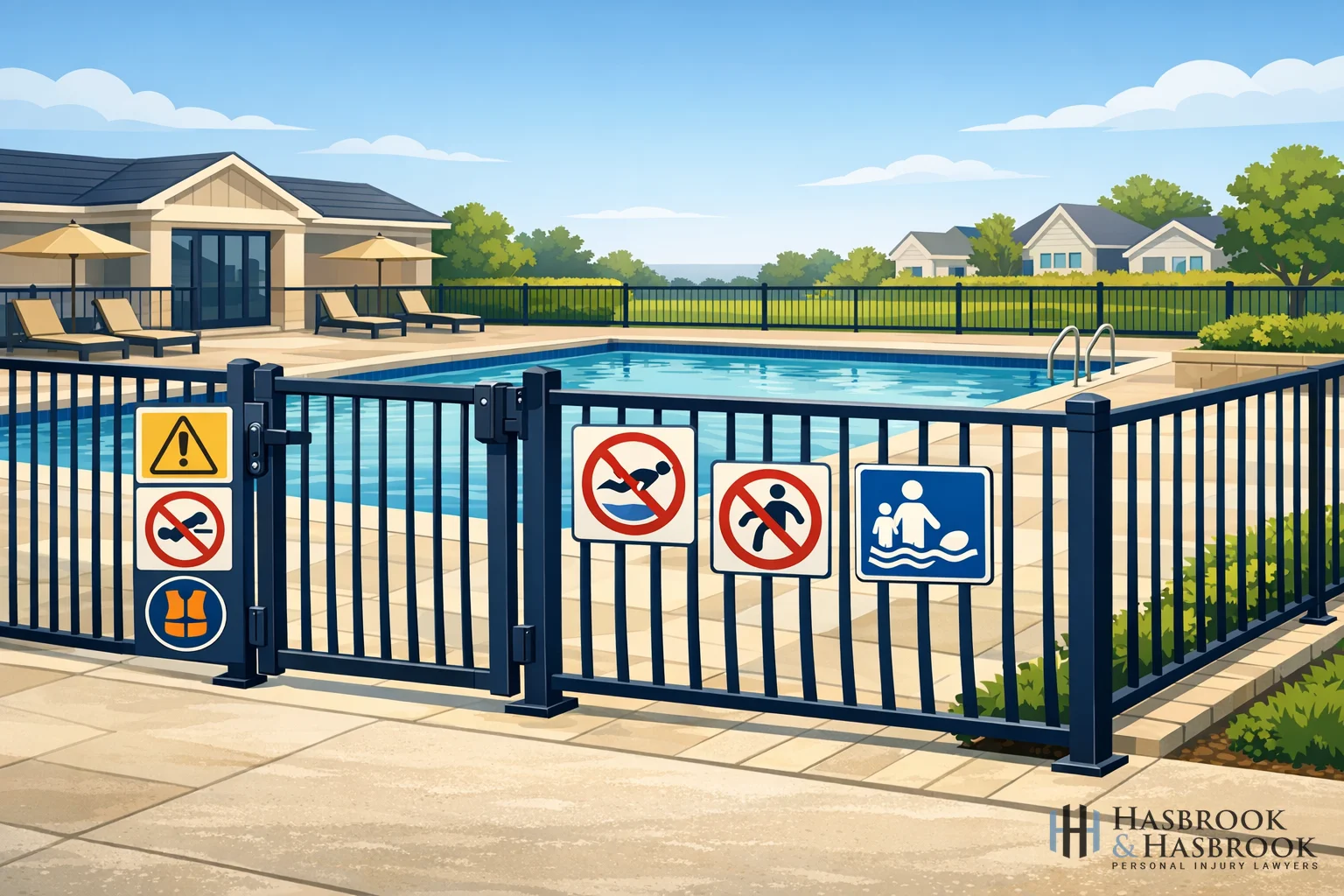
Swimming pools are one of the most commonly cited attractive nuisances in Oklahoma premises liability law. The attractive nuisance doctrine imposes a heightened duty of care on landowners whose property contains a feature that children are likely to be drawn to, even when those children are trespassing.
What the Doctrine Requires
Under Oklahoma’s attractive nuisance doctrine, a landowner can be held liable for injuries to a trespassing child if: the landowner knows children are likely to trespass near the condition; the condition poses an unreasonable risk of death or serious injury to children; the children do not appreciate that risk because of their age; the burden to eliminate the danger is slight compared to the risk; and the landowner fails to exercise reasonable care. A swimming pool on a residential lot satisfies this framework in most circumstances. Children do not fully appreciate the risk of unsupervised swimming, and the primary protective measure, fencing with self-latching gates, is inexpensive compared to the severity of potential harm. For child injury claims arising from pool accidents, the statute of limitations is also tolled, giving families additional time to act.
Pool Fencing Requirements in Oklahoma
Oklahoma does not have a single statewide pool fencing statute, but many municipalities within the Oklahoma City metro area have adopted local ordinances requiring barriers around residential pools. These ordinances typically require a fence of a minimum height (commonly four feet), with self-latching and self-closing gates, enclosing all sides of the pool so the barrier is between the house and the pool. When a homeowner’s pool lacks the fencing required by a local ordinance, that violation can be treated as negligence per se, meaning the failure to comply with the ordinance establishes breach of duty without needing to prove separately that the conduct was unreasonable.
Comparative Fault Defenses in Swimming Pool Cases
Under 23 O.S. § 13, Oklahoma follows a modified comparative fault rule. Your recovery is reduced by your percentage of fault, and you are barred from recovery entirely if your fault is more than 50 percent. For a detailed explanation of how comparative negligence operates in Oklahoma, see our dedicated page on the topic.
In swimming pool cases, defendants and their insurers commonly argue that the injured person assumed the risk of swimming, ignored posted warnings, was intoxicated, swam without a lifeguard present, or violated pool rules. In child injury cases, insurers sometimes attempt to attribute fault to the parents rather than the child. These are factual disputes that experienced attorneys challenge with evidence from the scene, pool maintenance records, incident reports, and witness accounts.
Legal Deadlines for Swimming Pool Accident Claims
The Standard Two-Year Filing Deadline
Under 12 O.S. § 95, you generally have two years from the date of a swimming pool accident to file a lawsuit in Oklahoma. Waiting too long forfeits your right to compensation regardless of how strong the underlying facts are. For a broader explanation of Oklahoma’s personal injury statute of limitations and the circumstances that can pause or extend it, see our page on statute of limitations exceptions.
When the Injured Person Is a Minor
Oklahoma tolls the statute of limitations for minors. A child who is injured at a pool does not have the two-year clock start running until they reach age 18. The family, however, retains the right to file a claim on the child’s behalf before that point, and doing so while evidence is fresh and witnesses are available is almost always the better approach. If you are considering waiting until your child reaches adulthood to file, discuss that decision with an attorney first.
GTCA Notice Deadline for Government-Owned Pools
If the pool is owned by a government entity, the notice-of-claim requirement under the GTCA has its own deadline that is separate from and shorter than the general statute of limitations. Missing the notice deadline bars the claim. If there is any possibility that the pool was government-owned, treat the deadline as urgent and contact an attorney immediately.
Damages Available After a Swimming Pool Accident
Economic and Non-Economic Damages
Pool accident survivors and their families can pursue both economic damages (quantifiable losses such as medical bills, future treatment costs, rehabilitation, and lost income) and non-economic damages (pain and suffering, permanent impairment, disfigurement, and loss of enjoyment of life). Non-fatal submersion injuries that cause brain damage from oxygen deprivation often result in permanent care needs that generate substantial lifetime costs. Head and spinal injuries from falls on pool decks carry similar long-term economic consequences.
Wrongful Death Claims for Fatal Drownings
When a swimming pool accident results in death, the family may pursue a wrongful death claim under 12 O.S. § 1053. Oklahoma’s wrongful death statute allows designated family members to recover for the grief and loss of companionship suffered by the surviving spouse and children, as well as medical and funeral expenses and the economic value of what the deceased would have contributed to the household. Fatal child drownings are among the most devastating losses a family can face, and Oklahoma law is designed to hold negligent pool owners accountable when inadequate barriers, failed supervision, or defective equipment contributed to the death. For more on how Oklahoma wrongful death law works, see our wrongful death page.
Frequently Asked Questions About Swimming Pool Accident Claims in Oklahoma
Can I sue a homeowner if my child drowned in their pool?
Yes, in most cases. A homeowner owes a duty of reasonable care to invited guests and, under the attractive nuisance doctrine, a heightened duty to children who may access the pool even without an explicit invitation. If the homeowner’s negligence, such as a missing fence, a broken gate latch, no supervision, or defective equipment, contributed to the drowning, you have the basis for a premises liability claim. The homeowner’s insurance policy typically provides coverage for these claims up to policy limits.
Does the attractive nuisance doctrine apply if my child was trespassing?
Yes. That is specifically what the attractive nuisance doctrine addresses. Oklahoma recognizes that children do not appreciate dangers the way adults do, and that pool owners who fail to take reasonable precautions against child access, such as adequate fencing, can be held liable even when the child entered the property without permission. The child’s trespassing status does not automatically relieve the homeowner of liability.
What if the accident happened at a public pool or a city recreation center?
Claims against government-owned pools are governed by the Oklahoma Governmental Tort Claims Act. You must file a written notice of claim with the governmental entity before you can file a lawsuit. The GTCA has specific deadlines and requirements that differ from standard personal injury claims. Missing the notice deadline eliminates your right to sue. If the accident occurred at a city, county, or school-district pool, contact an attorney as soon as possible to preserve your claim.
What if I was partly at fault, for example, I was swimming in an area marked off-limits?
Oklahoma’s comparative fault rule (23 O.S. § 13) reduces your recovery by your percentage of fault but does not eliminate it unless your fault is more than 50 percent. Ignoring a posted sign is a factor in the fault analysis, but it does not automatically mean the pool owner bears no responsibility. If the underlying hazard, for example, a defective drain cover in the restricted area, was still the pool owner’s responsibility to maintain, your fault percentage may be modest even if you disregarded a warning.
How long do I have to file a swimming pool accident lawsuit in Oklahoma?
For most private pool and HOA pool accidents, you have two years from the date of the accident under 12 O.S. § 95. That deadline is tolled for injured minors until they turn 18. For accidents at government-owned pools, the GTCA requires a written notice of claim to be filed with the governmental entity first, and that deadline is shorter. Because the deadlines depend on who owned the pool and the age of the injured person, consult an attorney soon after the accident rather than assuming you have the full two years.
Does an HOA or apartment complex have to provide a lifeguard at its pool?
Oklahoma law does not require lifeguards at most residential or HOA-operated pools. The duty of care typically focuses on the physical condition of the pool area: fencing, gate latches, pool chemistry, deck conditions, drain covers, and posted warnings. Where lifeguards are required (some public pools and certain commercial facilities), the failure to provide adequate supervision can become a separate basis for liability. For HOA pools specifically, the question is usually whether the association adequately maintained the equipment and warned about hazards, not whether it stationed an employee at the pool.
What if a pool drain caused my child’s injury?
Drain entrapment cases are governed in part by the federal Virginia Graeme Baker Pool and Spa Safety Act, which requires anti-entrapment drain covers on public pools and spas built or refurbished after December 2008. Liability in these cases typically extends to the pool operator (for failing to install or maintain compliant covers), the manufacturer (if the drain hardware itself was defective), and sometimes the contractor who installed it. Drain entrapment is one of the most catastrophic pool injury types because it can pull a swimmer under within seconds. Preserve the drain hardware as evidence and contact an attorney immediately.
What is a swimming pool accident case worth in Oklahoma?
Case value depends on the severity and permanence of the injuries, the identity of the at-fault party, and the available insurance coverage. Non-fatal submersion injuries with permanent neurological damage often produce the largest recoveries because lifetime care costs alone can run into seven figures. Slip-and-fall injuries with full recovery typically resolve in a smaller range, driven by medical bills and lost wages. Fatal drowning cases under Oklahoma’s wrongful death statute account for the surviving family members’ losses, including grief, loss of companionship, and economic contributions of the deceased. An attorney can give you a more specific estimate after reviewing the medical records, the pool ownership structure, and the insurance picture.
Hasbrook & Hasbrook represents people injured in swimming pool accidents throughout Oklahoma City and the surrounding communities. If a pool owner’s negligence injured you or your child, call us at (405) 605-2426 for a free case review. We work on contingency, which means you owe nothing unless we recover compensation for you.