ATV crashes in Oklahoma are different from car accidents in ways that change how liability is established, how insurance claims work, and what it takes to build a case that accounts for your full losses. At we work for injured plaintiffs, we represent people seriously hurt in ATV, UTV, and off-road vehicle accidents across Oklahoma. If you were injured on a trail, a rural property, or someone else’s land, we can help you understand what your claim is worth and who is responsible.
Call (405) 605-2426 to schedule a free case consultation with an Oklahoma ATV accident lawyer.



Why ATV accidents follow different legal rules than car crashes
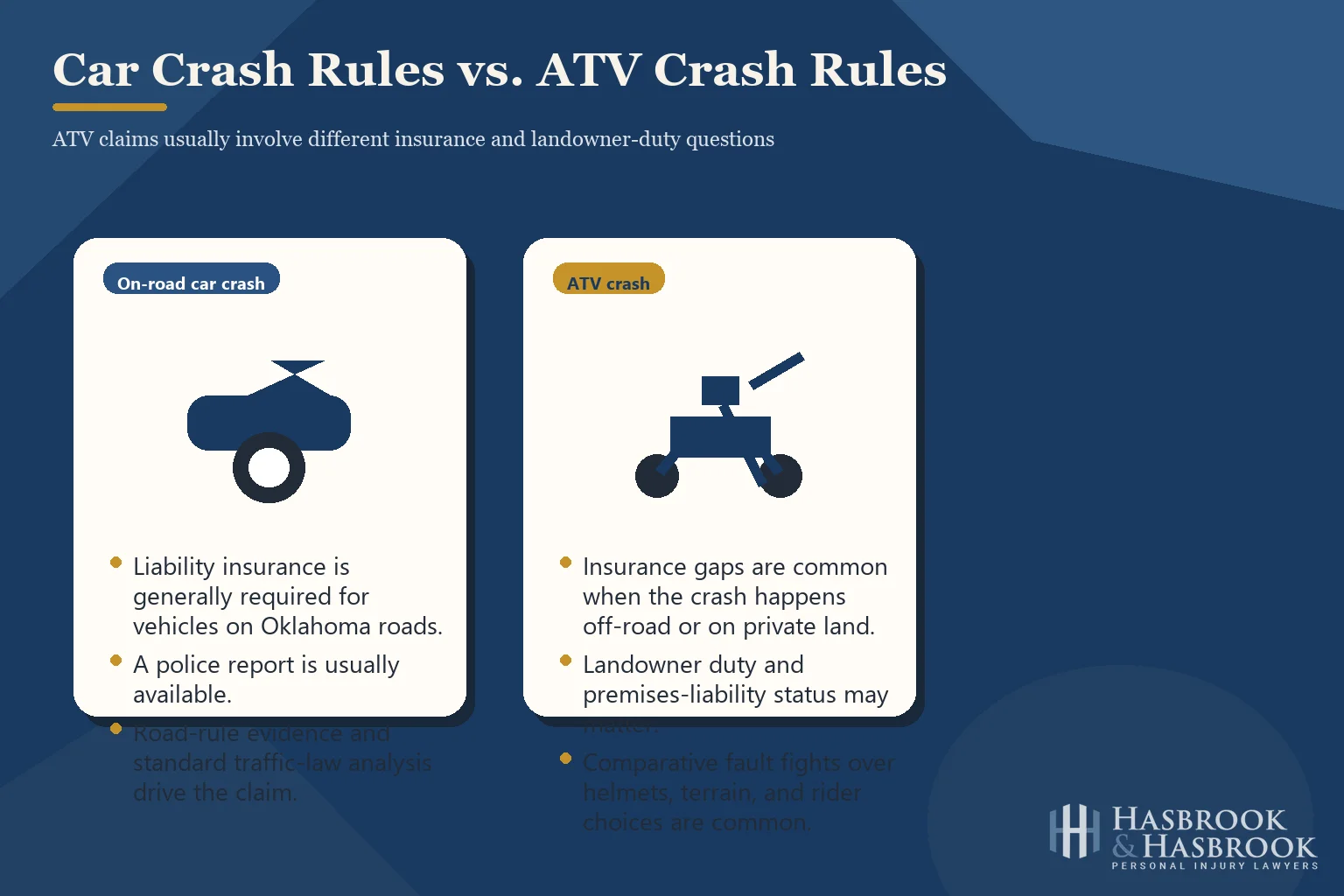
Most car accidents on Oklahoma roads involve a clear mandatory insurance framework, a police report, and established fault-assignment procedures. ATV accidents on private property or recreational trails often involve none of those.
Under 47 O.S. § 7-601, Oklahoma’s compulsory liability insurance requirement applies to motor vehicles operated on public roads and highways. Most ATVs are not operated primarily on public roads, which means the at-fault rider may have no liability insurance at all. The injured person’s own coverage, including homeowner’s policies, umbrella policies, and uninsured motorist coverage, often becomes the primary source of recovery.
Liability itself can also be more complicated. When a crash happens on private land, the landowner’s duty of care to the injured person depends on whether they were an invitee, licensee, or trespasser under Oklahoma premises liability law. When a child is hurt because an ATV was left accessible on a neighbor’s property, the attractive nuisance doctrine may apply. When two riders collide on a public trail at a state park, the State of Oklahoma’s sovereign immunity rules under 76 O.S. § 1 and the Oklahoma Governmental Tort Claims Act may come into play. Each of these situations requires a different legal approach.
Insurance gaps in Oklahoma ATV accident claims
The most common surprise after an ATV crash is discovering that the at-fault party has no liability coverage that applies. Here is how coverage typically works, and where it falls short:
The at-fault rider’s homeowner’s or renter’s policy
Some homeowner’s and renter’s policies include limited liability coverage for recreational vehicles used on the insured’s property. Whether coverage exists depends on the specific policy language and where the accident happened. Off-premises coverage is often excluded, and many policies exclude motorized vehicles entirely unless they are designed for use solely on private property.
Your own uninsured motorist coverage
If you carry uninsured motorist (UM) or underinsured motorist (UIM) coverage on a vehicle insured in Oklahoma, that coverage may apply to serious injuries even when the at-fault party is on an ATV rather than a car. Under 36 O.S. § 3636, Oklahoma requires insurers to offer UM/UIM coverage, and whether it extends to ATV accidents turns on your specific policy terms. An attorney can review your policy and identify every available coverage source.
Umbrella policies and specialty ATV coverage
Some ATV owners carry specialty off-road vehicle insurance, which can cover liability for injuries to others. Personal umbrella policies may also provide a layer of coverage above homeowner’s or auto limits. Identifying all potentially applicable policies is one of the first steps in any ATV injury case.
If you are unsure what coverage applies to your situation, our page on car and motor vehicle accident claims explains how Oklahoma’s insurance framework works generally, and we can review your specific policies in a free consultation.
Landowner liability and attractive nuisance in ATV accidents
If you were hurt on someone else’s property, that landowner may share responsibility depending on how you came to be there and what condition the property was in.
Oklahoma law categorizes people who enter land differently. An invitee (someone invited onto land for the owner’s benefit, such as a paying customer or a guest at an organized trail event) is owed the highest standard of care: the landowner must inspect for hazards and warn of known dangers. A licensee (someone permitted to be there, such as a friend given access to ride) is owed a duty to warn of known dangers but not to inspect. A trespasser is generally owed only a duty to avoid willful or wanton injury.
Attractive nuisance and children on rural property
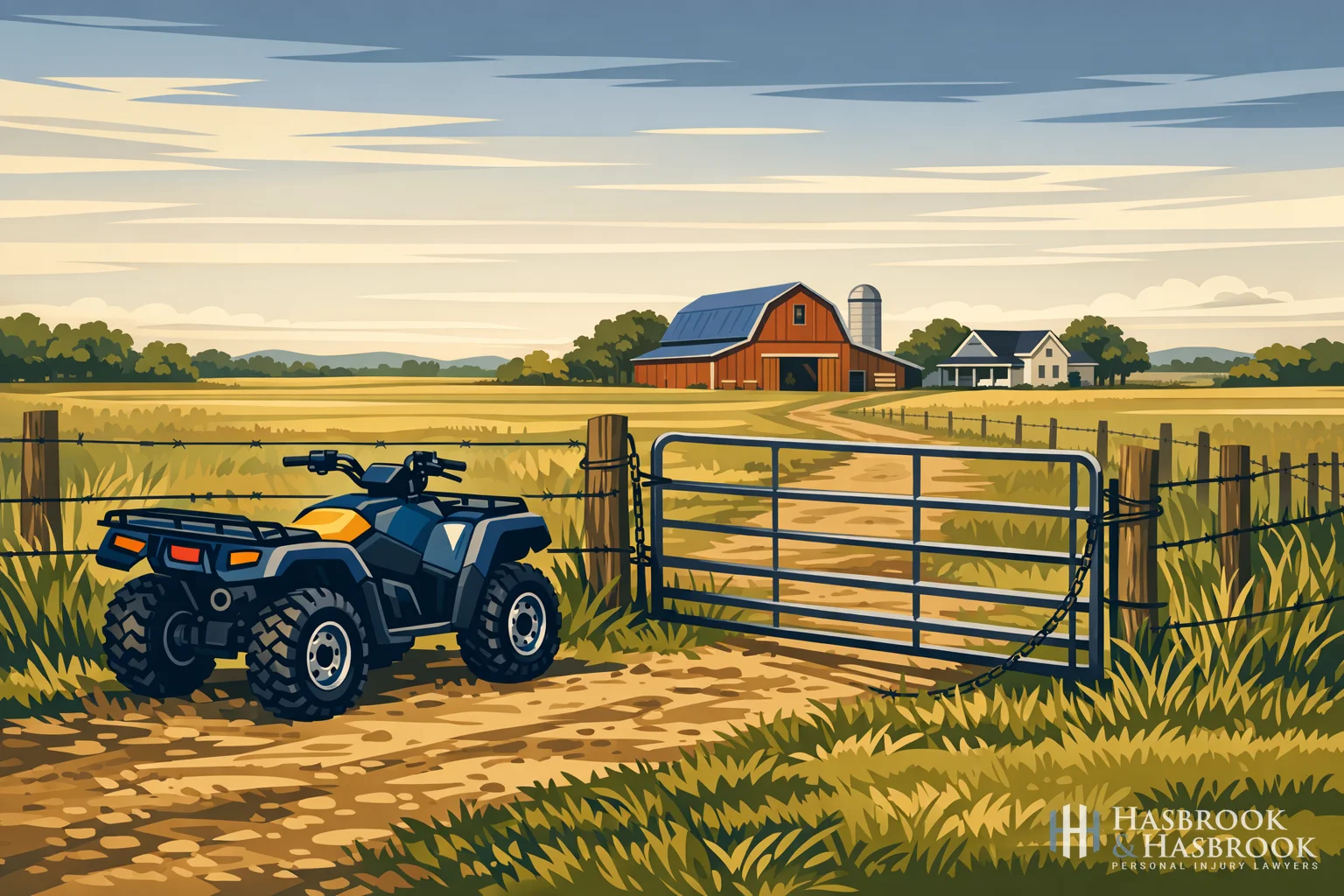
When a child enters property and is hurt by an unsecured ATV, the attractive nuisance doctrine can override the standard trespasser rule. Oklahoma courts have recognized that when a landowner leaves equipment that is likely to attract and endanger children accessible without precautions, liability may follow. An ATV left unattended, unlocked, and accessible near a fence line on a farm or hunting property is the kind of situation where this doctrine becomes relevant.
Leased hunting grounds, family farms, and rural recreational properties all present scenarios where landowner liability analysis matters. If a child in your family was hurt on a neighboring property because an ATV was left unsecured, this may be an avenue worth exploring with an attorney.


Public trail and state park ATV crashes in Oklahoma
Oklahoma has several popular ATV and off-road riding areas, including Little Sahara State Park near Waynoka and the Robbers Cave area. Crashes in these locations involve a different liability analysis than private-property accidents.
Claims against Oklahoma state agencies are governed by the Oklahoma Governmental Tort Claims Act (GTCA). Under 51 O.S. § 154, the GTCA imposes statutory caps on damages: generally $175,000 per claimant for claims against the State of Oklahoma or larger political subdivisions, $125,000 per claimant for most other political subdivisions, and a $1 million ceiling for any single occurrence. Property-only loss claims have a separate $25,000 limit. Trail design, inadequate warnings, and maintenance failures can still support claims against state agencies, but the process differs meaningfully from a standard personal injury lawsuit. If your crash happened at a state-operated facility, contact an attorney promptly, because the notice deadline under the GTCA is shorter than the standard two-year personal injury deadline.
Crashes on federally managed land in Oklahoma involve federal rules that may preempt state law on certain issues. In both cases, the immediate steps after the accident, including documenting the scene, reporting the crash, and getting medical care, matter as much as they do in any other injury case.
Common ATV injuries and why they lead to serious claims
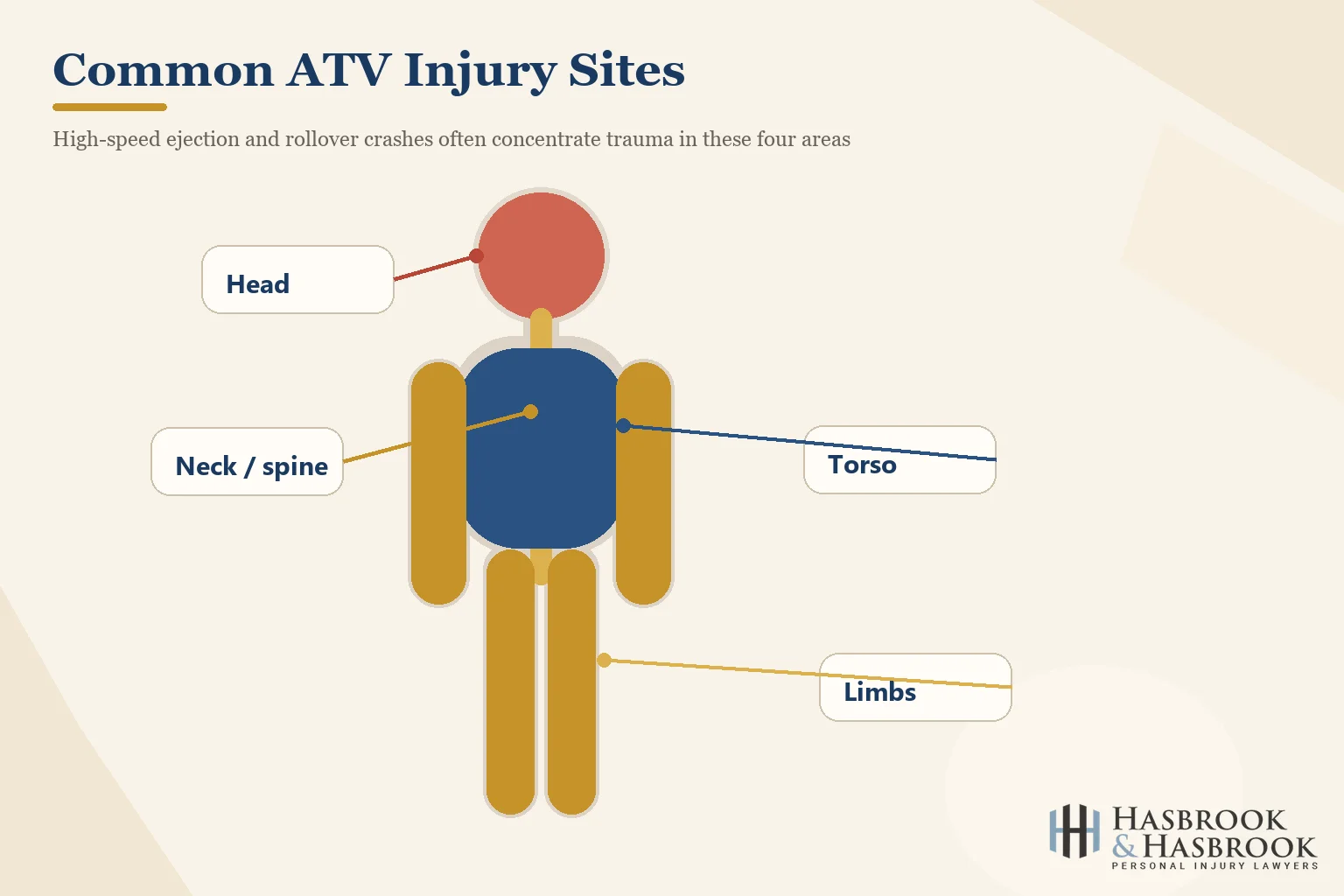
ATVs are designed to handle rough terrain at speed, with limited occupant protection. The injury patterns they produce are frequently severe:
- Ejection injuries. ATVs have no seatbelts or enclosed cab. Ejection in a rollover or sudden stop throws riders clear of the vehicle, often with no protective equipment. Head, neck, and spinal injuries are common results.
- Rollover crush injuries. Side-by-side UTVs and some ATV models can roll onto a rider, causing crush injuries to the chest, pelvis, and lower extremities.
- Traumatic brain injury (TBI). Oklahoma does not require adult ATV riders to wear helmets. Riders who go helmetless face a significantly higher risk of serious TBI in any crash, ranging from concussion to severe diffuse axonal injury. The absence of a helmet becomes a comparative fault issue, discussed below.
- Spinal cord injuries. High-speed rollovers and direct impacts cause cervical and thoracic spinal cord injuries, including quadriplegia and paraplegia. Our Oklahoma spinal cord injury page covers the lifetime cost framework for these cases.
- Internal organ injuries. Blunt abdominal trauma from handlebars, ground impact, or rollover crush can cause spleen lacerations, liver injuries, and internal bleeding that require emergency surgery.
- Fractures and orthopedic injuries. Arm and leg fractures, pelvis fractures, and hip injuries are common, particularly in ejection scenarios.
When ATV injuries are catastrophic, the damages framework changes substantially. Life care plans, vocational impact assessments, and medical economists become part of the case. Our catastrophic injury page covers how these cases are built and valued. Cases where someone died from ATV injuries involve Oklahoma’s wrongful death statute; our wrongful death attorney page explains who can file and what can be recovered.
Helmet non-use, intoxication, and Oklahoma comparative fault in ATV cases
Oklahoma’s comparative fault rule under 23 O.S. § 13 applies to ATV injury claims. If you are found more than 50 percent at fault for your own injuries, you cannot recover anything. If your share of fault is 50 percent or less, your recovery is reduced by your fault percentage. More detail is on our comparative fault page.
Several ATV-specific factors commonly affect comparative fault assignments:
Helmet non-use
Because Oklahoma does not require adult riders to wear helmets, the defense will often argue that an unhelmeted rider assumed the risk of head injury. Whether this argument succeeds and how much it reduces recovery depends on the specific facts: the severity of the crash, the type of injuries sustained, and whether a helmet would have made a material difference. Courts and adjusters will press this point. Having an attorney respond to it early, before the fault narrative is set in the insurer’s file, matters.
Intoxication
Alcohol and drug use raises fault percentage substantially. If a toxicology report shows impairment, the defense will argue that intoxication was a cause of the crash. This does not automatically bar recovery if the other party was also at fault, but it changes the negotiation.
Terrain and speed decisions
Riding in conditions beyond a rider’s skill level, choosing to ride terrain marked as closed or dangerous, or exceeding safe speeds for the terrain are all factored into comparative fault analysis. Insurance adjusters regularly point to rider behavior to reduce the payout, even in cases where vehicle defects or property conditions were the more significant cause.
An attorney’s job in a comparative fault case is to present the most accurate picture of what each party contributed to the crash, not to accept the insurer’s assignment. If the other rider, the landowner, or a vehicle manufacturer bears significant responsibility, that needs to be established with evidence before any settlement offer is evaluated.

Oklahoma statute of limitations for ATV accident claims
Under 12 O.S. § 95, the standard deadline to file a personal injury lawsuit in Oklahoma is two years from the date of the crash. Missing this deadline typically bars recovery entirely, regardless of how strong the underlying claim is.
Important exceptions apply:
- Minors. The limitations period is generally tolled (paused) while an injured person is under 18. The clock typically starts when the person turns 18.
- Government claims. If your claim is against the State of Oklahoma or a state agency (a state park, for example), the GTCA requires written notice within one year of the injury date. Under 51 O.S. § 157, the governmental entity then has 90 days to approve or deny the claim. If the claim is denied (including by the entity’s failure to act within 90 days), the claimant has 180 days from denial to file suit. Acting promptly is critical.
- Discovery rule. For injuries that were not immediately apparent, Oklahoma recognizes a discovery rule that starts the clock when the injury was or reasonably should have been discovered. This is fact-specific.
Do not wait until the deadline approaches to consult an attorney. Evidence becomes harder to gather, witnesses’ memories fade, and insurance companies’ positions become entrenched the longer the delay.
What you can recover in an Oklahoma ATV accident claim
Oklahoma law allows recovery for the full scope of losses caused by someone else’s negligence. In ATV accident cases, recoverable damages typically include:
- Past and future medical expenses, including emergency care, surgery, rehabilitation, and ongoing treatment
- Lost wages and lost future earning capacity
- Pain and suffering, both physical and emotional
- Permanent disability or disfigurement
- Home modification costs if injuries require wheelchair access or other adaptations
- Life care plan costs for catastrophic injuries (attendant care, equipment, future medical needs)
Oklahoma’s damages cap under 23 O.S. § 61.3 limits noneconomic damages (pain, suffering, disfigurement) to $500,000 in most personal injury cases (effective September 2025; this cap has not yet been tested by the Oklahoma Supreme Court). This cap does not apply to economic damages (medical bills, lost wages, life care costs) and does not apply in cases involving gross negligence, reckless disregard, or intentional conduct. Permanent and severe physical injuries (such as catastrophic ATV crash injuries) may also fall within statutory exceptions to the cap. In serious cases, the economic damages alone can far exceed the noneconomic cap, making the cap less determinative than it might initially appear.
For cases involving TBI, our Oklahoma brain injury lawyer page covers how traumatic brain injury cases are documented and valued.
Frequently asked questions about Oklahoma ATV accident cases
Can I sue if I was hurt on someone else’s property while riding their ATV?
Yes. Your ability to recover depends on your status on the property (invitee, licensee, or trespasser) and whether the landowner breached the duty owed to you. If you were invited onto the property and the landowner failed to warn you of a known hazard, or if the ATV itself had a defect the owner knew about, you may have a strong claim. The analysis is fact-specific, but being on someone else’s land does not bar recovery.
Does it matter that I was not wearing a helmet?
It matters, but it does not necessarily bar your recovery. Under 23 O.S. § 13, Oklahoma uses a modified comparative fault system. If your share of fault, including not wearing a helmet, is found to be 50 percent or less, you can still recover. The defense will argue that helmet non-use increased the severity of your head injuries, and a court may assign some percentage of fault to that decision. An attorney can challenge whether the lack of a helmet was actually a contributing cause of your specific injuries.
What if the ATV had a mechanical defect that caused the crash?
Product liability is a separate theory that may apply alongside or instead of a negligence claim. If a defect in the ATV’s steering, braking system, or design caused or contributed to the crash, the manufacturer or seller may be liable. These cases typically require expert analysis of the vehicle. Preserve the ATV in its post-crash condition if at all possible, and do not allow anyone to repair it before an attorney and expert inspect it.
How is an ATV accident case different if a child was hurt?
Children who are hurt on ATVs, whether riding themselves or as passengers, present specific legal issues. Under 47 O.S. § 11-1117, persons under 18 must wear a federally compliant crash helmet when operating or riding an ATV on public lands; the helmet requirement does not apply on privately owned property. If a child rode without adult supervision on a machine not designed for their age or size, the analysis shifts to who provided access and whether they acted reasonably. The attractive nuisance doctrine, discussed above, may apply if a neighbor’s or property owner’s unsecured ATV caused the injury. The statute of limitations is also tolled until the child turns 18.
How soon after an ATV accident should I contact a lawyer?
As soon as possible after getting medical care. Evidence from the crash scene deteriorates quickly, especially on rural property. The ATV itself should be preserved. Witnesses should be identified before memories fade. If a government entity may be responsible, the pre-suit notice deadline is much shorter than two years. The practical difference between calling an attorney in the first week versus the first year can be significant for the strength of your case.
What if I was hurt as a passenger on someone else’s ATV?
Passengers on ATVs face the same insurance coverage gaps as operators. If you were a passenger and the operator’s negligence (or someone else’s) caused your injuries, you generally have a claim. Under 47 O.S. § 11-1117, it is unlawful for an ATV operator to carry a passenger unless the ATV was specifically designed by the manufacturer to carry passengers in addition to the operator. Riding as an unauthorized passenger does not bar your claim, but it can become a comparative fault issue. The available recovery sources are the same: the operator’s homeowner’s or specialty policy, your own UM/UIM coverage, and any landowner or manufacturer that bears responsibility.
What insurance applies if neither the at-fault rider nor I had ATV-specific insurance?
This is the most common scenario. Possible coverage sources include: the at-fault rider’s homeowner’s or renter’s policy if it covers off-premises recreational vehicle use; your own auto policy’s uninsured motorist (UM) and underinsured motorist (UIM) coverage, depending on policy terms and how the carrier treats ATV crashes under 36 O.S. § 3636; a personal umbrella policy; medical payments coverage on a homeowner’s policy if applicable; and health insurance for medical bills (with potential subrogation rights). An attorney can review every available policy with you to identify all sources of recovery before negotiating with any of them.
Can I sue the property owner if a poorly maintained trail caused my crash?
It depends on your status on the property and the nature of the hazard. If you were an invitee at an organized event or commercial trail facility, the landowner had a duty to inspect for and warn of known hazards. If you were a licensee (a friend riding with permission), the duty is to warn of known dangers. If you were a trespasser, the duty is generally limited to avoiding willful or wanton injury, with a heightened duty for foreseeable child trespassers under the attractive nuisance doctrine. Whether a poorly maintained trail supports a claim turns on whether the owner knew or should have known of the hazard and what your status on the property was when the crash occurred.

Talk to an Oklahoma ATV accident lawyer about your case
Hasbrook & Hasbrook handles ATV and off-road vehicle accident cases across Oklahoma. We work on a contingency basis, meaning you pay nothing unless we recover for you. We review your insurance coverage, identify every potentially liable party, and build the case for the full value of your injuries.
Call (405) 605-2426 or contact us online to schedule a free consultation.