The driver qualification file is the single most useful document set in a commercial truck case. It tells you whether the carrier vetted the driver, whether the medical certification was current on the loss date, whether prior-employment investigations surfaced disqualifying history the carrier ignored, and whether annual reviews of the driving record were actually performed. A precise file-request list and a timely preservation letter are the difference between getting the complete federal-mandated record and receiving a sanitized printout. This checklist covers the 49 CFR § 391 DQ file requirements, the document-by-document request list, litigation use, and preservation timing.
What is a Driver Qualification File and who must keep one
A driver qualification file is the federally mandated personnel record a motor carrier must maintain on every commercial driver who operates a commercial motor vehicle in interstate commerce. The requirements live in 49 CFR Part 391, with contents enumerated at § 391.51. The carrier, not the driver, is the records custodian. Any motor carrier operating a vehicle that meets the FMCSA CMV thresholds (10,001-pound GVWR for interstate non-hazmat, or any placardable hazmat vehicle) must maintain the file from hire through three years past separation.
The requirement applies to owner-operators leased to a carrier the same way it applies to W-2 employees. A common defense theory is that the driver was an independent contractor and the carrier had no duty to vet him, but the regulation cuts through that argument: regardless of employment status, the carrier remains responsible for the file, and noncompliance is admissible on negligent-entrustment and negligent-hiring theories. Hasbrook & Hasbrook Personal Injury Lawyers approach commercial truck cases on this premise. For background, see our Oklahoma City truck accident lawyer page and the FAQ on whether you sue the trucking company or just the driver.
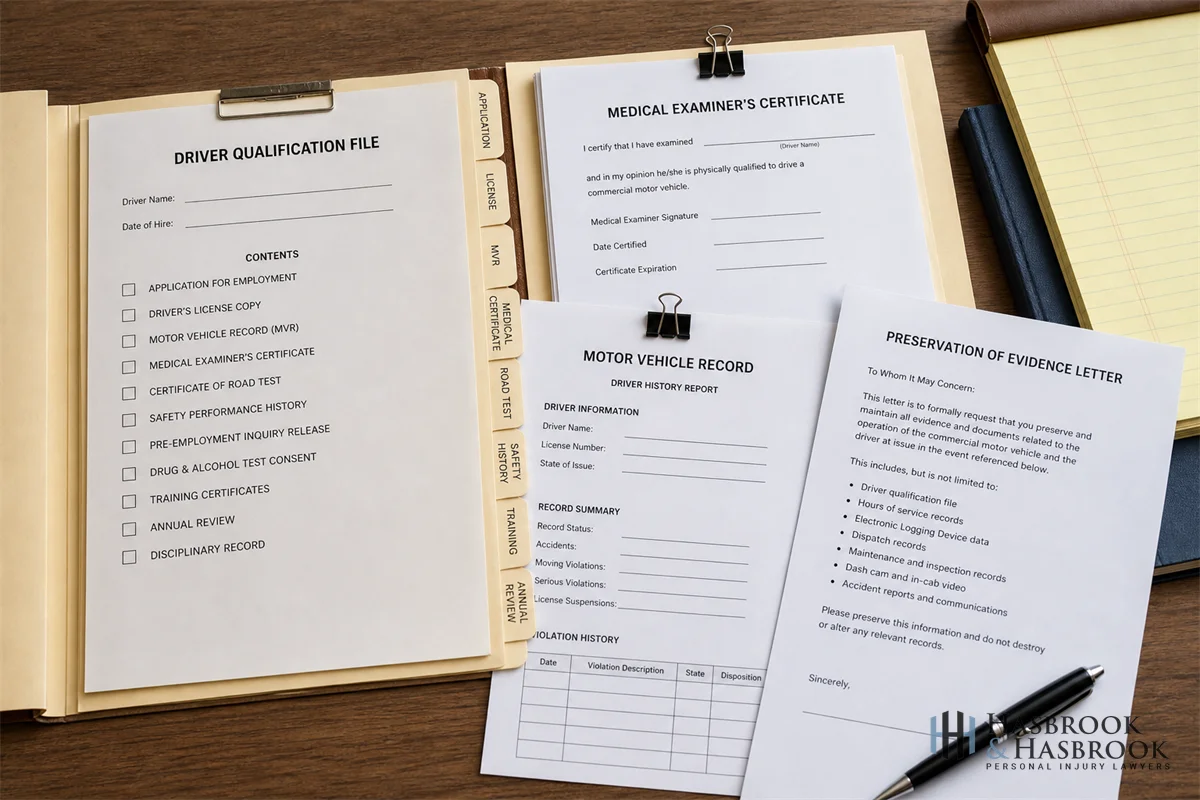
The Driver Qualification File document checklist
The required contents under 49 CFR § 391.51 fall into ten document categories. Demand each by category in your preservation letter and document request:
- Driver’s application for employment (§ 391.21). Signed application with ten years of CMV-driving history and three years of non-CMV employment. Gaps, terminations, and accident history must be disclosed; falsification is itself a regulatory violation under § 391.23 and a powerful impeachment tool.
- Inquiry to previous employers (§ 391.23). The carrier must request safety performance history from every DOT-regulated employer in the prior three years. The records and documentation of inquiries (including non-responses) must be in the file. Missing or perfunctory inquiries are the heart of most negligent-hiring cases.
- Initial motor vehicle record (§ 391.23(a)(1)). Pre-hire MVR from every state where the driver held a license in the prior three years. Compare against what the application disclosed.
- Annual motor vehicle record (§ 391.25). Updated MVR annually plus the carrier’s documented review for disqualifying offenses.
- Annual driver’s certification of violations (§ 391.27). Driver self-reports all moving violations annually. Compare against the annual MVR; discrepancies are evidentiary gold.
- Medical examiner’s certificate (§ 391.41 to § 391.49). Medical card current on every driving date in the loss period. The file should include the long-form medical examination report (form MCSA-5875), not just the wallet card.
- Road test certificate or equivalent (§ 391.31, § 391.33). Signed road test certificate or a valid CDL from a state with comparable testing. Many carriers use the CDL substitute and never administer their own road test.
- Drug and alcohol testing records (§ 382 series). Pre-employment, post-accident, random, reasonable-suspicion, return-to-duty, and follow-up testing records under 49 CFR Part 382. The Clearinghouse query record under § 382.701 must show the carrier ran a pre-employment full query.
- Disclosure and authorization forms (§ 391.21(b)(11)). Signed forms authorizing the carrier to request driving records, prior-employment safety histories, and Clearinghouse access.
- Entry-level driver training certificate (§ 380 series). For drivers who obtained their CDL after February 7, 2022, proof of completion from a registered provider on the FMCSA Training Provider Registry.
For drivers separated from the carrier before the loss date, the file must still be retained for three years from separation. A carrier that destroyed the file before the three-year mark has a regulatory problem regardless of what the file would have shown.



Pre-employment safety performance history: the document the carrier least wants to produce
The § 391.23 safety performance history is where most negligent-hiring cases are won. The regulation requires the prospective employer to investigate, in writing, every prior DOT-regulated employer for the past three years. The investigation must request accident register information, drug and alcohol testing history, return-to-duty and follow-up testing results, and any reason for separation. The carrier must document the request, the response, and any non-responses.
What you typically find in discovery: an investigation that was either never conducted, conducted on only one of three prior employers, or conducted but disclosing prior accidents, failed drug screens, or return-to-duty obligations the hiring carrier ignored. Each omission is a discrete negligent-hiring fact. A carrier that hired a driver after receiving a prior-employer report of an at-fault commercial collision in the past three years has a serious problem at trial. Make this a separate line item in the preservation letter and demand the inquiry letters, the responses, the non-response documentation, and any internal correspondence on how the information was reviewed. For broader Oklahoma carrier liability theories, see how fault is allocated in a truck accident case.
Medical certification: the wallet card versus the long form
A common defense production error is providing only the medical examiner’s certificate (the wallet card) and treating it as the complete medical-qualification record. The wallet card is a summary. The full record is the long-form medical examination report (form MCSA-5875), which captures medical history, examination findings, and any conditions the driver disclosed. Disqualifying or marginally qualifying conditions appear on the long form even when the examiner ultimately certified the driver: sleep apnea risk factors, uncontrolled hypertension at exam, vision and hearing thresholds, prescription medications with driving warnings, and prior cardiovascular events all show up there. Demand the long form by name, not the certificate. If the driver was certified with a Skill Performance Evaluation or a Vision Exemption, demand those records from the National Registry of Certified Medical Examiners. The physical qualification regulations are at 49 CFR § 391.41; the FMCSA medical fitness for duty page is the policy touchstone.
MVR review, certification of violations, and Clearinghouse queries
Each year the carrier must obtain a fresh MVR from every state where the driver holds or held a license, review it for disqualifying offenses under § 391.15, and document the review. The driver must separately certify all moving violations from the prior twelve months under § 391.27. Three failure modes recur: (1) the MVR shows offenses the driver did not self-report, (2) the annual review was never performed and the file contains only the MVR with no signed review, or (3) the MVR shows disqualifying offenses and the carrier kept the driver on the road anyway. Any of these supports negligent-supervision and negligent-retention theories. For the regulatory categories, the FMCSA serious traffic violation list is the touchstone.
Cross-reference the DQ file with the carrier’s drug and alcohol testing records under 49 CFR Part 382. The FMCSA Clearinghouse, operational since January 2020, records every positive test, refusal, return-to-duty determination, and follow-up completion for CDL holders. Under § 382.701, the carrier must run a full pre-employment query and an annual limited query thereafter. A carrier that skipped the pre-employment query has violated the regulation; one that ran the query, received a Drug-and-Alcohol-Program-Violation flag, and hired the driver anyway has a bigger problem. Demand the Clearinghouse records as a separate line item.


Litigation use: how the DQ file maps onto liability theories
| DQ file gap or violation | Liability theory it supports | Typical defense response |
|---|---|---|
| Missing or incomplete prior-employer inquiries (§ 391.23) | Negligent hiring | Driver had clean record; no further inquiry needed |
| No initial or annual MVR review (§ 391.25) | Negligent supervision and retention | Review was performed but documentation was lost |
| Expired or backdated medical certificate (§ 391.41) | Negligent entrustment and per se negligence | Driver was medically qualified in fact even if paperwork lapsed |
| Missing road test or CDL substitute (§ 391.31, § 391.33) | Negligent hiring (qualification failure) | CDL satisfies road test; no separate test required |
| No pre-employment Clearinghouse full query (§ 382.701) | Negligent hiring (regulatory violation) | Query was run; record is not in produced file |
| Disqualifying offense on MVR with continued employment (§ 391.15) | Negligent retention | Offense did not actually disqualify under the regulation |
Each row is a distinct evidentiary path. A single case can support several rows simultaneously, and stacking them at trial is far more persuasive than relying on one regulatory violation. The negligent-entrustment theory deserves separate emphasis because it survives the carrier’s typical strategy of admitting respondeat superior to keep negligent-hiring evidence out. When the carrier admits agency, defense will argue any direct claim against the employer is duplicative. The countering position is that negligent entrustment requires proof of the carrier’s specific knowledge of the driver’s incompetence, and the DQ file gaps go directly to that element regardless of agency admission. For the broader picture, see preserving the trucking evidence early and the explainer on the ELD and engine control module records.
Preservation letter timing and what to demand
The DQ preservation letter goes out within five business days of retention. Send it certified, return-receipt requested, with an electronic copy to any known claims adjuster. Time matters because § 391.51 retention windows are running, the driver may separate and trigger a different retention clock, and routine business-records destruction can sweep through related files (training, dispatch, route assignments) that fall outside the DQ requirement but bear on the case.
The preservation letter should demand:
- The complete DQ file under 49 CFR § 391.51, with each item enumerated by category and regulatory citation
- The long-form medical examination report (MCSA-5875), not only the medical certificate
- All Part 382 drug and alcohol testing records
- All FMCSA Clearinghouse query records, including the date and result of every query
- All training records under Part 380, including any entry-level driver training certificate and any post-hire safety training documentation
- All dispatch and trip records for the loss date and the seven preceding days
- All Hours of Service records (electronic logging device data and any paper logs) under § 395
- The carrier’s written safety policies, driver handbook, and any disciplinary records for the subject driver
Send a parallel preservation letter to the named insurer if known. The claims file will eventually contain the carrier’s internal investigation, including reports from accident reconstructionists or safety-compliance consultants retained at first notice. For the broader preservation framework in Oklahoma PI matters, see the section-by-section template our firm uses for pre-suit demands and the related evidence preservation checklist for premises cases.
DOT audit findings and what they reveal
FMCSA compliance review and Oklahoma Corporation Commission audit findings often disclose pre-existing gaps in the carrier’s DQ system. If the carrier was cited for missing or incomplete DQ files in a recent review, that is direct evidence the carrier knew the system was deficient and continued operating. SAFER snapshot data and BASIC scores under the Compliance, Safety, Accountability program are public; the carrier’s record from FMCSA’s SAFER system often shows whether the driver’s issues were part of a roster-wide pattern. If a recent audit produced a downgraded safety rating or specific DQ violations, depose the safety director on the corrective action taken; the plan filed with FMCSA becomes an admission of the prior deficiency, and any uncorrected deficiency at the loss date is a discrete supervisory failure.

Discovery sanctions and putting the file to work
When the carrier produces an incomplete file or cannot reproduce one because records were destroyed before the three-year retention period elapsed, remedies under Oklahoma practice run through 12 O.S. § 3237. Available sanctions include adverse-inference jury instructions, issue preclusion on negligent-hiring or supervision claims, and in severe cases default judgment on liability. Strength depends on whether litigation was reasonably anticipated when records were destroyed and whether the destruction violated the carrier’s own policy or the federal three-year rule. Build the spoliation record in the preservation letter, discovery requests, and deposition questioning. Ask the safety director when DQ files for separated drivers are destroyed, by whom, and on what authority; ask whether a litigation hold was placed on this driver’s file, when, and by whom. Where the carrier cannot produce a § 391.51 category, note the gap by regulatory citation and pursue a sanctions motion at the close of discovery rather than at trial. The Oklahoma PI statute of limitations is two years under 12 O.S. § 95, but DQ retention windows may close earlier; on a late-discovered defendant or delayed-onset injury, the file for a separated driver may already be gone.
Once the file arrives, work it before scheduling the driver deposition. Build a timeline overlaying each application disclosure, each MVR, each annual certification of violations, each medical certification, and each training record against the loss date. Write the deposition outline so the driver is asked about each disclosure he signed under penalty of perjury and each gap he is positioned to explain. Ask the same questions of the safety director and the recruiter at corporate depositions to surface carrier-side knowledge. In a serious commercial trucking case, the DQ file is the document set most likely to convert the carrier from a respondeat-superior-only defendant into a direct-negligence defendant. At our firm, the DQ request is one of the first written instruments out the door after retention. For sibling resources, see wide-right-turn collisions and carrier liability, rear and side underride crashes in Oklahoma, and the FAQ on penalties for hours-of-service violations. The closing point is operational: a vague “all records” demand invites a sanitized production; a category-by-category demand keyed to § 391.51 leaves the carrier nowhere to hide.