A slip-and-fall case lives or dies on what gets preserved before defense counsel deploys a litigation hold of its own. Surveillance footage overwrites on rolling cycles. Maintenance logs get amended. Witnesses scatter within weeks. Sweep logs that can prove or disprove constructive notice end up in back-office files that cannot be located by the time discovery opens. The practical difference between a case that settles at value and one that fails on constructive notice grounds often comes down to whether a preservation letter went out within the first week of retention. This checklist covers what to secure, how to secure it, and the spoliation-letter mechanics that protect your client’s evidentiary record from the start.
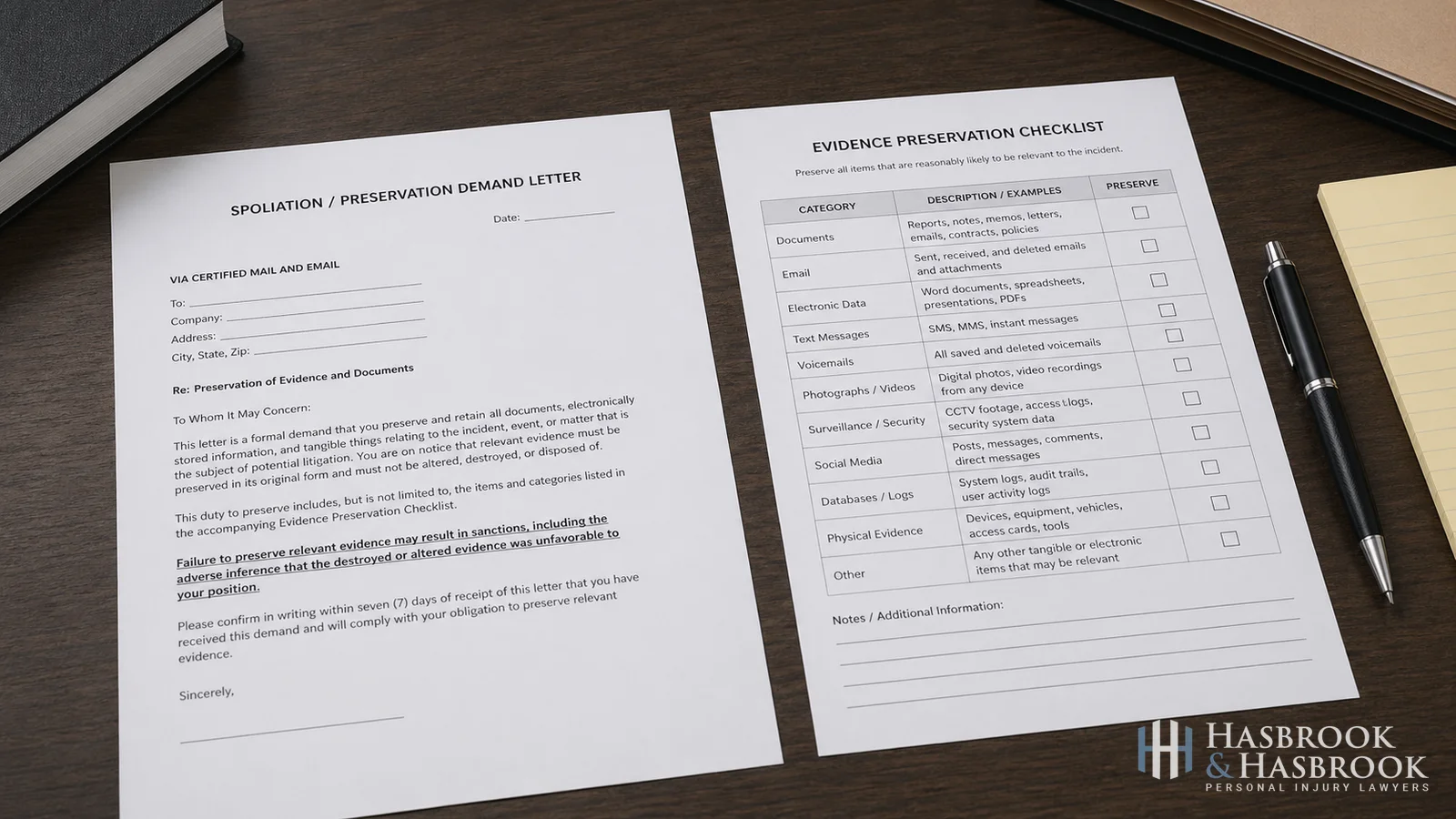
Why preservation is the first priority in a premises liability case
The property owner has a structural evidentiary advantage. It controls the surveillance system, the maintenance log, the incident report, and the employment records of every person who inspected the floor that day. An Oklahoma City premises liability attorney representing an invitee must show the owner knew or should have known about the hazard. The documents that prove or disprove notice sit entirely on the defendant’s side of the table. The quicker you move to freeze those records, the more leverage your client has. Waiting for formal discovery means the most valuable evidence may already be gone under routine-overwrite schedules or a deliberate litigation purge.



First steps after a premises liability event in Oklahoma City
Before drafting a preservation demand, walk your client through these questions in the first intake call:
- Date, time, and exact location of the fall (aisle number, entrance, parking lot zone)
- Whether the client reported the fall to an employee at the scene
- Whether an incident report was completed and whether the client received a copy
- Names and contact information for any witnesses who stopped
- Photographs taken before leaving the premises (full-frame and close-up of the hazard, footwear, and the surrounding area)
- Whether the client received medical treatment the same day
Witnesses are especially time-sensitive. A bystander who gave your client a name and phone number at the scene may be unreachable within 60 days. Take witness statements as early as possible, preferably within the first week of retention, while recollection of the hazard and scene conditions is still fresh. Whether witnesses will be material to a slip-and-fall claim depends on what the surveillance footage and sweep logs show, but treat them as a priority until you know.
Clients injured in a fall rarely document the scene the way a lawyer would. A focused intake call gives you the factual foundation for a targeted preservation demand. For a complete intake workflow, see the Slip-and-Fall Intake Checklist and the Premises Liability Intake Checklist.
Essential evidence in a slip-and-fall claim
A premises liability claim rests on four evidentiary pillars: the condition of the hazard, the owner’s knowledge of it, the owner’s failure to address it, and the causal connection to your client’s injuries. Each pillar requires specific evidence.
Hazard condition: Photographs showing the defect (wet floor, broken tile, torn carpet, uneven pavement). Maintenance and repair logs showing the defect existed before the fall. Prior incident reports for the same location or area.
Owner’s knowledge: Sweep logs and inspection records documenting the inspection schedule and any noted defects. Employee statements about when the area was last checked. Surveillance footage showing the hazard present before the fall.
Failure to correct: Absence of warning signs or barriers in the hazard zone. Emails or internal communications referencing the condition. Work orders issued but never executed.
Causation: Medical records linking the injury to the type of fall and impact pattern. Photographs of the client’s footwear showing it was appropriate for the surface conditions.
For the legal framework behind Oklahoma’s notice requirements, see the Notice-Proof Documentation Guide and notice proof in Oklahoma slip-and-fall cases.
Surveillance footage: the 30-day norm and what it actually means
Most commercial properties operate on a 30-day rolling overwrite cycle for their security camera systems. That figure is an industry norm, not an Oklahoma legal requirement. Oklahoma has no statute mandating a specific retention period for private security footage. What matters in practice is that many retailers run shorter windows. Some grocery and big-box chains operate 7-to-14-day cycles on peripheral cameras and retain entrance or cash-register footage longer. Large retailers with active loss-prevention departments may hold footage flagged for incident reports for 90 days while routine footage overwrites in a week.
The only way to know your particular defendant’s policy is to demand it in the preservation letter and follow up in discovery. In high-traffic premises cases, do not assume 30 days is a safe window. Treat the footage as potentially gone within 7 days and draft your preservation letter accordingly. For the scope of what to request and how courts have addressed these records, see security camera footage in premises cases.


Understanding spoliation and when the duty to preserve arises
Spoliation is the loss, destruction, or material alteration of evidence a party knew or should have known would be relevant to pending or reasonably anticipated litigation. Oklahoma courts can sanction spoliation with adverse-inference jury instructions, issue preclusion, or dismissal in egregious cases. The defendant’s duty to preserve arises not at filing but at the moment litigation becomes reasonably anticipated. A written preservation letter from your office to the property owner and insurer is the clearest marker that litigation was anticipated. It sets a defined point in time after which any overwritten footage or missing sweep log becomes spoliation rather than routine records management.
For a candid look at the evidentiary obstacles these cases present when records are not preserved, see why slip-and-fall cases are hard to win.
Sending the spoliation letter: timing, recipients, and what to demand
This is the single most time-sensitive action item in a premises liability case.
Timing: The letter goes out within five business days of signing the client. Do not wait for the complaint to be filed or the demand letter to be ready. Surveillance footage does not pause for your drafting schedule.
Recipients: Send separate certified letters to each of the following:
- The on-site manager or general manager of the specific location where the fall occurred
- The corporate risk management or legal department of the property owner (chain or franchise)
- The commercial landlord or property owner if the tenant does not hold title
- Any known liability insurance carrier or claims adjuster identified in the incident report
If you have a claims number or adjuster contact, include a copy with that reference. Defense counsel appointed by the insurer will typically acknowledge the letter, but you want the property-side record to show direct notice was sent to the location itself. Follow certified mail with an email to the same recipients so you have a date-stamped electronic confirmation alongside the certified-mail green card.
What to demand: Generic “all documents related to the incident” language invites scope disputes. Identify records by category:
- All video footage from every camera covering the hazard location, entrance, and parking area, from 24 hours before through 4 hours after the fall
- All maintenance, sweep, and inspection logs for the 30 days preceding the fall
- All incident reports referencing the hazard area for the 12 months preceding the fall
- All emails, work orders, or internal communications referencing the hazard or the area
- All cleaning and repair schedules for the date in question
- The complete retention policy for each category of records requested
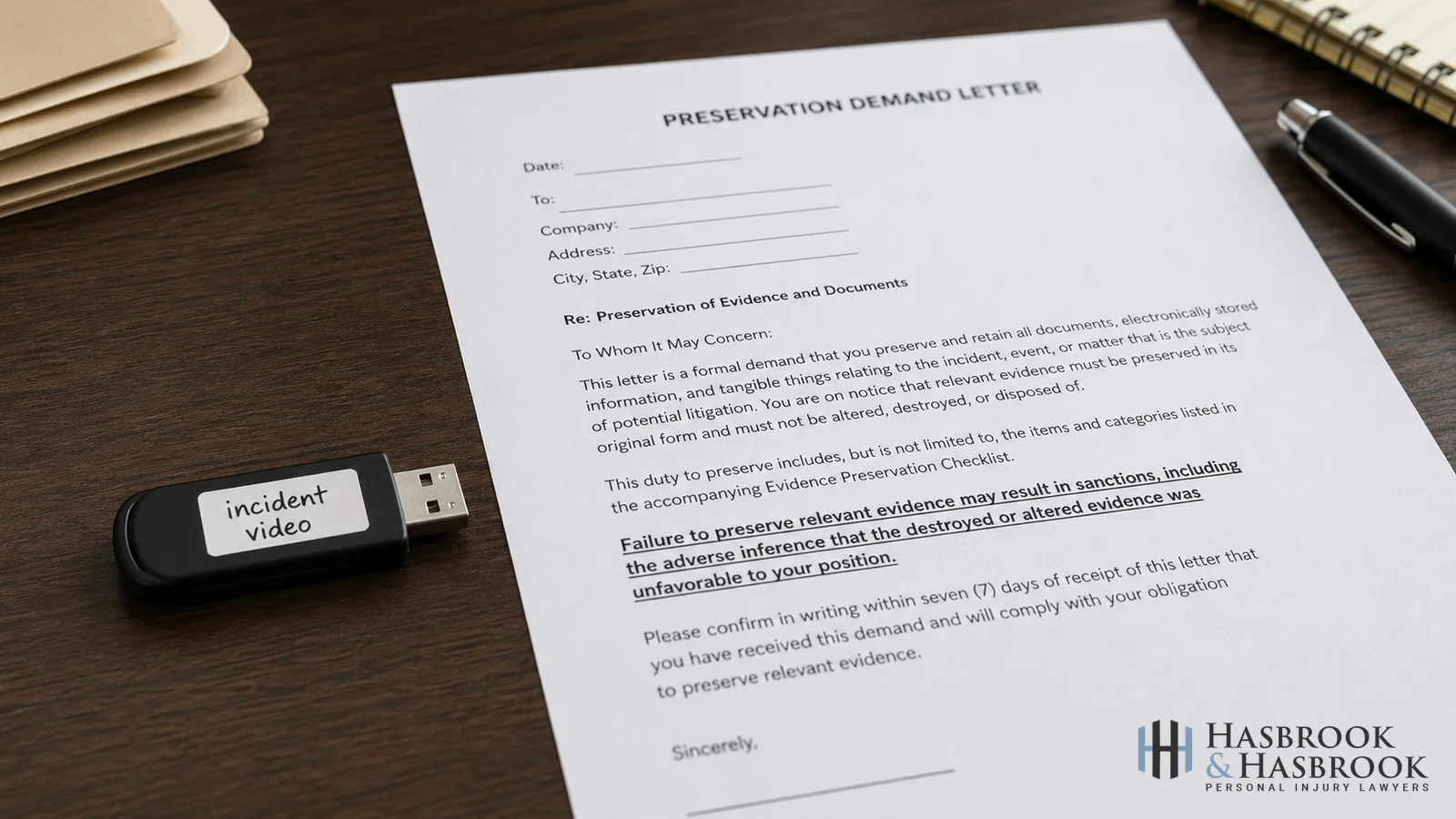
For the broader demand-letter framework used in Oklahoma PI claims, see the Demand Letter Structure guide.
Sweep logs and incident reports: the records that disappear first
Sweep logs are the property owner’s own contemporaneous record of whether anyone inspected the hazard area before your client fell. A log showing no inspection for two hours before a 2 p.m. fall in a grocery aisle can establish constructive notice without further argument. A log showing an inspection 15 minutes before the fall with no defect notation gives defense a reasonable-care argument. The log is one of the most probative documents in a premises case, and it is also among the most commonly unavailable by the time discovery opens.
Some stores maintain sweep logs electronically; others use paper. Staff turnover means the employee who signed the relevant entry may no longer be employed at that location. Demand the logs in your preservation letter and include a document-preservation instruction in your first discovery requests.
Incident reports present a parallel issue. Many stores create an internal incident report whenever a customer is injured on the property. Those reports sometimes contain admissions that appear nowhere else in the defendant’s records, including notations about the condition of the hazard and the names of employees who were informed. Request incident reports as a separate line item in your preservation letter, distinct from the sweep-log demand, to reduce the chance that a broad request is interpreted to cover only one category. For the legal standards Oklahoma courts apply to notice documentation, see how to prove the store had notice of the hazard.

Comparative fault and why a complete evidentiary record matters
Oklahoma follows a modified comparative fault framework under 23 O.S. § 13: your client recovers as long as their share of fault is less than 50%. Defense strategy in slip-and-fall cases typically involves pushing fault onto the plaintiff, arguing contributory inattention, inappropriate footwear, or familiarity with the hazard. A complete evidentiary record makes it significantly harder for defense to construct that narrative.
Surveillance footage showing how the fall occurred, witness statements about the scene conditions before the fall, and sweep logs confirming the absence of a recent inspection give you affirmative proof. Without that record, the defense argument is easier to build and harder to rebut at summary judgment. See how comparative fault plays out in Oklahoma slip-and-fall cases and what happens when a client asks whether being partially at fault for a fall bars their recovery.
The statute of limitations for a personal injury claim in Oklahoma is two years from the fall date under 12 O.S. § 95. Two years is a hard deadline, not a comfort margin. The evidence you need to win the case may be gone in the first two weeks. For edge-case tolling and discovery-rule arguments, see Oklahoma’s personal injury statute of limitations.
This checklist addresses the most time-sensitive evidentiary issues in a premises case. The preservation-letter mechanics and evidence categories above provide the framework for intake, pre-suit investigation, and early discovery planning. For the full damages and liability picture in these cases, see the Oklahoma City slip-and-fall attorney page.