our injury attorneys handle premises liability cases across Oklahoma City, and the single most common reason a strong slip-and-fall case collapses at summary judgment is notice. Not liability. Not damages. Notice. The store manager who cannot recall the last aisle inspection. The grocery chain whose surveillance tape overwrote in 48 hours. The defendant whose sole witness swears no employee saw the spill. If you cannot put paper behind the question “how did the property owner know about this hazard?” you are already fighting uphill.
This resource is written for attorneys handling cases in the slip-and-fall cluster. It covers the three notice theories available under Oklahoma premises law, the documentation each theory requires, and the steps you need in the first 48 hours to lock down evidence before it disappears.
What “notice” means in an Oklahoma slip-and-fall case
Oklahoma premises liability law imposes a duty on landowners and occupiers to keep their property reasonably safe for invitees. A customer who slips and falls must show the owner knew or should have known about the dangerous condition and failed to address it. That knowledge requirement is “notice,” and it is the element most often lost at summary judgment.
There are three distinct paths to establishing notice:
- Actual notice: the property owner had direct, subjective awareness of the specific hazard before the injury.
- Constructive notice: the condition existed long enough that a reasonable inspection program would have discovered and corrected it.
- Mode-of-operation: the owner’s method of conducting business made certain hazards so foreseeable that proof of the specific hazard or its duration may not be required. Oklahoma’s adoption of this theory is unsettled; see below.
These three theories are not interchangeable. A common briefing error is conflating constructive notice with the mode-of-operation theory. Constructive notice still requires proof that the hazard existed long enough to be found on reasonable inspection. The mode-of-operation theory, in jurisdictions that recognize it, eliminates that durational element entirely. In Oklahoma state court, lead with constructive notice and treat mode-of-operation as a preserved alternative. Use the slip-and-fall intake checklist to flag which theory applies at the intake stage.
Actual notice: when the property owner already knew
Actual notice is the cleanest theory and the hardest to establish without corroborating records. It includes:
- An employee who created the hazard (mopping without posting a wet-floor sign, stocking product that overhangs the aisle).
- A customer or coworker who reported the condition to management before the fall.
- A manager or owner who personally observed the hazard and chose not to act.
- A prior incident at the same location that put the business on specific notice of a recurring problem.
The documents you want for an actual notice theory include prior incident reports for the same location going back three years, internal complaint records, customer service emails or comment submissions, and employee training logs that reference the relevant hazard type. For a systematic list of initial discovery targets, see the premises liability intake checklist. Our FAQ on how courts determine whether a store knew about a hazard covers how judges evaluate these records at the pleading stage.



Constructive notice: time on the floor
Most grocery and retail cases ride on constructive notice. The plaintiff does not need to show anyone reported the spill. The plaintiff needs to show the spill existed long enough that a reasonable inspection would have found it.
Time-on-floor is the central factual dispute. Physical clues matter: a dried ring around the edge of a puddle, footprints already tracked through the liquid, or shopping cart marks through a spill. These details belong in your client’s description of the scene at intake, before memory fades.
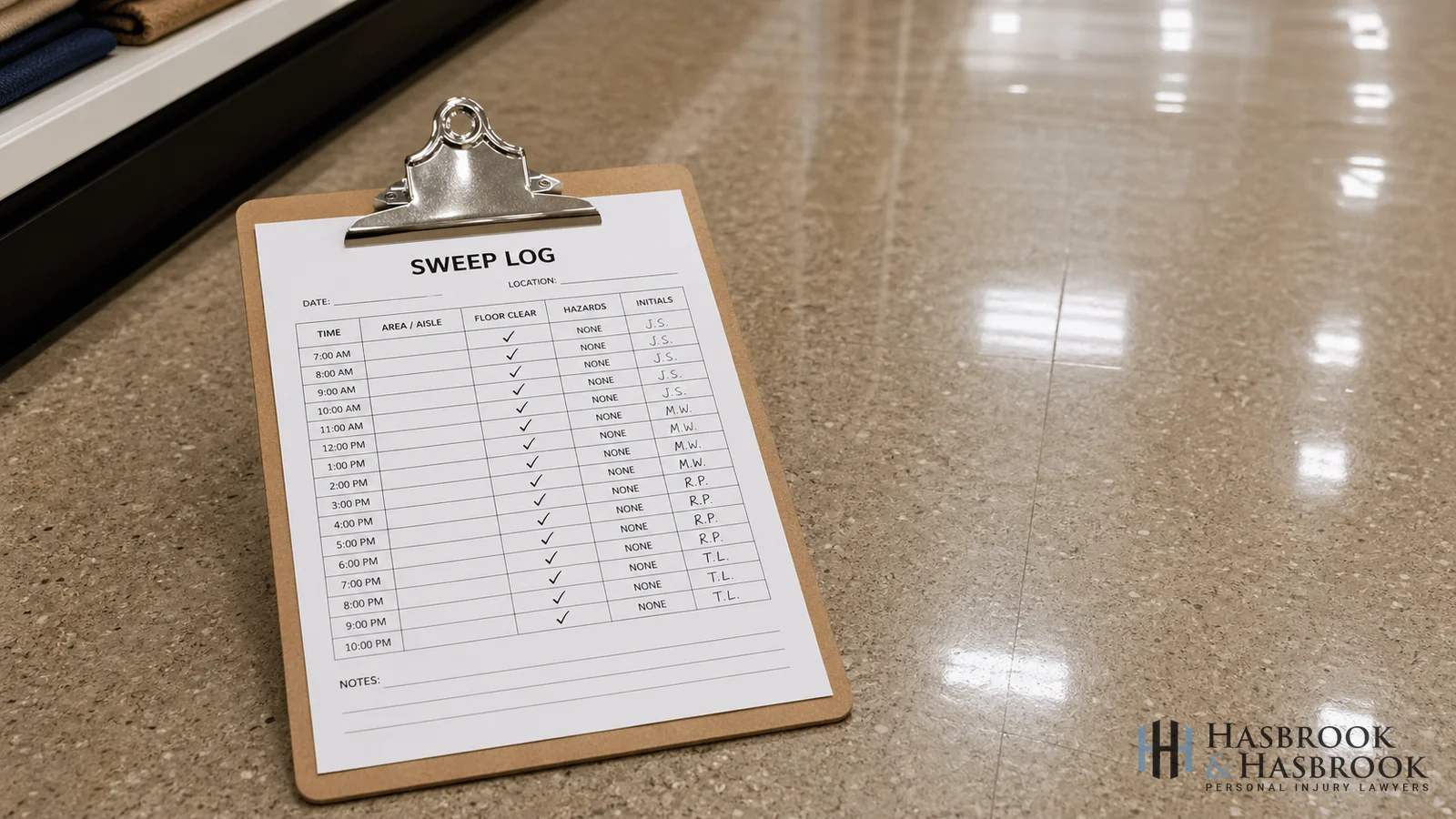
Inspection intervals are the other half of the analysis. A store running documented 20-minute aisle sweeps can argue it checked recently and found nothing. A store with no sweep log at all cannot make that argument with any credibility. Request sweep logs and inspection records in your first round of discovery. If no records exist, that absence itself is evidence that no adequate inspection program was in place. Many large retailers maintain electronic maintenance software that generates timestamped records separate from any paper log. Request both. The evidence preservation checklist includes a section specifically addressing inspection record requests. If other customers stepped over or around the hazard before your client’s fall, those witnesses establish duration directly; more on that in our FAQ about witnesses for a slip-and-fall claim.
The mode-of-operation theory: how it works and why it is uncertain in Oklahoma
The mode-of-operation rule holds that when a business operates in a way that makes floor hazards foreseeable (a self-service produce section where items drop, an open salad bar where liquids spill, a beverage dispense station with no drip mat), a plaintiff in some jurisdictions may establish notice through the business’s operating practices alone, without proving how long the specific condition existed. New Jersey, Massachusetts, and several other states have expressly adopted forms of this rule.
Oklahoma’s position is unsettled. We have not identified published Oklahoma Supreme Court or Court of Civil Appeals authority that expressly adopts or rejects the mode-of-operation rule. Treat it in state court as a preserved alternative theory, disclosed as such, not as settled Oklahoma law.
One important distinction: the mode-of-operation theory is not the same as res ipsa loquitur. Res ipsa is an evidentiary inference based on the type of injury being one that does not ordinarily occur without negligence. Mode-of-operation is a notice substitute based on business operations. In a standard slip-and-fall case, res ipsa almost never applies, and arguing it alongside a constructive notice theory can muddy both. Keep the doctrines separate in your briefing.
Documentation that builds the notice record

Whether your theory is actual or constructive, the paper trail is what wins or loses the motion for summary judgment. Organize your requests by theory:
For actual notice:
- Incident reports from the day of the fall and any prior incidents at the same location.
- Employee written statements taken at the scene.
- Customer complaint logs, comment card records, and service desk tickets.
- Work orders or maintenance requests referencing the relevant aisle or hazard type.
- Training materials showing the store had a policy for this hazard category.
For constructive notice:
- Sweep logs and aisle inspection records for the period surrounding the fall.
- Electronic maintenance software printouts with timestamps.
- Witness statements about when the condition first appeared.
- Surveillance timestamps showing the condition developing (see the next section).
- Photographs documenting physical signs of age in the hazard, such as dried edges or cart tracks.
In big-box retailer cases, corporate-level inspection policies often exist in operations manuals separate from anything the store manager will volunteer. Request both store-level and corporate-level maintenance standards in your discovery requests. Franchise locations typically operate under franchisor inspection protocols that differ from local management practices.


Getting surveillance footage before it overwrites
Most retail surveillance systems overwrite automatically on a 24 to 72 hour cycle for general floor coverage. The moment you are retained, send a written preservation demand by email and certified mail to the store manager and to the legal or risk management department of any corporate parent. Do not rely on the store’s internal incident report process to generate a hold.
Your demand letter should identify the date, time, and precise location; request all footage from the relevant aisle and adjacent areas; and specifically request footage from at least two hours before the fall. The two-hour window before the incident is where time-on-floor evidence lives. The clean-up footage immediately following the fall establishes what the hazard actually was.
If footage has already been overwritten after a claim was foreseeable, that is spoliation. The sanction in Oklahoma depends on whether destruction was negligent or intentional, but a missing tape is almost always worth a jury instruction request. Spoliation arguments are part of the broader discovery process in premises cases. For a deeper look at what courts have said about video evidence, see the FAQ on security camera footage in premises cases.
OSCN and published decisions: researching Oklahoma notice cases
Oklahoma’s published case law on premises liability notice is available through the Oklahoma State Courts Network. For research, search OSCN full-text for Oklahoma Supreme Court and Court of Civil Appeals decisions discussing actual and constructive notice in grocery, retail, and restaurant settings. Useful search terms: “constructive notice” combined with “invitee”; “premises liability” combined with “inspection”; “slip and fall” combined with “notice.”
Published decisions from the Court of Civil Appeals carry persuasive authority, not mandatory authority, unless approved for publication. Unpublished opinions are available at OSCN Unpublished Opinions and can support an argument if disclosed. When researching prior incidents at the same defendant location, OSCN docket searches may surface earlier lawsuits involving the same business and hazard type.
Legal resources for building a notice case
Two Oklahoma statutes bear directly on every premises liability notice case you work:
- 12 O.S. § 95 sets the two-year statute of limitations on personal injury actions. Know your deadline before discovery disputes consume your lead time.
- 23 O.S. § 13 governs comparative negligence in Oklahoma. How the plaintiff’s own conduct at the time of the fall interacts with the notice record often determines what the defense argues at trial.
The open-and-obvious defense and comparative fault in Oklahoma slip-and-fall cases both require attention at the same stage as notice development; they are often raised by the same defense motion. For a broader picture of the challenges inherent to these cases, see our overview of why slip-and-fall cases can be difficult to win. For statutory text, OSCN is authoritative. For secondary material and case summaries, law.justia.com/cases/oklahoma/ provides searchable Oklahoma appellate opinions at no cost.

Frequently asked questions about notice in Oklahoma slip-and-fall cases
What is the difference between actual notice and constructive notice?
Actual notice means the property owner had direct knowledge of the hazard before the injury. Constructive notice means the hazard existed long enough that the owner should have found it through reasonable inspection. Constructive notice requires proof of duration; actual notice does not.
How long does a hazard have to exist to support a constructive notice argument in Oklahoma?
Oklahoma courts do not apply a fixed time threshold. The jury weighs all circumstances: the store’s inspection frequency, the nature of the hazard, foot traffic in the area, and any physical evidence of age. A few minutes is typically insufficient. A hazard present for 20 to 30 minutes in a regularly traveled aisle is generally enough to support an argument, particularly when paired with absent or inadequate sweep logs.
What if the store claims it has no inspection records?
The absence of records can strengthen rather than undermine your constructive notice argument. A business that cannot produce sweep logs cannot demonstrate it was conducting reasonable inspections. Request records in your initial discovery; if none are produced, develop the argument that the store had no adequate inspection program at all. That is constructive notice through a different route.
Does comparative fault affect the notice analysis?
Comparative fault and notice are separate elements, but defense counsel often conflates them at trial. Under 23 O.S. § 13, a plaintiff’s fault reduces recovery proportionally but does not eliminate it unless the plaintiff’s fault exceeds the combined fault of all defendants. If the defense argues the hazard was open and obvious, you counter with the notice record showing the owner knew or should have known and chose not to act. The interplay between open-and-obvious and plaintiff fault is covered in our partial fault FAQ.
The client-facing explanation of notice proof is at notice proof in Oklahoma slip-and-fall cases. For the full practice area context, see our Oklahoma City slip-and-fall lawyer page.