If you slipped and fell while distracted, wearing certain footwear, or moving quickly through a store, you may worry your own conduct ends your claim. Under Oklahoma law, partial fault does not automatically bar recovery. What matters is whether your fault stays less than 50% of the total negligence in the case.
What Oklahoma’s modified comparative fault law means for your case
Oklahoma follows a modified comparative fault system under 23 O.S. § 13. The statute allows an injured person to recover damages even when they share some responsibility for the accident. The same statute governs car accident comparative fault claims and virtually every other personal injury case in the state.
Oklahoma’s framework differs from contributory negligence states, where any plaintiff fault cuts off recovery entirely. Under § 13, your fault reduces your award proportionally rather than eliminating it, as long as your share stays below the statutory limit. For a broader explanation of how these two systems compare, see our comparative and contributory negligence overview.
The “less than 50%” threshold explained
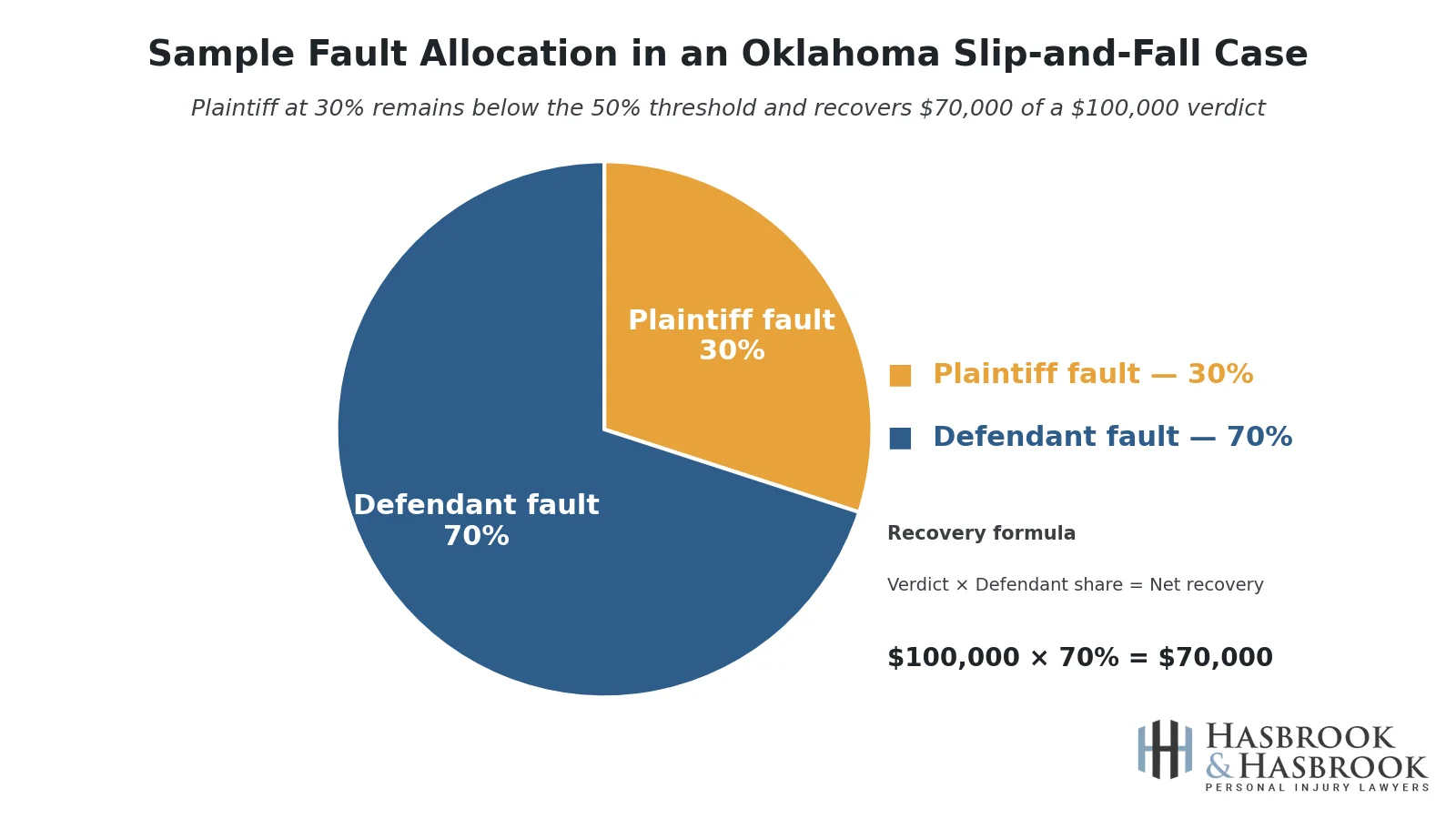
The statute bars recovery when a plaintiff’s negligence is of greater degree than the defendant’s negligence. In practice, your fault must be less than 50% for you to receive any award. Above 50%, your claim is barred entirely.
This threshold is why phrasing precision matters. Many Oklahoma firms describe the standard as “less than 50%,” which tracks the statutory language in 23 O.S. § 13. If a property owner’s insurer can persuade a jury that you were more at fault than the owner, your entire recovery disappears. Keeping your fault share below 50% is therefore a central objective of every slip and fall claim where the defense argues contributory negligence. The comparative negligence vs. contributory negligence blog post walks through how juries apply these concepts in practice.



How a jury assigns fault percentages in a slip and fall case
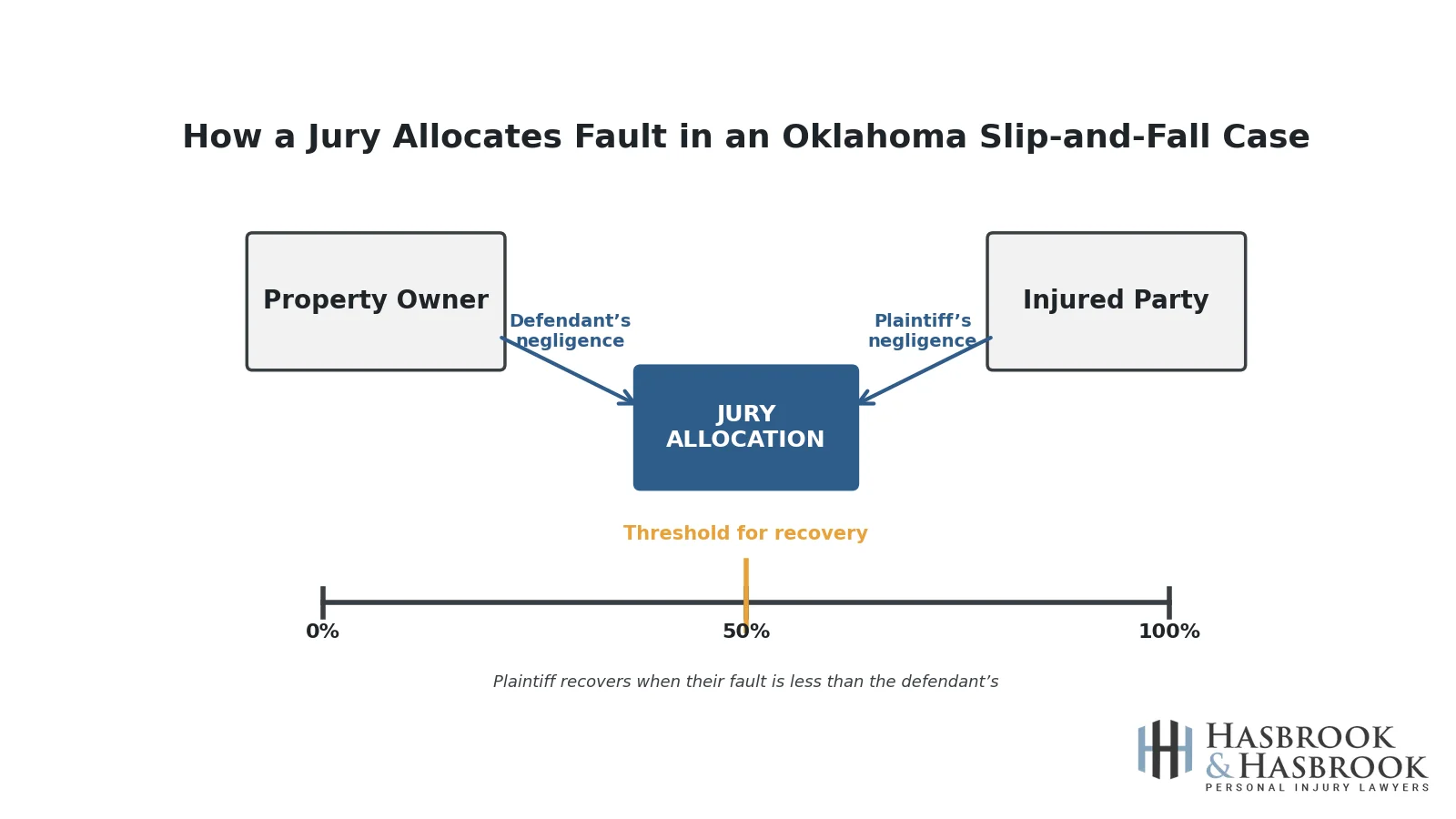
When a slip and fall case goes to trial, the jury receives a special verdict form asking it to allocate a percentage of fault to each party. Jurors weigh evidence on both sides:
- Property owner’s conduct: Did the owner know about the hazard? Did they fail to repair it, post a warning, or inspect within a reasonable time?
- Plaintiff’s conduct: Was the hazard open and obvious? Was the plaintiff ignoring posted warnings, moving through a restricted area, or engaged in an activity that diverted attention?
The the plaintiff burden rests with the plaintiff to establish the owner breached the duty owed to invitees under Oklahoma premises liability law. The defense will push the jury to assign as much fault to you as possible. Knowing the valid defenses property owners raise in slip and fall cases helps you anticipate and counter those arguments at every stage of the case.
How partial fault reduces what you recover
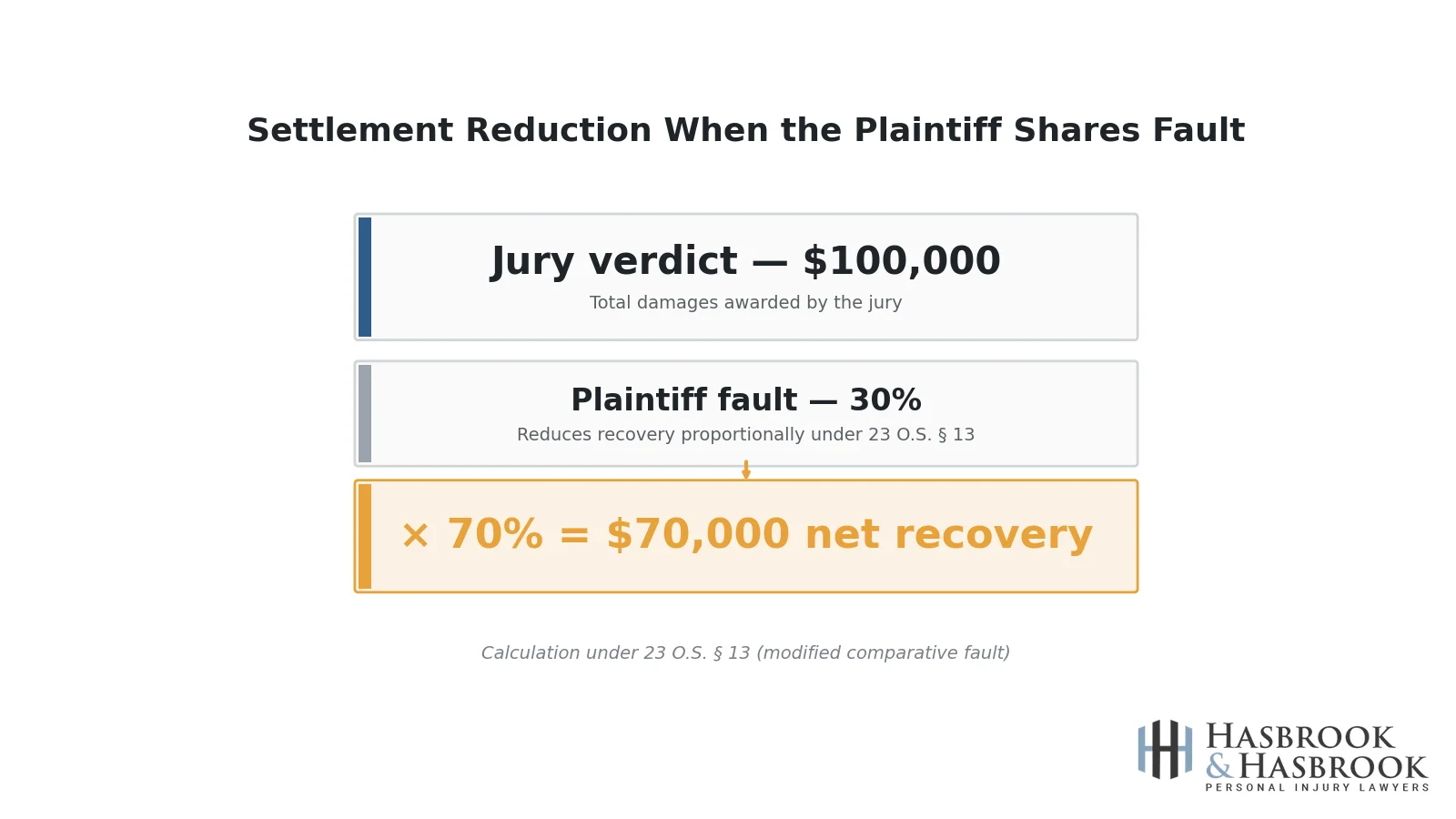
Once the jury assigns percentages, your damages award is reduced by your share of fault. The math applies directly to the verdict:
$100,000 verdict × 30% plaintiff fault = $70,000 recovery
At 45% plaintiff fault on the same verdict, you recover $55,000. Above 50% fault, you recover nothing. That line between just-below and just-above 50% is why slip and fall cases can be difficult to win. Insurance adjusters know that pushing your fault percentage over the threshold eliminates the claim entirely, so they investigate plaintiff conduct aggressively from the moment an incident is reported.
Damages that go into that verdict total can include medical bills, lost income, and pain and suffering. See our page on types of recoverable damages in slip and fall cases and our FAQ on how pain and suffering damages are calculated in Oklahoma for a breakdown of each category.
What counts as a valid slip and fall claim
Partial fault does not eliminate a claim, but you still need a valid premises liability case underneath it. A slip and fall claim in Oklahoma City requires four elements:
- The property owner owed you a duty of care (you were an invitee, such as a shopper in a store or a customer at a business).
- A hazardous condition existed on the property.
- The owner knew or should have known about the hazard and failed to fix it or warn you in time.
- That failure caused your injury and resulted in damages.
Even if you were distracted when you tripped, the question is whether the owner’s failure to address a known hazard was a greater cause than your inattention. Maintenance logs, surveillance footage, and prior incident reports all help establish what the owner knew and when. Taking the right steps after a slip and fall accident preserves that evidence before it is lost or overwritten.


How property owners use comparative fault as a defense strategy
Property owners and their insurers routinely investigate plaintiffs for contributory negligence. Expect the defense to examine:
- Surveillance footage of your path before the fall
- Whether a warning sign was posted in or near the hazard area
- Your footwear at the time of the incident
- Whether the area was restricted or marked as off-limits to the public
- Statements you made to store employees or security staff at the scene
The goal is to push your assigned fault percentage as high as possible. Knowing this in advance shapes how you document the scene, interact with property staff, and respond to the insurer’s investigation. Our Oklahoma City premises liability attorney page explains the duty owed to invitees and how violations of that duty are established in court.
How Oklahoma’s noneconomic damages cap interacts with your fault percentage
Oklahoma’s noneconomic damages cap under 23 O.S. § 61.3 (effective September 2025, replacing the former § 61.2 cap struck down in Beason v. I.E. Miller Services, 2019 OK 28) sets a $500,000 ceiling on noneconomic damages in most personal injury cases. The cap and the comparative fault reduction under § 13 are separate mechanisms; both can apply to the same case.
If the jury awards $700,000 in noneconomic damages, the cap may reduce that amount to $500,000. Your fault percentage then reduces the remaining figure further. Exactly how these two reductions interact has not yet been resolved by the Oklahoma Supreme Court under § 61.3. Our 2025 Oklahoma tort reform overview tracks how § 61.3 is developing and how it may affect pending claims.
Oklahoma’s filing deadline for slip and fall claims
Under 12 O.S. § 95, you have two years from the date of injury to file a personal injury lawsuit in Oklahoma. Missing that deadline bars your claim regardless of how strong the liability evidence is. Our Oklahoma statute of limitations guide covers the two-year rule in detail, and our page on how long after a slip and fall you can sue explains the limited exceptions that toll or extend the deadline.

Frequently asked questions
What if I was partially at fault for my fall?
You can still recover compensation as long as your fault is less than 50% under 23 O.S. § 13. Your damages award is reduced by your percentage of fault, not eliminated by it.
Does Oklahoma bar recovery at a “less than 50%” threshold or some other cutoff?
The bar is at fault of greater degree than the defendant’s, which means above 50%. At exactly 50% you can still recover. The accurate phrasing is “less than 50%” rather than a fixed-number rule, because the statute focuses on whose negligence is greater, not on reaching a specific percentage number.
How do I prove the property owner was negligent?
You must show the owner knew or reasonably should have known about the hazard and failed to fix it or warn you in time. Useful evidence includes maintenance logs, prior complaints to management, surveillance footage, and eyewitness accounts. A trained attorney can identify which records to request from the owner’s insurer and risk-management team before they are purged.
Can I recover if I was wearing sandals or looking at my phone when I fell?
Possibly. Those facts increase your assigned fault percentage but do not automatically bar your claim. The jury compares your inattention against the owner’s failure to address a known hazard. Many recoveries proceed even when plaintiffs shared some responsibility for the incident.
How much is a slip and fall case worth when fault is shared?
Value depends on total damages, your assigned fault percentage, and whether the noneconomic cap under § 61.3 applies. Our guide on how much a slip and fall case is worth covers the main factors. Our FAQ on how to maximize the value of your slip and fall case covers the steps that protect your recovery before and after filing.
What should I do right after a fall if I was partly at fault?
Report the incident to the property manager, photograph the hazard and your injuries before anything is cleaned or moved, collect witness names and contact information, and seek medical evaluation the same day. Do not apologize or speculate about fault to store employees or insurance representatives. The way you document the scene determines what evidence your attorney can work with.
contact our personal injury practice represent injured Oklahomans in slip and fall claims where partial fault is disputed. If you were hurt on someone else’s property and want to understand what your recovery could look like, our personal injury lawyers for a free consultation.