What You Must Actually Prove in an Oklahoma Slip and Fall Case
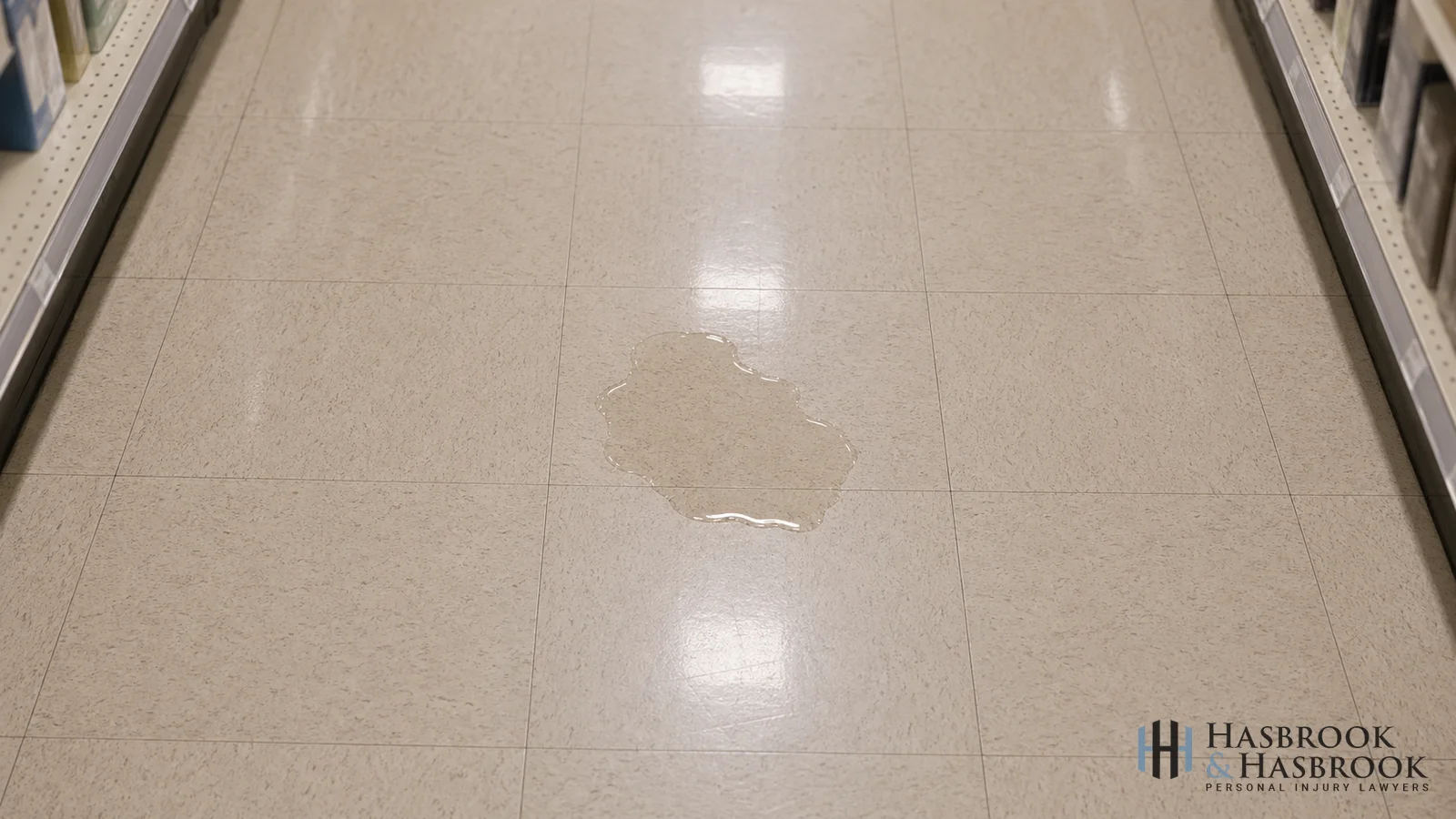
Under Oklahoma common law, a property owner who opens their premises to the public owes invited guests a duty of reasonable care to maintain a reasonably safe environment. See the Cornell Law overview of premises liability for the foundational doctrine. That duty does not make owners responsible for every fall; it requires showing the owner failed to address a known or knowable hazard.
Most slip and fall claims require proof of four elements: the owner owed a duty of care to invitees; a dangerous condition existed; the owner had actual or constructive notice of that condition; and the condition caused the injuries suffered. Notice is the element that makes or breaks most commercial premises cases, and these cases can be difficult to win when notice evidence is thin.



Actual Notice vs. Constructive Notice: The Core Distinction
Actual notice means the property owner or an employee directly knew about the hazardous condition before the fall. An employee who creates a spill and leaves the area unattended, or a manager who receives a complaint about a leaking refrigeration case, has actual notice. It is the stronger form to establish once the evidence surfaces.
Constructive notice is legally attributed knowledge. Even if no one observed the specific hazard, the condition existed long enough and was visible enough that a reasonable inspection program would have found it. Oklahoma courts apply a totality-of-circumstances analysis: how long the hazard was present, how visible it was, and what the property’s inspection history showed. See our FAQ on how to prove a store knew about the hazard.
Constructive Notice in Practice: Sweep Logs, Surveillance, and Timelines
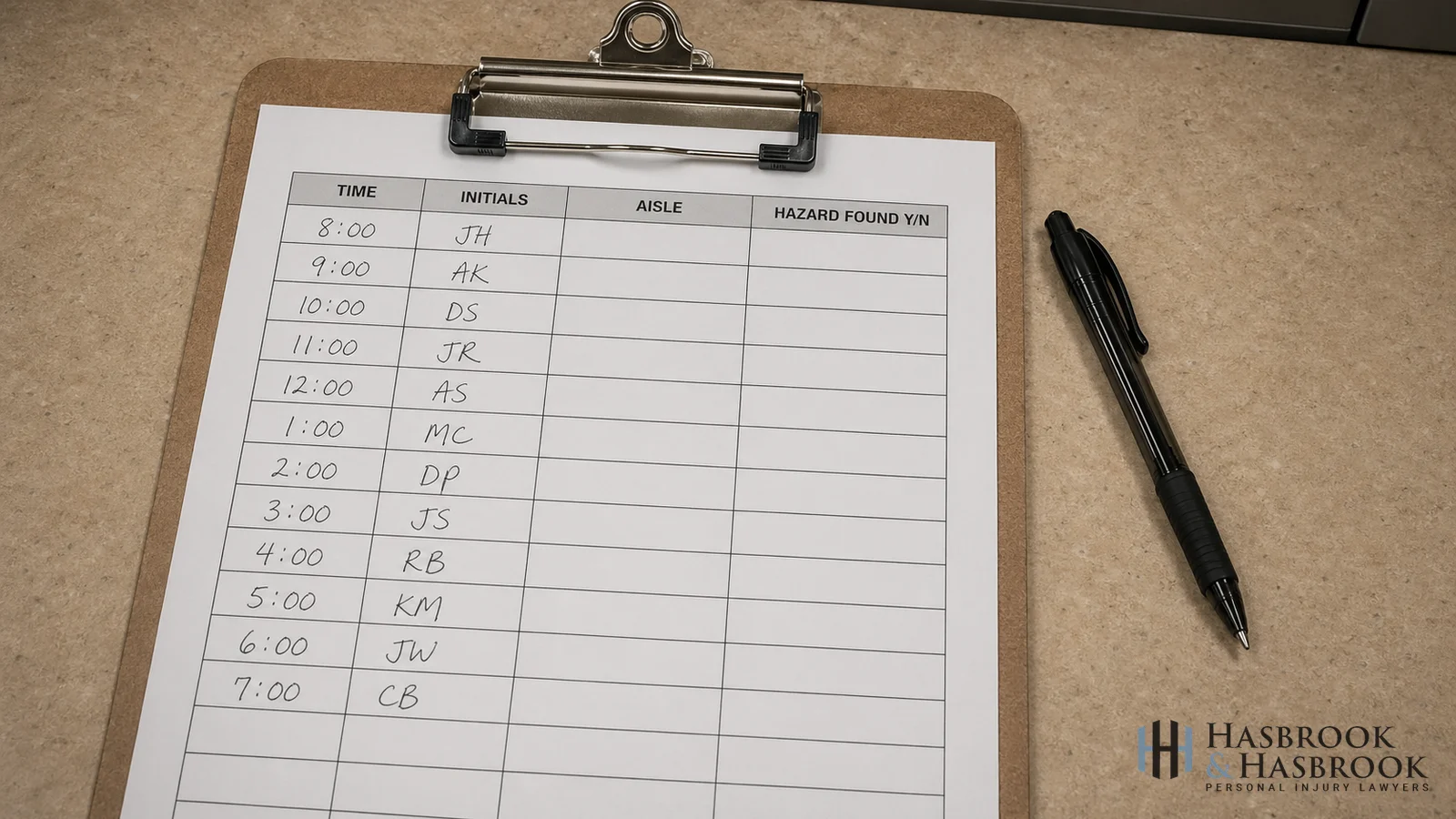
Key records to request in discovery: Commercial properties maintain sweep logs, inspection checklists, and maintenance records. Through civil discovery, your attorney should request:
- Sweep logs for the date of injury, with recorded times and employee signatures
- Maintenance request forms and open work orders for the fall location
- Store policies on inspection intervals for wet or slippery surfaces
- Surveillance footage from cameras covering the fall area
Surveillance footage establishes timelines. If footage shows a hazard present for 20 minutes before a fall, that duration strongly supports constructive notice in most commercial settings. Because many properties overwrite footage automatically, a written preservation demand should go out immediately. Learn how security camera footage is used in premises liability cases. Gaps in sweep logs carry equal weight: no entry for two hours before a fall in a high-traffic area strengthens constructive notice considerably.

Prior Similar Incidents as Evidence of Notice
A documented history of falls or hazard complaints at the same location can show the owner was on notice of a recurring dangerous condition. If a grocery store had multiple falls in the same produce section over two years, that history supports the argument that management knew about a persistent flooring or drainage problem.
Prior incident reports, complaints, and earlier claims related to the same area are discoverable in most cases. Courts generally permit discovery of substantially similar prior incidents at the same location, making this evidence most useful when the earlier conditions match those that caused your fall.


The Mode-of-Operation Rule: Unsettled Ground in Oklahoma
Some jurisdictions recognize a mode-of-operation theory under which a business that operates in a way that foreseeably creates recurring hazards (a self-serve salad bar or a produce section with active misting) is presumed to be on constructive notice without proof of a specific spill’s duration.
Oklahoma has not clearly adopted this rule. No published Oklahoma Supreme Court or Court of Civil Appeals decision has squarely endorsed mode-of-operation as a substitute for conventional notice proof. Until Oklahoma courts address it directly, plaintiffs should be prepared to establish notice through conventional means: duration of the hazard, sweep log gaps, surveillance timelines, or prior incidents.
Comparative Fault in Oklahoma Slip and Fall Cases
Oklahoma follows a modified comparative fault system under 23 O.S. § 13. If you are found partially at fault for your fall, your recovery is reduced proportionally. If your share of fault is 50% or more, you cannot recover anything. Defense teams frequently argue the person who fell contributed through inattention, inappropriate footwear, or disregarding visible warnings. Our page on comparative fault in Oklahoma slip and fall cases covers how fault allocation works, and the FAQ on what happens if you were partially at fault for your fall addresses common scenarios.
Falls send millions to emergency rooms each year. The CDC’s fall injury data identifies falls as a leading cause of injury-related emergency visits for adults of all ages. The Bureau of Labor Statistics documents slips, trips, and falls among the most frequent causes of nonfatal injuries in retail and commercial settings.
Common Mistakes That Hurt Slip and Fall Claims
- Not filing an incident report on site: An incident report creates a contemporaneous record. Review the steps to take after a slip and fall accident.
- Delaying medical attention: Gaps in treatment give insurers grounds to argue injuries were minor or pre-existing.
- Posting on social media: Activity photos and check-ins can contradict injury claims. See how social media affects personal injury cases.
- Accepting a quick settlement: Early offers typically resolve all future claims before the full extent of injuries is known. Understand the risks of accepting an early settlement.
- Missing the filing deadline: Oklahoma’s two-year period under 12 O.S. § 95 bars recovery if a lawsuit is not filed on time.
- Underestimating the open-and-obvious defense: Property owners frequently argue the hazard was plainly visible. Review the open and obvious defense in Oklahoma to understand how it is argued and countered.

What to Do Immediately After a Slip and Fall Injury
- Report the fall to management and ask that an incident report be completed. Request a copy before leaving.
- Photograph the scene: the hazard, any liquid or debris, warning sign placement or absence, and wide-angle context shots.
- Collect witness information: names and contact details for anyone who observed the fall or saw the hazard beforehand. Review whether witnesses are required for your claim.
- Seek medical attention promptly. Soft tissue injuries and concussions often present or worsen hours or days after a fall.
- Preserve clothing and footwear worn during the fall without washing them.
- Avoid recorded statements to insurance adjusters before consulting an attorney.
Steps to Strengthen Your Case Before You File
- Send a written preservation demand to the property owner within days of the fall, specifically requesting surveillance footage and all inspection records for the area. See the slip and fall evidence preservation checklist.
- Obtain the incident report from the property, through counsel if needed.
- Request sweep logs and maintenance records in formal discovery.
- Identify and preserve all witness contact information.
- Maintain all medical records, prescriptions, and itemized receipts.
Our notice proof documentation guide provides a structured approach for gathering these records. The slip and fall intake checklist outlines what information an attorney will need to evaluate your claim.
How Long You Have to File in Oklahoma
Most slip and fall claims must be filed within two years of the date of injury under 12 O.S. § 95. See how long you have to file a slip and fall case for a full discussion of when the clock starts and when exceptions apply. Falls on government-owned property carry additional notice requirements under the tort claims against Oklahoma government entities, and those procedural steps must be completed before a lawsuit against a government entity can proceed.
call our injury attorneys for a free review handle premises liability claims throughout Oklahoma, including complex notice disputes involving sweep log gaps, surveillance timelines, and prior incident history. Contact our office to discuss your situation.

Frequently Asked Questions
Does Oklahoma require a specific amount of time on the floor before constructive notice attaches?
There is no bright-line time rule under Oklahoma law. Courts look at duration, visibility, traffic volume, and inspection history in context. The longer a spill stayed uncorrected in a busy commercial area, the stronger the inference of constructive notice becomes.
Can I recover compensation if I was partly at fault for my fall?
Yes. Oklahoma’s modified comparative fault system allows recovery as long as your share of fault is less than 50%. Your award is reduced proportionally to your fault percentage. See the FAQ on how partial fault affects a slip and fall recovery.
What if there is no surveillance footage of my fall?
Absence of footage does not defeat a case. Sweep logs, incident reports, witnesses, and prior incident history can all establish notice. When footage that should exist is missing, courts may address that absence in appropriate circumstances. See how security camera evidence is handled in premises cases.
Do I need witnesses to support my slip and fall claim?
Witnesses are helpful but not required. Physical evidence, maintenance records, and medical documentation can sustain a claim without eyewitness testimony.
What if I slipped on ice or snow in an Oklahoma parking lot?
Outdoor ice and snow accumulations carry a distinct analysis under Oklahoma’s natural accumulation doctrine, which property owners frequently raise as a defense. Review our page on ice and snow slip and fall liability in Oklahoma for how this doctrine applies.