Short answer: in most Oklahoma truck wreck cases you can name both the driver and the trucking company, and you usually should. The driver caused the crash. The carrier created the conditions that put an unsafe driver behind the wheel of an 80,000-pound truck. Naming both protects the case if one defendant goes bankrupt, claims to be an “independent contractor,” or carries policy limits too low to cover serious injuries.
This page covers who can be sued after an Oklahoma commercial truck crash, the legal theories that put the trucking company on the hook, when shippers and brokers also become defendants, and how the federal motor carrier rules drive the analysis. For an overview of our truck practice, start at Hasbrook & Hasbrook Personal Injury Lawyers or the Oklahoma City truck accident lawyer hub.
Who Can Be Sued After an Oklahoma Truck Crash
An Oklahoma commercial truck case rarely has just one defendant. The parties that may be liable include:
- The driver, for the negligent act behind the wheel (speeding, distracted driving, fatigued driving, lane departure, failure to yield).
- The motor carrier (the trucking company holding the USDOT number), for putting an unfit driver on the road, failing to train, failing to maintain the equipment, or pushing the driver to violate federal hours-of-service rules.
- The truck or trailer owner, if separate from the carrier (some tractors are owner-operated and leased to a fleet, and trailers often belong to a different company).
- The freight broker, if the broker hired a carrier with a poor safety record.
- The shipper, if the shipper loaded the cargo improperly, knew the carrier was unsafe, or pressured an illegal schedule.
- A maintenance contractor that worked on the brakes, tires, or steering before the crash, or a parts manufacturer if a defective component caused or contributed to the crash.
Identifying every viable defendant matters because Oklahoma is a several-liability state for non-economic damages under 23 O.S. § 15. If you only sue the driver and the driver has a small personal policy, you can win the case and still leave money on the table.



Respondeat Superior and Direct Corporate Negligence
Respondeat superior holds an employer responsible for the negligent acts of an employee acting within the scope of employment. For a typical wreck where a company driver was on a dispatched run, this is the simplest theory of corporate liability: the plaintiff does not have to prove the company itself did anything wrong; the company answers for the driver’s conduct because the driver was working for it when the crash happened. Oklahoma courts ask whether the driver was doing the carrier’s work, on the carrier’s clock, in the carrier’s truck, on a route the carrier sent the driver on. If yes, the carrier is on the hook.
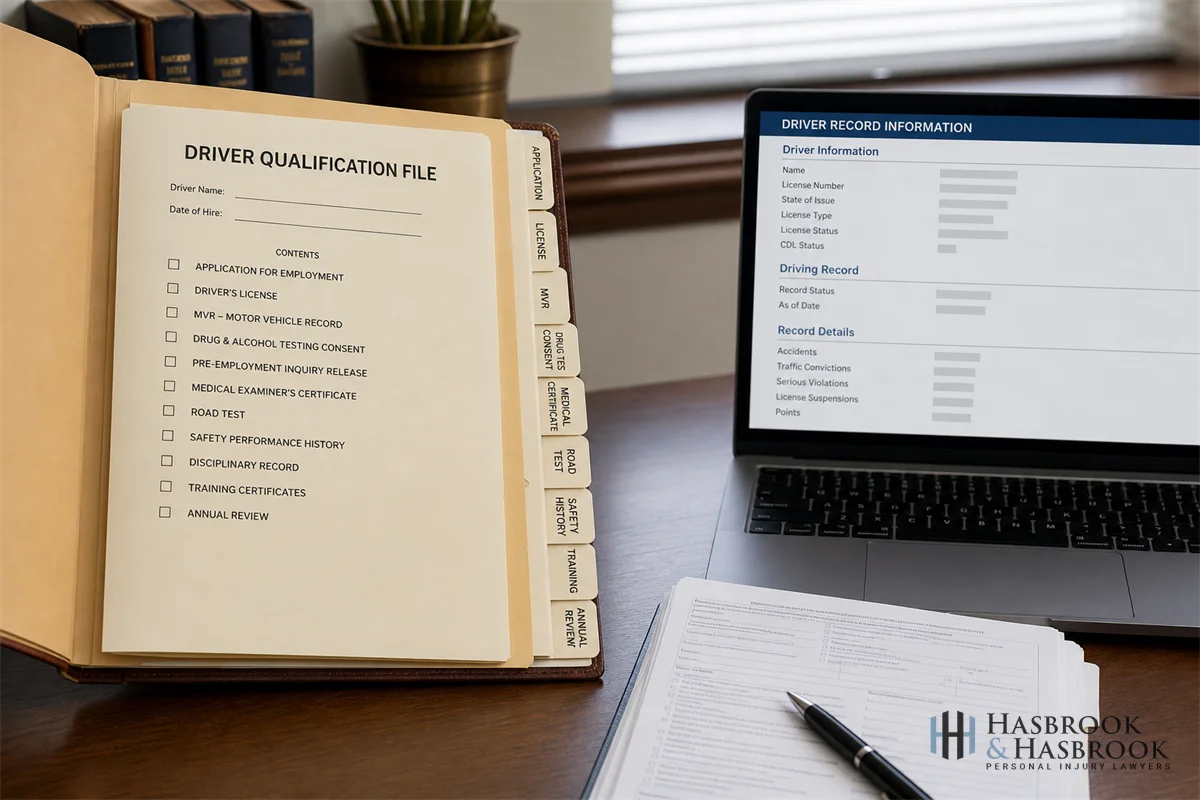
Even when respondeat superior is undisputed, plaintiffs routinely add direct claims against the carrier for what the company itself did or failed to do. Direct corporate negligence unlocks evidence the jury never sees in a pure respondeat superior case: prior crashes, prior moving violations, failed drug or alcohol screens, hours-of-service violations, and complaints from dispatch. The driver qualification file (DQ file) is the central record set; for the working request list see the the driver qualification file request checklist.
Five Direct Claims Against the Carrier
- Negligent hiring: the carrier hired a driver whose record (prior DUIs, CDL suspensions, preventable crashes) showed a foreseeable risk to the public.
- Negligent training: the carrier put the driver on the road without the entry-level driver training required by 49 C.F.R. Part 380, or without route-specific or equipment-specific instruction.
- Negligent supervision: the carrier failed to monitor logs, GPS, ELD data, or dispatch records that would have caught fatigue, off-route driving, or pattern speeding.
- Negligent retention: the carrier kept a driver after later events (a new violation, a crash, a positive drug screen) made continued employment unreasonable.
- Negligent entrustment: the carrier put a known-incompetent driver behind the wheel of this specific truck for this specific run.
FMCSA Regulatory Liability: Federal Rules as State-Law Standards of Care
Most interstate commercial trucks are governed by the Federal Motor Carrier Safety Regulations (FMCSRs). The FMCSA publishes the rules at 49 C.F.R. Parts 350-399, and Oklahoma applies a parallel framework under Title 47. A regulatory violation is not automatic liability, but Oklahoma juries can be instructed that the regulation sets the standard of care, and a violation is evidence of negligence.
FMCSR Provisions Most Often in Play
| Regulation | What It Covers | Common Violation |
|---|---|---|
| 49 C.F.R. Part 391 | Driver qualifications, DQ file contents, road test, medical certification | Hiring a driver with a disqualifying record or no current medical card |
| 49 C.F.R. Part 392 | Driving rules, ill or fatigued operation, texting and handheld use | Driver dispatched while fatigued; texting at impact |
| 49 C.F.R. Part 395 | Hours of service, ELD requirements, 11-hour driving limit, 14-hour window | Falsified or edited logs, dispatch over the 14-hour window |
| 49 C.F.R. Part 396 | Inspection, repair, and maintenance; pre-trip inspections; DVIRs | Out-of-service brake or tire defects; missing daily vehicle inspection reports |
| 49 C.F.R. Part 382 | Drug and alcohol testing; pre-employment, random, post-accident | No post-accident test, missed random pool, prior positive ignored |
For background on the federal hours-of-service framework, see the FMCSA’s summary of the HOS rule and our Oklahoma break-time guide. For the dollar consequences of an HOS violation, see What Is the Penalty for Hours of Service Violations?.
Broker, Shipper, and Independent Contractor Issues
A freight broker can face a negligent-selection claim if the broker hired a carrier with an obvious safety problem (poor SAFER score, out-of-service rates well above industry average, an unsatisfactory rating). A shipper can be liable when the shipper’s own conduct contributed to the crash: improperly loaded or secured cargo, unrealistic delivery windows that force HOS violations, or selecting a known-bad carrier to save on the rate. The National Highway Traffic Safety Administration’s large-truck overview documents how loading defects and equipment failures contribute to fatal commercial crashes.
Many carriers’ first defense is to call the driver an “independent contractor” and walk away. Federal trucking law and Oklahoma law both push back. The IRS uses a multi-factor test built around behavioral control, financial control, and the type of relationship; see employee vs contractor designation. Oklahoma courts apply a similar control-based test in tort cases.
The Statutory Employer Rule
Even when a driver is genuinely an independent owner-operator, the FMCSRs treat the motor carrier whose USDOT number is on the door as the statutory employer for the duration of the lease. Under 49 C.F.R. § 376.12, a regulated motor carrier leasing a tractor for interstate commerce must have exclusive possession, control, and use of the equipment, and must assume complete responsibility for its operation. Practical effect: if the truck ran under a placard and DOT number when it hit you, the carrier owns the federal-motor-carrier liability regardless of how the driver-side paperwork is labeled. The driver remains personally responsible for the driver’s own negligence.


Why Naming the Driver Personally Still Matters
- Coverage stack. The driver may have a personal auto policy that becomes available, especially in non-trucking-use scenarios.
- Punitive damages. DUI, deliberate log falsification, or knowing operation of an out-of-service vehicle supports punitive exposure under 23 O.S. § 9.1.
- Bankruptcy protection. A carrier can file Chapter 7 or 11 mid-case; a solvent driver keeps the case moving.
- Comparative fault allocation. Oklahoma compares fault under 23 O.S. § 13; a missing defendant means missing fault on the verdict form. See our breakdown of Oklahoma’s modified comparative negligence rule and the 50-percent bar.
Evidence, Coverage, and Government Trucks
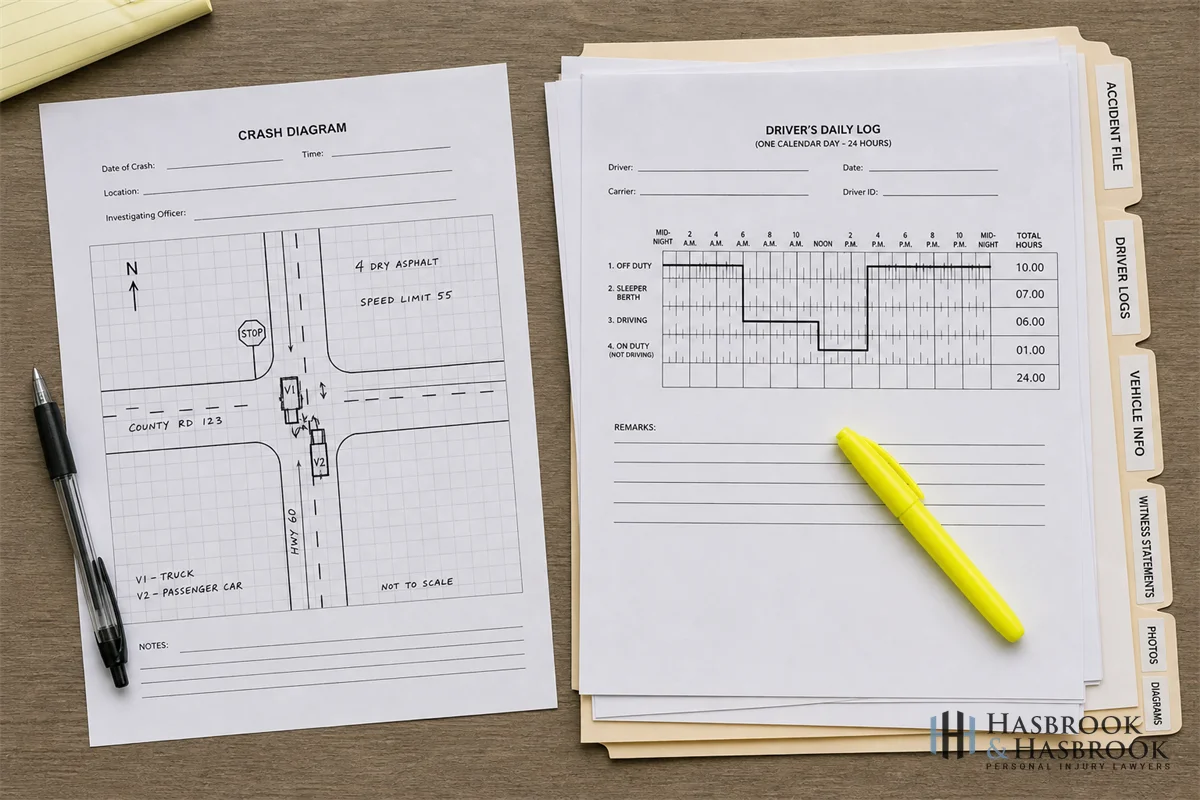
Trucking evidence disappears fast. The black box overwrites in days, dashcam loops faster, and the DQ file starts moving the moment the carrier’s safety director gets the crash notice. Three first-week actions: send a spoliation letter to the carrier, broker, shipper, and any maintenance vendor demanding ELD data, dashcam, GPS, dispatch records, DVIRs, post-accident drug and alcohol tests, and the DQ file (the first 48 hours after a truck accident guide details what each letter should cover); document the scene, including the truck’s DOT number, USDOT placard, and trailer markings; and pull federal SAFER and SMS data on the carrier. Background: ELD and black box data in truck crash cases and the evidence preservation guide.
Federal law requires interstate motor carriers to carry minimum liability coverage of $750,000 for general freight, $1,000,000 for oil, and up to $5,000,000 for certain hazardous materials, per 49 C.F.R. § 387.9. A serious case often pulls in primary auto liability, an umbrella or excess layer, a separate broker policy, and (when the truck was leased) a non-trucking-use policy. See truck insurance minimums in Oklahoma and our Tulsa truck practice page.
If the at-fault truck belongs to a state agency, county, or city, the Oklahoma Governmental Tort Claims Act applies and the notice of claim must be filed within one year under 51 O.S. § 156. Oklahoma applies modified comparative fault: a plaintiff’s recovery is reduced by their share of fault and barred only when their fault exceeds 50 percent. Multiple defendants protect the case against an empty-chair defense at trial. For more, see how fault is established in a truck crash and when retaining counsel changes the trajectory of a commercial truck case.
Frequently Asked Follow-Up Questions
Do I have to choose between the driver and the company?
No. In almost every commercial truck case where both are viable defendants, both are named. If the carrier admits respondeat superior, some courts may limit certain direct-negligence claims, but the carrier remains a defendant.
What if the trucking company is out of state?
Oklahoma courts have personal jurisdiction over an interstate carrier whose truck caused harm in Oklahoma. The case proceeds in Oklahoma state court (or federal court on diversity grounds). The carrier’s home state does not control.
Can I sue the freight broker if the load was the problem?
Sometimes. Preemption arguments under the Federal Aviation Administration Authorization Act have narrowed broker negligence claims, but courts have repeatedly allowed negligent-selection claims when the broker hired a carrier with a documented unsafe record.
How long do I have to file a truck accident lawsuit in Oklahoma?
The general personal injury statute of limitations is two years from the date of the crash under 12 O.S. § 95. Wrongful death is two years from the date of death under 12 O.S. § 1053. Government-owned trucks have shorter notice deadlines. Don’t wait; trucking evidence is gone long before the limitations clock runs out.
Will my case settle or go to trial?
Most commercial truck cases settle once the policy stack and corporate-negligence record are developed. The cases that try are the ones where coverage, fault, or punitive exposure is disputed. We staff every case as if it will try and let the defense decide.

Talk to Our Firm
Our firm investigates on day one and identifies every viable defendant before the carrier’s records start moving. We handle truck cases statewide, including in Midwest City personal injury matters and Edmond personal injury matters, plus the smaller venues in between. For a clearer picture of the day-to-day work of a commercial truck accident attorney on a fatal-injury or serious-injury case, read the linked overview. Call (405) 605-2426 for a free case review.
The driver-plus-carrier theory becomes especially powerful when a car slides under a tractor-trailer because federal underride standards add a separate violation layer.