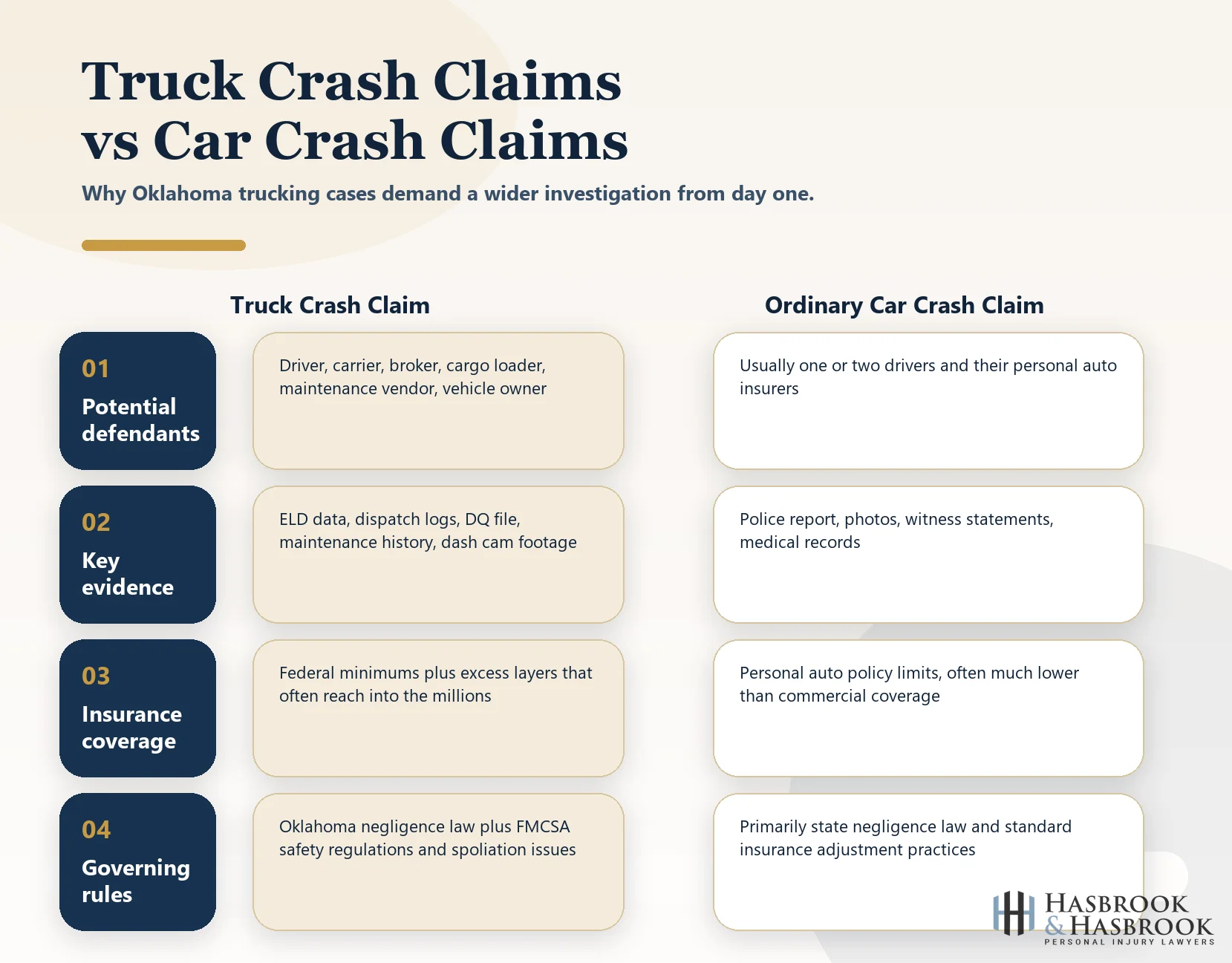
Federal regulations set firm limits on how long truck drivers can stay behind the wheel before taking mandatory rest. Under 49 CFR Part 395, the Federal Motor Carrier Safety Administration’s hours-of-service (HOS) rules cap daily driving time and weekly on-duty hours. When carriers or drivers ignore those limits, Oklahoma injury law treats the violation as direct evidence of negligence. Our Oklahoma City truck accident attorneys explain what the rules require.



The four core HOS limits
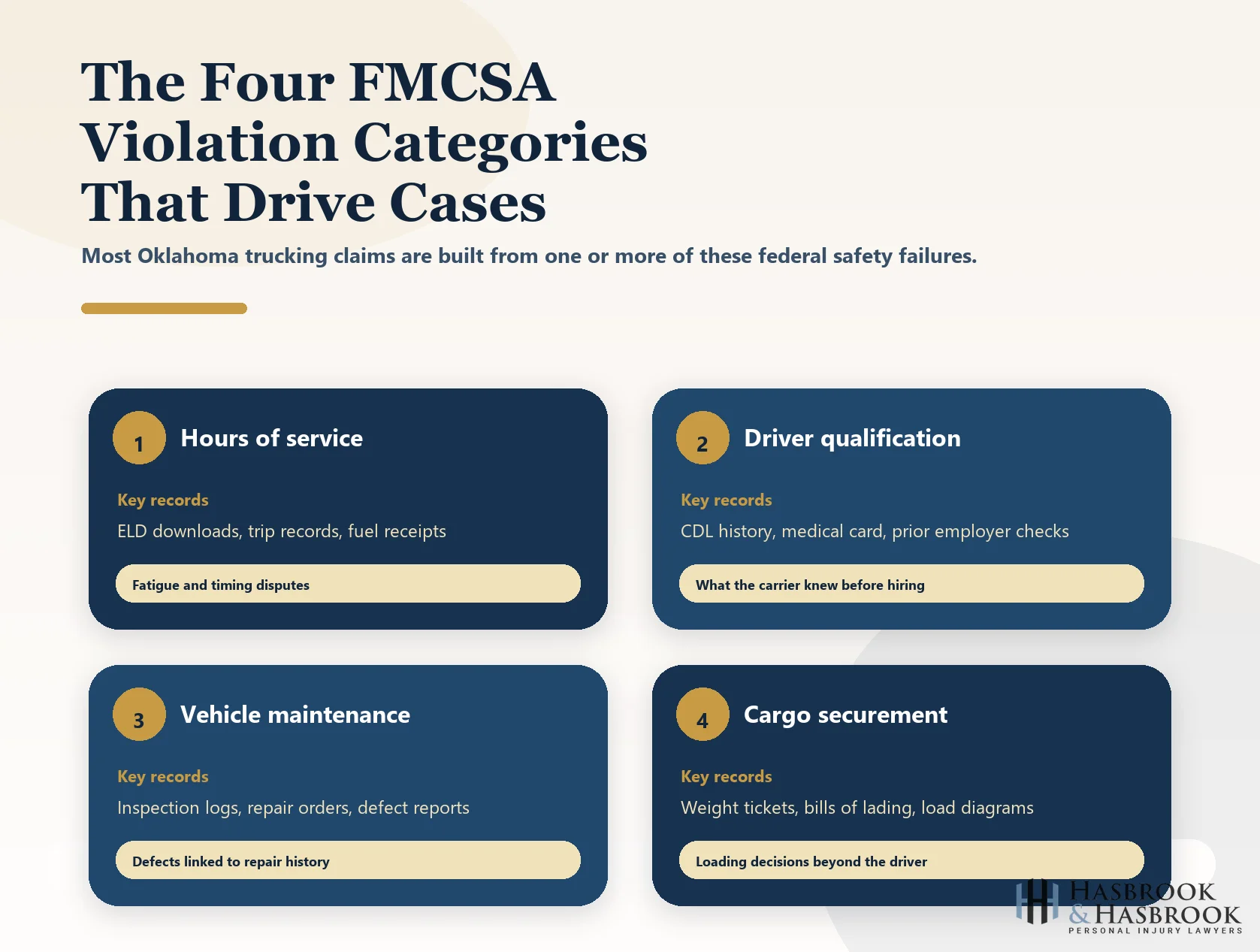
For property-carrying commercial motor vehicle drivers, four limits apply under 49 CFR Part 395:
- 11-hour driving limit. A driver may not operate a commercial motor vehicle for more than 11 hours in a shift, beginning only after 10 consecutive hours off duty.
- 14-hour on-duty window. Once a shift begins, a 14-hour clock starts. All driving must finish within that window. Non-driving tasks, including loading and fueling, count against it.
- 30-minute break requirement. After 8 cumulative hours of driving since the last qualifying rest period, the driver must take at least a 30-minute off-duty break before continuing.
- 60/70-hour weekly limit. Drivers cannot exceed 70 on-duty hours across any 8 consecutive days, or 60 hours across 7 consecutive days for carriers not operating daily.
Narrow exceptions exist for short-haul operations and adverse driving conditions, but each requires documentation. A driver who stretches an exception past its legal bounds is still in violation.
Electronic logging devices
Since December 2017, most commercial carriers must equip trucks with electronic logging devices (ELDs). ELDs automatically record driving time, engine hours, and location data, replacing paper logbooks that could be changed after the fact. In a crash investigation, ELD data shows whether the driver exceeded legal limits at the time of the collision. Federal rules require carriers to keep this data for 6 months. An attorney sends a preservation demand immediately after a crash because waiting risks losing critical records. Our page on black box and ELD evidence in commercial vehicle crashes covers how this data is obtained and used.

How HOS violations affect an Oklahoma claim
A violation of 49 CFR Part 395 can establish negligence per se under Oklahoma law, meaning the federal regulation itself sets the applicable standard of care. The carrier may share liability if it pressured drivers to exceed limits or failed to enforce compliance. See the penalties carriers face for HOS violations.
Oklahoma’s comparative fault rule under 23 O.S. § 13 still applies: if a claimant’s share of fault is 50 percent or less, they can recover, with the amount reduced by their fault percentage. Insurance adjusters use this rule to push fault upward early; an attorney can challenge those assignments before they become fixed in the insurer’s file.
Frequently asked questions
How many hours can a truck driver drive in one day?
A property-carrying truck driver may not exceed 11 driving hours in a single shift under 49 CFR Part 395. The shift must begin after at least 10 consecutive off-duty hours, and all driving must be completed within a 14-hour on-duty window.
When is a truck driver required to stop and rest?
After accumulating 8 cumulative driving hours since the last qualifying break, the driver must take at least a 30-minute off-duty rest before driving again. Weekly limits also apply: 70 hours in 8 consecutive days, or 60 hours in 7 consecutive days.
Are all truck drivers required to use ELDs?
Most commercial carriers have been required to use ELDs since December 2017. Exceptions cover certain short-haul drivers, drivers of pre-2000 vehicles, and those using paper logs fewer than 8 days in a rolling 30-day period. Outside those categories, ELD use is mandatory.
Can a logbook violation be used as evidence in court?
Yes. ELD records, paper logs, and driver qualification files are subject to discovery. A log showing the driver exceeded legal limits at the time of the crash is direct evidence of a federal safety violation and can shift how fault is analyzed in the case.


Talk with an Oklahoma City truck accident attorney
Preserving HOS and ELD records is one of the most time-sensitive steps in a truck accident case. Call 405-605-2426 to reach Hasbrook & Hasbrook for a free consultation, or contact us through the form on this page.