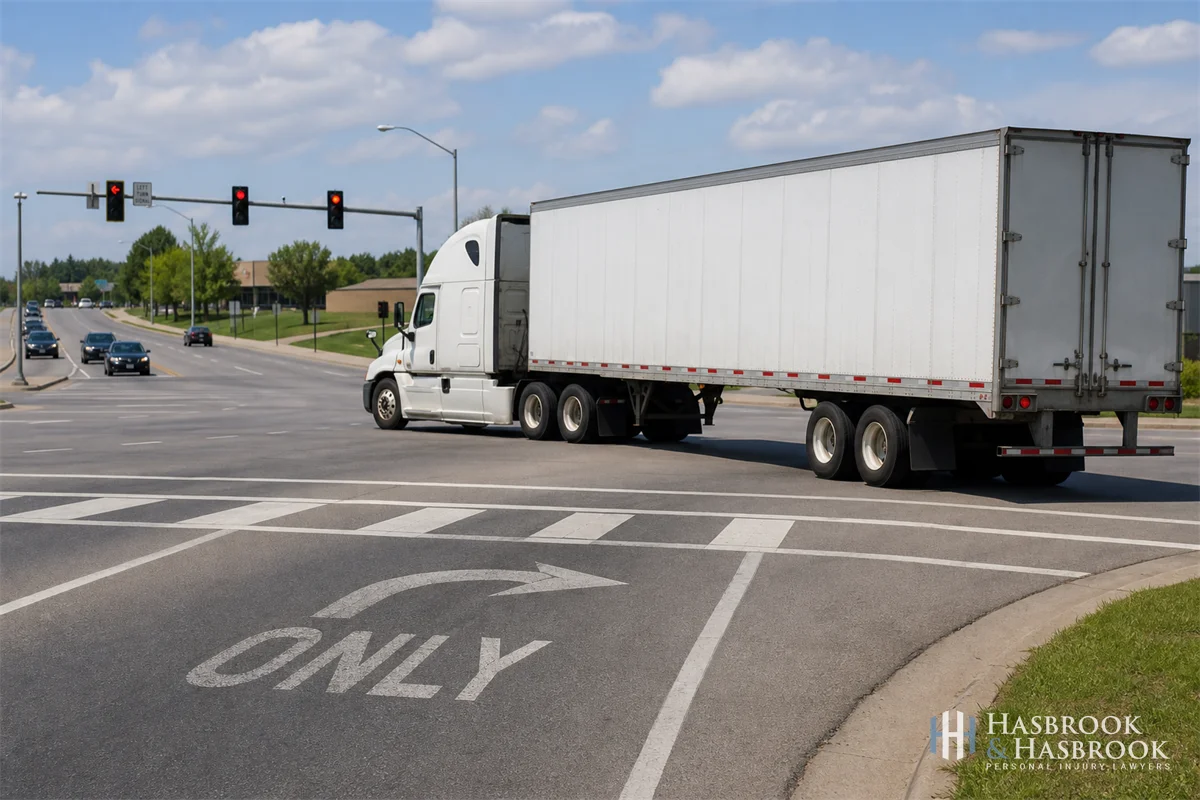
A wide-turn truck crash happens when a tractor-trailer driver swings into an adjacent lane to set up a turn, then sweeps the trailer across that lane completing it. If you were hit beside or behind a turning truck on an Oklahoma road, the case typically turns on driver training, route choice, and proof of how the trailer tracked through the turn.
What is a wide-turn truck crash?
Tractor-trailers cannot turn the way passenger cars turn. The trailer rides on a separate axle group 40 to 53 feet behind the steer tires, and the rear of the trailer cuts a tighter arc than the cab. To clear a curb or a parked vehicle on the inside of a right turn, a driver often swings the cab into the left lane, then turns right, dragging the trailer across the intended turn lane and the lane to its right. A car beside or just behind the cab during that swing is in the spot where the trailer lands.
The Federal Motor Carrier Safety Administration calls this maneuver a wide right turn and identifies it as one of the highest-risk decisions a commercial driver makes on city streets. The agency’s wide-turn safety guidance explains the swing-out mechanic and lists the no-zone where a passenger vehicle becomes invisible during the turn. The same geometry produces a left-turn version: a driver entering a left turn from a multi-lane approach can clip a vehicle in the next lane, or fail to clear an oncoming vehicle if the cab is set wide of the turn radius.
Wide-turn crashes in Oklahoma
Most wide-turn truck crashes in Oklahoma happen at street-grid intersections in Oklahoma City and Tulsa, on industrial-park access roads, and at fuel stops along I-35, I-40, and I-44. Common scene patterns:
- Right-turn squeeze: a car at the curb to turn right is pinned by the trailer as the cab swings left and the rear tracks over the right turn lane.
- Adjacent-lane sweep: a vehicle in the left lane during a right-turn setup is struck by the cab swinging out or by the trailer pivoting back.
- Curb-clearance failure: the trailer’s rear tires ride over the inside curb, striking a pedestrian, cyclist, or stopped car at the corner.
- U-turn or three-point turn: a driver tries to reverse direction on a road that cannot accommodate the trailer’s swept path, producing strikes from approaching traffic.
Crush injuries to the upper body are common because the trailer often comes in at door-and-window height. See concussion versus traumatic brain injury for head-injury outcomes after a low-speed truck strike.
The geometry: cab path, trailer path, and the swept area
Two paths matter in every wide-turn case:
- Cab path. The arc the steer tires follow through the turn. The driver sees and anchors the maneuver on it.
- Trailer path. The arc the rear axle group follows. Because the trailer pivots from the fifth wheel, the rear tracks inside the cab path on a tight turn. The space between the two is the swept area, and it can cover an entire adjacent lane on a 90-degree city turn.
The Insurance Institute for Highway Safety has documented the off-tracking problem in its large-truck safety research. Reconstruction starts with measured roadway dimensions, trailer wheelbase and overhang, and the truck’s actual swept path overlaid on the scene. See accident reconstruction experts.



Why wide-turn crashes happen: driver, route, and equipment
Wide-turn crashes rarely come from a single mistake. Most cases involve several contributing factors:
- Inadequate swept-path training. A new commercial driver who has not practiced the swing-out mechanic on the equipment he is driving will misjudge the room the trailer needs.
- Wrong route for the equipment. A 53-foot trailer routed through a downtown grid platted for short-wheelbase delivery trucks creates wide-turn opportunities at every corner. Dispatch’s route choice is the carrier’s decision.
- Fatigue and distraction. The FMCSA hours-of-service rules exist because fatigue degrades the judgments a wide turn requires. A driver looking at a routing tablet during the setup loses the mirror sweep entirely. See our FAQ on the penalty for hours-of-service violations.
- Defective mirrors, cameras, or no spotter. A cracked mirror or fogged rear camera turns the no-zone into a complete blind area. A tight turn at a loading dock often calls for a ground spotter; carriers that do not enforce this own the decision.

Federal and Oklahoma rules that apply
Two layers of rules govern a commercial truck making a turn on an Oklahoma road. Each plays a different role in a wide-turn case.
| Source | What it covers | Role in a wide-turn case |
|---|---|---|
| Federal Motor Carrier Safety Regulations (49 C.F.R. Parts 350-399) | Driver qualifications, hours of service, vehicle inspection, and accident recordkeeping. | Standard of care for driver conduct and equipment condition. A documented violation supports a negligence-per-se argument in many Oklahoma courts. |
| FMCSA training and safety guidance on wide turns and no-zones | Best-practice instruction on swept-path planning, mirror sweep, and lane-occupancy decisions. | Industry-standard reference at trial. A carrier whose training program ignores the agency’s own guidance has trouble defending a wide-turn case. |
| Oklahoma Vehicle Code (47 O.S. Chapter 11), including Section 11-601 (turning movements) and Section 11-602 (signal requirements) | State turning-movement rules: lane position approaching a turn, signal distance, and right-of-way at intersections. | Direct rule violations support a statutory negligence claim alongside the federal-regulation theory. |
| Oklahoma negligence law plus comparative fault under 23 O.S. § 13 | Fault, damages, and the comparative-fault allocation between drivers. | Federal and state rules supply the standard of care; Oklahoma negligence law decides the outcome. |
For more on how these layers interact, see how the 50% bar reduces a verdict when fault is split between drivers. Recovery is allowed as long as the injured driver’s share of fault does not exceed 50% under the fixed-number rule in 23 O.S. § 13.
Liability theories in a wide-turn case
A wide-turn claim rarely lands on the driver alone. The case typically involves several overlapping theories:
- Driver negligence: failure to plan the swept path, failure to clear the mirrors, illegal lane straddle, or speed inappropriate for the turn. Direct claim against the driver and, through respondeat superior, the carrier.
- Negligent training: a carrier that hands a new driver the keys to a 53-foot trailer without verified swept-path training on the equipment owns the predictable result.
- Negligent route selection: a dispatcher who routes a long-combination vehicle through a grid platted for short trucks owns the choice.
- Negligent maintenance: a carrier that puts a truck on the road with a cracked mirror, defective rear camera, or worn fifth-wheel cannot rely on equipment to compensate for the blind spot.
- Negligent hiring and retention: a driver kept in service after documented turn-related violations supports a direct claim against the carrier. The carrier’s DQ file will surface the history.
- Shipper or broker liability: if a shipper specified a delivery point a long-combination vehicle could not safely reach, that decision can come into the case. Viability depends on the contract.
Sorting defendants is one of the first jobs after we are retained. See our FAQ on whether you can sue the trucking company or just the driver.
How fault gets proven: evidence with a short shelf life
The proof usually falls into four buckets:
- Vehicle-side data: the truck’s electronic logging device, engine control module data on speed and braking through the turn, dashcam footage, telematics, and maintenance records for mirrors and cameras. See ELD and black-box data in truck crash cases.
- Driver and carrier records: the driver qualification file, training records (especially swept-path training on the equipment involved), the dispatch sheet for the route, and prior incident history at the same intersection.
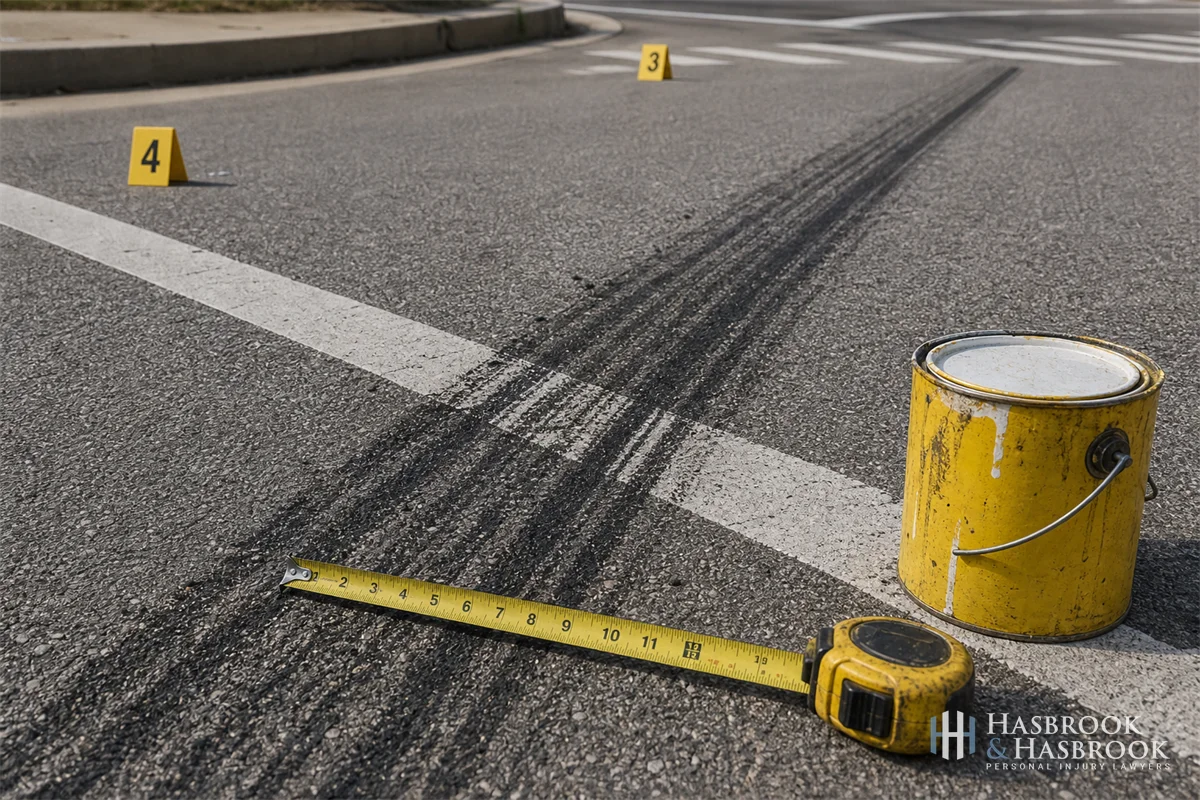
- Scene evidence: tire scrub marks across lane lines, gouges from the trailer’s rear corners, debris field, and vehicle positions before they were moved. Traffic-camera and business-camera footage often captures the swept path; recordings overwrite within days.
- Witness statements: drivers behind the truck and pedestrians at the corner often see the cab swing out before impact.
For preservation strategy, see evidence preservation in Oklahoma truck accident cases and the first 48 hours after a truck accident.


The carrier’s rapid response and how to counter it
Within hours of a serious wide-turn crash, the carrier’s insurer dispatches a rapid-response team that often includes an adjuster, a reconstructionist, and sometimes counsel. Their job is to lock down evidence and take statements before the family has retained a lawyer. The team will frame the crash as a no-fault swing-out or argue the injured driver entered the cab’s blind spot.
Two practical responses help: decline to give a recorded statement to the carrier’s insurer, and get a preservation letter to the carrier early so the duty to retain ELD data, ECM downloads, dashcam footage, mirror inspection records, and route documentation is formal. Failure to retain after notice supports spoliation sanctions. For more on dealing with the other side’s adjuster, see why a recorded statement to the carrier’s adjuster usually hurts the claim and how reservation-of-rights letters and quick lowball offers actually work; coverage issues are at truck insurance coverage gaps.
Damages in an Oklahoma wide-turn case
Wide-turn cases reach the upper end of the truck-accident range when the strike is at door height or the trailer rolls onto a smaller vehicle. Recoverable damages under Oklahoma law include past and future medical expenses, past and future lost income and lost earning capacity, pain and suffering and loss of enjoyment of life, punitive damages in cases of egregious carrier conduct (such as falsified hours-of-service logs or knowingly running drivers without swept-path training), and wrongful death damages under 12 O.S. § 1053 when the crash is fatal.
Background on settlement ranges is at typical recovery ranges for fatigue, brake-failure, and underride collisions. The personal-injury filing deadline is two years from the crash date under 12 O.S. § 95, with a separate deadline for wrongful death under § 1053. The evidence preservation window is measured in days, not years.
Steps to take after a wide-turn truck crash in Oklahoma
If you or a family member was in a wide-turn truck collision, the early actions matter:
- Call 911 and accept emergency medical evaluation, even without obvious symptoms.
- Do not give a recorded statement to the carrier’s insurer.
- Photograph the position of both vehicles before they are moved, tire scrubs across lane lines, and any gouges from the trailer’s rear corners.
- Get the trailer’s identifying information: DOT number, trailer number, and license plate.
- Collect names and contact information for every witness on scene, especially drivers behind the truck who saw the cab swing out.
- Note nearby business cameras and traffic-camera locations so a preservation letter can capture the footage before the loop overwrites.
- Contact a truck accident attorney before 48 hours pass so a preservation letter can reach the carrier before electronic records overwrite.
See also how a truck accident lawyer helps and the day-to-day case-development tasks counsel takes on after a CMV crash.
Frequently asked questions about wide-turn truck crashes
Is a wide-turn crash automatically the truck driver’s fault?
Not automatically, but often. Oklahoma turning-movement rules require a right turn from as close to the right curb as practicable. A driver who swings into the left lane to set up a right turn has shifted the burden onto the carrier to explain why the corner required the swing. Comparative fault still applies if the injured driver was speeding past the cab on the right.
What is the deadline to file a wide-turn truck accident lawsuit in Oklahoma?
Two years from the crash date for personal injury under 12 O.S. § 95, and a separate filing deadline for wrongful death claims under 12 O.S. § 1053. The evidence preservation window is shorter: ELD data, dashcam footage, and traffic-camera recordings can disappear within days.
Who can be sued in a wide-turn case?
Possible defendants include the truck driver, the motor carrier, the trailer’s owner if separate, a third-party maintenance contractor (for mirror or camera failures), and the shipper or broker if routing contributed.
Does Oklahoma’s comparative fault rule affect a wide-turn claim?
Yes. Under 23 O.S. § 13, an injured person can recover as long as their share of fault does not exceed 50%. A jury that finds the carrier 75% at fault and the injured driver 25% at fault reduces the verdict by 25%. The carrier’s insurer will push as much fault as possible onto the injured person, which is why complete scene evidence matters.
What is the no-zone, and does it bar my claim if I was in it?
The no-zone is the FMCSA’s term for the four blind areas around a tractor-trailer where a passenger vehicle is hard for the driver to see. Being in the no-zone does not bar a claim. The driver still has to plan the turn, sweep the mirrors, and check for vehicles before initiating a swing-out.
How long does a wide-turn truck accident lawsuit take in Oklahoma?
The arc varies with case complexity, number of defendants, and whether the case settles or tries. The general range is covered at how long a truck accident lawsuit takes in Oklahoma.

Talk to an Oklahoma truck accident attorney
A wide-turn case rewards early, organized work. The preservation letter, the trailer measurements, the reconstructionist’s swept-path overlay, and discovery requests for the driver’s training file all need to land before the carrier’s records and the scene markings disappear.
Hasbrook & Hasbrook Personal Injury Lawyers handle commercial trucking cases across Oklahoma, including wide-turn collisions in Oklahoma City, Tulsa, Edmond, and surrounding metros. Call (405) 605-2426 or send case details through our secure web intake for a free case evaluation. Our firm pulls the carrier’s records, retains the reconstructionist, and builds the engineering case.
Related coverage: our OKC commercial-vehicle case practice, our Tulsa-metro CMV crash practice, our Edmond corridor trucking practice, and underride truck accidents in Oklahoma.