Most people use “concussion” to mean a mild knock to the head and “traumatic brain injury” to mean something dramatic that lands a person in the ICU. The medical literature does not support that split. A concussion is a mild traumatic brain injury, the lowest-severity tier of TBI on the same diagnostic spectrum, not a separate or lesser condition. The Centers for Disease Control and Prevention, the American Congress of Rehabilitation Medicine, and the major neurological societies all classify concussion as mild TBI.
That distinction matters in personal injury cases because defense lawyers and adjusters rely on the public’s confusion. Calling an injury “just a concussion” makes it sound minor; calling the same injury a mild traumatic brain injury makes it sound serious. Both descriptions are accurate, and which one the jury hears affects the verdict. our Oklahoma City personal injury practice handles brain injury cases across Oklahoma and treats the medical taxonomy as the starting point of every claim.
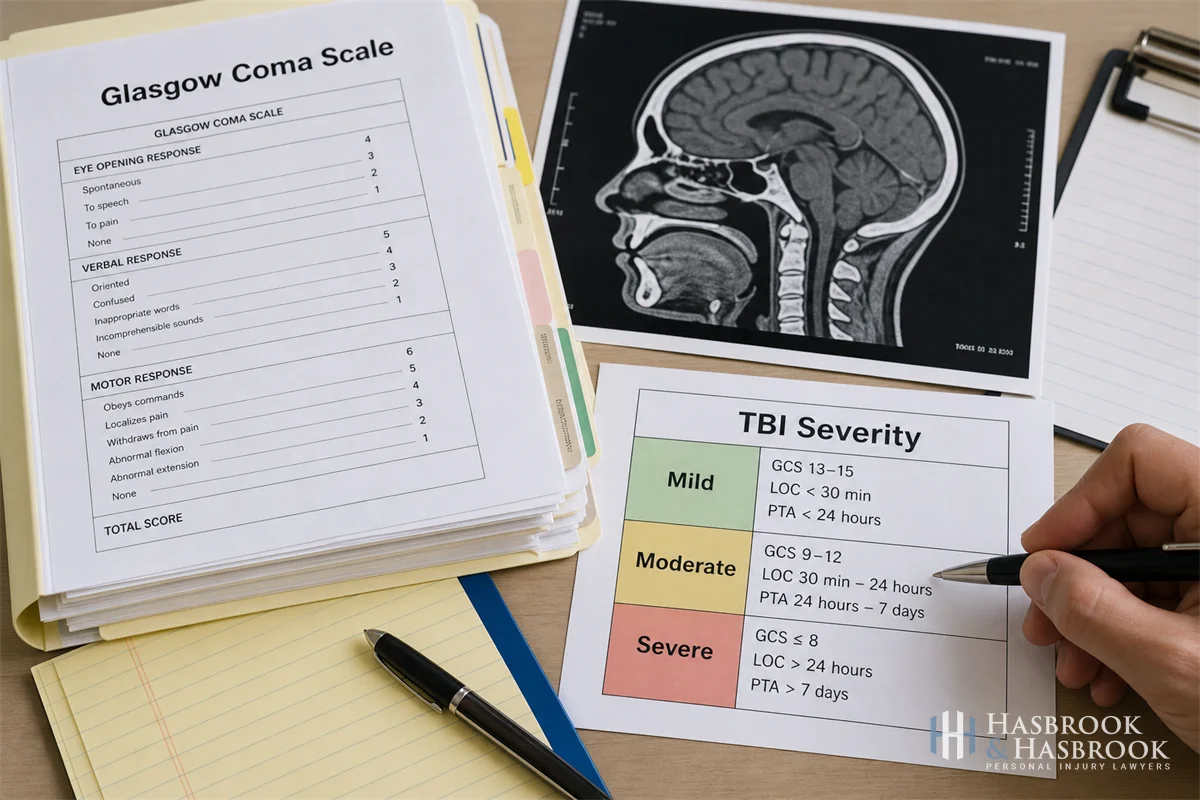
The medical definition: concussion is mild TBI
The standard clinical definition treats traumatic brain injury as any disruption of brain function caused by external force, whether a bump, a blow, a jolt, or a penetrating injury. What follows the impact determines severity. Loss of consciousness, post-traumatic amnesia, confusion, headache, nausea, balance problems, sensitivity to light or sound, and changes in cognition or mood all signal the brain has been injured.
The CDC’s TBI classification places concussion firmly inside the TBI category as the mild tier. The National Institute of Neurological Disorders and Stroke uses the same framework, as do the Mayo Clinic patient education library and the Cleveland Clinic Health Library. There is no version of the medical literature in which concussion is something other than mild TBI.
This matters in litigation: when a treating physician documents “concussion” on the discharge summary, that is a medical diagnosis of mild traumatic brain injury. When the defense lawyer argues at trial that the plaintiff’s case “is just a concussion, not a real brain injury,” the diagnosis itself is the answer. The chart says brain injury. The defense argument is rhetorical, not medical.
How severity is graded: the Glasgow Coma Scale
Clinicians grade TBI severity primarily by the Glasgow Coma Scale (GCS), a 15-point bedside assessment of eye opening, verbal response, and motor response. The score determines severity tier and drives imaging and treatment.
| Severity tier | GCS score | Loss of consciousness | Post-traumatic amnesia | Initial imaging |
|---|---|---|---|---|
| Mild TBI (concussion) | 13 to 15 | None or under 30 minutes | Under 24 hours | Often normal CT |
| Moderate TBI | 9 to 12 | 30 minutes to 24 hours | 1 to 7 days | CT or MRI, often abnormal |
| Severe TBI | 3 to 8 | Over 24 hours | Over 7 days | CT abnormal, ICU course |
The ED-documented score is the anchor. A patient who walks into triage oriented but reports a brief loss of consciousness at the scene is GCS 15 and almost certainly mild. A patient unresponsive to voice who only opens eyes to pain is in the moderate or severe range. The score is reproducible across clinicians, which is why defense neurologists and plaintiff’s experts both build opinions around it. The mild category is the largest by volume; the CDC’s TBI surveillance data shows the great majority of diagnosed TBIs fall in the mild range, which means most courtroom TBI cases are mild TBI cases.
Imaging differences: why a normal CT does not rule out injury
Imaging strategy splits sharply by severity. A moderate or severe TBI almost always shows a finding on a non-contrast CT in the emergency department: a contusion, an epidural or subdural hematoma, a subarachnoid bleed, midline shift, diffuse swelling, or a fracture. CT is fast, sensitive to acute bleeding, and the right tool for the moderate-to-severe range.
Mild TBI is different. A standard CT typically reads as normal, and an MRI in the days after injury is sometimes normal too. That does not mean the brain was not hurt. It means the structural injury is below the resolution of conventional imaging. The cellular damage in mild TBI happens at the axonal level, where neurons are stretched and torn at the microscopic scale; CT cannot see that, and even standard MRI often cannot.
The imaging that does see mild TBI is research-grade and not yet routinely insured:
- Diffusion tensor imaging (DTI). A specialized MRI sequence mapping white matter tracts; damaged axons disrupt the diffusion pattern even when conventional MRI shows nothing.
- Functional MRI (fMRI). Measures blood flow tied to brain activity. Common in research, less common in routine practice.
- Susceptibility-weighted imaging (SWI). Detects microbleeds invisible on standard MRI.
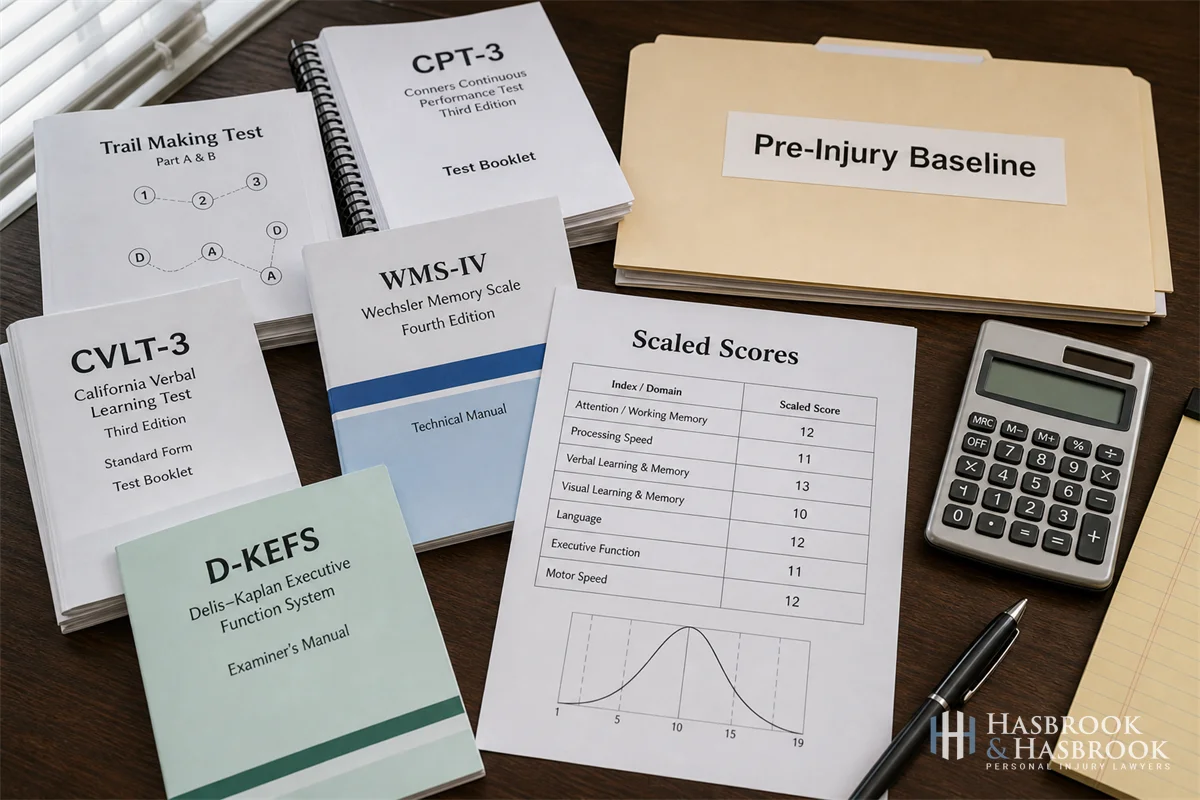
- Quantitative EEG and neuropsychological testing. Not imaging, but the same role: documenting an injury that does not show on a conventional film.
“The CT was normal” is a defense talking point, not a medical conclusion. Plaintiffs’ counsel works the imaging story carefully: which scans were ordered, which sequences were used, and what the treating neurologist or neuropsychologist concluded after a full workup. For more, see our piece on mild TBI litigation in Oklahoma and the invisible-injury problem.



Why laypeople and adjusters conflate the two terms
Three reasons explain why ordinary people, jurors, and some general-practice doctors use the terms as if they were different conditions. Sports culture made “concussion” the everyday word for a temporary football-or-hockey setback that benches a player for a week or two, making the term sound recoverable and minor. Medical communication style leads ER physicians to tell patients “you have a concussion” while documenting “mild traumatic brain injury” in the chart. Adjuster framing picks up the gap: bodily-injury adjusters learn that “concussion” cases settle for less than “traumatic brain injury” cases, even when the medical facts are identical. The Brain Injury Association of America publishes patient education materials that explicitly push back on the “just a concussion” minimization.
The practical takeaway: the question is not “is this a concussion or a TBI?” The question is “which severity tier does this TBI fall into, and what symptoms persisted past the acute phase?”
The defense playbook in mild TBI cases
Defense counsel in a mild TBI case has a familiar set of arguments. Counsel who knows the playbook answers each one before the jury hears it.
- “The CT was normal.” Mild TBI is below CT resolution; current diagnostic standards do not require imaging findings.
- “There was no loss of consciousness.” Current criteria do not require loss of consciousness. Confusion, disorientation, or altered mental state at the scene is sufficient.
- “It was just a concussion.” Concussion is mild TBI. The terms describe the same injury.
- “The plaintiff is exaggerating.” Neuropsychological testing with embedded validity measures detects symptom magnification; a clean validity profile is durable evidence.
- “Symptoms should have resolved by now.” A meaningful minority of mild TBI patients have symptoms that persist beyond three months, and a smaller subset have symptoms that persist for years.
- “Pre-existing conditions caused the symptoms.” Answered with pre-injury medical records, school transcripts, work performance reviews, and lay witnesses who knew the plaintiff before the event.
None of these defenses is frivolous, but each has a standard plaintiff’s response built on the medical literature.
The damages valuation gap between concussion-framing and TBI-framing
The same injury, framed two different ways, produces different settlement values. Oklahoma personal injury law makes no distinction between a “concussion case” and a “mild TBI case”; the valuation gap exists because adjusters, mediators, and juries respond to language. Records that use “concussion” exclusively, with no explanation, settle for less. Records that consistently use “mild traumatic brain injury” and walk through symptoms, treatment, and persistence of post-concussion findings settle for more.
That is why competent counsel asks treating physicians early to use the diagnostic term, not the colloquial one, in narrative reports and deposition testimony. Settlement valuation tracks a few hard variables: persistence past three months, neuropsychological testing results, work-loss documentation, treating-provider testimony, and the pre-injury baseline. See our overview of how much a traumatic brain injury is worth and our discussion of calculating pain and suffering damages.
Expert witness types in TBI litigation
The expert lineup in a mild TBI case looks different from a moderate-to-severe case. Severity drives which specialists matter most.
Mild TBI cases. The center of gravity is the neuropsychologist, who administers a multi-hour cognitive battery with embedded validity measures. A neurologist supports the diagnosis and rules out competing causes. A vestibular physical therapist may speak to balance and visual symptoms; a vocational expert addresses employment impact when symptoms persist.
Moderate and severe TBI cases. A neurosurgeon anchors causation testimony, a neuroradiologist explains imaging findings, a physiatrist addresses rehabilitation and prognosis, a neuropsychologist documents cognitive deficits, a life care planner builds the future-care projection (often into seven figures), and an economist reduces future damages to present value.
Oklahoma applies the expert-testimony standard at 12 O.S. § 2702, which mirrors Federal Rule of Evidence 702 and incorporates Daubert reliability factors. Defense Daubert motions typically target neuropsychological methodology, DTI interpretation, and life care plan assumptions.

Where Oklahoma personal injury law fits in
The legal framework for a TBI claim in Oklahoma is the standard negligence framework: duty, breach, causation, damages. The brain injury is the harm caused by the defendant’s breach. Severity affects damages rather than liability.
- Statute of limitations. Two years from the date of injury under 12 O.S. § 95. The clock starts when the injury occurs, not when post-concussion symptoms become disabling.
- Comparative fault. Oklahoma uses modified comparative negligence under 23 O.S. § 13. Recovery is reduced by the plaintiff’s share of fault and is barred when the plaintiff’s share exceeds 50%.
- Paid not incurred. Medical-bill recovery is limited to amounts actually paid under 12 O.S. § 3009.1, compressing the medical-bills column when health insurance has paid at contracted rates.
- Government defendants. Tort claims against governmental entities trigger the Oklahoma Governmental Tort Claims Act. A written notice of claim must be presented within one year of the loss under 51 O.S. § 156.
- Medical causation. The plaintiff links the impact to the diagnosis to the persistent symptoms to the resulting losses. See Cornell Law’s negligence overview for the doctrinal framework.
For procedural background, see our pieces on the two-year filing window under 12 O.S. § 95 and comparative versus contributory negligence.
Settlement-value benchmarks: ranges, not numbers
Practitioners who quote a single dollar number for a “typical TBI settlement” are not being honest about the variability. A few patterns hold across mild-TBI files in Oklahoma:
- Quick-resolution mild TBI. Symptoms resolved within four to six weeks, neuropsychological testing normal, no demonstrable work loss. These cases settle on the lower end of the auto-injury range, often in the soft-tissue tier despite the brain-injury label.
- Persistent post-concussion mild TBI. Symptoms documented past three months, neuropsychological testing showing measurable deficits, lay witnesses confirming personality and cognitive change, and work-loss documentation. These settle in a meaningfully higher range.
- Moderate TBI. Imaging findings, ICU admission, persistent cognitive and behavioral changes. Values move into the range that drives life care planning and economist testimony.
- Severe TBI with permanent impairment. Catastrophic-injury caseload, built around the life care plan, the loss-of-earning-capacity analysis, and structured settlement options. See life care plans in Oklahoma catastrophic injury cases, diminished work capacity damages, and structured settlements for catastrophic cases.
The variables that move a case within these tiers are the same in every file: symptom persistence, pre-injury baseline, neuropsychological validity, treating-provider engagement, and causation strength. None of them is set by which word the chart uses.
Educating the jury on the medical taxonomy
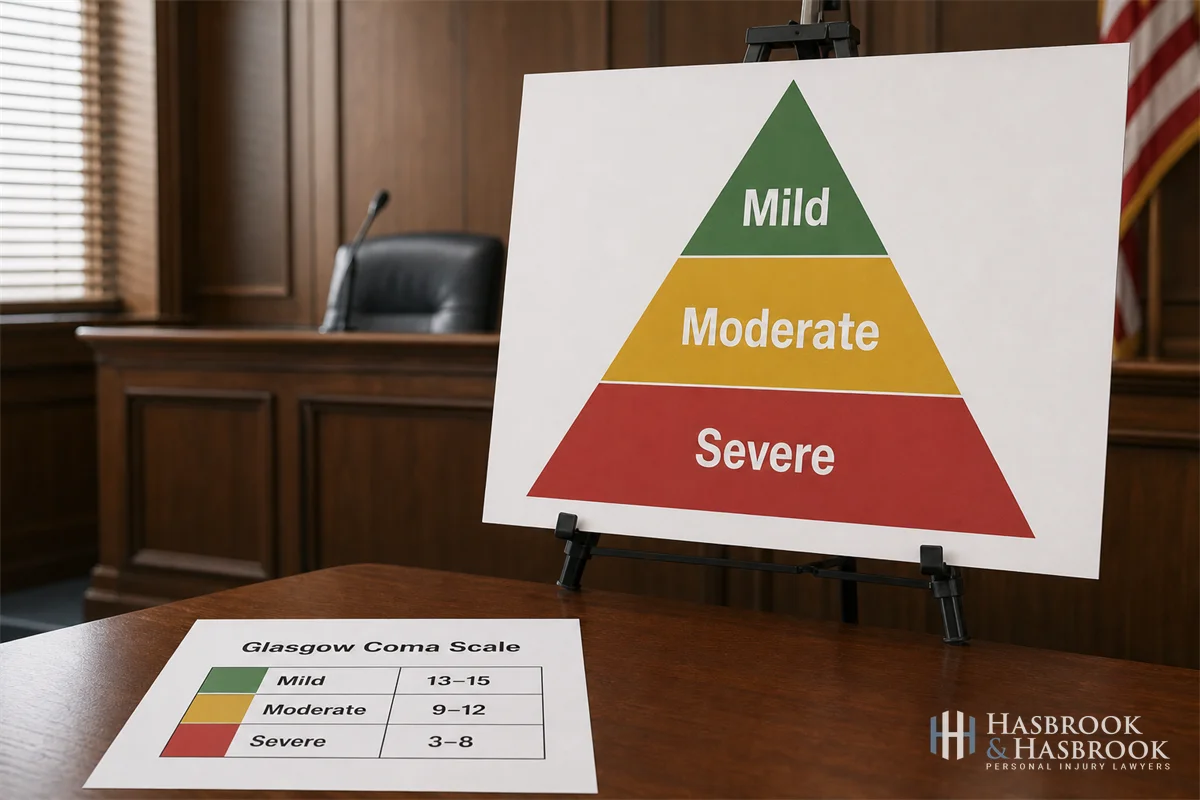
If a brain injury case reaches a jury, the most important pre-trial work is the medical-literacy work. Jurors arrive with the same conflation as the general public: concussion sounds minor, TBI sounds dramatic. The trial team’s job is to align the jury’s understanding with the medical record before the defense reaches closing argument. The methods are well-known: clean direct examination of the treating neurologist on the diagnostic spectrum; demonstratives that show concussion sitting inside the TBI category, not next to it; neuropsychological testimony explaining how cognitive deficits show on testing even when imaging is normal; and lay witness testimony from family members and co-workers describing the before-and-after picture.
The opposite mistake is over-claiming. A mild TBI plaintiff who demands catastrophic-injury damages with no objective findings loses credibility quickly. At our firm we pitch the case at the level the medical record supports, no higher and no lower. For broader brain-injury context, see our pages on Oklahoma City brain injury, cognitive testing, post-concussive symptoms families should watch for in the first month, recovery from mild-to-moderate TBI, return to work, and the litigation hurdles unique to mild TBI cases.
Frequently asked questions
Is a concussion the same thing as a TBI?
Yes. A concussion is a mild traumatic brain injury under the standard medical classification used by the CDC, the National Institute of Neurological Disorders and Stroke, and the major neurological societies. The two terms describe the same injury at the lowest severity tier of the TBI spectrum.
If my CT scan was normal, do I still have a TBI?
Yes. Mild traumatic brain injury is typically below the resolution of standard CT and often below standard MRI. The diagnosis is clinical, based on the mechanism, the symptoms, and the post-injury examination. A normal CT rules out the acute bleeding that requires emergency surgery; it does not rule out mild TBI.
How long do post-concussion symptoms typically last?
Most mild TBI symptoms resolve within four to six weeks. A meaningful minority of patients have symptoms that persist past three months (sometimes called post-concussion syndrome), and a smaller subset have symptoms that persist for a year or longer. Persistence is the variable that most affects case value.
What is the deadline for filing an Oklahoma brain injury lawsuit?
Two years from the date of injury under 12 O.S. § 95 for a typical personal injury claim. Claims against governmental entities are subject to the Oklahoma Governmental Tort Claims Act, which requires a written notice of claim within one year of the loss.


Talk to our firm
If you or a family member has suffered a head injury in an Oklahoma crash, fall, or workplace event, the medical taxonomy is where the case starts. To discuss whether the diagnosis on your record supports a claim, call (405) 605-2426 or use our online intake. The first conversation is free, and there is no fee unless we recover for you.