Mild traumatic brain injury (mTBI) cases are won and lost on credibility. Imaging often comes back normal, symptoms fluctuate, and a client describing brain fog or word-finding trouble does not look injured to a jury. Defense lawyers run a structured playbook against these claims. This FAQ walks through the common tactics and how to counter each. For the parallel piece on how to prove a mild TBI, see our guide on proving a mild TBI as an invisible injury.
Why mild TBI claims are uniquely hard to litigate
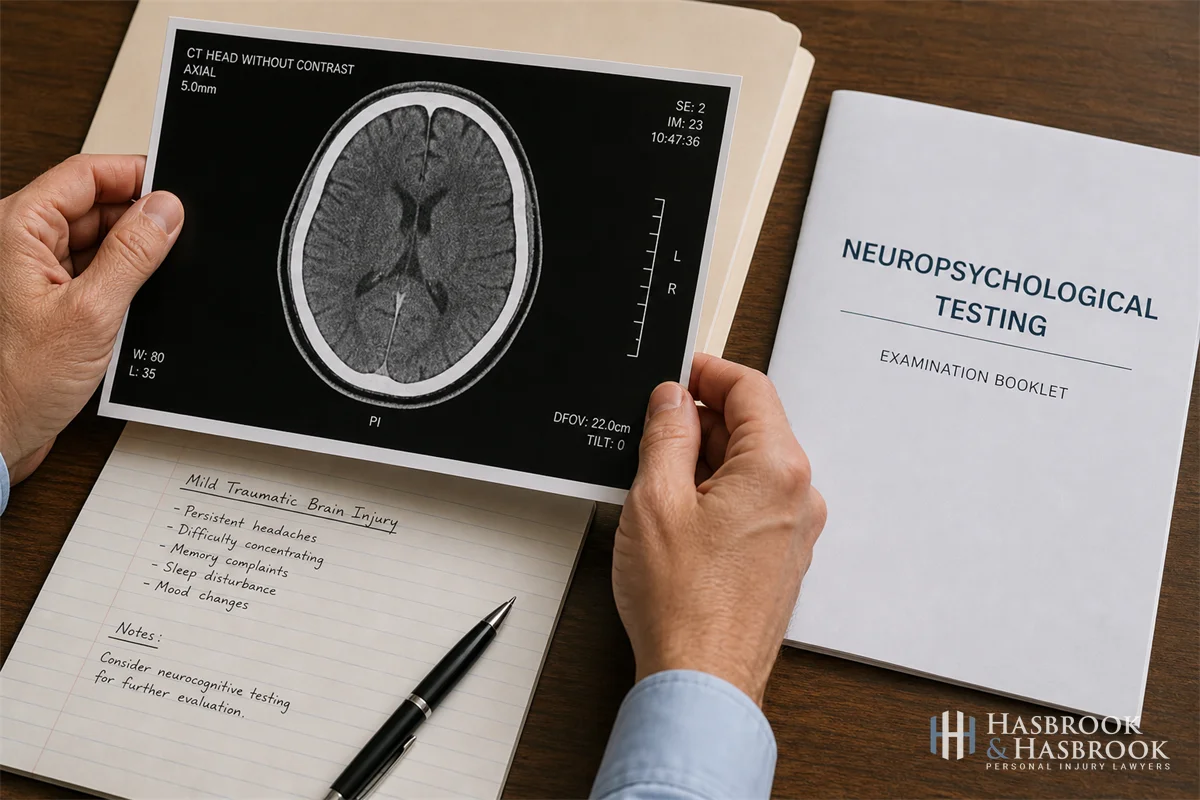
The Centers for Disease Control reports roughly 75 to 85 percent of traumatic brain injuries are classified as mild, and most do not show on a standard CT scan. The Cleveland Clinic notes that a concussion is a functional injury, not a structural one: the disruption is in how brain cells communicate, not in tissue you can photograph. The injury is real but the proof is indirect. Defense arguments fall into four categories: symptoms are exaggerated, real but caused by something else, would have resolved anyway, or the plaintiff is malingering.



Downplaying symptoms and the missing-imaging attack
The simplest defense tactic is the most common. The adjuster finds the early ER note (“GCS 15, no LOC, alert and oriented”) and treats that snapshot as the whole case: plaintiff was fine when EMS arrived, the CT was clean, later complaints are ordinary stress or pre-existing conditions.
Counter-evidence comes from the longitudinal record. The CDC’s TBI surveillance data recognizes post-concussive symptoms can appear or persist for weeks, and Mayo Clinic guidance confirms conventional imaging is often normal even with significant ongoing symptoms. A two-week-out primary-care visit documenting fatigue, photophobia, and sleep disturbance carries more weight than the day-of ER note.
For the missing-imaging attack, pursue advanced imaging where clinically warranted (diffusion tensor, susceptibility-weighted, PET, SPECT), although admissibility varies by judge. Then address the imaging question through the treating physician: explain why a normal CT does not rule out a brain injury and why neurology relies on clinical examination, symptom course, and neuropsychological testing rather than pictures alone.
Secondary-gain arguments and malingering testing
“Secondary gain” is the defense theory that an active claim gives the plaintiff a financial reason to magnify symptoms. Defense neuropsychologists administer effort tests to detect this, and a poor effort score is often the most damaging single finding. Common standalone tests include TOMM, WMT, and MSVT (Test of Memory Malingering, Word Memory Test, and Medical Symptom Validity Test). Most full batteries also embed validity indicators.
Plaintiffs need their own neuropsychological evaluation that explicitly addresses validity. The contrast between treating and defense experts is predictable:
| Issue | Defense neuropsychologist | Treating neuropsychologist |
|---|---|---|
| Posture | One-time forensic exam, 2-3 hours | Multi-session, tied to treatment |
| Effort testing | Flag malingering, discredit deficits | Confirm validity, support diagnosis |
| History review | Find inconsistencies, prior complaints | Track symptom trajectory, treatment response |
| Conclusion focus | Whether complaints can be objectively confirmed | What the deficits are, how they affect daily function |
Where a defense exam reports failed validity, the better response is rarely to attack the test. Show why the condition was unrepresentative: headache that day, medication effects, fatigue from a long session, or adversarial examiner behavior. A clarifying affidavit from the treating neuropsychologist usually works better than cross on the test.
ImPACT baseline disputes and gap-in-care attacks
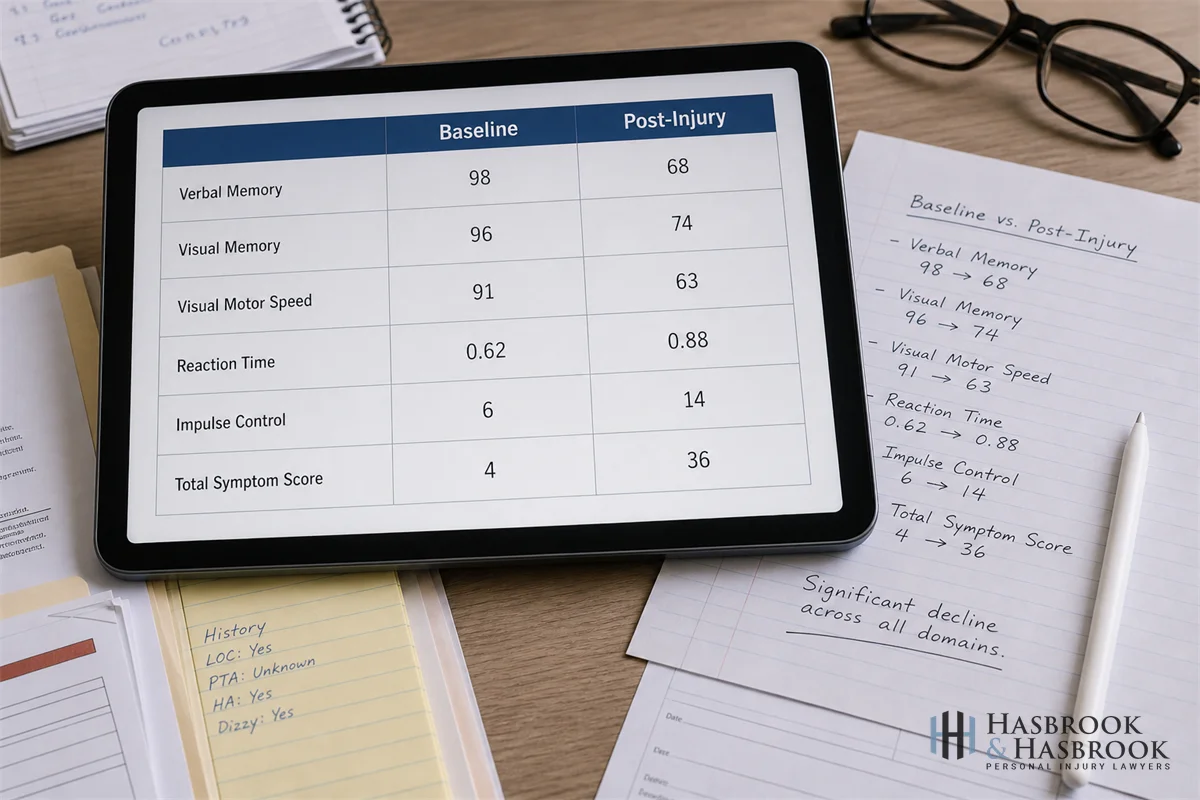
Immediate Post-Concussion Assessment and Cognitive Testing (ImPACT) is a computerized neurocognitive screen widely used in sports medicine. Many schools and teams collect baseline scores before the season, then compare post-injury results against that baseline.
Where ImPACT helps: a clean pre-injury baseline plus a post-injury score showing measurable decline gives a strong before-and-after picture. Where it hurts: no baseline, or one taken when the athlete was sandbagging, leaves the test open to attack. ImPACT works best as one data point alongside symptom inventories, vestibular and oculomotor testing, and a structured neuropsychological battery, not as a standalone diagnostic tool.
“Gap in care” is defense shorthand for any meaningful interval between the injury and a documented complaint. Three gap patterns recur:
- Early gap: ER discharge, then no provider for two or three weeks. Counter: post-concussive symptoms commonly emerge 24 to 72 hours after the event, often once the patient is back home or back at work.
- Treatment gap: A stretch with no visits between PT and a return to neurology. Counter: insurance-driven plateaus, referral waits, and a patient managing residual symptoms at home while waiting on a specialist.
- Vocational gap: Plaintiff returns to full-time work. Counter: returning to work does not equal full function. Many return on accommodations, shorter hours, or FMLA-protected leave the employer documents.
Documentary evidence closes most gap arguments: a scheduling note showing the patient called within 48 hours of the ER, an authorization denial letter, an accommodation request, or a symptom log. a contemporaneous symptom and treatment log earns its keep here.

Pre-existing conditions and the comparative-fault overlay
Mild TBI defendants love comorbidities. Prior depression, anxiety, ADHD, sleep disorders, migraine history, learning disabilities, and prior concussions all get flagged as alternative explanations. The narrative is that the plaintiff would have these problems anyway.
Oklahoma’s eggshell-skull rule says a defendant takes the plaintiff as found. A claimant with a prior anxiety diagnosis whose post-injury symptoms are objectively worse can recover for the worsening, but only if the record draws a clean before-and-after line. Obtain prior treating records, psychotherapy notes, and employer performance reviews early; the defense will subpoena them anyway.
Comparative-fault arguments often piggyback. Under 23 O.S. § 13, recovery is barred when the claimant’s share of fault is greater than the combined fault of all defendants. In mild TBI car cases, expect arguments about distraction, seatbelt non-use, or contribution to the collision. A finding above 50 percent on the plaintiff ends the case.
Juror skepticism and the lay-witness fix
Most jurors have had a headache. Many have had a concussion in a sport or a minor fall. The injury feels familiar, which is the problem. A juror who recovered in three days is naturally suspicious of a plaintiff still impaired a year later.
Lay-witness testimony is the best counter. A spouse, coworker, or close friend who describes specific behavioral, functional, memory, or temperament changes between before and after the injury is more persuasive than expert testimony alone. “He used to balance the checkbook every weekend, and now he can’t follow a YouTube recipe” sticks with a jury in a way an MMSE score does not.
Lay-witness preparation checklist:
- Identify three to five observers who knew the plaintiff well before the injury.
- Have each one keep a contemporaneous journal of specific incidents with dates for at least 60 days post-injury.
- Prepare them to describe concrete examples, not generalities.
- Use pre-injury family video where it exists. Birthdays, vacations, and holidays capture function.
Damages and what to do early in your case
Mild TBI damages center on cognitive, behavioral, and earning-capacity changes rather than scars or hardware. Categories include medical expenses (neurology, neuropsychology, vestibular and vision therapy, cognitive rehab, psychiatric care), lost wages, reduced earning capacity, pain and suffering, and loss of consortium. See how a TBI claim is valued, cognitive testing, earning capacity, and life-care plans. For related background, see concussion versus TBI and whether full recovery is realistic.
The first 30 days set the foundation: get evaluated same-day or next-day; track symptoms daily in writing; obtain a neurology referral; ask about neuropsychological testing 8 to 12 weeks post-injury with effort testing; preserve work records; avoid social media (social media can sink a personal injury lawsuit); and talk with an attorney early so preservation letters for surveillance footage, EDR data, and 911 audio go out fast. The discovery process is where most preservation happens. See also return to work after a brain injury.
Hasbrook & Hasbrook Personal Injury Lawyers represent Oklahoma brain injury claimants statewide. Our firm has handled mild TBI cases through litigation and trial. Call (405) 605-2426 for a free consultation, or tell us about your TBI claim through the intake form.


Frequently asked questions
Can I win a mild TBI case if my CT scan was normal?
Yes. Most mild TBI patients have normal CT scans and routine MRIs because the injury is functional rather than structural. Wins come from longitudinal medical records, neuropsychological testing with documented effort, neurologist testimony, and lay witnesses who describe before-and-after changes.
What is a “secondary gain” argument and how do plaintiffs answer it?
Secondary gain is the defense theory that an active claim motivates a plaintiff to magnify symptoms for money. The response combines documented effort testing, contemporaneous symptom logs, and lay-witness testimony from observers with no financial stake.
How does comparative fault apply in a mild TBI car-accident case?
Oklahoma’s comparative-fault rule under 23 O.S. § 13 bars recovery when the claimant’s share of fault is greater than the combined fault of all defendants. Defense counsel often argue distraction, following distance, or seatbelt non-use. A finding above 50 percent on the plaintiff ends recovery entirely.
Is ImPACT testing good or bad for a brain injury claim?
It depends on the baseline. With a clean pre-injury baseline plus a post-injury score showing measurable decline, ImPACT supports a claim. Without a baseline, or with one taken when the test-taker was sandbagging, ImPACT is vulnerable to defense attack.
How long after a head injury can post-concussive symptoms appear?
Post-concussive symptoms can emerge or worsen 24 to 72 hours after the initial event and persist for weeks to months. A several-day gap between the accident and symptom onset is medically expected, not evidence the injury was minor.
What records strengthen a mild TBI claim the most?
All medical records from the date of injury forward, a contemporaneous symptom diary, employer records of missed work or accommodations, prior records establishing baseline function, a neuropsychological evaluation with effort testing, and lay-witness statements. Anything that establishes a clean before-and-after comparison is worth obtaining.