Hours of service violations carry civil fines from the Federal Motor Carrier Safety Administration, mandatory out-of-service orders, and in serious cases criminal exposure for the carrier. In Oklahoma, the same logbook records that trigger federal penalties become powerful liability evidence in a civil truck-accident case. Hasbrook & Hasbrook Personal Injury Lawyers handles Oklahoma truck-crash cases where driver fatigue is suspected, and HOS records are the first evidence we preserve.
What are the federal hours of service rules?
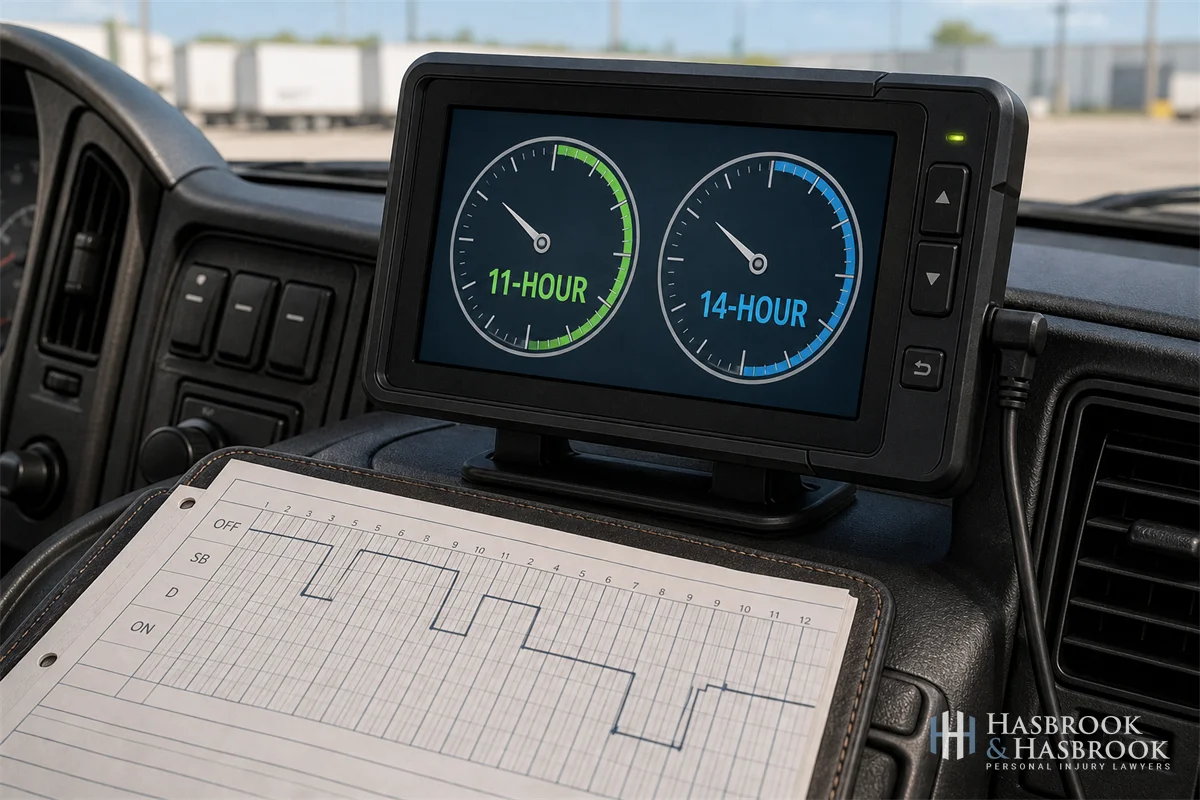
The HOS rules cap driving and on-duty time per shift and per rolling week. They are codified at 49 CFR Part 395 and enforced by the Federal Motor Carrier Safety Administration. They cover commercial vehicles 10,001 pounds or more, vehicles with placarded hazardous materials, and buses carrying 9 or more passengers for hire. The property-carrying framework has five core limits:
- 11-hour driving limit. A driver may drive a maximum of 11 hours after 10 consecutive hours off duty.
- 14-hour on-duty window. A driver cannot drive beyond the 14th consecutive hour after coming on duty, even if not all of those hours were spent driving.
- 30-minute break. A driver must take a 30-minute non-driving break after 8 cumulative hours of driving.
- 60/70-hour weekly limit. No driving after 60 hours on duty in 7 days, or 70 hours in 8 days. The clock restarts after 34 consecutive hours off.
- Sleeper-berth provision. A driver using a sleeper berth may split the required 10 hours off into two qualifying periods (7/3, 8/2, or similar).
Passenger-carrying drivers operate under parallel caps. Short-haul drivers within a 150 air-mile radius who return to the same work location each day may use a simplified record, but the underlying hours still count. Required-break rules for Oklahoma truck drivers follow this federal framework.
Violations surface at roadside inspections, carrier compliance reviews, and post-crash investigations. The ELD mandate requires nearly all interstate carriers to use a registered device that automatically records driving time and location. After a serious crash, FMCSA or the Oklahoma Highway Patrol can subpoena the logs and dispatch records.



What are the civil penalties for HOS violations?
FMCSA assesses civil penalties under 49 CFR Part 386. Dollar amounts adjust annually for inflation. The principal categories:
| Violation type | Civil penalty range | Who pays |
|---|---|---|
| Driving after 11/14-hour limit (driver) | Up to about $1,800 per violation | Driver |
| Carrier requiring or permitting a violation | Up to about $18,000 per violation | Carrier |
| Pattern of violations (egregious) | Up to about $26,000 per violation | Carrier |
| False record of duty status | Up to about $14,000 per occurrence | Driver and/or carrier |
| ELD non-compliance (no device, tampering, missing data) | Up to about $1,800 per violation | Driver and/or carrier |
| Hazmat-related HOS violation | Up to about $90,000 per violation | Carrier |
Penalties stack. One trip can produce a violation for driving past the 11-hour limit, a second for falsifying the log, and a third for the carrier dispatching past the 60-hour weekly cap. Hazmat penalties are an order of magnitude higher.
What is an out-of-service order?
An out-of-service order is the most immediate consequence of a serious HOS violation. The inspector parks the truck wherever it sits, and the carrier cannot dispatch a replacement to the same load until the violation is cured. Triggers include driving after the 11-hour, 14-hour, or 60/70-hour limit; no required record of duty status; and driver fatigue documented at the scene.
The order does not produce a fine on its own; the fine attaches separately. But the order shows up on the carrier’s CSA (Compliance, Safety, Accountability) score and follows the carrier in future inspections. The Insurance Information Institute publishes commercial-line loss-cost trends showing that HOS and fatigue cases drive a meaningful share of commercial-auto claim severity.
Are there criminal penalties?
Most HOS violations are civil. Criminal exposure exists in two narrow categories. First, knowingly falsifying a log: a driver or dispatcher who creates a false record of duty status, or instructs another to do so, can be charged with a federal misdemeanor under 49 U.S.C. § 521(b)(6). Second, HOS violations that cause death: if a driver knowingly drove past the limit and caused a fatal crash, federal prosecutors can pursue charges and Oklahoma district attorneys can file negligent-homicide or manslaughter charges. Carrier executives have faced charges where dispatch records show a pattern of pressuring drivers to violate the rules.

How do HOS violations affect a civil truck-accident case in Oklahoma?
This is where the federal regulation becomes load-bearing in a civil case. An HOS violation does three things:
- Establishes negligence as a matter of law. A safety regulation designed to prevent the type of harm that occurred is strong evidence of negligence. Driver-fatigue rules exist to prevent fatigue crashes; an injured motorist is squarely in the protected class.
- Supports a direct claim against the carrier. Oklahoma recognizes both vicarious liability and direct claims for negligent hiring, training, supervision, and entrustment. A pattern of HOS violations the carrier knew or should have known about can support direct liability even where the driver is judgment-proof. Our FAQ on suing the trucking company or just the driver walks through that distinction.
- Opens the door to punitive damages. Oklahoma allows punitive damages for reckless trucking conduct under 23 O.S. § 9.1 when conduct is reckless or willful. A driver who falsified a log and drove past the 14-hour cap, or a carrier that pressured drivers to do so, can face punitive damages on top of compensatory damages.
Oklahoma adopts the federal rules for intrastate drivers with limited variations for agricultural haulers, with the Corporation Commission and Department of Public Safety enforcing alongside FMCSA. The Oklahoma truck-accident statistics show fatigue is a recurring contributing factor, and the two-year personal-injury statute of limitations under 12 O.S. § 95 governs the civil case window.
Civil and criminal exposure typically lines up by violation type as follows:
| Pattern | Civil fine | Out-of-service likely? | Criminal exposure? | Civil-case impact |
|---|---|---|---|---|
| 14-hour exceeded, no falsification | Yes | Yes | Low | Strong negligence evidence |
| 11-hour exceeded, no falsification | Yes | Yes | Low | Strong negligence evidence |
| False log to extend hours | Yes (higher) | Yes | Yes (misdemeanor) | Punitive-damages exposure |
| Carrier-pressured falsification pattern | Yes (carrier-level) | Yes | Yes (executives) | Direct corporate liability + punitive |
| Hazmat HOS violation | Up to $90,000 | Yes | Possible | Strong negligence + punitive |
| ELD missing or tampered | Yes | Yes | Possible | Adverse-inference jury instruction available |
How do you prove an HOS violation caused the crash?
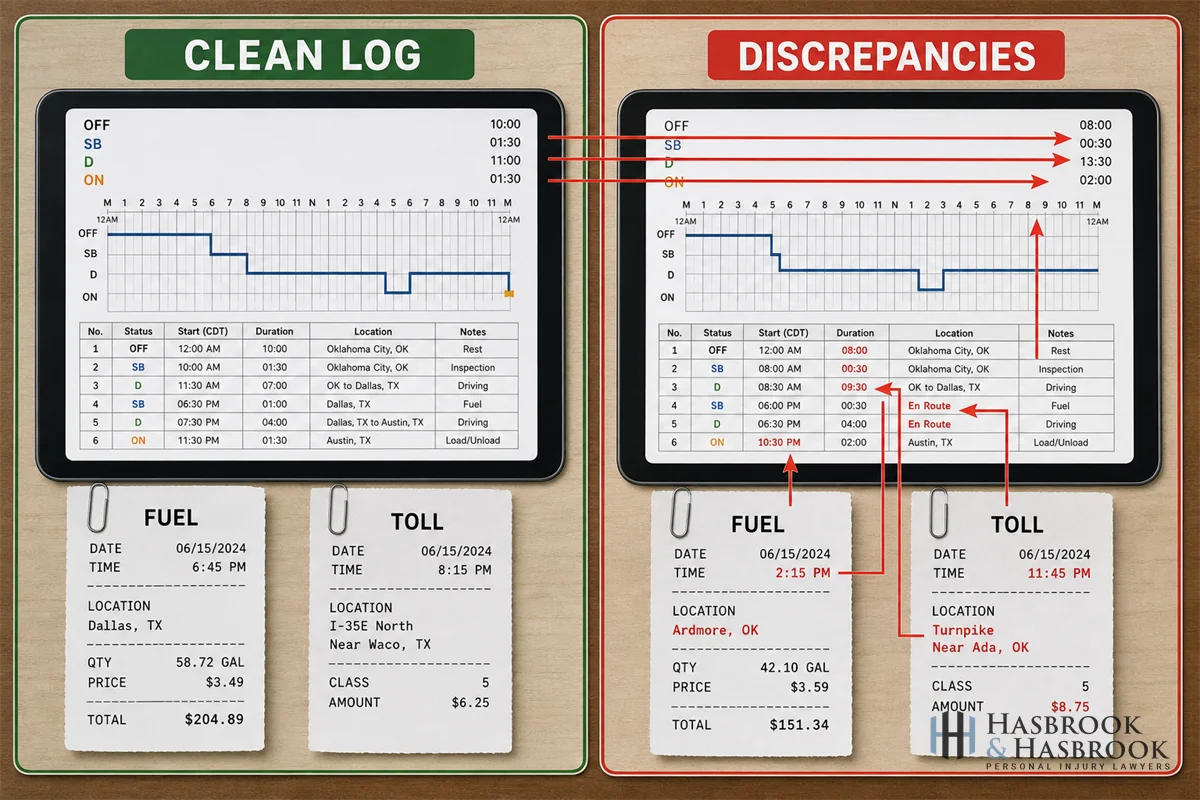
Proving the violation is one task; proving it caused the crash is a separate one. The two pieces of evidence that most often connect them are the ELD timestamp at impact and post-crash fatigue indicators. If the device shows the driver was 12 hours into an 11-hour limit at impact, the violation and the crash are simultaneous. Fatigue-crash signatures include no skid marks, no evasive steering, a straight-line lane departure, or the driver admitting at the scene that they “must have nodded off.”
An accident-reconstruction expert ties these together. Our work centers on preserving the ELD and black-box data before it is overwritten, and on the first-48-hours response that locks down dispatch records, fuel receipts, and toll records. The evidence-preservation guide details the spoliation-letter process.
Checklist: HOS evidence to preserve immediately after a crash
- Driver’s ELD data (last 7 days minimum)
- Driver’s paper log if any
- Dispatch records and load assignments
- Bills of lading for the trip and the prior 7 days
- Fuel receipts and toll records
- Carrier’s qualification file (DQ file) on the driver
- Carrier’s CSA history and prior out-of-service orders
- Cell phone records during the trip
- Onboard camera footage if equipped
- Engine control module data (the truck’s “black box”)
Our DQ file request checklist covers the qualification documents to subpoena, and our overview of Oklahoma truck-insurance minimums explains why carrier-level evidence matters for collectibility. HOS violations also surface in underride collisions and wide-turn truck crashes; for broader framing, see how a truck-accident lawyer helps and fault in truck-accident cases.
Frequently asked questions
How much is the fine for driving past the 11-hour limit?
Civil penalties for a driver who exceeds the 11-hour limit run up to about $1,800 per violation, with carrier-side penalties for permitting the violation reaching about $18,000. The exact figure depends on FMCSA’s annual inflation adjustment, severity, and prior violations.
Can a driver be fired for an HOS violation?
Yes. Most carriers treat out-of-service-level HOS violations as terminable, and a pattern of violations almost always ends the carrier-driver relationship.
Is the 30-minute break a real penalty risk?
Yes. The ELD record makes it easy to detect, and the penalty counts on the carrier’s CSA score.
Do HOS rules apply to owner-operators?
Yes. The rules attach to the vehicle, not the employment relationship. An owner-operator on their own authority is subject to the same limits as a company driver.
Can I get the trucking company’s HOS records before filing suit?
You generally need litigation tools. A pre-suit spoliation letter puts the carrier on notice to preserve records; once suit is filed, records come through subpoena and request for production. Federal retention windows are short.

How our firm handles HOS-violation truck cases
At our firm, the HOS evidence is the first thing we look at when a truck crash comes in. The last 7 days of ELD data, dispatch records, and supporting documents tell us whether fatigue is in play before we depose the driver. When the violation is there, carrier exposure goes up, the punitive question becomes live, and settlement leverage shifts. Our truck-accident settlement guide covers how leverage translates to recovery.
If a commercial truck hit you in Oklahoma and you suspect the driver was over hours, the records that prove it are perishable. Call (405) 605-2426 for a free case review.