No. Lane splitting is illegal in Oklahoma. Under 47 O.S. § 11-1103(D), no motorcycle rider may pass other vehicles between lanes of traffic traveling in the same direction, whether that traffic is crawling or stopped. The only exception is the operator of an authorized emergency vehicle. Violations bring fines, license points, and complications in injury claims.
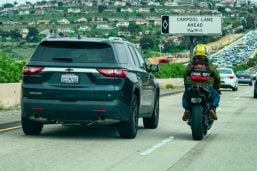 Riding the stripe past slower cars might save a few minutes on I-35, but Oklahoma treats the space between lanes as off limits. Split anyway and you pick up a traffic violation, plus an argument the insurance company will use against you if a crash follows.
What Oklahoma’s Lane Splitting Law Says
 The prohibition reaches past motorcycles. Section 11-1103(D) applies the same rule to motor-driven cycles, motorized scooters, motorized bicycles, and electric-assisted bicycles: none may pass other vehicles between lanes of traffic headed the same direction. It applies whether traffic is stopped at a red light or backed up bumper to bumper.
A citation is only the start. Points go on your driving record, premiums climb, and repeat violations can risk license suspension. Lane discipline is one strand of Oklahoma’s motorcycle traffic laws, and the Oklahoma Highway Safety Office publishes rider safety guidance built around them.



Lane Splitting vs. Lane Filtering
Lane splitting means riding between two lanes of moving traffic. Lane filtering means easing between stopped or nearly stopped vehicles, usually at a light, to reach the front of the queue. Some traffic codes draw that line. Oklahoma’s does not: the statute bars passing between lanes without qualifying by speed, so filtering is illegal here too.
Lawmakers have considered changing that. House Bill 2667, introduced in 2021, would have let two-wheeled motorcycles lane filter under certain conditions by amending Section 11-1103. The bill died, and no filtering exception exists in Oklahoma today.
Is Lane Splitting Legal Anywhere in the U.S.?
California is the only state that fully allows lane splitting, and the California Highway Patrol publishes safety guidance for riders who do it. A handful of states permit the narrower practice of lane filtering, among them Arizona, Montana, Colorado, Minnesota, and Utah, whose lane filtering rules spell out where and how slowly it is allowed. Hawaii has a narrow carve-out of its own.
None of that travels with you. The moment you ride into Oklahoma, the stricter rule applies, whatever state issued your plate.


How Lane Splitting Affects an Oklahoma Accident Claim
 Insurers lean hard on lane splitting after a motorcycle wreck. If you were hit while lane splitting, expect the adjuster to argue the violation makes the crash entirely your fault and the claim worthless. Oklahoma law is not that absolute.
Under the comparative negligence statute, 23 O.S. § 13, you can recover as long as your fault does not exceed 50%, with the award reduced by your percentage. A lane-splitting citation is one piece of the fault picture, not the end of it. The driver who swerved across a lane without signaling, or was looking at a phone, still carries a share.
Fault allocation is where these cases are won or lost, and it turns on early evidence: scene photos, camera footage, witness accounts. An attorney who handles Oklahoma motorcycle crashes can pin down lane position and driver behavior before the insurer’s version hardens. For a sense of value, see what motorcycle claims typically pay in Oklahoma.
Common Questions About Oklahoma’s Lane Splitting Laws
Is lane filtering legal in Oklahoma?
No. Oklahoma’s statute prohibits passing between lanes at any speed, so filtering through stopped traffic at a light is treated the same as splitting on the highway.
Can motorcycles split lanes in Oklahoma?
No, and neither can motor-driven cycles, motorized scooters, or electric-assisted bicycles. Only operators of authorized emergency vehicles are exempt, and you can be ticketed for lane splitting even when no accident happens.
How long do you have to file a motorcycle accident lawsuit in Oklahoma?
Two years from the crash for most injury claims, under 12 O.S. § 95. Evidence fades much faster than that, so the practical deadline is earlier.

Talk to an Oklahoma Motorcycle Accident Lawyer
 If a driver hit you while you were riding, do not let a lane-splitting argument talk you out of a claim you may still have. Hasbrook & Hasbrook handles motorcycle accident cases, including lane-splitting crashes, and the consultation is free. Call (405) 605-2426 or tell us about your motorcycle crash online.