Yes. Oklahoma law lets you recover compensation for emotional distress after a car accident caused by someone else’s negligence, provided the distress stems from a physical injury and significantly affects your daily life. Your recovery is reduced by your share of fault, and it’s barred only if your fault exceeds 50 percent under Oklahoma’s comparative negligence law (23 O.S. § 13).
If you are suffering from emotional distress after a negligent driver’s crash in the Oklahoma City metro, you can pursue compensation for that mental anguish, though proving it can be more challenging than proving a physical injury.
A car accident can be a traumatic experience that leaves an injured person struggling with more than broken bones or torn ligaments. Many people involved in serious crashes also deal with anxiety, depression, or other psychological injuries that make it hard to resume normal life.
Understanding Emotional Distress
Emotional distress, also called mental anguish, is the psychological suffering that follows a traumatic event. After a car accident, it can show up as:
- Anxiety or fear related to driving or riding in a vehicle
- Depression or feelings of hopelessness
- Sleep disturbances such as insomnia or nightmares
- Mood swings and irritability
- Difficulty concentrating
- Post-traumatic stress disorder (PTSD), often with flashbacks of the crash and grounds for a separate claim
These symptoms can affect a person’s relationships, work, and daily routine. The American Psychological Association publishes guidance on recovering emotionally from disasters and traumatic events, and Oklahoma law allows an injured person to pursue compensation for these real, though non-physical, damages.
How do I prove emotional distress after a car accident in Oklahoma?
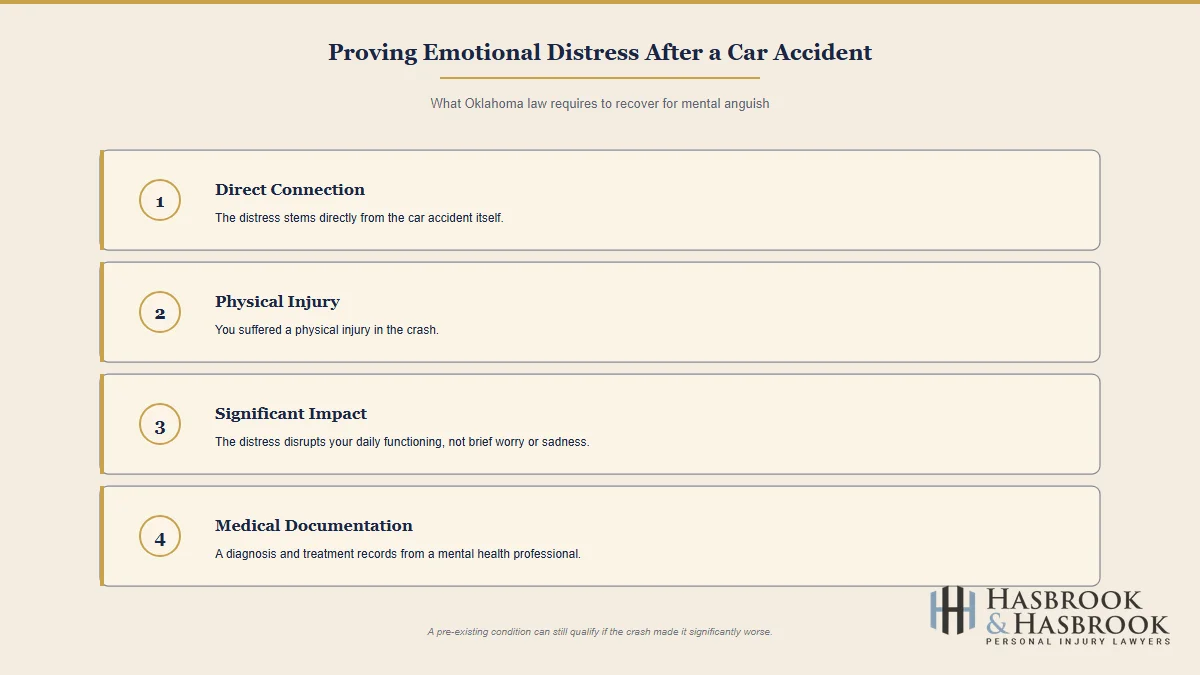
To recover compensation for emotional distress in Oklahoma, you generally need to show:
- The distress stems directly from the car accident. A pre-existing mental health condition typically can’t be claimed on its own, unless the accident significantly worsened it.
- You suffered a physical injury in the crash. Oklahoma law ties emotional distress damages to a physical injury from the accident; a standalone emotional distress claim without any bodily harm generally isn’t permitted.
- The distress has had a significant impact on your life. Brief, minor worry or sadness usually won’t meet the threshold; the distress needs to be severe enough to disrupt your daily functioning.
- You have medical documentation. A diagnosis from a psychiatrist, psychologist, or other mental health professional, along with treatment records, is important evidence for your claim.
Witness statements describing changes in your mood or behavior after the crash, and documentation of how the distress has affected your work, school, or social life, can further support your claim.



Caps on Non-Economic Damages
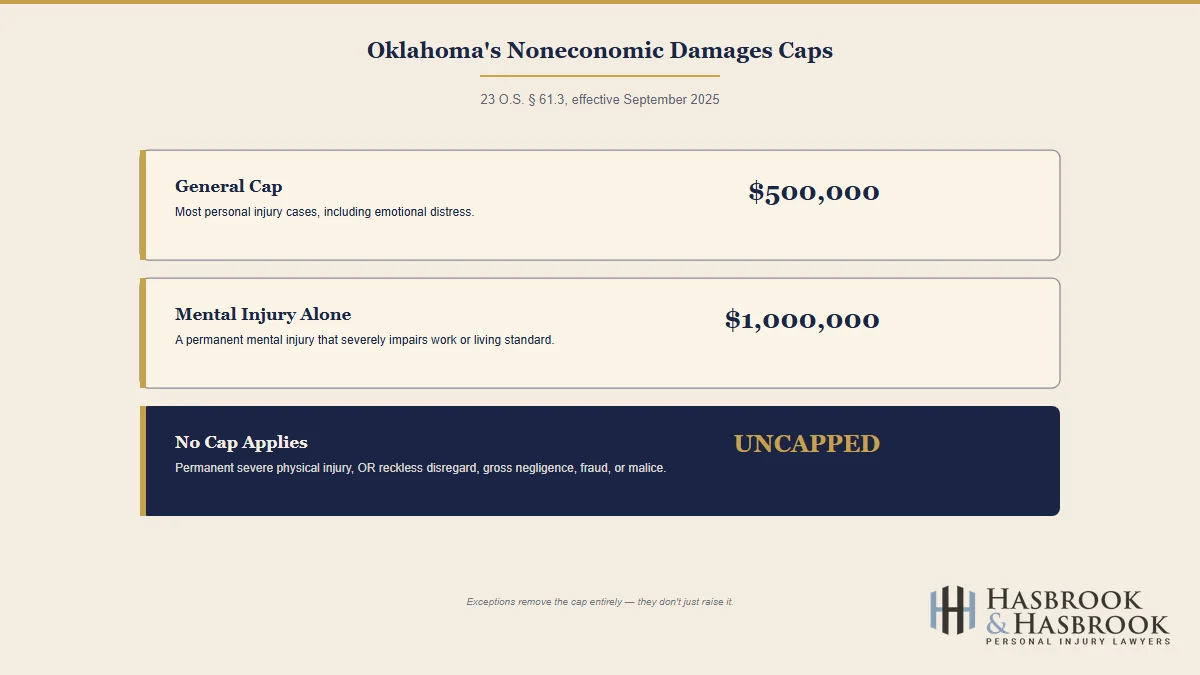
Oklahoma previously capped non-economic damages like emotional distress at $350,000 in most cases, but the Oklahoma Supreme Court struck down that cap as unconstitutional in 2019. Effective September 2025, the Legislature enacted a new cap: under 23 O.S. § 61.3, non-economic damages including emotional distress are generally capped at $500,000. That cap does not apply, however, if you suffered a permanent and severe physical injury, such as loss of use of a limb, loss of or substantial impairment to a major organ, or an injury that leaves you unable to care for yourself, or if the trier of fact finds the at-fault driver acted with reckless disregard, gross negligence, fraud, or malice. A separate $1,000,000 cap applies specifically where a permanent mental injury alone severely impairs your ability to work or maintain a reasonable standard of living.
Comparative Negligence
Oklahoma follows a modified comparative negligence rule. You can still recover damages from a car accident as long as your fault does not exceed 50 percent of the total negligence that caused the crash; at exactly 50 percent you still recover, just reduced by your percentage of fault. This reduction applies to emotional distress damages the same way it applies to your other damages. Claims seeking to punish a reckless or drunk driver financially follow separate, stricter rules and require a higher standard of proof.

Statute of Limitations
In Oklahoma, you generally have two years from the date of the crash to file a lawsuit seeking compensation for your physical injuries and emotional distress, under 12 O.S. § 95‘s limitation period for an injury to the rights of another not arising from contract. Missing this deadline will likely get your case dismissed. Narrow exceptions can extend it in some circumstances, so it’s worth confirming your specific deadline with an attorney as soon as possible. See our overview of Oklahoma’s personal injury statute of limitations for more on how these deadlines work.
Can I still get compensation if the emotional distress aggravated a pre-existing condition?
Yes. You can pursue compensation for the worsening of a pre-existing mental health condition caused by the crash, but you’ll need clear medical evidence showing the accident caused a relapse or made your symptoms worse. An attorney can help you gather records from your mental health providers documenting your condition before and after the crash, and can walk you through the types of compensation available in a car accident claim, including medical expenses, lost wages, and pain and suffering.
How long does it take to settle an emotional distress claim after a car accident?
Timelines vary with the complexity of the case, the severity of the damages, and how willing the insurance company is to negotiate. Some claims resolve in a few months; others take a year or more if a lawsuit becomes necessary. How long it takes to reach maximum medical improvement, how much evidence is needed to prove emotional distress, and whether the case goes to trial all affect the timeline, including PTSD-related claims. An attorney handling your claim can give you a realistic estimate based on your specific situation.
The team at Hasbrook & Hasbrook can review your accident, help you document your emotional distress, and pursue the full compensation Oklahoma law allows.