An Oklahoma ATV accident claim turns on finding insurance that applies: the at-fault rider often has no liability coverage, so homeowner’s, umbrella, or your own uninsured motorist coverage may pay. You have two years to file suit under 12 O.S. § 95, and claims against the state require written notice within one year (51 O.S. § 156).
ATV and UTV crashes differ legally from car wrecks: often no liability policy, no police report, no set fault process. Our Oklahoma City personal injury law firm represents riders, passengers, and children hurt in all-terrain vehicle crashes across Oklahoma.
Call (405) 605-2426 for a free case evaluation with an Oklahoma ATV accident lawyer.
Why ATV accidents follow different legal rules than car crashes
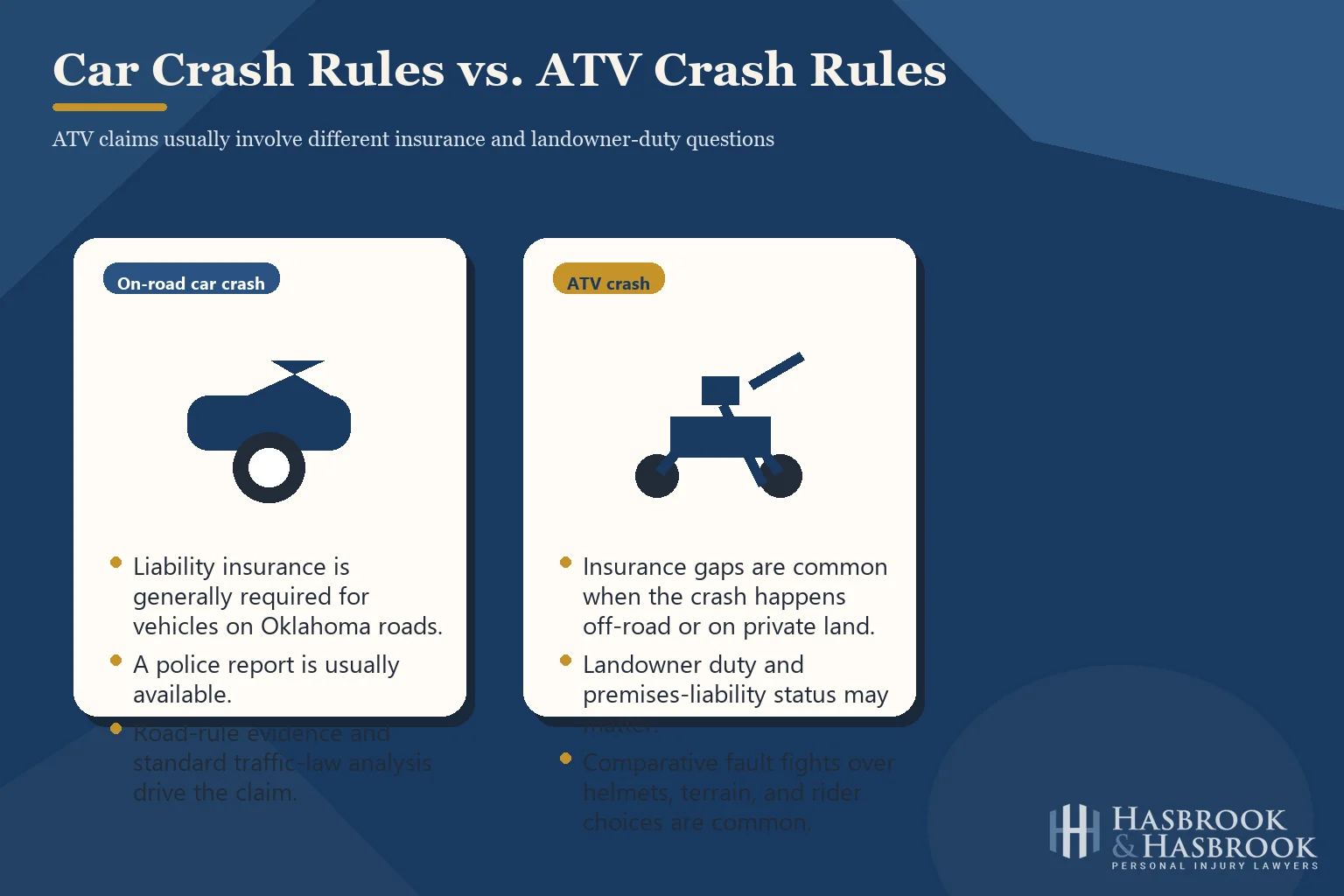
Oklahoma’s compulsory liability insurance system is built around vehicles driven on public roads. Most ATVs never touch one, so the at-fault rider often carries no liability insurance, and fault is rarely documented as it is after a wreck between two cars on Oklahoma City streets.
Liability usually turns on where the crash happened instead: premises liability rules on private land, the attractive nuisance doctrine when a child finds an unsecured ATV, and the Oklahoma Governmental Tort Claims Act at state-run riding areas, each with its own deadlines and caps.



Insurance gaps in Oklahoma ATV accident claims
The first question in most ATV cases is not who was negligent but which insurance company has to pay. Our ATV accident lawyers look at:
- The at-fault rider’s homeowner’s or renter’s policy. Some cover recreational vehicles, but many exclude motorized vehicles or off-premises use entirely.
- Your own UM/UIM coverage. Insurers must offer uninsured and underinsured motorist coverage under 36 O.S. § 3636; whether it reaches an ATV crash depends on your policy’s terms.
- Umbrella and specialty off-road policies, which can add a layer of coverage above the primary limits.
We identify every policy before negotiating with any carrier; settling with the wrong one first can cost you compensation.
Landowner liability and attractive nuisance in ATV accidents
If you were hurt on someone else’s property, the owner’s responsibility depends on why you were there. An invitee (a paying customer or event guest) is owed inspection and warnings. A licensee (a friend riding with permission) must be warned of known dangers. A trespasser is owed only a duty against willful or wanton harm. The framework is explained in landowner responsibility for unsafe property in Oklahoma.
Children are the exception. When an unsecured ATV attracts a child who is hurt, the attractive nuisance doctrine can override the trespasser rule. We handle children’s injury claims in Oklahoma with these doctrines in mind.
Public trail and state park ATV crashes in Oklahoma
Oklahoma’s popular riding areas include Little Sahara State Park near Waynoka and the Robbers Cave area. A crash caused by trail design, missing warnings, or poor maintenance at a state-operated facility runs through the Governmental Tort Claims Act: damages are capped under 51 O.S. § 154, and written notice is due within one year. The agency then has 90 days to act; a claim it does not approve in full is generally deemed denied at 90 days, or earlier if the agency denies it (a request for more information can change when the 90 days begin), and suit must be filed within 180 days after the denial (51 O.S. § 157). See the tort-claim process for suing Oklahoma public entities. Crashes on federally managed land follow federal rules instead, including land overseen by the U.S. Department of Agriculture.


What are the most common causes of ATV accidents in Oklahoma?
Most serious ATV cases trace back to a short list of causes:
- Rollovers on slopes, ruts, or uneven terrain
- Ejection in a collision, sudden stop, or failed jump
- Speed beyond what the terrain allows, and alcohol or drug impairment
- Carrying a passenger on a machine built for one, unlawful on public lands under 47 O.S. § 11-1117 unless designed for passengers
- Young or inexperienced operators on adult-sized machines
- Steering or brake failures, which can support a product liability claim against the manufacturer
Each points at a different responsible party.
Common ATV injuries and why they lead to serious claims
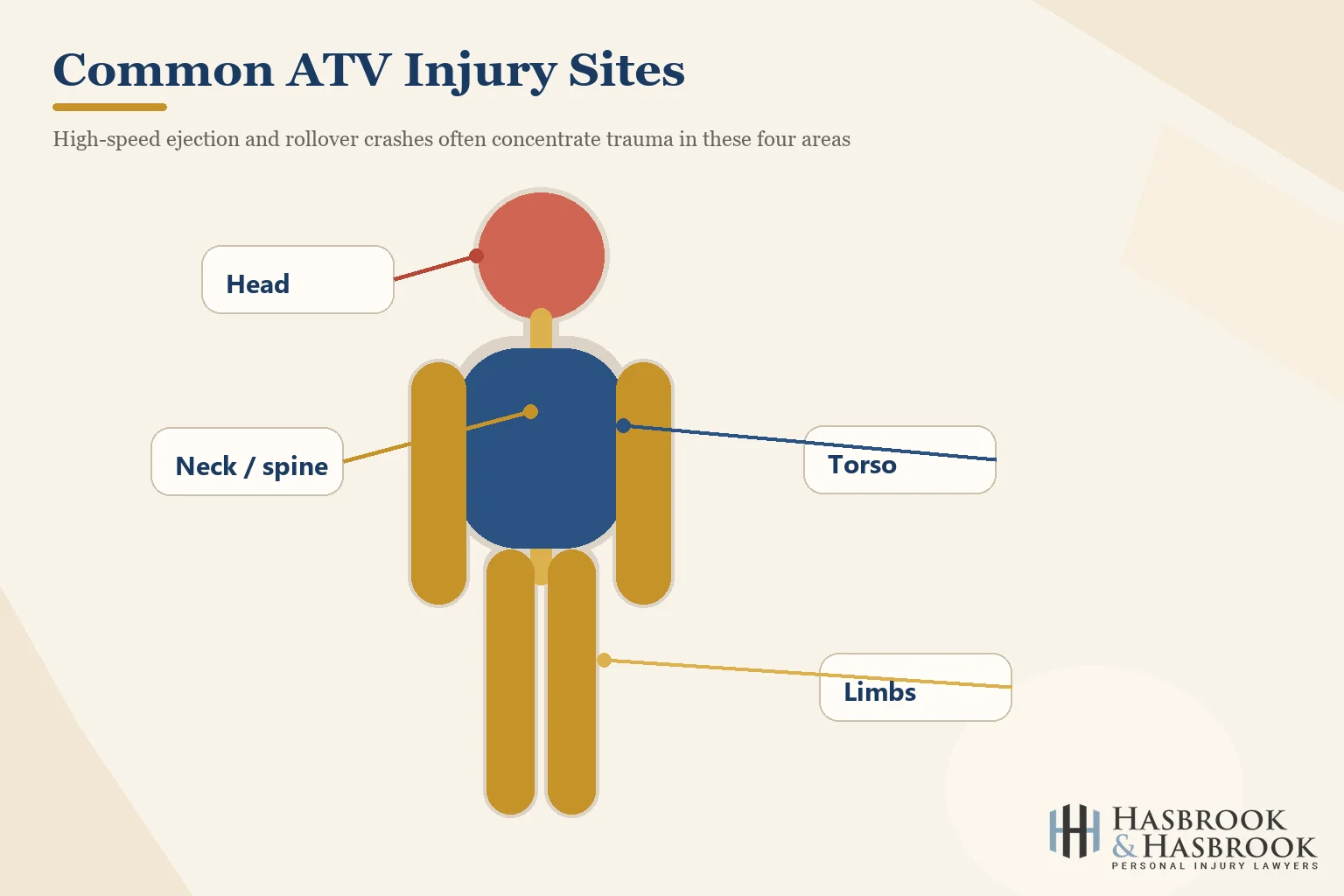
ATVs combine speed and rough terrain with almost no occupant protection: no seatbelts, no enclosed cab. Crash injuries are a public health problem tracked by the CDC’s motor vehicle safety program:
- Head trauma, from concussion to severe traumatic brain injury; see how brain injury claims are documented and valued
- Neck and back trauma, including spinal cord injury claims from ATV rollovers
- Crush injuries to the chest, pelvis, and legs when a machine rolls onto a rider
- Internal organ injuries from handlebar impacts, and fractures of the arms, legs, pelvis, and hips
When the harm is permanent, the case is built on life care plans and future medical treatment; see catastrophic injury claims after an ATV wreck. When a crash is fatal, who can file an Oklahoma wrongful death claim explains the family’s options.
Helmet non-use, intoxication, and Oklahoma comparative fault in ATV cases
Oklahoma’s comparative negligence statute, 23 O.S. § 13 (full text also on Westlaw), bars recovery only when your own negligence is greater than the combined negligence of everyone who caused the crash. In practice, more than 50 percent at fault means no recovery; 50 percent or less reduces your compensation by your share. See Oklahoma’s comparative negligence standard applied.
Adjusters push three arguments in ATV cases. Helmet non-use: Oklahoma does not require adult riders to wear helmets, and the under-18 helmet rule in 47 O.S. § 11-1117 applies only on public lands, yet the defense will argue an unhelmeted rider caused their own head injury. Intoxication: a toxicology result raises your fault share but does not automatically bar recovery. Terrain and speed choices: riding closed or dangerous terrain counts against you. The ATV rules themselves sit in Title 47 of the Oklahoma Statutes.

Oklahoma statute of limitations for ATV accident claims
The deadline to file an ATV injury lawsuit is two years from the date of the crash under 12 O.S. § 95. The main exceptions: a child injured by a private defendant generally may sue until one year after turning 18 (12 O.S. § 96), but being a minor does not extend the one-year GTCA notice deadline for a claim against a government entity; and injuries that were not immediately apparent may get a discovery-based start date.
What you can recover in an Oklahoma ATV accident claim
A successful claim can recover the full scope of your losses:
- Past and future medical treatment, including emergency care, surgery, and rehabilitation
- Lost wages and lost future earning capacity
- Pain and suffering
- Permanent disability or disfigurement
- Life care costs in catastrophic cases
For injuries on or after September 1, 2025, Oklahoma caps noneconomic damages, such as pain and suffering, at $500,000 in most cases (23 O.S. § 61.3); economic damages are not capped. The cap does not apply to wrongful death actions or to claims under the Governmental Tort Claims Act, which has its own limits under 51 O.S. § 154. The cap is also lifted if the jury finds permanent and severe physical injury (for example, loss of use of a limb, loss of or substantial impairment to a major body organ or system, or an injury that leaves you unable to care for yourself independently). If the jury finds a permanent mental injury that itself severely impairs your ability to be employed or to enjoy a reasonable standard of living, noneconomic damages are capped at $1,000,000. Neither limit applies if the judge and jury find, by clear and convincing evidence, that the defendant acted in reckless disregard for the rights of others, was grossly negligent, or acted fraudulently, intentionally, or with malice. It is a new statute that has not yet been tested in court.
Frequently asked questions about Oklahoma ATV accident cases
Does it matter that I was not wearing a helmet?
It matters, but it rarely ends the case. Helmet non-use is a comparative fault argument: the insurance company will claim it worsened your head injuries, and we answer with medical evidence. At 50 percent fault or less, you can still recover.
What if I was hurt as a passenger on someone else’s ATV?
Passengers generally have claims against whoever caused the crash. Riding on a machine not designed for passengers can affect the fault split, but it does not bar your claim.
What if the ATV accident happened on private property?
You can still have a claim. Private-property crashes are premises liability cases: recovery depends on your status on the land and what the owner knew. Claims against a negligent rider or a manufacturer run alongside the premises analysis.
What insurance applies if nobody carried ATV-specific coverage?
We review the at-fault rider’s homeowner’s or renter’s policy, the UM/UIM coverage on every auto policy in your household, any umbrella policy, and health insurance to keep bills paid while the claim is pending.
How soon after an ATV accident should I contact an attorney?
As soon as your medical care is underway. The ATV should be preserved before anyone repairs it, rural scene evidence fades fast, and the one-year government notice deadline can pass long before the two-year lawsuit deadline.

Contact an Oklahoma City ATV accident lawyer for a free case evaluation
Hasbrook & Hasbrook handles ATV, UTV, and off-road vehicle injury cases across Oklahoma on a contingency basis: you pay nothing unless we recover for you. Call (405) 605-2426 or schedule a free case evaluation online. Our accident attorneys map every coverage source before you talk to any adjuster.