Oklahoma’s Good Samaritan Act (76 O.S. § 5) protects anyone who stops, in good faith and without pay, to give emergency care such as first aid, CPR, or bleeding control at a car accident. It shields good-faith rescuers from being sued for unintentional harm, though the protection doesn’t extend to gross negligence or willful, wanton misconduct.
Every year, Oklahoma drivers and passersby stop to help at crash scenes: checking on occupants, calling 911, applying pressure to a wound, or starting CPR before an ambulance arrives. The instinct to help is immediate, but so is the next thought: could stepping in expose you to a lawsuit if something goes wrong? Good Samaritan laws exist across the country to answer that question in the rescuer’s favor, and Oklahoma’s version, officially titled the Good Samaritan Act, is no exception. This page covers who the Act protects and what providing emergency care actually means. It also covers the narrow situations where a rescuer can still be held liable, and what happens if you’re the one who gets hurt while helping someone else.



What Oklahoma’s Good Samaritan Act Covers
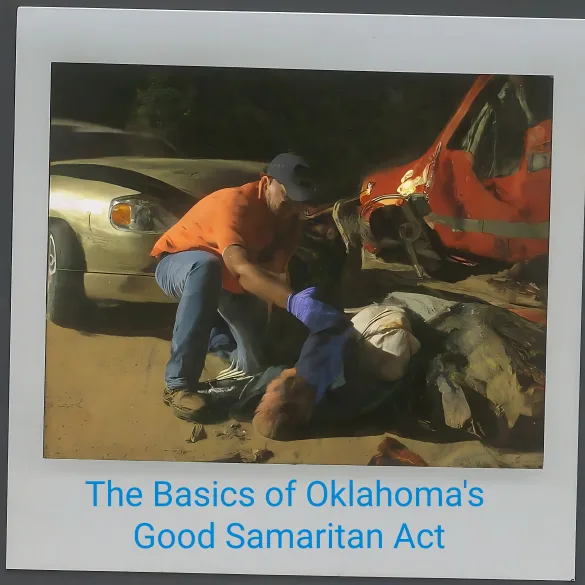
Oklahoma’s Good Samaritan law, codified at 76 O.S. § 5, shields a person who voluntarily renders emergency care in good faith, and without expecting to be paid, from civil liability for unintentional harm caused while giving that care. Lawmakers designed the immunity so that fear of a lawsuit isn’t a reason to keep driving past someone who needs help.
The statute was amended in 2024 to extend the same protection to anyone who administers an emergency opioid antagonist, such as naloxone, to reverse a suspected overdose. That’s on top of its longstanding coverage of CPR, bleeding control, and restoring breathing.
Who Is Protected Under the Act?
The Act’s protection reaches several categories of people, not just off-duty doctors or trained first responders.
- Any person who, in good faith and without pay, provides emergency care such as CPR, artificial respiration, controlling severe blood loss, or administering an opioid antagonist.
- Licensed medical professionals, including registered and practical nurses, who render emergency aid outside a pre-existing treatment relationship when the alternative is probable death or serious injury.
- Licensed surgeons or dentists who perform emergency surgery on an accident victim who cannot consent and whose family cannot be reached in time.
- Individuals registered with a local police chief or county sheriff who offer aid or shelter at home to someone in apparent danger.
What Counts as “Providing Emergency Care” Under the Act?
The statute lists specific forms of aid, and a car accident scene typically involves several of them at once. That list covers administering first aid, performing CPR, controlling bleeding, restoring breathing, aiding heart action or circulation, and, since the 2024 amendment, giving naloxone or a similar opioid antagonist. Calling 911, directing traffic around a wreck, or simply staying with an injured person while paramedics are en route falls within the same good-faith, no-compensation framework the Act is built around. Those specific acts wouldn’t expose a bystander to liability in the first place, but they still fit comfortably inside what the statute describes as emergency care.
Applying the Good Samaritan Act at a Car Accident Scene

Car accidents are the most common setting where the Good Samaritan Act comes into play. Oklahoma courts have confirmed that a bystander who stops to help an injured person after a crash is protected from liability for unintentional harm caused while rendering that aid. The protection applies as long as the bystander acts in good faith, voluntarily, and without expecting payment (Estate of Hwan Youn v. Kula, 2005, Okla. Civ. App., 125 P.3d 705).
At the scene of a crash, the kinds of help that fall under the Act’s protection include:
- Checking on the occupants and calling 911 to request emergency responders.
- Helping someone exit a vehicle if it’s unsafe to stay inside.
- Applying pressure to control bleeding.
- Performing CPR if you’re trained and it’s needed.
- Staying with an injured person and keeping them calm until help arrives.
Your own safety comes first. If the scene involves fire, a fuel leak, downed power lines, or oncoming traffic, it’s usually safer to call 911 and wait for trained responders than to approach directly.
Mistakes to Avoid When Helping at a Crash Scene
Good intentions don’t erase the value of caution. A few habits reduce risk for both you and the person you’re helping.
- Don’t move an injured person unless leaving them in place creates an immediate danger, such as fire or oncoming traffic; unnecessary movement can worsen a spinal or neck injury.
- Don’t give an injured person food, water, or medication.
- Stay within your own training. Working through hands-only CPR by phone with a 911 dispatcher is safer than attempting an unfamiliar procedure on your own.
- Tell paramedics exactly what care you already provided once they arrive, so they can build on it instead of duplicating or second-guessing it.
- Avoid moving a damaged vehicle unless it’s blocking traffic or creating a hazard; its resting position can matter to how the crash gets investigated.
The National Highway Traffic Safety Administration’s guidance on road safety covers the same pull-over-and-assess-first approach before you ever get out of your vehicle.

When a Good Samaritan Can Still Be Held Liable
The Good Samaritan Act is broad, but it isn’t absolute. Oklahoma courts have recognized a few situations where the immunity doesn’t apply:
- The person providing aid acted with gross negligence or engaged in willful or wanton misconduct (Youn).
- The person already had a pre-existing duty to render aid, such as a medical professional acting within the scope of employment (Gomes v. Hameed, 2008, Okla. Supreme Court, 184 P.3d 479).
- A prior contractual relationship, such as an existing doctor-patient relationship, already governed the interaction (Gomes).
What Counts as “Gross Negligence”?
Ordinary negligence is generally a failure to use reasonable care. Gross negligence is a higher bar: a conscious and voluntary disregard of the need to use reasonable care, of a kind likely to cause foreseeable, serious injury. The Good Samaritan Act excuses the first and not the second. An honest mistake made while helping someone is treated very differently from conduct that is reckless or grossly negligent.
Are Medical Professionals Treated Differently?
Licensed medical professionals get the same good-faith immunity as anyone else when they stop to help outside of a pre-existing treatment relationship. The immunity applies so long as the emergency leaves probable death or serious injury as the only alternative to acting. That protection extends to a licensed surgeon or dentist who performs emergency surgery on an accident victim who cannot consent. Two conditions apply: a spouse, parent, or guardian cannot be reached in a reasonable time, and another licensed surgeon concurs. Where a doctor-patient relationship, or an on-duty obligation to a specific patient, already existed before the emergency, the Act’s rescuer immunity doesn’t apply. The professional’s conduct is judged under ordinary standards instead (Gomes).
Can Someone Still Sue a Good Samaritan Even If the Act Applies?
Yes. Filing a lawsuit is always possible; the Act doesn’t stop someone from bringing a claim, it gives the person who stopped to help a strong defense once they’re sued. If the rescuer acted in good faith, without pay, and without gross negligence or willful misconduct, the Act typically supports dismissing the claim or resolving it well short of a trial on the merits. The exceptions above, gross negligence, a pre-existing duty, or an existing contractual relationship, are the situations where that defense doesn’t hold up.
Step-by-Step: What to Do If You Witness a Car Accident in Oklahoma

- Pull over safely and check for hazards, like fire, fuel, or oncoming traffic, before approaching.
- Call 911 immediately and give your location and a description of what happened.
- Check on the occupants of each vehicle and ask if anyone needs immediate help.
- If it’s safe to do so, help someone exit a vehicle and move away from traffic.
- Provide first aid, CPR, or bleeding control only if you’re trained and it’s needed.
- Stay with the injured person and keep them calm until responders arrive.
- When paramedics and police arrive, tell them what you saw and what care you already gave.
Once professional responders take over, your role as a Good Samaritan is finished. Stepping back at that point isn’t giving up on the person you helped; it’s letting trained responders do what they’re equipped to do.


Do You Have to Stop and Help? Oklahoma’s Duty-to-Rescue Rule
No. Oklahoma doesn’t impose a general legal duty on bystanders to assist someone in an emergency situation. The Good Samaritan Act works from the opposite direction: instead of requiring you to help, it removes a legal risk that might otherwise make a willing person hesitate.
What to Weigh Before You Get Involved
- Your own safety and the safety of anyone else nearby.
- Whether you have the training to provide the kind of help that’s actually needed.
- Whether emergency responders are already on the way or already on scene.
- Whether waiting for a trained responder is the safer choice for everyone involved.
None of these considerations reduce the Act’s protection once you decide to help. They’re simply worth thinking through in the moments before you do.
If You’re Hurt While Helping as a Good Samaritan
Stopping to help doesn’t waive your own right to recover if you’re hurt in the process, for example if a passing vehicle strikes you while you’re assisting at the roadside. If another driver’s negligence caused your injury, what a claim for your own injuries could look like depends on the same factors as any other car accident case. Oklahoma’s standard two-year deadline for filing an injury lawsuit (12 O.S. § 95) still applies.
Oklahoma law also gives an injured Good Samaritan a backstop that most people never hear about. Under 76 O.S. § 5.2, a private citizen who is injured, killed, or suffers property damage while rendering aid under the Good Samaritan Act may file a claim with the Governor’s office for indemnification. A dependent of that citizen can file the same claim, and either version only covers loss that isn’t already paid from another source, such as insurance or a liability claim against an at-fault driver. The claim has to describe the date, place, and circumstances of the incident, what the Good Samaritan was doing at the time, the estimated extent of the uncompensated loss, and a corroborating statement.

Talk to an Oklahoma Attorney About What Happened
The Good Samaritan Act is meant to protect you, not to leave you without options if something goes wrong. Whether you’re unsure if your actions at an accident scene expose you to a claim, or you were hurt while helping someone else, it’s worth getting clear answers. An Oklahoma attorney who can untangle Good Samaritan immunity from an actual injury claim can walk through both sides with you. That includes the protection you have as a rescuer, and any claim you may have if someone else’s negligence caused your own injury.
Hasbrook & Hasbrook has represented Oklahoma injury victims across two generations since 2000. Call (405) 605-2426 for a free consultation.