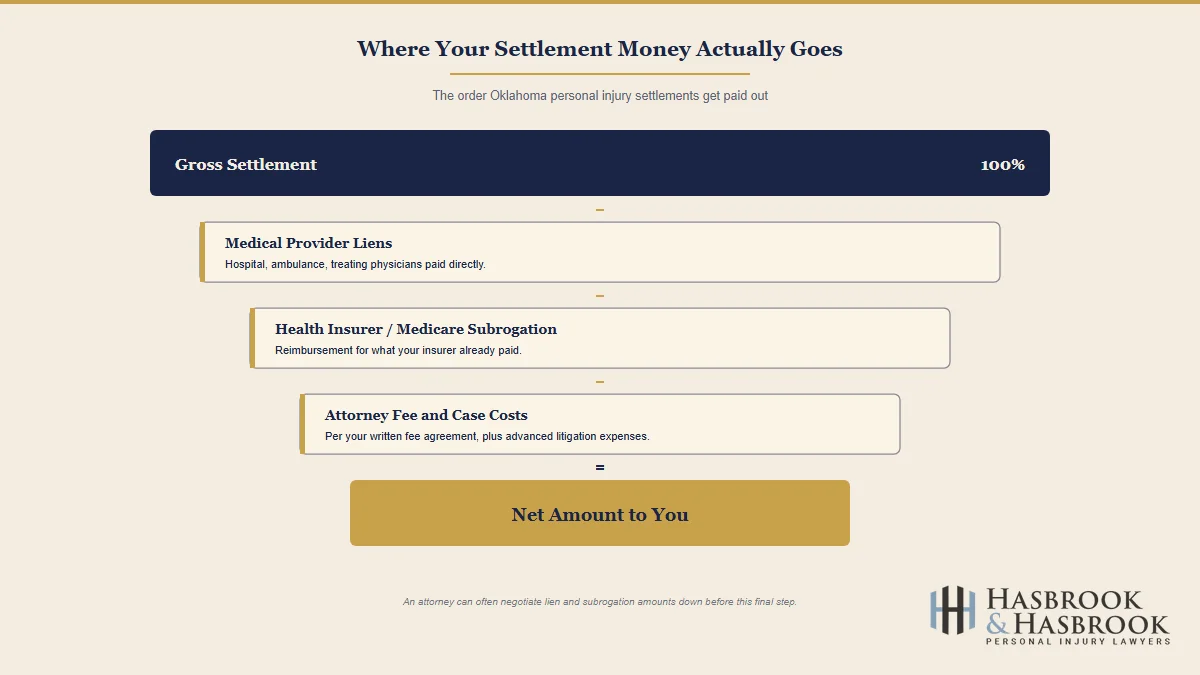
Yes, in most cases. Your medical bills are typically paid directly out of your car accident settlement, through provider liens, health insurer subrogation, or MedPay, before you receive the balance. In Oklahoma, only the amount actually paid for your treatment, not the amount billed, counts as recoverable medical expense under 12 O.S. § 3009.1.
Paying Medical Bills After a Car Accident
After a car accident, your medical bills usually fall into two groups: bills a provider has secured with a lien, and bills you simply owe. If a doctor, hospital, or ambulance service files a lien against your claim, the insurance company will name that provider on your settlement check so the bill gets paid directly out of the proceeds. If your health insurer already paid for your treatment, it typically has a right of subrogation, meaning it can seek reimbursement from your settlement for what it paid on your behalf. A provider who skips filing a lien has not forgiven the bill either. You still owe it, and an unpaid bill can go to collections and hurt your credit.



Oklahoma’s At-Fault Car Insurance System
Oklahoma is an at-fault insurance state, so the driver who caused the crash is financially responsible for your medical bills, lost wages, and other damages. Every Oklahoma driver must carry minimum liability coverage of $25,000 per person and $50,000 per accident for bodily injury, plus $25,000 for property damage, under 47 O.S. § 7-103. Those numbers are a floor, not a guarantee: many drivers carry only the state minimum, which will not always cover a serious injury. Insurance adjusters weigh fault using the same negligence-based standard that is the legal definition of liability a court applies in a lawsuit.
Filing a Third-Party Insurance Claim
Your first step after a crash is usually a claim against the at-fault driver’s insurance. Once you document the other driver’s fault and the extent of your injuries, the insurer either accepts liability and negotiates a settlement or denies the claim. When liability is accepted, the insurer pays out up to the policy limits for medical bills, lost wages, and compensation for your pain and suffering. If the at-fault driver’s coverage is not enough to cover your bills, your own uninsured/underinsured motorist (UM/UIM) coverage, if you carry it, can help fill the gap. Be cautious if an insurer offers to pay your medical bills directly outside a full settlement. Accepting that offer can limit your ability to pursue the rest of your claim later.
Personal Injury Protection (PIP) and MedPay
Oklahoma does not require drivers to carry Personal Injury Protection (PIP), but MedPay is an optional add-on many drivers choose anyway. MedPay pays your medical bills up to your policy limit regardless of who caused the accident, which can help cover treatment costs while your liability claim is still pending.


Health Insurance, Subrogation, and Medicare Liens
 Your own health insurance can also step in to cover accident-related treatment, though you will usually still owe your deductible and any co-pays. If your insurer pays and you later recover a settlement, it generally has the right to be reimbursed for what it paid, through the same subrogation process described above. Medicare and Medicaid liens work in a similar way and are governed by federal reimbursement rules. The Centers for Medicare & Medicaid Services publishes guidance on Medicare’s reimbursement and recovery process. A personal injury attorney can often negotiate a subrogation or lien amount down, so less of your settlement goes toward repaying bills that have already been paid.
Your health insurer’s payment does not disappear from the case just because you settle. Whoever handles your claim has to account for every lien and every subrogation interest before your settlement check is cut, or you could end up owing money you thought was already resolved.
Out-of-Pocket Medical Bills and Liens
If your insurance does not fully cover your treatment, you may end up paying some medical bills out-of-pocket while your claim is pending. Some providers offer payment plans or reduced rates, and in many cases an attorney can arrange for treatment on a lien basis, meaning the provider agrees to wait for payment until your case settles or reaches a judgment. Keep every bill, receipt, and treatment record. Complete documentation supports the admissibility of your medical bills in court and strengthens your claim for reimbursement.
If You Have to File a Lawsuit: Fault, Deadlines, and Proof
If a fair settlement is not on the table, you may need to file a personal injury lawsuit. Oklahoma follows a modified comparative negligence rule under 23 O.S. § 13: if you are found partly at fault, your compensation is reduced by your percentage of fault, and you are barred from recovering only if your fault exceeds 50 percent. At exactly 50 percent fault, you can still recover a reduced award. You generally have two years from the date of the accident to file suit under 12 O.S. § 95, though exceptions can apply, so it is worth talking to an attorney promptly. At trial, only the amount actually paid for your treatment, not the amount billed, is admissible to prove your medical expenses, and future treatment costs can be included if your injuries require ongoing care. Most of a settlement that reimburses medical expenses is not taxable income, though the tax treatment of your settlement can vary, so confirm the details with a tax professional.

Talk to an Oklahoma City Car Accident Lawyer About Your Medical Bills
Sorting out liens, subrogation claims, and insurance offers while you are trying to recover from an injury is stressful, and mistakes here can cost you money you are owed. An Oklahoma City car wreck injury lawyer can review your liens, push back on what you owe, and make sure your settlement accounts for the medical bills you have already paid and the treatment you still need. Hasbrook & Hasbrook has helped Oklahoma clients work through this kind of settlement before, from documenting medical expenses to negotiating down subrogation claims, and offers a free consultation to review your situation. Even if you did not see a doctor right away, understanding your car accident legal rights is worth a phone call before you sign anything.