After a slip-and-fall in Oklahoma, your first question is usually how much your claim is worth. No attorney can give a precise figure before reviewing the medical records and liability evidence, but the factors that drive settlement values are consistent across cases. See our Oklahoma City slip-and-fall lawyer page for how we handle these claims, or read our guide on what a slip-and-fall case is worth.
What factors determine a slip-and-fall settlement amount?
Settlement values in slip-and-fall cases are not arbitrary. The same fall can produce a $15,000 settlement or a $400,000 settlement depending on several variables.
- Severity of your injuries. Fractures, traumatic brain injuries, and spinal damage produce higher settlements because medical costs, treatment duration, and long-term impact are greater.
- Strength of liability evidence. Security footage, incident reports, prior complaints about the same hazard, and witness statements all establish that the property owner knew or should have known about the dangerous condition.
- Your percentage of fault. Under 23 O.S. § 13, Oklahoma uses comparative negligence. Your recovery is reduced by your percentage of fault, and recovery is barred only if your fault exceeds 50 percent.
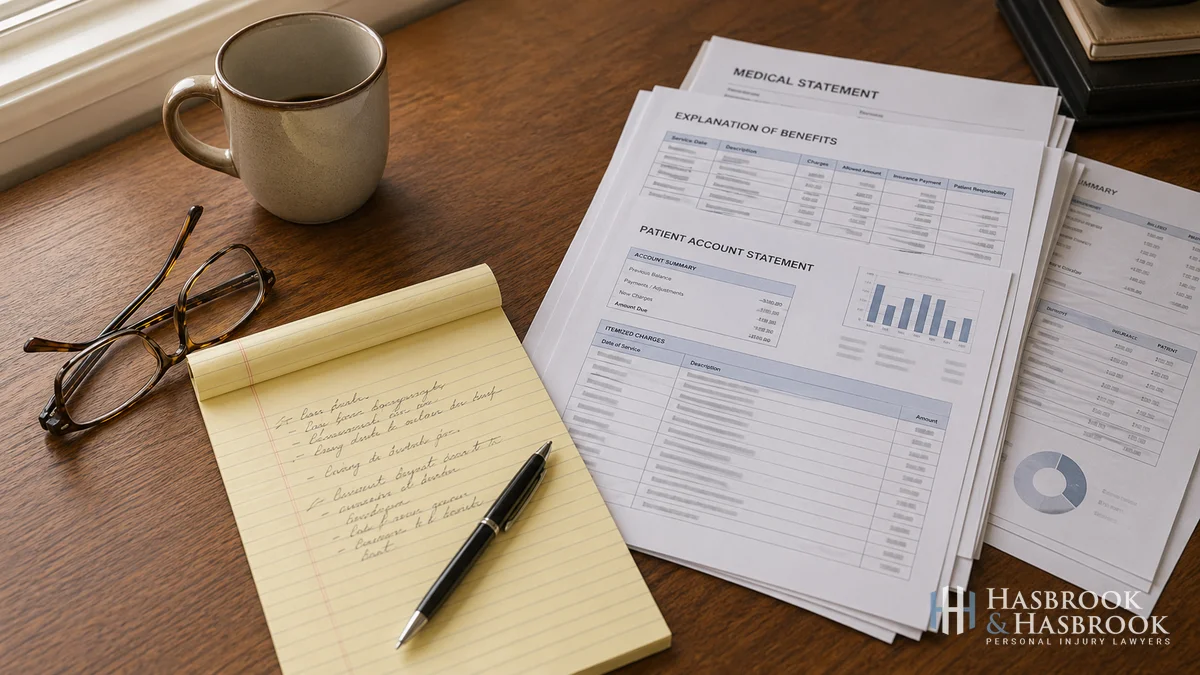
- Documented economic losses. Medical bills, future treatment costs, lost wages, and lost income all increase settlement value when supported by records.
- Non-economic damages. Pain and suffering, emotional distress, and loss of enjoyment of life are compensable but routinely undervalued by insurance companies unless supported with consistent medical documentation.
- Policy limits. A property owner’s liability coverage places a ceiling on recovery without a judgment that exceeds the policy.
A practical framework: start with your total documented economic losses, then assess the strength of the liability evidence. Strong liability plus significant documented harm produces the best settlement position. Weak liability or gaps in treatment documentation give insurers leverage to reduce offers.



Understanding slip-and-fall injuries in Oklahoma
Falls are among the leading causes of emergency room visits nationally. According to the Centers for Disease Control and Prevention, millions of Americans are treated for fall injuries each year. In Oklahoma, these accidents occur on wet floors, uneven pavement, icy parking lots, poorly lit stairwells, and in retail stores and private residences.
The injuries that drive the highest settlement amounts include:
- Hip fractures, which are common among older adults and frequently require surgery and extended rehabilitation
- Traumatic brain injuries from striking a hard floor or surface
- Herniated discs and spinal cord injuries
- Torn knee ligaments and cartilage damage
- Wrist and shoulder fractures from outstretched hands during the fall
Injury severity matters because long-term treatment, reduced earning capacity, and permanent disability significantly affect total compensation. A TBI cases carries a fundamentally different settlement profile than a soft-tissue injury, even when liability is equally clear.
How Oklahoma’s liability law applies to your claim
To recover compensation for a slip-and-fall in Oklahoma, you must establish that the property owner or occupier was negligent. Under 23 O.S. § 61, a person who breaches a legal obligation and causes harm is liable for resulting damages. In premises liability cases, that obligation is to maintain the property in a reasonably safe condition or to warn visitors of known hazards. For a full overview of how these claims work, see our Oklahoma City premises liability lawyer page.
Oklahoma recognizes three visitor categories: invitees (customers and business guests), licensees (social guests), and trespassers. Property owners owe the highest duty to invitees, which requires regular inspection for hazards and prompt remediation, not merely posting warnings after the fact.
Comparative negligence plays a central role in settlement negotiations. If an adjuster argues you were distracted, wearing inappropriate footwear, or ignored a warning sign, the adjuster is attempting to assign you a percentage of fault and reduce the payout. Our page on Oklahoma comparative negligence rules explains how fault allocation affects recovery in detail. For more on why these cases are harder to win than they appear, see our article on why slip-and-fall cases can be difficult to win.
Oklahoma’s statute of limitations for personal injury claims is two years under 12 O.S. § 95. Missing this deadline eliminates your right to any recovery. See our guide on how long you have to sue after a slip and fall for deadlines that apply to specific situations, including claims against government entities.
Adding up your damages after an Oklahoma City slip-and-fall
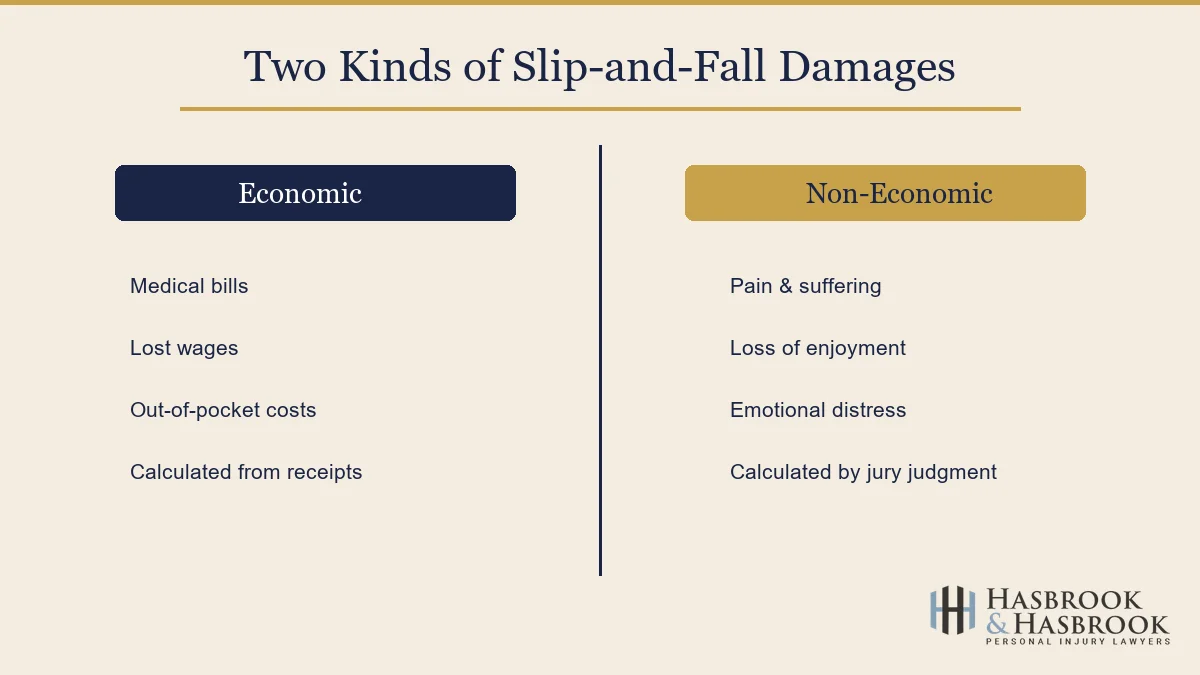
Oklahoma law distinguishes between economic and non-economic damages. Both are recoverable in a successful claim.
Economic damages include:
- Emergency room and hospital costs
- Surgery and rehabilitation expenses
- Future medical care when injuries require ongoing treatment
- Lost wages from time missed at work
- Lost income or reduced earning capacity if injuries prevent returning to prior employment
- Out-of-pocket costs for transportation to appointments, home care, and medical equipment
Non-economic damages include:
- Physical pain and suffering
- Emotional distress and mental anguish
- Loss of enjoyment of life
- Loss of consortium for impact on spouse or family relationships
Oklahoma’s noneconomic damages cap is an open legal question. The prior cap under 23 O.S. § 61.2 was struck down in Beason v. I.E. Miller Services, 2019 OK 28. A new $500,000 cap under 23 O.S. § 61.3 (effective September 2025) has not yet been reviewed by the Oklahoma Supreme Court.
For a complete breakdown of what you can seek in an Oklahoma slip-and-fall claim, see our page on types of recoverable damages in slip-and-fall cases.

How insurance companies handle slip-and-fall claims
Property owners and businesses carry general liability insurance to cover slip-and-fall claims. When you file, the insurance company assigns an adjuster whose primary objective is to close the claim for as little as possible.
Common tactics insurers use to reduce slip-and-fall settlements:
- Requesting a recorded statement early in the process, before you have legal advice, to capture statements that can be used against you
- Disputing the severity of your injuries by citing gaps in treatment or delay in seeking care
- Assigning you a portion of fault for the fall, such as claiming the hazard was “open and obvious”
- Making a fast, low settlement offer before your full medical costs are known
- Arguing pre-existing conditions caused or contributed to your injuries
You are not required to give a recorded statement to the property owner’s insurer. For a broader look at these tactics and how to respond, see our article on negotiating with insurance adjusters.
Settlement negotiations and when to go to trial
Most Oklahoma slip-and-fall cases resolve through settlement before trial. Settlement is faster and less expensive, though amounts may be lower than what a jury would award in a strong case.
The negotiation process generally follows this sequence:
- You reach maximum medical improvement (condition stabilized, total costs determinable)
- Your attorney sends a demand package with medical records, bills, lost wage documentation, and a demand letter
- The insurer responds with a counteroffer
- Negotiations continue until an agreement or impasse
- If no agreement is reached, your attorney files a lawsuit; most cases settle after litigation begins
Going to trial makes sense when the insurer’s best offer falls well short of what the case is worth, particularly in cases involving serious injuries or clear negligence. Our guide on whether to settle or go to trial covers the factors that inform this decision. For a realistic sense of how long the process takes, see our article on how long personal injury lawsuits take in Oklahoma.
How a personal injury attorney can help your slip-and-fall claim
discuss your case with our lawyers represent injured Oklahomans in slip-and-fall and premises liability claims. Legal representation produces measurable differences in outcomes because of how evidence is gathered and presented.
An experienced personal injury attorney can:
- Preserve critical evidence before it disappears, including security footage overwritten within 30 to 90 days
- Identify all responsible parties, including property managers, cleaning contractors, and municipal entities
- Document every recoverable loss so nothing is left off the demand
- Counter insurance tactics with a complete factual and legal record
- Negotiate backed by trial experience
We handle slip-and-fall claims on a contingency fee basis: no fee unless we recover for you. For a detailed breakdown of how to build the strongest possible claim, see our FAQ on how to maximize the value of your slip-and-fall case. Ready to talk? Call (405) 605-2426 or our oklahoma injury attorneys for a free consultation.


Slip-and-fall settlement FAQ
What is the average slip-and-fall settlement amount in Oklahoma?
There is no reliable average because values vary widely based on injury severity, liability strength, and available coverage. Soft-tissue injuries may settle for a few thousand dollars; cases involving fractures, surgery, or permanent disability can reach $100,000 or more. An attorney can give you a realistic range after reviewing your records.
Can I still recover compensation if I was partly at fault for my fall?
Yes, as long as your fault does not exceed 50 percent. Oklahoma’s comparative negligence law reduces your recovery by your fault percentage. At 30 percent fault on a $100,000 case, you recover $70,000. Recovery is barred only when your fault exceeds 50 percent.
How long does it take to settle a slip-and-fall claim in Oklahoma?
Simple claims with clear liability and limited injuries may settle within a few months. Cases involving serious injuries or disputed liability routinely take one to two years, and cases that go to trial take longer still.
Should I accept the insurance company’s first settlement offer?
No. First offers are typically low and made before the full extent of your injuries is known. Once you sign a release and accept, you cannot reopen the claim for additional compensation. Wait until you have reached maximum medical improvement before evaluating any settlement offer.
What evidence do I need to support a slip-and-fall claim?
Strong claims are built on: an incident report filed at the scene, photographs of the hazard and your injuries, medical records documenting all treatment, witness contact information, security camera footage (request written preservation immediately), and lost wage documentation from your employer. Our guide on steps to take after a slip-and-fall covers each of these in detail.
How is pain and suffering calculated in Oklahoma slip-and-fall cases?
Oklahoma does not use a fixed formula. Attorneys and insurers typically apply a multiplier of economic damages (often 1.5 to 5 times medical bills depending on severity) or a per-diem rate per day of documented suffering. Courts and juries have discretion. See our FAQ on how pain and suffering is calculated in Oklahoma for details.
If an insurance company has already contacted you after a slip-and-fall, speaking with a lawyer now protects you from early settlement pressure. Hasbrook & Hasbrook handles cases statewide on a contingency basis, with a free consultation to evaluate your claim.