Opening an estate for a wrongful death claim in Oklahoma takes about three to six weeks once the petition is filed in district court. A judge issues Letters Testamentary or Letters of Administration to a personal representative, and only that representative may bring the wrongful death lawsuit under 12 O.S. § 1051. The procedure sits in Title 58 (the Oklahoma Probate Code); the wrongful death claim itself rides inside Title 12. This page walks the petition, notice, hearing, and appointment steps. For who should serve, see how to get appointed personal representative in Oklahoma.
Why an estate has to be opened first
A wrongful death lawsuit cannot be filed in the family’s individual names. 12 O.S. § 1053 places the cause of action with “the personal representative of the deceased.” Until probate is opened and Letters issue, no one has legal capacity to sue, accept service, sign discovery responses, or settle.
A will does not skip this step. The named executor still has to file a petition, give notice, attend a hearing, and receive Letters Testamentary before acting. Without a will, the same process appoints an administrator. Either way, only the personal representative may file on behalf of the surviving spouse, children, parents, and next of kin defined in 12 O.S. § 1054. See how Section 1054’s class of statutory beneficiaries lines up against the personal representative’s filing authority.



Where and how to file the petition
Venue is in the district court of the county where the decedent was domiciled at death (Title 58 O.S. §§ 5 and 6). If the decedent lived out of state but owned Oklahoma property, file where the property is located. Filing fees run roughly $200 to $250, plus certified-copy and publication charges.
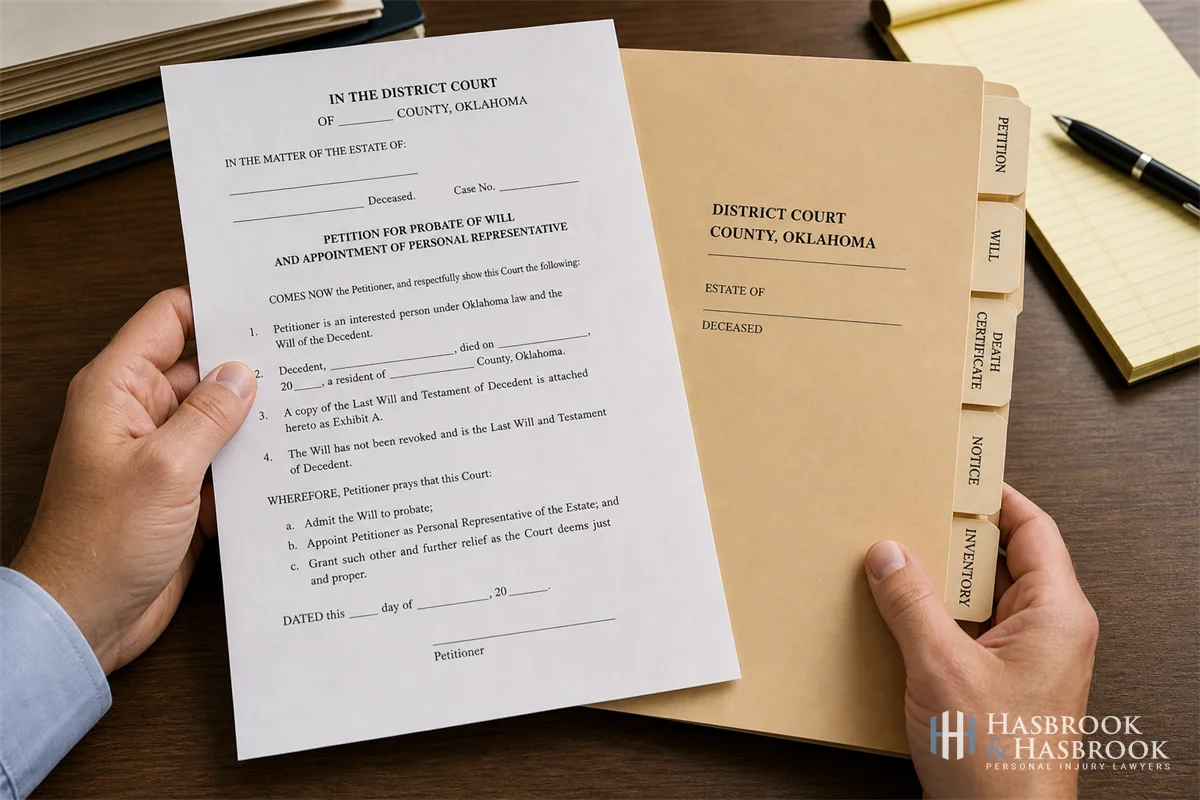
The petition is a form pleading signed under oath. Required elements:
- Decedent’s full legal name, date of death, last residence address
- Whether the decedent died testate (with a will) or intestate
- Original will attached, if any, with self-proving affidavit if available
- Estimated estate value (often “value to be determined” when the wrongful death claim is the primary asset)
- Names, addresses, and ages of all heirs at law and devisees
- Name of the proposed personal representative and their willingness to serve
Our firm often prepares the petition for the family so the heir list and litigation-asset description track the wrongful death pleading that follows.
Notice to heirs, creditors, and the public
Once the petition is filed, two notices go out. The notice of hearing on appointment is mailed to heirs and devisees at least ten days before the hearing. The notice to creditors is published in a local newspaper once a week for two consecutive weeks, giving creditors two months from first publication to present claims; known creditors also receive a mailed copy. The creditor list in a wrongful death case is often short (final medical bills, funeral expenses), but publication is mandatory.
Failing to give proper notice is the most common reason a probate gets reopened, and a missed step becomes an argument that the representative lacks authority to sign the settlement release.
The appointment hearing, bond, and inventory
Uncontested hearings run five to ten minutes. The judge confirms notice, asks the proposed representative whether they will faithfully discharge the duties of office, and signs the order admitting the will (if any) and making the appointment. The clerk issues Letters Testamentary or Letters of Administration the same day.
Practical tip: ask the clerk for at least four certified copies of the Letters at issuance. The defendant’s insurer demands one before cutting a settlement check, medical providers need a copy to release records, the funeral home keeps a copy, and the estate bank account needs the original.
Judges have discretion to require a bond. Wrongful death-only estates usually seek a waiver, either through the will or by signed agreement of all interested heirs. Within two months of appointment, the representative files an inventory and appraisement; for a wrongful death-only estate that often lists one line item (“cause of action under 12 O.S. § 1053, value to be determined”) plus minor personal property.

Special administrator vs full or summary probate
If the only reason to open an estate is to pursue the wrongful death claim, Title 58 O.S. § 215 lets the court appoint a special administrator with limited authority to bring and prosecute a single lawsuit. Special administration is faster and skips the inventory, accounting, and final-discharge steps. Cornell’s Legal Information Institute offers background on the general probate process.
Use this framework to decide which path fits the facts:
| Situation | Path | Why |
|---|---|---|
| Will plus non-litigation assets (home, accounts, vehicles) | Full probate with named executor | One appointment handles distribution and the wrongful death claim. |
| Intestate with assets above the small-estate threshold | Full probate with administrator | Administrator winds up the estate. |
| Only asset is the wrongful death cause of action | Special administrator (58 § 215) | Faster; appointment limited to the lawsuit. |
| Estate qualifies for summary administration ($200,000 or less, no contested claims) | Summary administration (58 §§ 245–249) | Compressed timeline, single notice, shorter creditor period. |
| Heirs disputing who serves | Full probate with contested-appointment hearing | Court resolves priority under 58 § 122. |

Filing the wrongful death lawsuit and timeline
Once Letters issue, the personal representative is the named plaintiff. The petition is filed in district court (or removed to federal court if diversity exists), captioned “Jane Doe, as Personal Representative of the Estate of John Doe, Deceased v. [Defendant].” The two-year limitations period under Oklahoma’s personal-injury limitations rule still controls; opening the estate does not pause the clock. See damages in an Oklahoma wrongful death case and survival vs wrongful death damages.
Typical timeline, start to finish:
- Day 1–5: Petition filed; hearing date set.
- Day 5–15: Notice mailed to heirs; first publication of notice to creditors.
- Day 15–25: Second publication; appointment hearing; Letters issued.
- Month 1–2: Inventory filed; creditor claim period closes 60 days after first publication.
- Months 2–24: Wrongful death case filed and litigated by the representative.
- At settlement: Court approval under § 1053; distribution; final accounting; discharge.
Court approval and common pitfalls
Section 1053 requires court approval of any wrongful death settlement. The personal representative files an application showing gross settlement, deductions (fees, costs, liens), net distribution among the spouse, children, parents, and next of kin, final medical and burial expenses, lien status, and basis for apportionment. The judge enters an order approving the settlement and authorizing distribution. Medicare’s recovery process must clear before disbursement when a beneficiary is on Medicare. IRS Publication 4345 generally treats wrongful death proceeds for personal injury as nontaxable; punitive-damage and interest portions are taxable.
Pitfalls our firm sees regularly:
- Wrong county. Venue follows residence, not where the death occurred. A fatal Oklahoma County crash for a Cleveland County resident gets probated in Cleveland County.
- Heir list incomplete. Estranged adult children, half-siblings, and parents who outlived the decedent must all be listed. A missing heir can void notice.
- Successor representative needed. If the named executor declines, dies, or cannot serve, the court appoints a successor under 58 § 122.
- Carrier asks for the wrong document. A wrongful death settlement requires Letters and a court-approved distribution order, not just a death certificate.
- Probate and PI counsel out of sync. The two pleadings must align on caption, fiduciary capacity, and inventory description.
If a government entity is the defendant, the Governmental Tort Claims Act adds a written notice-of-claim requirement on top of probate. See fatal GTCA cases and government liability for deaths.


Frequently asked questions
Do I have to open an estate if my family member had no assets?
Yes, if there is a wrongful death claim. The cause of action under § 1053 is itself an estate asset, and only a personal representative can pursue it. A special administrator is often the most efficient path.
Does a will avoid the need to open an estate?
No. A will has no legal effect until the district court admits it to probate and issues Letters Testamentary. The wrongful death suit cannot be filed until the executor has those Letters.
How much does opening the estate cost?
Filing fees run about $200 to $250, plus $80 to $200 in publication fees depending on the county. Our firm typically advances probate costs and recovers them from the eventual settlement.
Can the surviving spouse file without opening an estate?
No. The surviving spouse must still be appointed personal representative first. If the spouse declines, an adult child, parent, or next-of-kin under § 1054 can be appointed instead.
What if the family does not agree on who should serve?
The court resolves the dispute at the appointment hearing under the priority rules in 58 O.S. § 122. The companion FAQ linked above walks through the statutory priority list.
Does opening the estate affect the two-year wrongful death deadline?
No. The two-year clock under § 1053 runs from the date of death. File the petition for letters within 30 to 60 days. The discovery rule in wrongful death cases can apply in narrow circumstances.
Hasbrook & Hasbrook Personal Injury Lawyers has handled wrongful death claims for Oklahoma families for two generations. Our firm coordinates the probate, advances costs, and runs the litigation. Call (405) 605-2426 or send a message through the intake form for a free consultation. See also our OKC fatal-injury practice page and our Tulsa wrongful death practice page, plus the wrongful death damages checklist for referring counsel.
Before the estate is opened, families should understand what an Oklahoma survival claim recovers alongside the death cause of action.