

Trampolines send more than 100,000 people to U.S. emergency rooms in a typical year, according to Consumer Product Safety Commission data. Deaths are far rarer: the CPSC counted 22 over the ten years from 2000 through 2009, roughly two per year. Most of the people hurt are children, and broken bones are common.
How Many Trampoline Injuries Happen Per Year?

The Consumer Product Safety Commission tracks the number of trampoline-related injuries through emergency room reporting. Its September 2000 CPSC report shows ER-treated injuries climbing from about 37,550 in 1991 to nearly 99,000 by 1999, with roughly 100,000 people needing hospital treatment that year.
The count never came back down. A 2014 study in the Journal of Pediatric Orthopaedics estimated that close to 1 million people needed emergency treatment for trampoline injuries between 2002 and 2011, an average of about 150,000 per year. By 2018, the CPSC tallied more than 300,000 medically treated trampoline injuries in a single year.



Trampoline Deaths Per Year: What the CPSC Counts
Fatal accidents are rare next to the injury volume. The CPSC’s trampoline safety alert reported 22 deaths in the ten-year period between 2000 and 2009, an average of about two per year. In the agency’s earlier death and injury data, the people who died ranged in age from 3 to 43, and six were teenagers between 12 and 19.
Falling off the trampoline caused the most deaths in the CPSC’s reporting. Landing on the neck while attempting a somersault came second.
Who Gets Hurt on Trampolines?
Children absorb most of the damage: more than 80% of trampoline-injury ER visits involve children under age 15, kids ages six to 14 account for roughly two-thirds of ER-treated injuries, and children younger than six make up about 15% of the serious injuries.
In its 2012 policy statement on trampoline safety, the American Academy of Pediatrics put the 2009 injury rate at 70 per 100,000 for ages 0 to 4 and 160 per 100,000 for ages 5 to 14. Adults are not exempt: the oldest person killed in the CPSC’s report was 43.
The Most Common Trampoline Injuries

Leg and foot injuries top the CPSC’s breakdown, causing roughly four in ten trampoline injuries. Arm and hand injuries come next at 29%, followed by injuries to the head, face, and neck at 20% and trunk and shoulder injuries at about 10%.
Fractures are the signature trampoline injury. In the Journal of Pediatric Orthopaedics data, about 29% of patients, roughly 289,000 people, broke a bone. Around 60% of those fractures involved the arms, most often the forearm (37%) or elbow (19%), the classic result of bracing a fall. Growth plate fractures in kids raise extra concern with still-developing bone, and even a wrist fracture shapes what a hand injury case is worth. A 2022 study covering 800,969 trampoline injuries from 2008 to 2018 found that 33% were sprains.


Spinal Cord Injuries, Broken Necks, and Paralysis
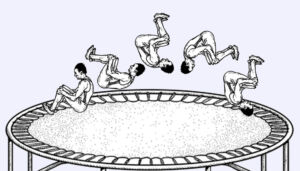
Some fractures lead to consequences bigger than the broken bone. A broken neck is the clearest example: the bone may heal quickly while the damage to the spinal cord is permanent.
Damage at C1 through C4 can paralyze the body below the neck (quadriplegia). Damage at C5 through C8 may spare some arm and hand control while paralyzing the lower body (paraplegia). The level of the damage drives spinal cord injury case values and shapes how a neck fracture case is valued when the fracture stops short of the cord.
This is why the American Academy of Pediatrics strongly discouraged home recreational trampoline use in 2012, and why Cleveland Clinic warns about the dangers trampolines pose to kids. Flips and somersaults put the neck directly in the line of force.
Who Is Liable for a Trampoline Injury in Oklahoma?
Liability turns on where the accident happened and what failed:
- Backyard trampolines. Homeowners take on a duty to supervise young guests, and many homeowners insurance companies treat trampolines as an attractive nuisance. Unsafe setups and missing padding support premises liability claims against Oklahoma property owners.
- Trampoline parks. Trampoline parks allow dozens of jumpers on connected beds and exposed springs, and nearly all require a signed waiver. A waiver does not automatically end the case: enforceability depends on its language and who signed it, especially for a child.
- Defective equipment. Failed welds, broken springs, and torn mats point to a product liability claim against the manufacturer or seller.
Oklahoma applies comparative negligence under 23 O.S. § 13: recovery is reduced by the injured person’s share of fault and barred only when that share exceeds 50%. The filing deadline for Oklahoma injury claims is two years under 12 O.S. § 95. A child’s own claim is paused during minority under 12 O.S. § 96, and a minor’s settlement goes through the court approval process for a minor’s settlement. These questions dominate child injury cases in Oklahoma City.
Trampoline Injury Questions
How many people get hurt on trampolines every year?
More than 100,000 per year measured by emergency room visits alone; the CPSC’s broader count of medically treated injuries topped 300,000 in 2018.
How many people get paralyzed from trampolines?
Paralysis usually follows a cervical fracture that damages the cord. Spinal fractures were about 4% of the broken bones in the 2002-2011 hospital data, roughly 36% of them in the neck, but they carry the worst outcomes. Paralysis and spinal cord injury claims are litigated as catastrophic cases.
Does homeowners insurance cover trampoline injuries?
Sometimes. Policies split on trampolines: some cover injuries on the property, others exclude them outright. When a child is hurt on someone else’s trampoline, the homeowner’s policy is usually the first source of recovery, so the policy language gets read early.

Hurt in a Trampoline Accident in Oklahoma?
Hasbrook & Hasbrook has represented injured Oklahomans since 2000. If a trampoline accident put your child in the emergency room, call (405) 605-2426 or contact our Oklahoma City office for a free consultation with a personal injury attorney. We will tell you plainly whether you have a case.



