Returning to a job after a traumatic brain injury (TBI) is rarely a single event. It is a months-long process that overlaps medical recovery, vocational planning, family finances, and an injury claim. Doing it well protects health and the value of an Oklahoma personal injury claim. Doing it badly causes symptom relapse, lost income, and a damaged earning-capacity case.
This guide covers the realistic timeline, the barriers that derail returns, the Oklahoma and federal vocational programs, ADA accommodations, and how the return-to-work decision affects damages. Hasbrook & Hasbrook Personal Injury Lawyers represents Oklahomans with brain injuries and works alongside treating providers and vocational counselors on this transition.
How brain injury severity shapes the timeline
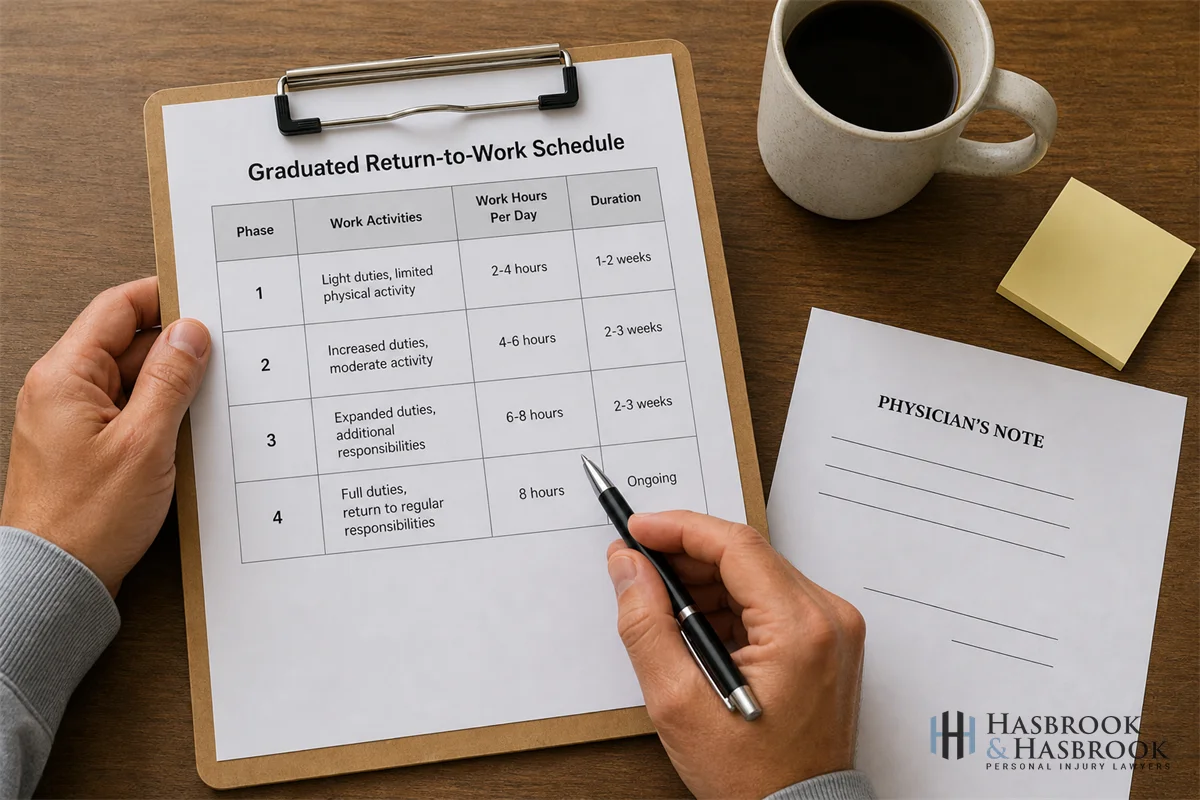
The biggest predictor of when (and whether) someone returns to work is the severity of the initial injury. The CDC groups TBI into mild, moderate, and severe categories using loss of consciousness, post-traumatic amnesia, and Glasgow Coma Scale scores. The CDC TBI overview describes how those track with recovery. Three rough phases map onto re-entry:
| Phase | Timeframe | Realistic work status |
|---|---|---|
| Acute | Days 0 to 90 | Off work for moderate or severe TBI; mild concussion 2 to 6 weeks off depending on job demands |
| Subacute | 3 to 12 months | Graduated, accommodated re-entry begins for many; cognitive rehab usually still active |
| Chronic | 12 months and beyond | Stabilized pattern: full duty, modified duty, reduced hours, alternate occupation, or long-term disability |
Mild TBI clients sometimes assume a week off is enough. A meaningful subset still report cognitive or fatigue symptoms at 3 and 6 months. The NIH National Library of Medicine archives cohort studies on this slower-than-expected recovery curve. We see it in mild TBI litigation: a client looks fine at deposition but has not performed at pre-injury level for months.



Why returning is harder than it looks
Even when imaging is clean and the doctor releases the patient, the workplace surfaces deficits that home life hides. Barriers fall into four categories:
- Cognitive: slowed processing, divided-attention problems, working-memory gaps, executive-function decline (planning, switching tasks), and word-finding difficulty
- Physical: headache, light and sound sensitivity, vestibular problems, sleep disruption, and fatigue, often triggered by open-plan offices, fluorescent lighting, and long commutes
- Emotional and behavioral: irritability, depression, anxiety, decreased frustration tolerance, and disinhibition, often misread as personality changes
- Sensory and communication: reduced tolerance for noise, multitasking, and rapid back-and-forth conversation
Mayo Clinic’s post-concussion syndrome overview covers how these persist past the expected recovery window.

Vocational rehabilitation: Oklahoma DRS and ODC
Two Oklahoma agencies intersect the return-to-work process. The Oklahoma Department of Rehabilitation Services (DRS) runs the state vocational rehabilitation program under the federal Rehabilitation Act of 1973. DRS counselors evaluate work capacity, fund training, pay for assistive technology, and place clients with accommodating employers. Federal funding flows through the Rehabilitation Services Administration.
The Oklahoma Office of Disability Concerns (ODC) focuses on advocacy, ADA technical assistance, and program information. ODC does not pay for services but is the right starting point for understanding eligibility. The federal Administration for Community Living funds many state disability services and lists independent living centers nationally.
The typical sequence:
- Treating physician documents work-capacity restrictions in writing
- Client or family calls Oklahoma DRS to open a case
- DRS counselor schedules a vocational evaluation, often coordinated with neuropsychology
- Joint plan is written: training, accommodations, placement, or alternate occupation
- Plan is reviewed and updated as recovery progresses
If the injury happened on the job, workers’ compensation pays first and the vocational rehab piece runs through the comp carrier. We address that overlap in vocational rehabilitation in injury cases.
Accommodations under the ADA and Oklahoma anti-discrimination law
The federal Americans with Disabilities Act (ADA) requires employers with 15 or more employees to provide reasonable accommodations to qualified employees with disabilities, including TBI, unless doing so would cause undue hardship. The EEOC’s enforcement guidance spells out the obligations; ada.gov’s employment overview is a plain-English starting point.
Oklahoma’s Anti-Discrimination Act (Title 25 of the Oklahoma Statutes) mirrors much of the federal ADA framework and is enforced by the Oklahoma Attorney General’s Office of Civil Rights Enforcement. Federal law is what most TBI clients rely on; the Oklahoma statute matters for parallel state-court remedies.
Common accommodations employers grant under these statutes include:
- Reduced hours or compressed workweeks during early re-entry
- Quiet workspace and modified lighting (no overhead fluorescents)
- Written instructions, or verbal confirmed in writing
- Assistive technology: text-to-speech, calendar and reminder apps, organization software
- Frequent short breaks; single-task assignments rather than parallel deliverables
- Flexible start time (sleep disruption is common after TBI)
- Reassignment to a vacant position when the original job cannot be accommodated
- Job coach during re-entry (often funded by DRS)
The process is interactive: the employee or treating provider proposes, the employer responds, both negotiate. Employers who refuse to engage, or who terminate before the process is complete, expose themselves to ADA liability separate from the injury claim.


Building a graduated return-to-work plan
The biggest mistake we see is the all-or-nothing return: full-duty too early, crash within two weeks, end up on disability with worse symptoms than before. A graduated return reduces that risk substantially.
| Variable | Week 1 to 2 | Week 3 to 6 | Week 7 to 12 | Beyond Week 12 |
|---|---|---|---|---|
| Hours per day | 2 to 4 | 4 to 6 | 6 to 8 | Full or final reduced schedule |
| Days per week | 2 to 3 | 3 to 4 | 4 to 5 | Full or final reduced schedule |
| Task complexity | Familiar, routine | Routine plus one new | Mixed, supervised | Full duty or restricted to capacity |
| Cognitive load | Single task | Two tasks, one active | Normal load with breaks | Stable |
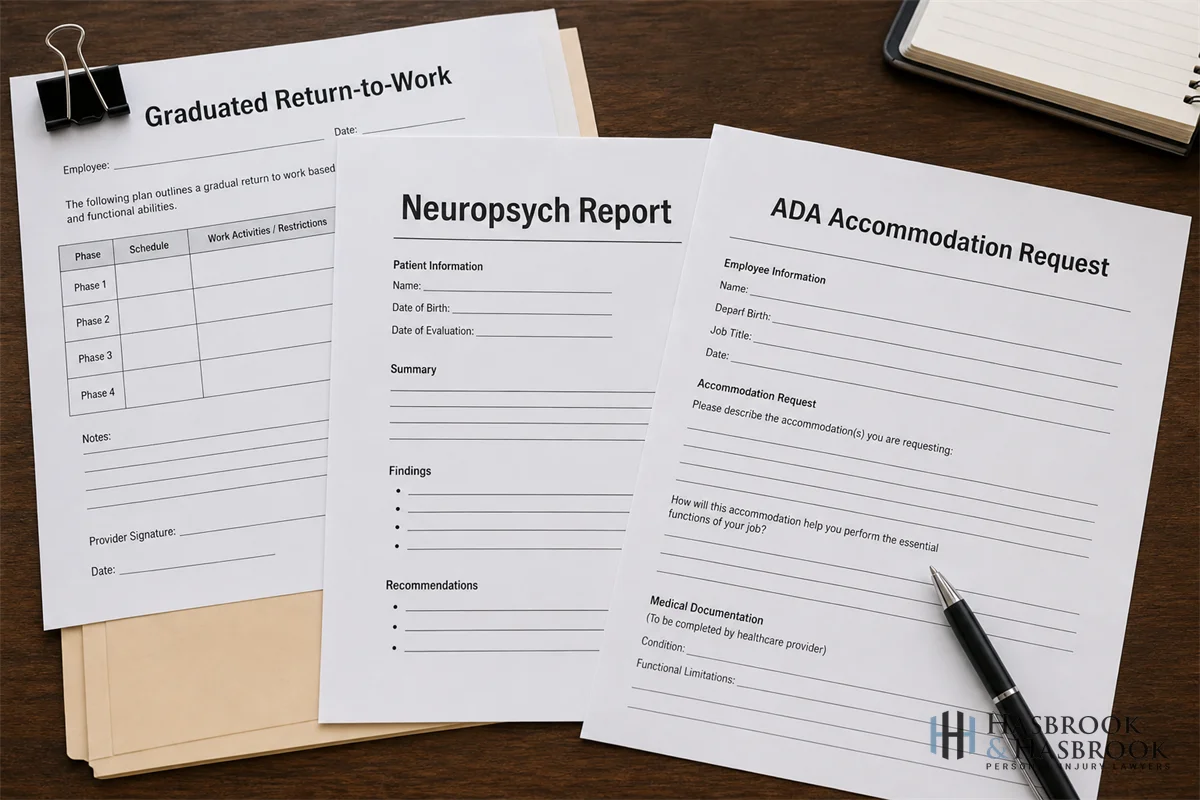
The plan should be in writing, signed by the treating physician, and shared with HR. It must include stepback criteria: if symptoms (headache lasting more than two days, sleep disruption, three or more cognitive errors in a week) reappear, the schedule reverts. A plan without a stepback rule is a one-way ramp that punishes honest reporting.
SSDI and earning-capacity damages
Some brain injuries are too severe for meaningful work re-entry. For those clients, Social Security Disability Insurance (SSDI) or private long-term disability becomes the primary income. SSDI turns on whether the impairment prevents any substantial gainful activity, not just the prior job. The SSA Ticket to Work program lets recipients try part-time work without immediately losing benefits. Coordinating SSDI with an injury case takes care: settlement timing, structured-settlement design, and any Medicare set-aside must be considered before resolution. See structured settlements and lump-sum settlements and SSDI.
Lost earning capacity is one of the largest damage categories in a serious brain injury case: the present value of the gap between pre-injury career earnings and what the client can realistically earn now. Oklahoma allows recovery under 23 O.S. § 61, with comparative-fault rules under 23 O.S. § 13. Our reduced ability to earn a living page covers the methodology.
The return-to-work decision affects the calculation in two directions. Returning too aggressively and crashing onto disability lets the defense argue disability was a choice. Refusing to attempt any return when the medicine supports a graduated try lets the defense argue failure to mitigate. The cleanest record shows a documented graduated return with accommodations and either measurable success or inability to sustain despite good-faith effort. See how much is a TBI worth and future medical costs in catastrophic cases.
Frequently asked questions
How long should I stay out of work after a concussion?
Most mild concussion patients are off work or school for 2 to 6 weeks, with desk jobs on the shorter end and demanding jobs on the longer end. If symptoms have not resolved by week 4, see a concussion specialist before pushing return.
Can my employer fire me for needing accommodations after a TBI?
Not legally, if the employer is covered by the ADA (15 or more employees) and you are qualified to perform the essential job functions with reasonable accommodation. Termination for requesting accommodation, or before the interactive process is complete, can support a separate ADA claim.
Do I have to disclose my brain injury to a new employer?
Not during application or interview. The ADA framework lets you raise accommodation needs after the offer or after you start. Many TBI clients choose to disclose proactively to a trusted supervisor, but that is a personal call.
Will applying for SSDI hurt my injury case?
Not by itself. SSDI documentation can support the disability narrative. The risk is coordination: a lump-sum settlement can affect future SSDI benefits and trigger Medicare-set-aside obligations. Involve the lawyer in timing.
What if my employer refuses accommodations?
Document the request and refusal in writing. Contact the EEOC or the Oklahoma Attorney General’s Office of Civil Rights Enforcement. Refusal can be a separate cause of action.
How does Oklahoma DRS differ from workers’ compensation vocational rehab?
DRS serves any person with a disability regardless of cause. Workers’ comp vocational rehab applies only when the brain injury was work-related and the comp carrier is responsible. The two can run in parallel or sequentially.

Working with our firm on a brain injury case
At our firm, we handle TBI cases from concussion through severe catastrophic injury. We coordinate with treating providers, neuropsychologists, vocational counselors, and life-care planners to manage the medical and financial transition while preserving the value of the injury claim. If a family member has a brain injury and is sorting out the next step on work, call (405) 605-2426 or use our Oklahoma City brain injury lawyer page. The consultation is free; we work on contingency. Related reading: cognitive testing after a brain injury, concussion vs. TBI, mild TBI litigation challenges, and red-flag symptoms that warrant emergency evaluation.