Yes. Most scoliosis is congenital or shows up during childhood growth, but the direct force of a car accident can fracture or misalign the spine and produce a lateral curve doctors call traumatic scoliosis. The same trauma can also worsen a curve someone already had. Watch for uneven shoulders, a tilted waistline, or new back pain in the weeks after a crash.
A traumatic scoliosis diagnosis after a wreck raises two separate questions: what happened to the spine, and how you pay to treat it. Below is how car accident trauma causes or worsens a spinal curve, what the warning signs look like, and how to pursue a spinal injury claim in Oklahoma City.
Can a Car Accident Cause Scoliosis, or Make an Existing Curve Worse?

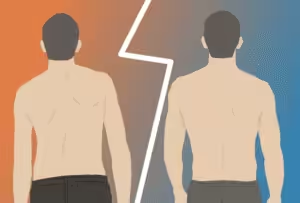
The spine is a stack of 33 vertebrae that protects the spinal cord, the bundle of nerves running from the base of the brain to the tailbone. A healthy spine runs straight from behind; scoliosis bends it sideways into an “S” or “C” shape instead. Most cases are idiopathic, showing up during childhood growth with no clear cause. A smaller share is traumatic scoliosis, a curve caused by blunt-force injury that fractures a vertebra or damages the discs and ligaments holding the spine in alignment. Mayo Clinic’s overview of scoliosis symptoms and causes covers both forms.
A car accident can deliver exactly that kind of force. The same crash that fractures a vertebra or ruptures a disc can pull the spine out of alignment, and someone who already had a mild idiopathic curve can see it worsen after the impact. Either way, the resulting curve and the medical bills that come with it trace back to the crash, not to a condition that existed on its own.



Common Signs of Traumatic Scoliosis After a Car Accident
Symptoms often appear right away, but they can also build gradually over the weeks and months after a crash. Common signs include one shoulder or hip sitting higher than the other, a shoulder blade that sticks out more on one side, an uneven waistline, and back pain that does not resolve with rest. In more severe cases, a curve that compresses the ribcage can make breathing feel more difficult.
Diagnosing and Treating Post-Traumatic Scoliosis
Doctors diagnose scoliosis with a physical exam and X-ray imaging that measures the angle of the curve. The same imaging often turns up the injury that caused it: a car accident can bulge or rupture a spinal disc, fracture a vertebra, or damage the soft tissue holding the spine in place. Treatment depends on severity, ranging from a back brace or physical therapy to chiropractic care, with surgery reserved for severe cases involving fractured vertebrae, a badly herniated disc, or a torn rotator cuff from the same crash. PubMed, the National Library of Medicine’s database, indexes clinical literature on trauma as a factor in spinal curvature, available here.
Getting evaluated within the first 72 hours after the crash matters for more than your health. A delay gives the insurance company an opening to argue the curve or the underlying injury came from something other than the accident. Keep your medical records, including every X-ray, brace fitting, and physical therapy visit, so the connection between the crash and the diagnosis is documented from the start.

Filing an Injury Claim for Traumatic Scoliosis in Oklahoma City
A personal injury claim for traumatic scoliosis can cover medical bills, lost wages while you recover, and pain and suffering, and it typically comes from the at-fault driver’s insurance. Oklahoma law requires every driver to carry minimum liability insurance for exactly this kind of claim. If the insurance company disputes the diagnosis or undervalues it, filing a lawsuit is the other option, and Oklahoma gives you two years from the date of the crash to do it under 12 O.S. § 95.
A car accident rarely causes just one injury. The same collision that fractures or misaligns the spine can also aggravate a pre-existing condition like rheumatoid arthritis, and a claim should account for every diagnosis that traces back to the crash, not just the most obvious one. Hasbrook & Hasbrook handles car accident injury claims across Oklahoma City and can help sort out which of your injuries the at-fault driver’s insurance is responsible for.
Traumatic Scoliosis FAQs
Can a car accident aggravate scoliosis I already had?
Yes. A curve that was mild or stable before the crash can worsen when the impact adds new stress or fresh damage to the spine, and doctors will compare pre-accident and post-accident imaging to measure the change.
Can a fall cause the same kind of spinal trauma as a car accident?
Yes. Traumatic scoliosis comes from blunt force to the spine, and a hard fall can deliver that force just as a collision can. The mechanism, not the label “car accident” or “fall,” determines whether the resulting curve counts as traumatic scoliosis.
Can whiplash contribute to scoliosis?
Whiplash itself is a neck and soft-tissue injury, but the same violent motion that causes whiplash can also strain or damage the muscles and ligaments supporting the spine further down, which can contribute to a developing curve alongside a direct fracture or disc injury.
Can children develop traumatic scoliosis in a car accident?
Yes. A child’s spine is still developing, and any car accident injury to a child should include a full evaluation for scoliosis, along with vision problems and torn muscles and strained ligaments, both common after a crash and easy to miss without a thorough exam.


Talk to an Oklahoma City Car Accident Attorney
If a car accident left you with a new or worsened spinal curve, Hasbrook & Hasbrook offers a free consultation to go over the diagnosis, the medical bills, and what your claim could recover. Call (405) 605-2426 or send details about your accident online.