Sue both the truck driver and the trucking company. Oklahoma law lets you name every party whose negligence contributed to the crash, and under 23 O.S. § 15 each defendant answers only for its own share of fault. The company usually carries deeper insurance and independent liability for how it hired, trained, and supervised the driver.
The direct answer: should you sue the driver, the company, or both?
Oklahoma law lets you pursue every party whose negligence contributed to your injuries, typically the driver and the motor carrier:
- The driver answers for the act that caused the crash: speeding, fatigue, running a red light, or driving impaired.
- The trucking company carries broader liability: it owns or leases the truck, employs the driver, and holds the commercial insurance policy.
- Third parties, including cargo loaders, manufacturers, or maintenance contractors, may also share fault. See how Oklahoma courts assign fault after a truck wreck.
Naming both protects every avenue of recovery and keeps the defense from shifting blame to an absent party.



Common ways trucking companies act negligently
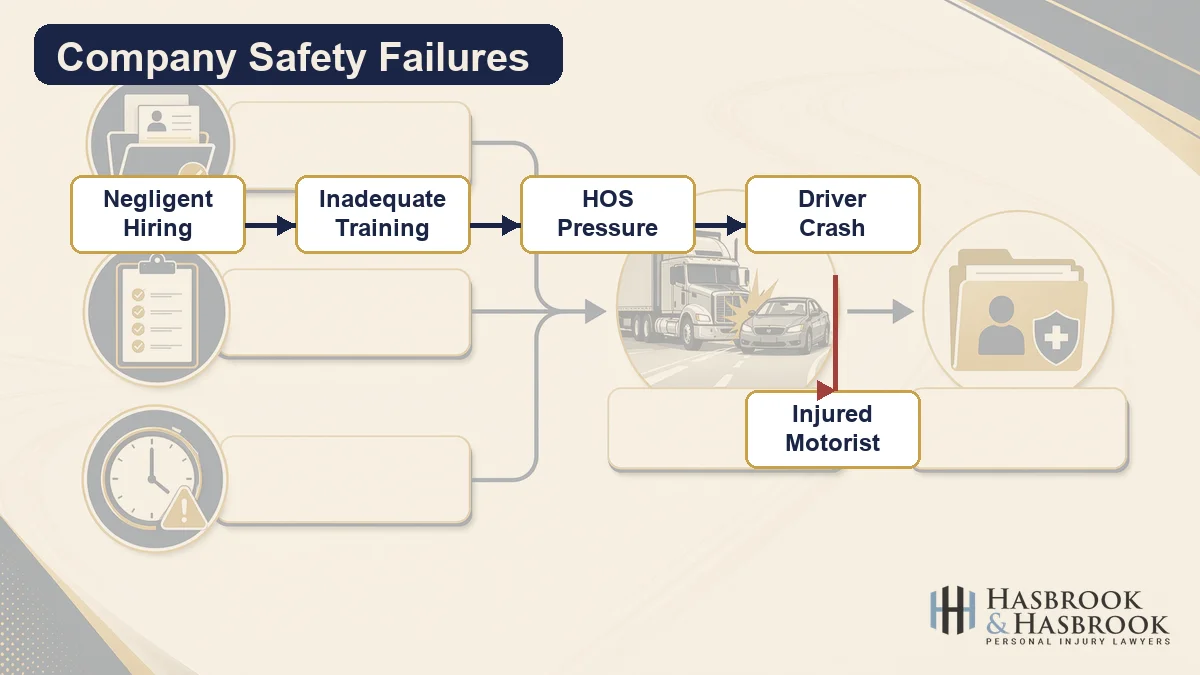
Commercial carriers face federal safety duties beyond an ordinary driver’s. Cutting corners on any of them creates a separate basis for liability:
- Negligent hiring: putting a driver with a history of violations, crashes, or failed drug tests on the road. Carriers must check three years of employment history and driving record first; a driver’s prior record is often central to this claim.
- Negligent training: assigning a 40-ton rig without adequate instruction on defensive driving or load securement.
- Negligent retention or entrustment: keeping an unfit driver on the road, or assigning one a vehicle, after learning of violations, failed drug tests, or disqualifying conditions.
- Hours-of-service violations: pressuring drivers to falsify logs or skip rest breaks. See the penalties carriers face for breaking federal safety rules.
Which theory applies often shapes what a truck accident case is typically worth.
How vicarious liability works under Oklahoma law

Respondeat superior, Latin for “let the master answer,” holds an employer liable for an employee’s negligence within the scope of employment (see Cornell Law’s overview of vicarious liability). Oklahoma courts apply it whenever the driver was acting as the carrier’s agent on a dispatched route, which describes most over-the-road hauls.
Carriers often raise the independent contractor label as a defense. FMCSA rules, including 49 CFR § 390.5, undercut it: a carrier holding the operating authority is the statutory employer of any driver under it. Oklahoma courts look past the label at actual control: routes, required equipment, enforced safety standards.
Why naming both defendants protects your full recovery
Oklahoma’s several-liability rule under 23 O.S. § 15 makes each defendant responsible only for its own share of fault, so naming every negligent party matters more, not less:
- Insurance depth: interstate carriers must carry at least $750,000 in liability coverage, and hazmat loads up to $5 million. When a claim exceeds an individual driver’s policy limits, the carrier’s coverage is the next layer.
- Asset access: a driver with limited assets can leave a judgment uncollectable even after you win, unlike a carrier’s balance sheet.
- Punitive exposure: Oklahoma allows punitive damages under 23 O.S. § 9.1 for reckless disregard, exposure a company that ignored known violations faces beyond the driver.
- Fault apportionment: the jury allocates fault among every named defendant; drop one, and you absorb that share.


Evidence you need to build a truck accident claim
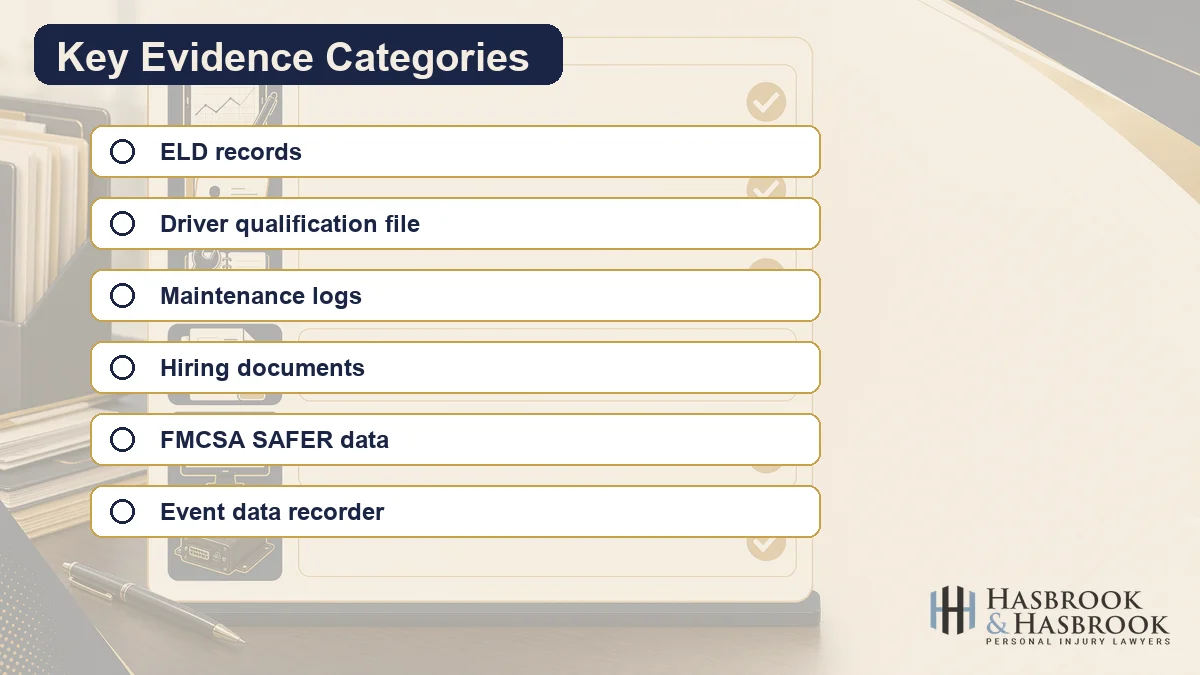
Truck crash claims involve evidence ordinary car cases do not. Knowing what to demand before it disappears often decides the case:
- ELD data: logging records showing hours driven, rest periods, and speed history, kept only six months before carriers may destroy them.
- Driver qualification file: application, employment history, motor vehicle records, and medical certificates FMCSA requires carriers to retain.
- Maintenance records: repair orders and pre- and post-trip reports showing whether a known defect existed before the crash.
- FMCSA SAFER data: the public safety database showing a carrier’s inspection history and violation pattern.
- Event data recorder: speed, braking, and throttle inputs before impact, preserved only if a written hold notice reaches the carrier immediately.
Compelling production when a carrier delays or resists runs through Oklahoma’s civil discovery rules for injury claims.
Why you must act quickly after a truck crash

Oklahoma’s two-year deadline under 12 O.S. § 95 applies to truck claims, but truck cases carry extra time pressure car crashes do not:
- ELD data disappears on a schedule without a written hold notice, which carriers may lawfully ignore after six months.
- The carrier moves first, sending investigators to the scene within hours, often while you are still at the hospital.
- Spoliation sanctions require timely notice. Courts sanction destroyed evidence only when the carrier got a preservation demand first.
Oklahoma’s statute of limitations rules for injury claims also cover exceptions for wrongful death and minor children.
How a truck accident attorney protects your claim
A commercial carrier is not the same opponent as a standard auto insurer. By the time most injured people call a lawyer, the carrier’s defense team has already visited the scene.
An attorney handling truck accident claims in the Oklahoma City area sends immediate hold notices and knows which records to demand. See what a truck accident lawyer does for your case.
Hasbrook & Hasbrook represents injured Oklahomans on a contingency basis. You pay nothing unless we recover for you. Call 405-605-2426 for a free consultation.

Common questions about truck accident lawsuits in Oklahoma
Should I sue just the truck driver or the trucking company?
Sue both. Limiting your claim to the driver caps your recovery at his personal policy, far less than the carrier’s commercial coverage, and the company faces independent claims for how it hired and trained him. Retaining an attorney early puts you in the best position to pursue every defendant.
What if the truck driver fled the scene after the crash?
You can still sue the carrier. The truck’s registration, operating authority, and insurance policy trace back to the company regardless of the driver’s actions, and FMCSA or ELD data can often identify the driver afterward. uninsured motorist protection on your own policy may also respond to a hit-and-run truck crash.
Can I still recover compensation if I was partly at fault?
Yes, as long as your fault does not exceed 50%. Under 23 O.S. § 13, your damages are reduced by your percentage of fault, and recovery is barred only when your share exceeds 50%. Someone 25% at fault in a $400,000 case still recovers $300,000. See how partial fault changes an Oklahoma injury claim.
What is the deadline to file a truck accident lawsuit in Oklahoma?
Two years from the crash date under 12 O.S. § 95. The window for preserving ELD and black box data is shorter, since carriers may destroy logs after six months, so most attorneys send hold letters within days of being retained. The exceptions to Oklahoma’s filing deadline cover minors and discovery-rule situations.