A Midwest City truck accident lawyer investigates crashes along I-40 and the Tinker Air Force Base freight routes, identifies every liable party under Oklahoma’s modified comparative fault rule (23 O.S. § 13), and moves to preserve electronic logging data before Oklahoma’s two-year injury deadline (12 O.S. § 95) runs.
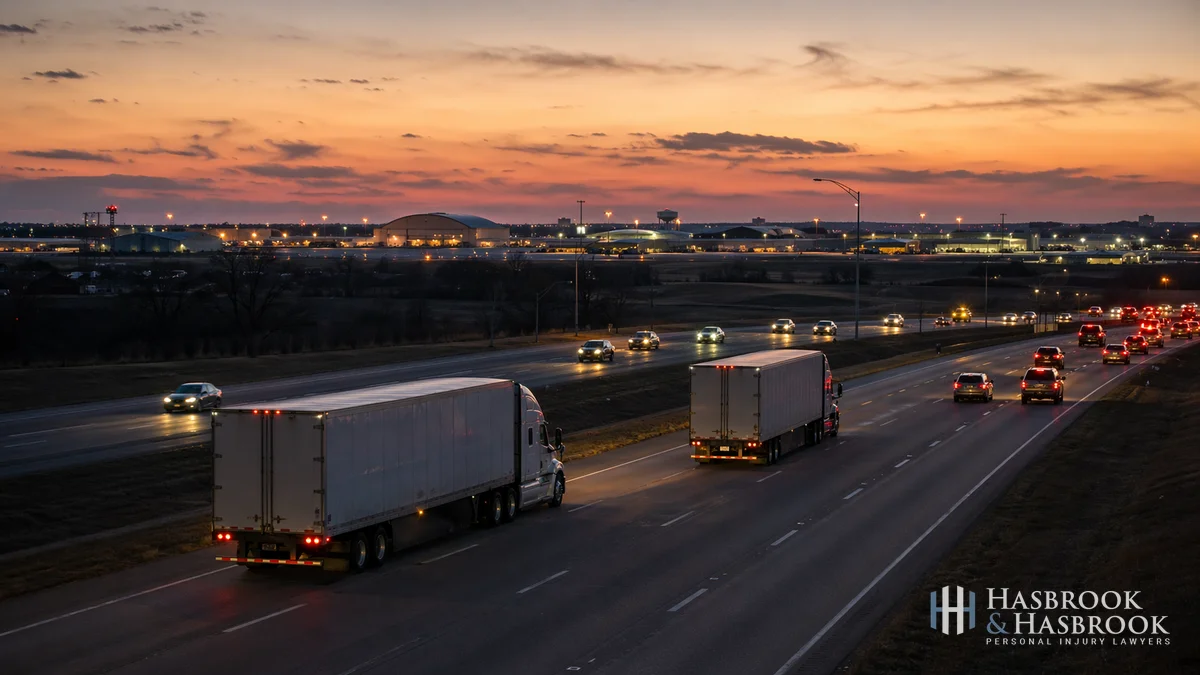
Midwest City sits along one of the busiest commercial freight corridors in the Oklahoma City metro. Interstate 40 cuts through the city, and SE 29th Street channels warehouse and retail traffic onto that highway. Tinker Air Force Base adds its own steady stream of logistics trucks on Air Depot Boulevard and Douglas Boulevard. A loaded semi that drifts out of its lane or cannot brake in time rarely produces a minor fender-bender. The sheer size mismatch raises the stakes for anyone driving a passenger car nearby. Hasbrook & Hasbrook represents people hurt in these crashes throughout Midwest City and the rest of Oklahoma. Call 405-605-2426 to talk about what happened.



Why Midwest City truck accidents are especially dangerous
The stretch of I-40 through Midwest City sees crash concentrations at the Douglas Boulevard and Midwest Boulevard interchanges, and along SE 29th Street, where trucks constantly cross active lanes to reach nearby distribution and retail sites. When someone is hurt in one of these wrecks, Midwest Regional Medical Center on Douglas Boulevard is typically the first stop for trauma care. Size is the core problem. A fully loaded tractor-trailer can outweigh a passenger car by a factor of 20, and that mismatch is a large part of why truck wrecks so often produce catastrophic injuries rather than the bumps and bruises of an average fender-bender. Interstate carriers also answer to a separate layer of federal rules on top of Oklahoma tort law, covering driver hours, qualification, and vehicle upkeep. Much of the digital proof of a violation, from ELD logs to event-recorder downloads, can vanish through routine overwriting within one to two weeks unless a lawyer moves fast to preserve it.
The Oklahoma Highway Safety Office and the National Highway Traffic Safety Administration both study how large-truck wrecks differ from ordinary passenger crashes. The pattern those agencies describe nationally shows up locally on the I-40 corridor every year.
Common causes of truck accidents near Midwest City
A handful of recurring failure points show up again and again in Midwest City truck crash claims:
- Driver fatigue and hours-of-service violations. Federal rules limit a driver to 11 hours behind the wheel inside a 14-hour window, yet fatigue still drives many of the overnight wrecks along I-40.
- Equipment failure. Worn brake components, blown tires, and trailers running without proper lighting usually point back to a carrier that skipped scheduled maintenance.
- Improper cargo loading. A load that isn’t secured evenly can shift mid-turn and roll the rig; see a Midwest City rollover claim built around a shifted load.
- Distracted driving. The phone-record and dash-cam evidence that proves inattention in a Midwest City crash works the same way against a commercial driver as it does against any other motorist.
- Speeding. Posted limits change repeatedly near the Midwest City interchanges, and a loaded rig cannot slow down as fast as the cars around it; see the highway-speed collision claims we handle in Midwest City.
- Weather. A loaded semi’s high center of gravity makes it far more sensitive than a car to hydroplaning, crosswinds, and ice.
- Impaired driving. CDL holders operate under a 0.04 blood-alcohol limit, exactly half the standard threshold, and a positive test after a crash strengthens both the liability case and any punitive-damages claim.
Who is liable, and what Oklahoma and federal law require
More than one company can end up owing money after a Midwest City truck wreck, and each usually carries a separate insurance policy:
- The driver, when negligence, impairment, or an hours-of-service violation caused the crash
- The motor carrier, when hiring, training, or maintenance failures contributed
- The shipper or loader, when improperly secured freight caused the wreck
- The manufacturer of a vehicle or component, when a defective brake, tire, or steering part played a role
- A maintenance contractor, when a known defect went unrepaired
- The freight broker, when it placed the load with a carrier known for a poor safety record
Oklahoma’s modified comparative fault standard lets an injured person recover as long as their own share of fault stays at or below the combined fault of the defendants. Our page on dividing responsibility after a shared-fault Oklahoma wreck walks through how that math works, and our FAQ on naming the driver, the carrier, or both on a complaint covers how the two liability theories interact. Federal rules also set minimum insurance floors for motor carriers: at least $750,000 for general freight, rising to $5 million once hazardous materials are involved. Both figures sit well above a standard auto policy. Those same interstate carriers answer to federal hours-of-service limits, driver-qualification standards, and inspection rules that shape nearly every claim of this kind.


Injuries common in Midwest City truck accident cases
An ordinary car accident rarely produces the injury patterns a truck wreck does. On the catastrophic end, that includes traumatic brain injury with permanent cognitive effects. Our pages on the approach we take on head-injury claims and what a brain-injury case is typically worth in Oklahoma cover both angles. Spinal cord damage and paralysis requiring lifetime care are common too; see our approach to building a paralysis and long-term-care claim. Severe burns from a fuel fire or cargo spill, and fractures serious enough to need surgical repair, round out the catastrophic end. Oklahoma law treats injuries at this level as a permanently disabling category with its own damages analysis. On the moderate end, whiplash, soft-tissue strain, and internal injuries sometimes do not announce themselves for days. Post-traumatic stress also shows up after truck wrecks more often than after an average collision. Getting checked out right away protects both your health and the strength of the claim.
Building the case: evidence, experts, and carrier records
A carrier’s defense team is usually investigating within hours of the wreck, which means the injured side needs to move just as quickly. A legal hold letter sent in the first days demands that the carrier preserve ELD and hours-of-service records, event-recorder downloads, cab and trailer camera footage, driver qualification files, and maintenance and cargo paperwork. Much of that can disappear through routine overwriting inside one to two weeks. From there, the case typically needs an accident-reconstruction engineer who can recreate the impact, a trucking-industry expert who can read the ELD and hours-of-service data, and a life-care planner who can project long-term medical costs. Every carrier registered with USDOT keeps a public safety profile. Pulling that carrier’s crash and violation history through the federal safety database often supports a negligent-hiring or negligent-retention theory. Depositions of the driver, the safety director, and the dispatcher are frequently where admissions about falsified logs or pressure to skip rest breaks surface.
Compensation available after a Midwest City truck accident
Oklahoma recognizes three categories of damages, and what a case is ultimately worth depends on how serious the injuries are, how strong liability is, and how much coverage is available. Economic damages cover costs with a receipt attached: emergency and future medical care, income lost while recovering and any longer-term hit to earning capacity, vehicle and property damage, and out-of-pocket expenses such as prescriptions or home modifications. Non-economic damages cover real losses that do not come with an invoice, including pain and suffering, disfigurement, and strain on family relationships. Our FAQ on the method Oklahoma juries use to value pain and suffering breaks down how that number gets built. When a carrier knowingly lets a fatigued driver keep exceeding hours-of-service limits, or ignores maintenance warnings it already knew about, punitive damages can come into play under 23 O.S. § 9.1.
A Midwest City truck claim often settles for more than a comparable car-accident case built on similar injuries. The higher federal coverage minimums play a role, and so does the outsized weight documented safety violations and falsified logs tend to carry.

Do you need a lawyer after an 18-wheeler accident in Midwest City?
The carrier’s insurer typically has adjusters, defense counsel, and a reconstruction team at the scene before an injured person has any legal representation of their own. An attorney can send a preservation demand right away, before ELD data gets overwritten. Handling every call from the insurer directly also keeps an early recorded statement from coming back to hurt the claim later; see the early missteps that quietly undercut a case. Offers that arrive before an injury is fully diagnosed rarely account for surgery or care that is still coming. See why a quick advance-payment offer from the insurer almost never reflects full value and what a commercial-vehicle injury lawyer actually does once retained.
Related truck and injury claims we handle in Midwest City
Truck wrecks frequently overlap with other kinds of injury claims. Beyond trucking, we represent Midwest City clients hurt in ordinary car wrecks, people injured in a Midwest City bus accident, and drunk-driving crash claims arising in this city. We also handle motorcycle crash claims here, all under our broader Midwest City personal injury practice. Within trucking specifically, separate pages cover blind-spot truck wrecks and side-impact truck collisions in Midwest City. For a truck wreck elsewhere in the state, see our Edmond trucking practice, Tulsa-based practice covering eastern Oklahoma, or how our firm handles truck wrecks across the OKC metro.
Why Midwest City clients choose our firm for a truck case
Clayton Hasbrook has practiced Oklahoma injury law since 2008, and the firm itself has represented injured Oklahomans since 2000. He has led the trucking caseload personally for most of that stretch, rather than routing cases through a rotating case manager. The firm also fronts the cost of experts and discovery that a serious trucking case demands. Familiarity with the judges, defense firms, and jury pools in Oklahoma County comes from years of trying cases here, not from a script.

Frequently asked questions about Midwest City truck accidents
Do I need a truck accident lawyer, or can I handle the claim myself?
Carriers send a dedicated claims team to the scene long before an injured person has legal help of their own. People who bring in an experienced truck accident lawyer typically walk away with meaningfully more than those who deal with the carrier’s insurer directly; see how outcomes compare with and without counsel.
How long do I have to file a truck accident lawsuit in Oklahoma?
Oklahoma’s statute of limitations gives most injured people two years from the crash date to file suit, under 12 O.S. § 95. Evidence, especially ELD data a carrier has no duty to keep forever, only gets harder to obtain the longer a claim sits. Talk to a lawyer well before that window closes.
The truck driver says I caused the crash. Can I still recover?
Usually, yes. Oklahoma’s comparative fault rule reduces a recovery by an injured person’s own percentage of fault, and only blocks it entirely once that fault is greater than the combined fault of the defendants. Carriers routinely point the finger at the other driver, and crash-reconstruction evidence is often what unravels that argument.
Can I sue the trucking company, even if the driver was an independent contractor?
In most situations, yes. Under respondeat superior, an employer answers for an employee’s negligence committed within the scope of the job. A carrier can also face direct liability for negligent hiring, training, or retention, no matter how the driver is classified on paper. Oklahoma courts look at how much control the carrier actually exercised over the driver’s work, not just the label in a contract.
What if a defective truck part caused or contributed to the accident?
A failed brake, tire, or steering component can support a product liability claim against the manufacturer, distributor, or maintenance shop, layered on top of the negligence claims against the driver and carrier, which adds another defendant and another insurance policy to the case.
What if someone died in a Midwest City truck accident?
Surviving family members can bring a wrongful death claim. The filing deadline, the people entitled to file, and the damages the estate can recover all differ from a standard injury case; our page walks through what a Midwest City wrongful death claim involves.
How much does it cost to hire a truck accident lawyer in Midwest City?
The firm takes truck accident cases on contingency: no fee unless it recovers money for you, and costs such as expert fees are advanced along the way at no upfront charge.
If a commercial truck injured you or someone in your family in Midwest City, call Hasbrook & Hasbrook at 405-605-2426 for a free consultation, or request a case review online any time. There is no attorney fee unless the firm recovers compensation for you.