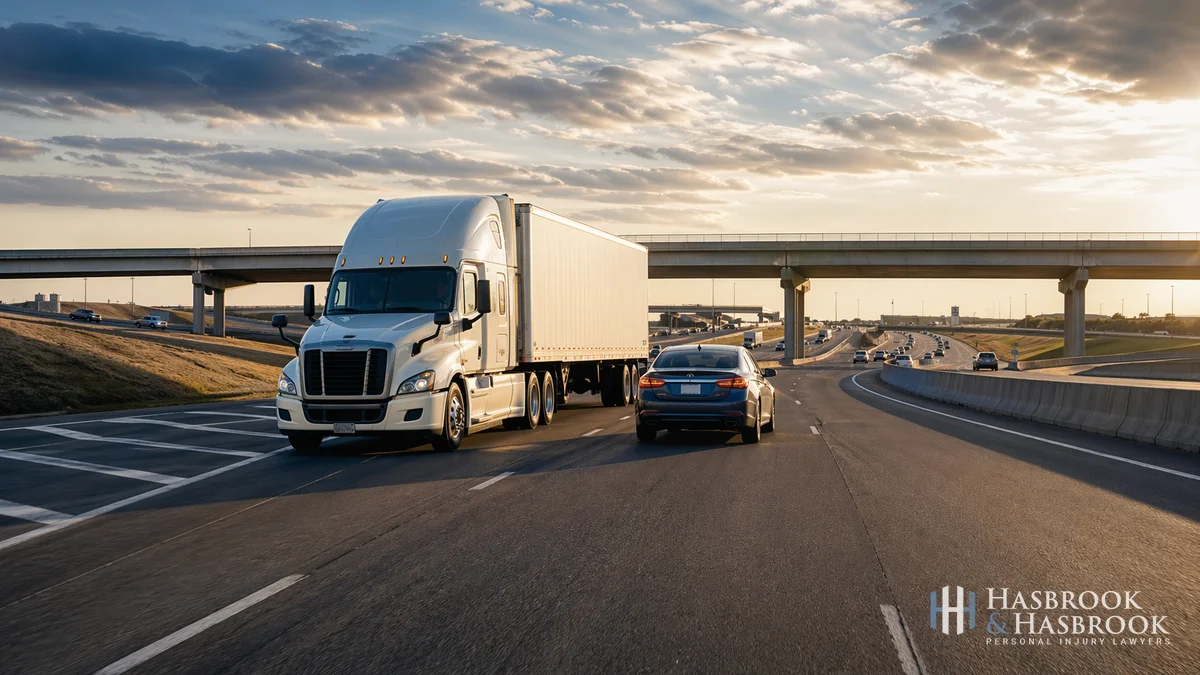
Midwest City sits along I-40 and I-240, two of Oklahoma’s busiest commercial freight corridors, where loaded tractor-trailers change lanes through the Sooner Road interchange, pass Tinker Air Force Base, and navigate SE 15th Street every day. Many of those moves happen in or near the blind spots the Federal Motor Carrier Safety Administration calls “no-zones,” areas around a commercial truck where a smaller vehicle disappears entirely from the driver’s mirrors. When a driver fails to check a no-zone before moving, a sideswipe or side-impact crash often follows.
Hasbrook & Hasbrook, a personal injury law firm in Oklahoma City, represents people injured in blind-spot truck crashes in Midwest City and throughout the surrounding area. Call 405-605-2426 for a free consultation.
What is a truck blind spot (no-zone)?
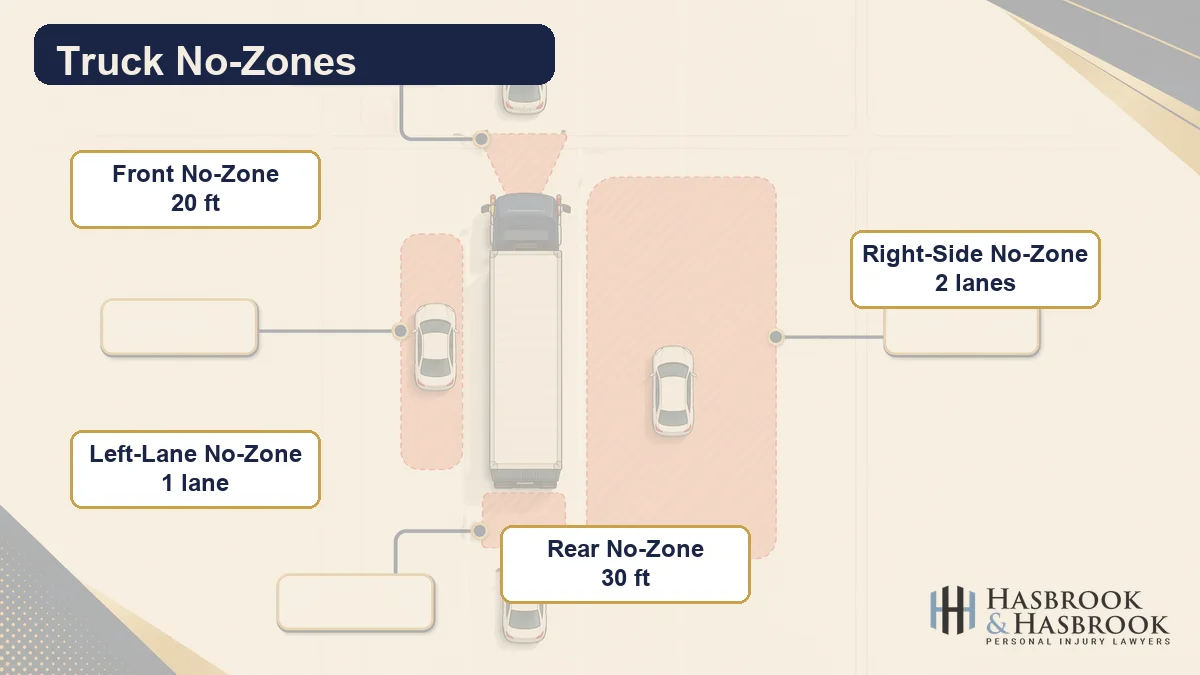
The FMCSA uses the term “no-zone” to describe four areas around a commercial truck where mirrors provide little or no visibility.
- Front no-zone. The area directly ahead of the cab. A tractor’s raised hood means the driver cannot see vehicles within roughly 20 feet of the front bumper.
- Rear no-zone. The area directly behind the trailer. Without a rear window, anything within about 30 feet of the trailer’s back end is invisible unless it appears in a side mirror.
- Right-side no-zone. The largest zone, extending rearward from the cab across one to two lanes. Even with wide-angle mirrors, vehicles alongside the rear quarter of the trailer often remain hidden.
- Left-side no-zone. Smaller than the right because the driver’s-side mirror provides better coverage, but vehicles at mid-trailer can still vanish from view.
If you cannot see the truck driver’s face in the mirrors, the driver cannot see you. The right-side no-zone is the most dangerous because most interstate merges in Midwest City funnel smaller vehicles directly into it.

How blind-spot truck crashes happen in Midwest City
Midwest City’s road layout creates repeating no-zone collision points. The I-40/Sooner Road interchange routes merging vehicles into the right-side no-zone of trucks already in the travel lanes. Along SE 15th Street, trucks serving the Tinker industrial corridor make right turns with restricted rear-quarter visibility. Oklahoma truck accident rates have risen alongside freight demand, and congested interchanges are where blind-spot crashes concentrate.
Common blind-spot crash patterns on this corridor:
- A truck initiating a lane change on I-40 without verifying the right-side no-zone, sideswiping a vehicle alongside the trailer
- A merging truck moving into the travel lane before a passenger vehicle clears the no-zone
- A truck making a wide right turn on SE 15th Street or Sooner Road and squeezing a vehicle against a curb
For the broader picture, see our our main truck accident practice hub page.
Who is liable for a blind-spot truck crash
Liability typically starts with the driver but extends to the carrier. Potentially responsible parties include:
- The truck driver. CDL holders receive formal training in no-zone awareness. Moving into an occupied lane without checking the no-zone is a direct breach of that duty.
- The motor carrier. Carriers must train drivers on no-zone procedures. If records show no blind-spot instruction or logs were falsified, the carrier faces direct liability for that gap.
- Negligent hiring or retention. Prior no-zone crash history the carrier overlooked when hiring or retaining the driver supports separate negligent hiring and retention claims.
Oklahoma uses modified comparative fault under 23 O.S. § 13: your recovery is reduced by your share of fault and barred if your fault exceeds 50 percent. See our page on Oklahoma’s comparative and contributory negligence rules and our FAQ on suing the truck driver versus the trucking company.
Federal standards for truck mirrors and blind-spot technology
49 CFR § 393.80 requires every commercial motor vehicle to carry mirrors providing a clear view to the rear and to each side; where a single mirror does not cover that field, additional or wide-angle mirrors are required. FMCSA has also issued advisory guidance encouraging carriers to adopt voluntary blind-spot detection technology. A carrier that knew about available no-zone cameras and chose not to equip its fleet supports a finding of negligent operation. See our page on how black box data works in Oklahoma accident cases.
Common injuries from blind-spot collisions

Blind-spot crashes produce side-impact or sideswipe contact where a truck’s mass strikes the door side of a smaller vehicle, an area with far less structural protection than a front bumper.
- Cervical spine and neck injuries. Lateral impact snaps the neck sideways, causing herniated discs and vertebral fractures that frequently require surgery. See our page on back and neck injuries from collisions.
- Traumatic brain injury. Head contact with the door frame or window can produce TBI even when airbags deploy. See our Oklahoma City brain injury attorneys page for how these claims are evaluated.
- Rib fractures and internal organ damage. Side-impact force concentrates on the ribcage and can lacerate the liver, spleen, or lungs. Internal bleeding may not be visible at the scene.
- Crush injuries and limb fractures. When a truck forces a smaller vehicle against a barrier, door intrusion can cause crush injuries to the arm, leg, or hip. See our overview of broken bone claims.
- Soft tissue injuries. Lateral shoulder and thoracic injuries often go undetected at the emergency room. See our page on soft tissue injuries after collisions.
Proving the truck’s blind spot caused your crash
Proving a no-zone failure requires more than eyewitness accounts. Commercial trucks generate electronic evidence that, if preserved quickly, pinpoints each vehicle’s position at the moment the driver moved.
- ELD and event data recorder data. The ELD records hours-of-service compliance; the event data recorder captures speed, braking, and engine inputs in the seconds before impact, confirming whether the truck was making a lane change and at what speed.
- Dash-camera footage. Many carriers equip trucks with forward- and side-facing cameras that can show whether the driver signaled, checked mirrors, and verified the lane before moving.
- Accident reconstruction. An accident reconstruction engineer maps each vehicle’s path using gouge marks, paint transfer, final vehicle positions, and electronic data.
- Driver training and qualification records. A carrier with no documented blind-spot training program, or a driver with prior no-zone violations, provides an independent basis for direct negligence claims against the carrier.
ELD records can be overwritten within days without a preservation demand; an attorney can send a spoliation letter within the first week to stop that clock. For more, see our page on determining liability in truck crashes.
Damages available in blind-spot truck accident cases
Economic damages cover losses with a measurable dollar amount: emergency care, surgery, and hospitalization; future medical treatment and rehabilitation; lost wages and reduced earning capacity and reduced earning capacity; vehicle damage; and home modifications for permanent injuries.
Non-economic damages cover losses without a bill: physical pain, emotional distress, loss of enjoyment of activities, and permanent disfigurement. For how Oklahoma courts calculate these losses, see our overview of how pain and suffering damages are calculated in Oklahoma.
Punitive damages may be available in reckless-conduct cases. Under 23 O.S. § 9.1, a carrier that knowingly operated a truck without required mirrors or continued using a driver with prior blind-spot failures may face punitive exposure. See our page on 23 o.s. § 9.1 punitive damages oklahoma statute for when they apply.
Blind-spot truck cases tend to settle higher than comparable passenger-vehicle cases because commercial policies carry larger limits. For what these cases settle for, see our page on what these cases settle for and our midwest city wrongful death lawyer page if a family member died in the crash.
Why choose Hasbrook & Hasbrook for your blind-spot truck case
Hasbrook & Hasbrook is a personal injury law firm in Oklahoma City. We represent people injured in truck accidents in Midwest City and throughout the Oklahoma City area. Consultations are free and we work on contingency: no attorney fee unless we recover compensation for you. See our FAQ on contingency fees for how that structure works.
On blind-spot truck cases, we send legal hold letters to stop ELD data from being overwritten, work with accident reconstruction engineers, pull the carrier’s FMCSA safety record, and handle all communications with the trucking company’s insurer. Clayton Hasbrook leads our truck accident cases; see his Clayton’s professional profile, the role of a truck accident attorney, and how a truck accident lawyer can help.
Frequently asked questions about Midwest City blind-spot truck accidents
What should I do right after a blind-spot truck crash in Midwest City?
Call 911 and stay at the scene. Photograph the truck’s position, both vehicles’ damage, the DOT number and carrier name on the trailer, and any skid marks. Get the driver’s CDL number and the carrier’s insurance information. Do not give a recorded statement to the carrier’s insurer before speaking with an attorney.
How do I prove the truck driver failed to check the blind spot?
Electronic and physical evidence establishes the failure. Dash-camera footage, ELD lane-change data, paint transfer analysis, and witness statements can each show the driver moved without clearing the no-zone. An accident reconstruction engineer ties those sources into a position-by-position account of the crash.
Can I recover if I was partly in the truck’s no-zone?
Yes, in most cases. Oklahoma’s comparative fault rule, 23 O.S. § 13, reduces your recovery by your share of fault but bars recovery only if your fault exceeds 50 percent. Courts consider how long you were in the zone and whether the driver had time to clear the lane before moving.
How long do I have to file a blind-spot truck accident claim in Oklahoma?
Two years from the date of injury under 12 O.S. § 95. ELD data can be overwritten within days, so acting quickly protects the evidence. See our overview of Oklahoma’s personal injury statute of limitations.
Who pays my medical bills after a blind-spot truck crash?
Initial costs come through your own health insurance, medical payments coverage, or out of pocket; compensation from the carrier’s insurer arrives through a settlement or judgment. Our page on how medical bills are handled in a settlement explains how provider liens affect your net recovery.
What if the trucking company says I should have stayed out of the blind spot?
That argument goes to comparative fault, not a complete defense. The driver had a duty to check mirrors before changing lanes; the carrier had a duty to train on no-zone procedures. Moving without verifying the lane was clear cannot shift full responsibility to another driver by pointing to the no-zone.
Contact Hasbrook & Hasbrook about your Midwest City blind-spot truck crash
If you or a family member was injured in a blind-spot truck collision in Midwest City, call Hasbrook & Hasbrook at 405-605-2426. The consultation is free and there is no attorney fee unless we recover compensation for you.
You can also reach us through our through our online contact form. We respond promptly to truck accident inquiries.