Uber and Lyft carry $1 million in liability coverage once a driver has an accepted trip or passenger onboard, but only contingent coverage up to $50,000 per person if the app is merely open with no ride accepted yet. Oklahoma law caps the filing window for injury claims at two years and cuts off recovery once you are more than half at fault.
Midwest City residents lean on Uber and Lyft daily: Tinker Air Force Base workers catching a ride off-shift, commuters on I-40, or a group out along SE 29th Street. When one of those trips ends in a driver-caused crash, getting paid back is not as simple as a typical two-vehicle crash claim in Midwest City, because rideshare coverage is built in tiers keyed to what the app showed the driver doing at impact.
How rideshare insurance works in Midwest City
Uber and Lyft classify their drivers as independent contractors rather than employees, and that single label decides how much insurance responds after a wreck. Both companies split their coverage into three tiers keyed to the driver’s app status the moment of the crash.
- Tier 1, app off: nothing from Uber or Lyft. Only the driver’s own auto policy is in play.
- Tier 2, app on but no ride accepted yet: a thin contingent layer – $50,000 per injured person, $100,000 per accident, $25,000 for property damage – and it only kicks in once the driver’s own insurer refuses the claim outright.
- Tier 3, matched to a rider or a trip underway: $1 million in third-party liability coverage, plus uninsured/underinsured motorist and contingent comprehensive protection. Uber lays out its own version of this coverage structure for drivers and riders.
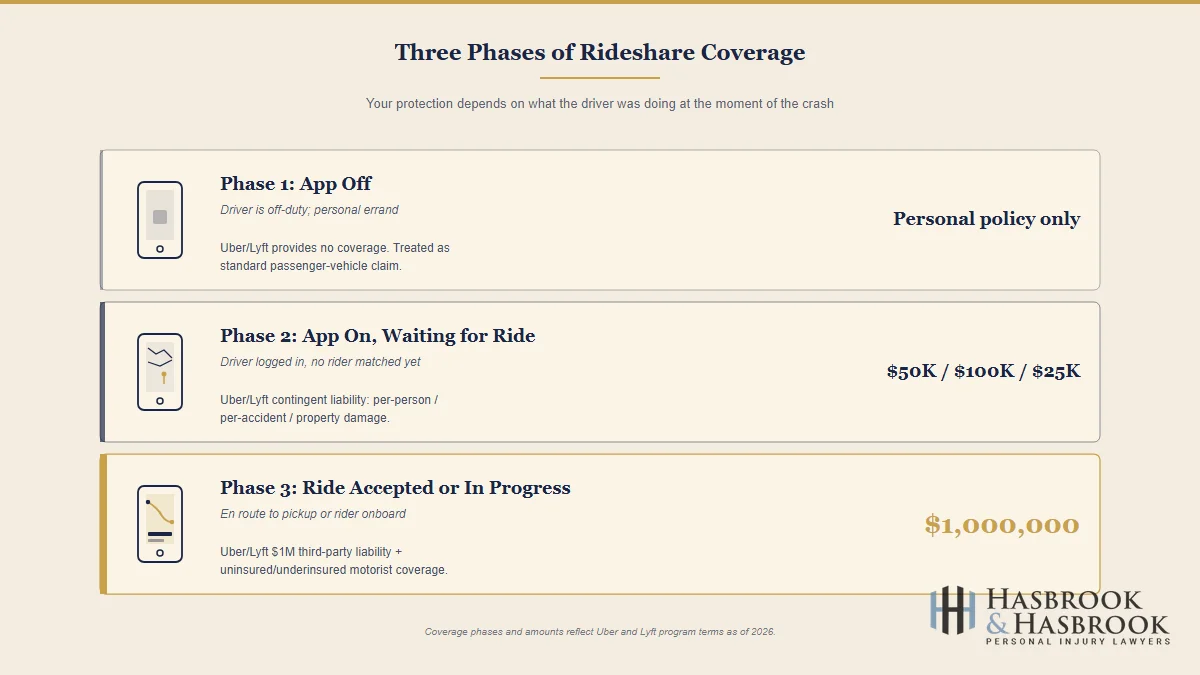
Most disputes land in Tier 2, where the app was open but no ride had been taken, so the $1 million policy never triggers. A driver without a rideshare rider on their own policy can be left with almost nothing, since personal auto policies usually write rideshare use out of the contract. Insurers work out which tier applied from GPS and app logs, so getting that data preserved fast matters. See how a rideshare claim diverges from an ordinary two-car claim.
Common causes of Uber and Lyft accidents in Midwest City
Rideshare drivers face pressures a regular commuter never does, and which one caused your wreck shapes who ends up on the hook.
- App-driven distraction: accepting a fare and following turn-by-turn directions pulls eyes off the road, a platform-specific flavor of distracted driving here in Midwest City.
- Racing the surge: per-trip pay and surge multipliers push drivers to squeeze in more rides, feeding speed-related crashes, especially on busier stretches of I-40.
- Fatigue behind the wheel: drivers stacking rideshare hours on a day job see reaction times slow about as much as a couple of drinks would.
- Screening gaps: initial background checks have blind spots, and neither company runs a routine re-check, so violations picked up after approval often slip through.
- Driving under the influence: a driver who is drunk or on drugs is as dangerous as any impaired motorist, with the added wrinkle that the company may dodge blame, unlike a standard Midwest City DUI crash.
Injuries common in Midwest City rideshare crashes
A passenger in the back seat of a rideshare vehicle gets hurt differently than someone up front: no steering wheel to worry about, but also fewer ways to brace, which can mean more rotational injury in a side-impact hit.
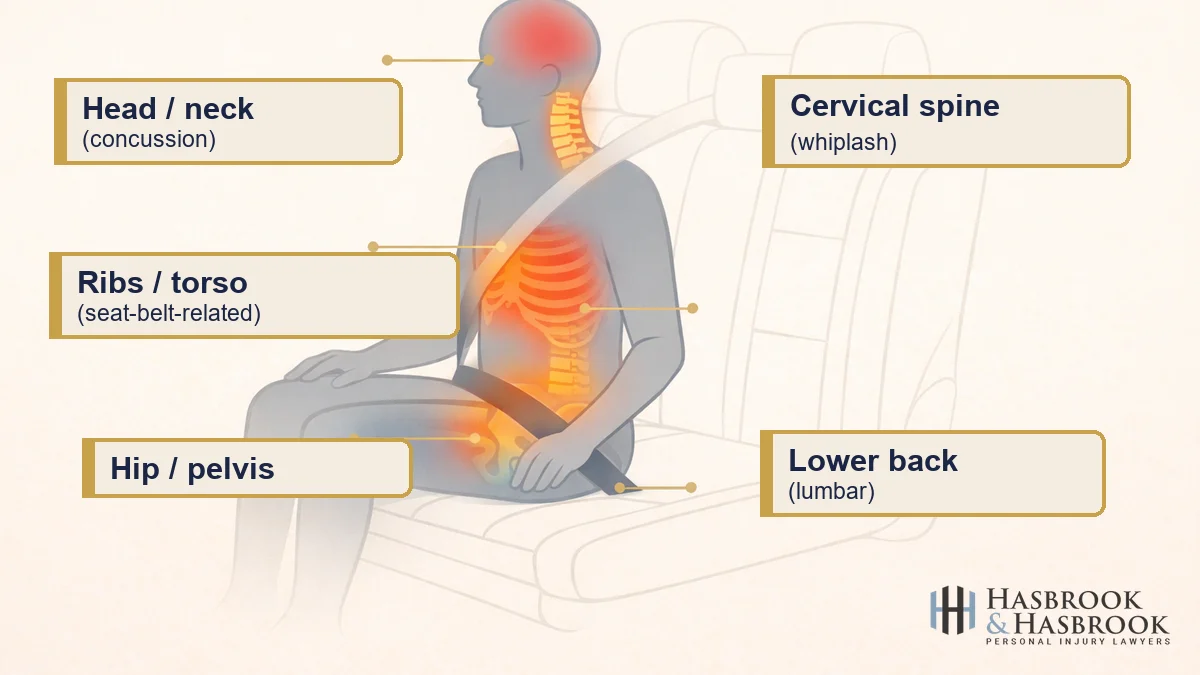
- Whiplash and soft tissue damage: neck strain from the sudden back-and-forth motion of a rear impact is the most common injury here, and symptoms can take one to three days to surface, so a same-day exam matters even if nothing hurts yet.
- Head and brain trauma: hitting the interior can cause concussions and other brain trauma needing specialist evaluation; see what a brain-injury claim is typically worth.
- Spinal cord damage: a hard side-impact or high-speed hit can leave permanent nerve damage at the spinal cord level, with the steepest lifetime care costs of any injury on this list.
- Fractures: arms, wrists, and ribs break easily as a passenger braces; our page on how broken-bone claims are valued covers the details.
- Fatalities: a fatal rideshare crash opens a wrongful death claim for the surviving family; our Midwest City wrongful death page covers the separate rules involved.



What damages you can recover after a Midwest City rideshare accident
When someone else’s carelessness caused the wreck, Oklahoma law opens recovery in three buckets. Economic losses cover medical bills, lost income, reduced future earning power, and property costs. Non-economic losses cover pain, emotional strain, lost enjoyment of life, and spousal loss of consortium. Punitive damages are narrower: under 23 O.S. § 9.1, a jury can award them where a driver showed reckless disregard for others’ safety, which could fit sending a text message while driving or driving drunk.
How to prove liability in an Uber/Lyft accident
A rideshare case takes more proof than a normal two-car wreck, since the outcome hinges on which coverage tier was live at impact.
- Trip and app data: acceptance timestamps, GPS pings, and app logs pin down Tier 2 versus Tier 3, but the companies don’t keep this data forever, so a legal hold letter needs to go out fast.
- Police report and scene photos: the officer’s report plus photos of vehicles, road, and visible injuries should be locked down right away.
- Nearby camera footage: businesses along SE 29th Street and intersections near Tinker AFB often run cameras that may have caught the crash; private footage tends to get overwritten within days.
- Medical proof of causation: how quickly you sought care feeds directly into the negligence analysis insurance adjusters run.
- Countering the contractor defense: beating the argument that a driver has no agency tie to the company usually means using the evidence-exchange stage of a lawsuit to pull internal control records.
Steps to take after a Midwest City rideshare accident
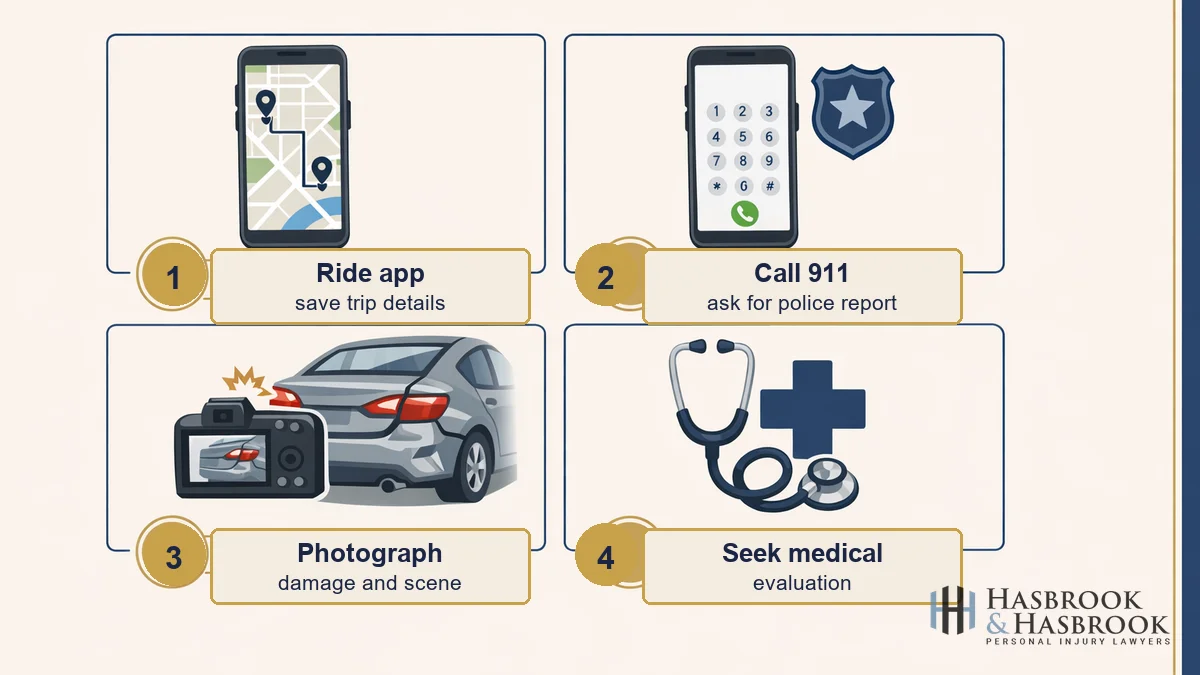
- Call 911 for police and paramedics even if injuries seem minor; you’ll want that report number later.
- Screenshot the trip screen before the app closes, locking in proof of Tier 3 status.
- Photograph everything: vehicles, road surface, injuries, skid marks, and the other driver’s insurance card and plate.
- Write down the driver’s details: name, phone number, insurance information, and the trip reference number.
- See a doctor the same day, since brain and spinal symptoms can take time to surface and gaps in treatment get used against you.
- Skip the recorded statement for now. Nothing requires a recorded statement to an insurance adjuster before you’ve talked to a lawyer.
- Report it inside the app so there’s an official record, without agreeing to any version of events.
For a longer walkthrough, see the OKC-specific rideshare accident checklist.
Why Uber/Lyft claims are harder than regular car accident claims
- Fighting over which tier applied: the swing between Tier 2’s $100,000 ceiling and Tier 3’s $1 million is enormous, and the companies control the GPS and app data needed to prove it.
- The contractor shield: both companies lean on the position that drivers are contractors, blunting direct liability absent real proof of company control.
- Personal policies that exclude rideshare use: a driver’s own policy often carves out rideshare driving, shoving recovery onto the thin Tier 2 backup, which is frequently not enough.
- Juggling several policies at once: a bad crash can mean filing against the driver’s policy, the company’s tier-appropriate policy, and your own uninsured and underinsured motorist coverage, each on its own clock.
- Data that disappears: trip and GPS records can be purged within weeks absent an early legal hold demand.
Our Lyft-specific injury page for the metro walks through how this same tier framework carries over to that platform.


How Oklahoma’s comparative fault rules can affect your recovery
Oklahoma runs on a modified comparative fault model under 23 O.S. § 13: your payout shrinks by your share of fault, and disappears past the 50 percent mark. That rule matters in rideshare wrecks, where three or more parties often end up in the mix. As the paying passenger riding inside the vehicle, you almost never carry blame for the crash itself, ahead of either driver in the dispute. Adjusters sometimes argue a passenger distracted the driver; that rarely survives once the facts are laid out. See how fault gets split among Oklahoma drivers or what determines fault in an Oklahoma crash.
The deadline for filing a Midwest City rideshare accident claim
Oklahoma gives you two years from the crash date to file under 12 O.S. § 95, no matter how solid the underlying case is. See Oklahoma’s two-year injury filing window or the tolling exceptions that can push that date back. A rideshare case still rewards moving early, since Uber and Lyft only hold trip and app data for a limited stretch. When a crash proves fatal, a different clock applies under 12 O.S. § 1053 for the wrongful death claim surviving family can bring.
Why choose our firm for your Midwest City rideshare case
Hasbrook & Hasbrook has represented injured Oklahomans since 2000 out of Oklahoma City. The attorney who leads our injury practice is licensed across every Oklahoma state court and takes rideshare cases from the first call through resolution, on contingency, with a free consultation covering coverage tiers, evidence preservation, and your options. An attorney, not a case manager, stays on your file throughout, which matters given the tier-analysis and contractor-defense work these claims involve. The firm also covers the rest of our Midwest City injury practice, so a rideshare wreck involving a commercial truck or catastrophic injury can stay under one case. See examples of past case results.
Frequently asked questions about Midwest City Uber and Lyft accidents
Does Uber or Lyft’s $1 million policy cover me as a passenger?
Yes, if the driver had an accepted ride underway (Tier 3). In Tier 2 (app open, no accepted ride), only the thinner contingent coverage applies: $50,000 per injured person, $100,000 per accident, and $25,000 for property damage, often not enough for a serious injury.
What if the Uber driver does not have a rideshare endorsement on their personal insurance?
Expect the personal insurer to deny the claim, since standard auto policies typically write out rideshare driving. That leaves only the contingent Tier 2 coverage, well below the $1 million Tier 3 policy. See how to pursue recovery when a driver is underinsured.
Can I recover damages if another driver, not the Uber or Lyft driver, caused the crash?
Yes. Oklahoma’s fault-sharing rules let you pursue every party who contributed. A non-rideshare driver who ran a light while you were a passenger brings their own insurance into play alongside any rideshare coverage.
What if the at-fault driver is underinsured?
Uninsured or underinsured motorist coverage may fill that gap. Under 36 O.S. § 3636, Oklahoma insurers must offer UM and UIM coverage, and the Oklahoma Insurance Department publishes consumer guidance on auto coverage requirements. Depending on which tier applied, the rideshare company’s own UM/UIM protection may also apply.
What if I was partially at fault for the crash?
You can still recover as long as your fault stays at or below 50 percent under 23 O.S. § 13, with your payout trimmed by that percentage. As a rideshare passenger you almost never carry fault for the crash itself.
Can I sue Uber or Lyft directly for my injuries?
Not automatically. The independent-contractor label limits how directly the company answers for a driver’s conduct, though both companies can be named under other legal theories, and their coverage obligations hold up regardless of the employment question. Whether to name the company is one of the first calls your attorney makes.

Talk to a Midwest City Uber/Lyft accident attorney
A rideshare dispute comes down to which coverage tier was live at the moment of the crash and what evidence has to be locked down before the companies close their files. Call 405-605-2426 for a free consultation, or reach us through our secure online contact form. If a commercial vehicle was involved too, our Midwest City commercial-vehicle claims page covers those cases as well.