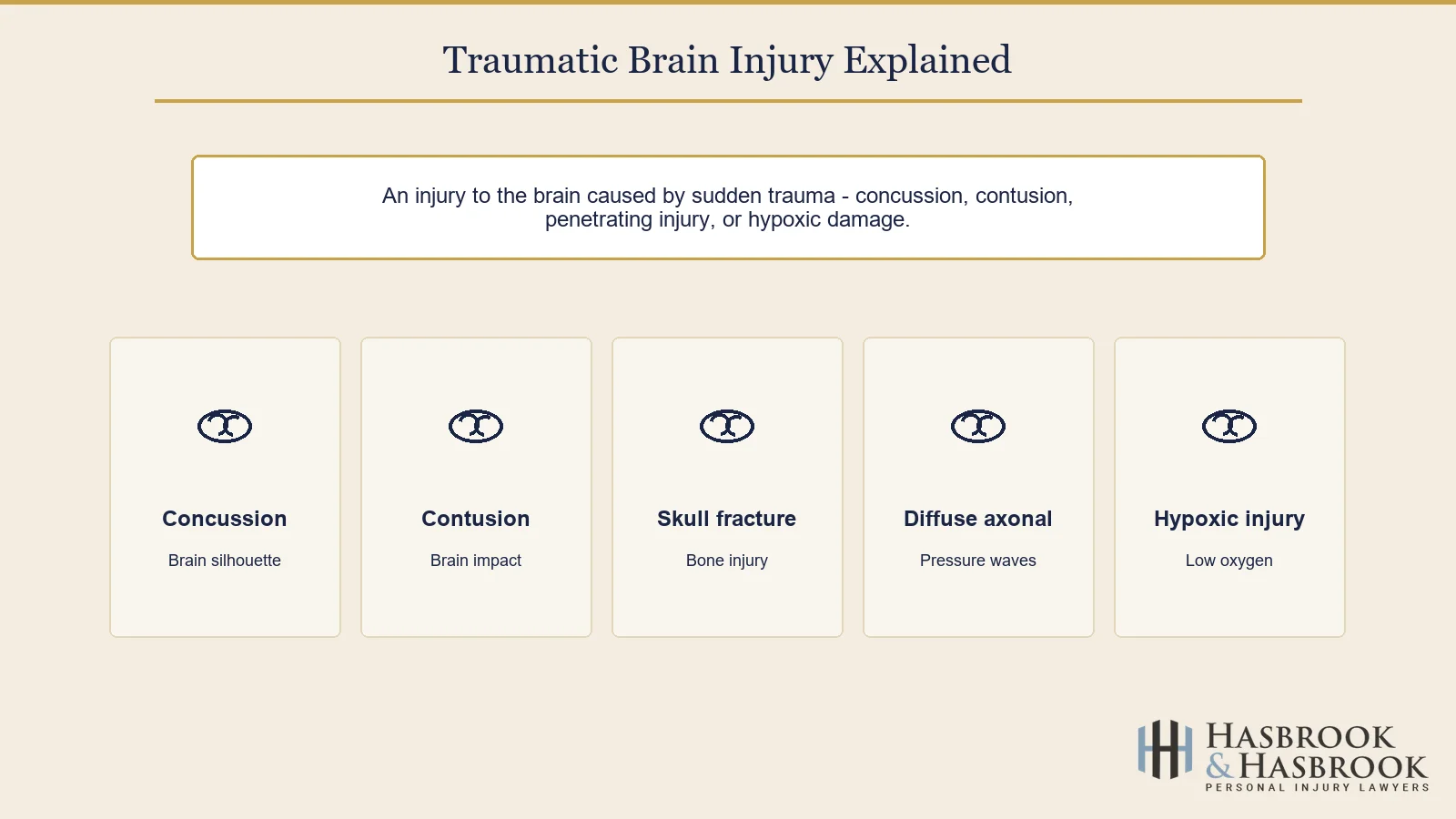
According to CDC traumatic brain injury data, roughly 2.8 million brain injuries occur in the United States each year. In Oklahoma, highway and street crashes are the leading cause of serious traumatic brain injury (TBI) in adults. A brain injury TBI can disrupt your memory, your ability to work, and your sense of who you are.
The injury lawyers at our personal injury law firm represent people who suffered traumatic brain injury TBI in car accidents, falls, workplace incidents, and other events caused by another party’s negligence. This page explains the law, how a strong case is built, and what your recovery may look like.
Key takeaways for brain injury claims in Oklahoma
- The two-year statute of limitations under 12 O.S. § 95 runs from the date of injury.
- You can recover if your share of fault does not exceed 50%, under 23 O.S. § 13.
- Noneconomic damages face a $500,000 cap under 23 O.S. § 61.3; the cap’s constitutionality is an open question after Beason.
- Medical bills, future care, and lost wages face no cap.
- TBI symptoms may not appear immediately; delayed presentation does not bar a claim.
- We handle brain injury cases on contingency: no fee unless we recover.
Traumatic brain injury in Oklahoma: what the data shows
The CDC reports TBIs account for about 30% of injury deaths nationally. The NINDS notes even moderate injury TBI can produce permanent changes in personality, memory, and cognitive ability. The Mayo Clinic describes the same pattern: invisible damage at first, lasting impact for years.
| Severity | GCS | Loss of consciousness | Typical outcome |
|---|---|---|---|
| Mild (concussion) | 13 to 15 | 0 to 30 minutes | Most recover within weeks; some develop persistent post-concussion syndrome |
| Moderate | 9 to 12 | 30 minutes to 24 hours | Lasting cognitive deficits common; months of rehabilitation |
| Severe | 3 to 8 | Over 24 hours | Permanent disability likely; coma, vegetative state, or death possible |
A “mild” GCS score does not mean “minor” in legal terms. It is important to recognize that many mild TBIs produce months of cognitive symptoms and lost work time that insurers undervalue.
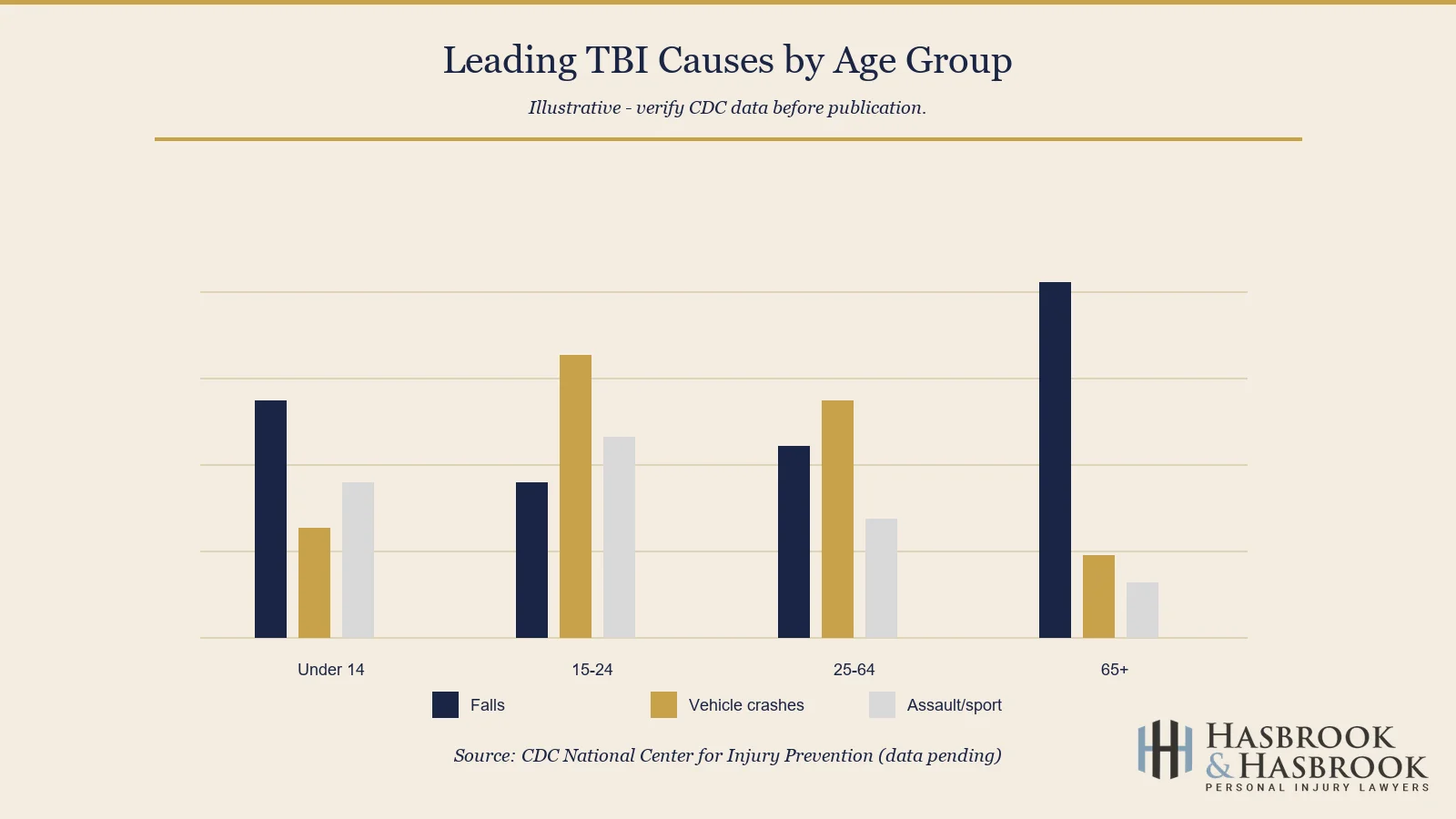
Adults are most often hurt in motor vehicle crashes; falls lead causes for children under 14 and adults over 65. Workplace incidents and sports collisions account for the rest. The cause matters because it determines who is legally responsible.



Types of traumatic brain injury our Oklahoma City head trauma lawyers handle
Motor vehicle and truck crashes
Car and tractor-trailer crashes are the most common cause of adult TBI in Oklahoma. Violent deceleration can cause coup-contrecoup injury without any direct blow to the head. Our Edmond corridor trucking practice handles cases that often produce the most severe TBIs. We handle phone-distracted driving and alcohol-impaired driving claims as well.
Falls, premises hazards, and motorcycle crashes

A slip-trip-or-fall on a negligently maintained property can support a premises-injury claim. Riders on two wheels face elevated TBI risk regardless of Oklahoma’s motorcycle-helmet statute.
Pedestrians, cyclists, and workplace incidents
When a person on foot or bicycle rider is struck, the head often hits pavement unprotected. Construction and warehouse workers face TBI risk from falling objects and falls from elevation; a third-party personal injury claim can run alongside the workers’ comp claim.

Where to seek treatment for a TBI in Oklahoma City
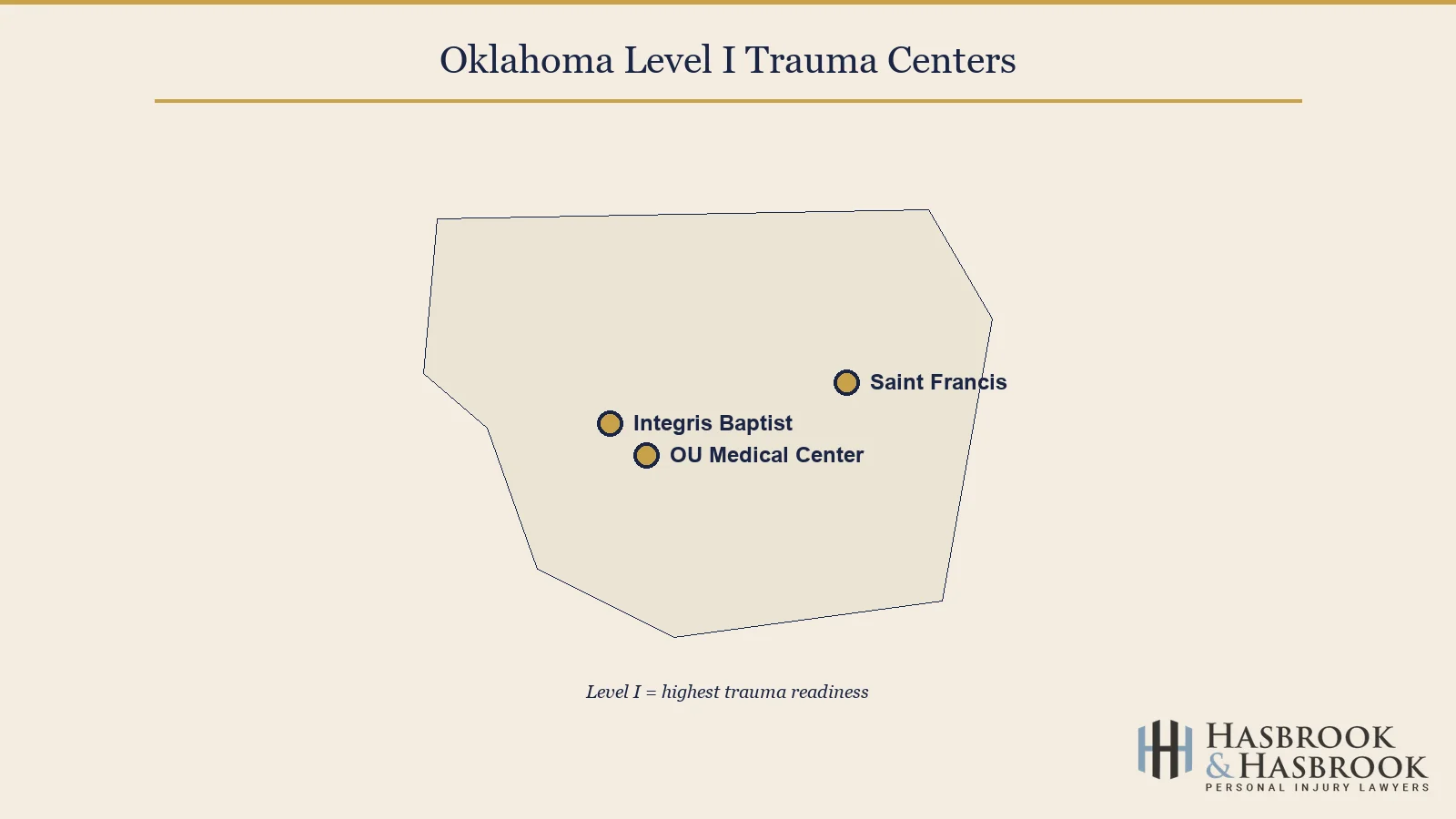
Quick access to a Level I or II trauma center can change outcomes:
- OU Health University of Oklahoma Medical Center (Level I): neurosurgery, neuro-ICU, pediatric trauma.
- INTEGRIS Baptist Medical Center (Level II): adult trauma and neurosurgical coverage.
- SSM Health St. Anthony Hospital: emergency neuro consult and inpatient rehab.
- Mercy Hospital Oklahoma City: acute imaging and neurology referral.
- Jim Thorpe Rehabilitation: post-acute cognitive and physical rehab.
Seek same-day evaluation after any head injury. Records from the first 24 hours anchor the medical timeline.
Oklahoma law that governs brain injury claims
Statute of limitations: 12 O.S. § 95
Two years from the date of injury. Missing the deadline ends your right to recover. For TBI, the clock can be complicated because symptoms may not appear immediately. Contact an attorney quickly to preserve evidence.
Comparative negligence: 23 O.S. § 13
Modified comparative negligence: recovery is reduced by your percentage of fault, and you cannot recover if your fault exceeds half. See how Oklahoma applies the 50-percent fault bar in car crashes.
Noneconomic damages cap: 23 O.S. § 61.3 (open question after Beason)
Starting September 2025, SB 453 placed a $500,000 cap on noneconomic damages in most personal injury cases. Whether the cap will survive constitutional challenge is an open question. The Oklahoma Supreme Court struck down the prior cap in Beason v. I.E. Miller Services, Inc., 2019 OK 28, holding it violated the Oklahoma Constitution’s special-laws provision. Whether the new cap clears the same bar has not been tested. Exceptions cover severe physical injury, reckless conduct, gross negligence, fraud, and intentional wrongdoing. Permanent mental injuries may qualify for a separate $1 million threshold.


How we investigate traumatic brain injury cases
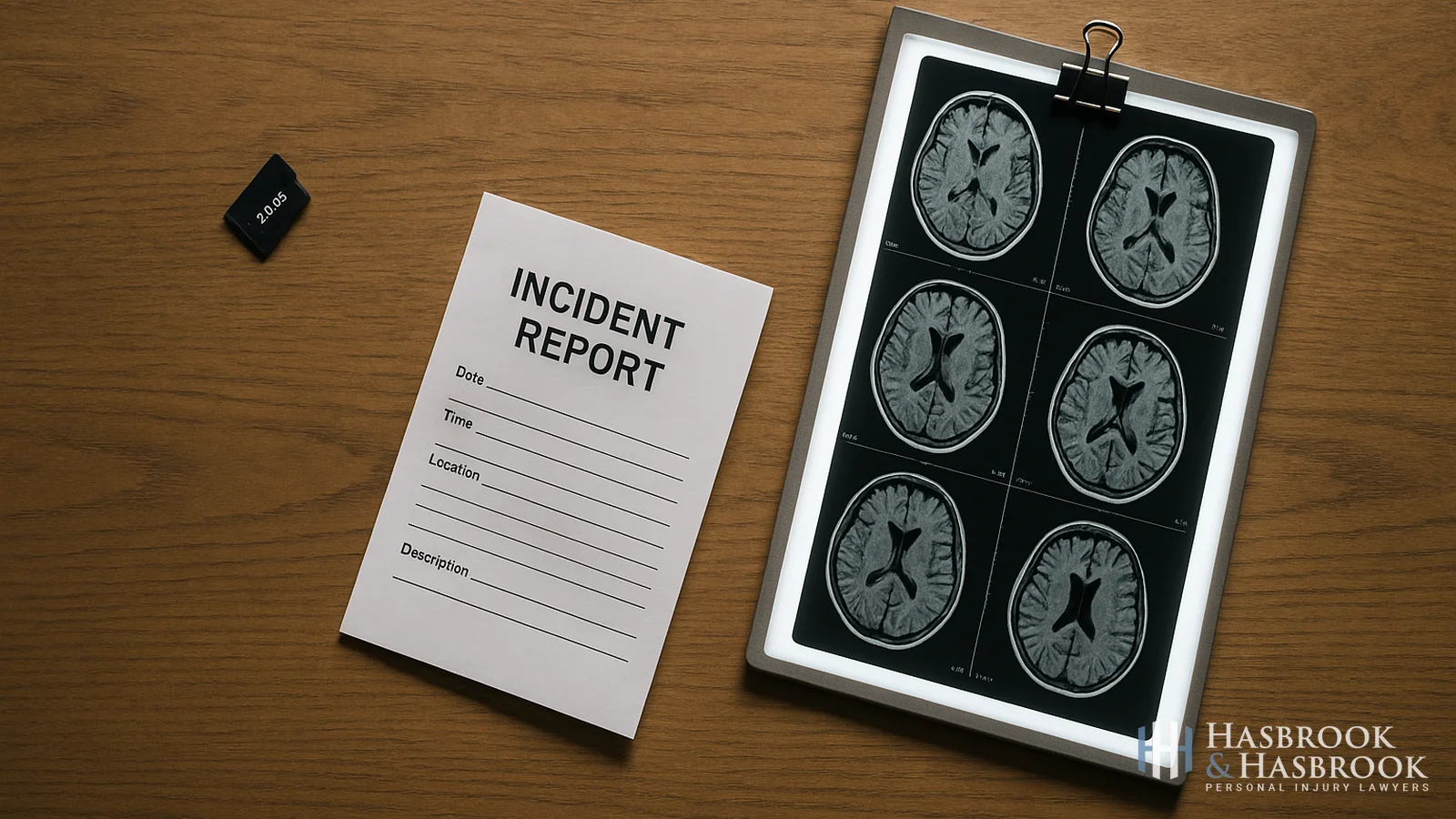
Brain injuries are often invisible on initial scans. From day one, we secure:
- Dashcam, surveillance, and traffic camera footage
- Police reports, 911 recordings, and witness statements
- The at-fault party’s cell phone records when distraction is in play
- Vehicle event-data-recorder downloads
- Complete medical records, including CT and MRI imaging
Surveillance footage disappears quickly, so we send preservation letters within days. For head injury on blood thinners, see our page on TBI in anticoagulated patients.

Severe TBI cases need expert testimony. We work with neurologists, neuropsychologists, and life-care planners who translate medical records into clear explanations of how your injury affects daily life. For early symptoms, see our page on post-concussive symptoms families should watch for in the first month.
Compensation available in brain injury cases
Economic damages
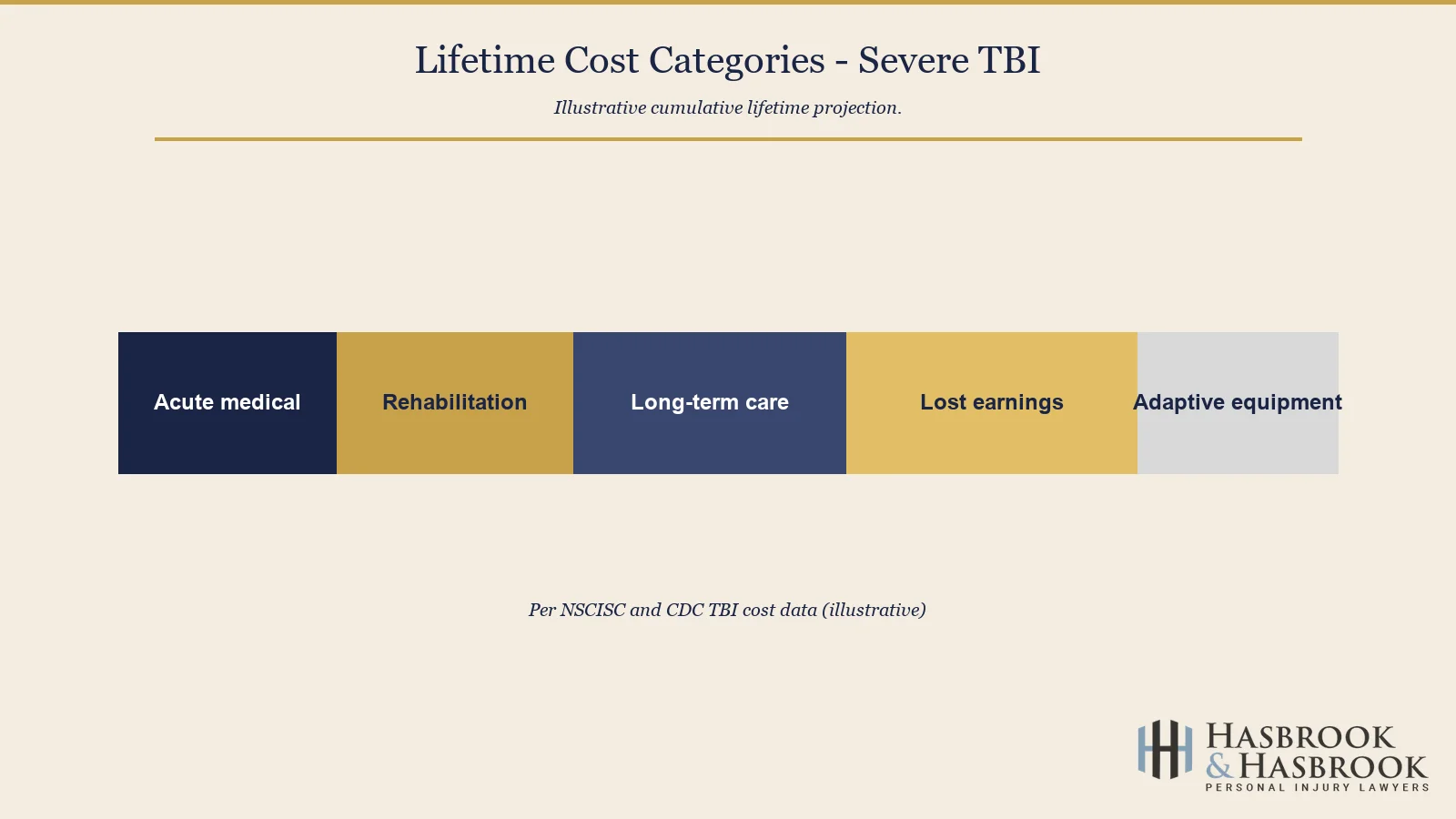
Lifetime care costs for serious TBI can exceed $3 million. Oklahoma places no cap on economic damages:
- Past and future medical expenses
- Lost wages and diminished earning capacity
- Home modification and in-home care
- Life-care costs calculated by a professional planner
Non-economic and punitive damages
Non-economic damages cover pain and suffering, emotional distress, and loss of enjoyment of life, subject to the cap discussion above. Brain injuries causing permanent disability often qualify as severe-permanent-injury cases. See our breakdown of the methods used to value pain and suffering. When a TBI causes death, families can pursue a fatal-injury claim. For reckless or intentional conduct, 23 O.S. § 9.1 authorizes punitive damages.
| Category | What it covers | Cap |
|---|---|---|
| Economic | Medical bills, future treatment, lost wages, life-care costs | None |
| Non-economic | Pain and suffering, emotional distress, loss of companionship | $500,000 under 23 O.S. § 61.3 (constitutionality unresolved); statutory exceptions apply |
| Permanent mental injury | Permanent cognitive or psychological impairment | Separate $1,000,000 threshold |
| Punitive | Punishment for reckless or intentional misconduct | Tiered under 23 O.S. § 9.1 |
For a value-range estimate, see typical TBI settlement ranges in Oklahoma.
Common tactics insurance companies use to lowball TBI claims

- “It’s just a concussion.” Adjusters minimize mild TBI by treating the GCS as the whole story. We rebut with neuropsychological testing.
- Pre-existing-condition framing. Carriers blame prior headaches or concussions; the eggshell-plaintiff rule answers this.
- Gap-in-treatment arguments. Pauses between appointments become “proof” you healed; we document waitlists and referrals.
- Recorded statements. Don’t give one without counsel.
- Quick lowball offers. An early check before maximum medical improvement (MMI) almost never reflects true value. See how carriers process auto-collision claims.

How brain injury claims are resolved
Most claims begin with a demand to the at-fault carrier, supported by medical records, billing, employment documentation, and expert opinion. If negotiation fails, we file suit; the stages of a car-accident lawsuit cover discovery, depositions, and motions. We prepare every file as if it will go to trial. See the settle-versus-trial decision in injury cases.
Areas we serve
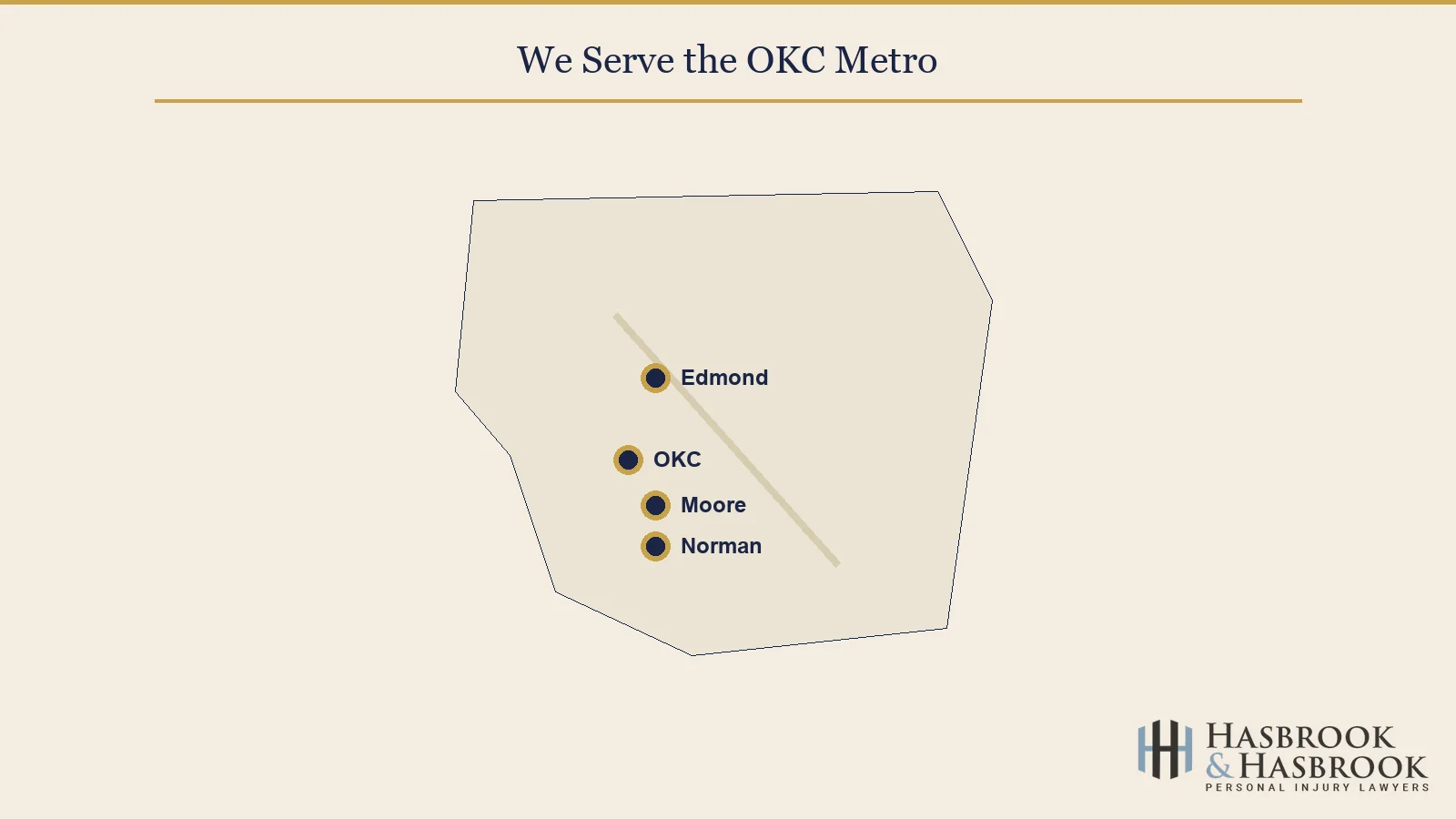
We meet clients where they are, including hospital rooms and rehab centers, throughout the Oklahoma City metro:
- Edmond injury representation
- Norman injury representation
- Moore injury representation
- Midwest City injury representation
- Bethany injury representation
- Oklahoma City and surrounding metro
Common questions about brain injury cases in Oklahoma
Is there an Oklahoma City brain injury lawyer who can take my case?
Yes. We handle brain injury cases throughout OKC on contingency. Call (405) 605-2426 for a free consultation.
How long do I have to file a brain injury claim in Oklahoma?
Two years from the date of injury under 12 O.S. § 95. Delayed symptoms can change the calculation; contact counsel quickly.
What if I was partly at fault for the accident that caused my TBI?
You can recover so long as your fault does not exceed half. Under 23 O.S. § 13, recovery is reduced by your percentage of fault.
How much is a traumatic brain injury claim worth in Oklahoma City?
Mild TBI claims may settle in the tens of thousands; severe cases with permanent disability can reach millions. Value depends on severity, treatment costs, lost income, and liability evidence.
What if my TBI symptoms appeared days after the accident?
Delayed symptom onset is common with traumatic brain injury TBI. Delayed presentation does not bar your claim, but it requires medical records and expert opinion connecting the injury to the accident.
What evidence do I need to prove a brain injury claim?
Imaging, ED records, neurological evaluation, and neuropsychological testing. See how to build a written record of treatment and limitations.
Do concussions qualify for personal injury compensation in Oklahoma?
Yes. A concussion is a traumatic brain injury and can support a claim. Many “mild” concussions produce months of post-concussion syndrome.
How long does a brain injury case take to resolve?
Settlements often close within 6 to 18 months after MMI; trials can take two to three years. See Oklahoma injury case timelines.
Does workers’ compensation cover a TBI from a workplace accident?
Workers’ comp may cover initial treatment and partial wages but does not pay full pain and suffering. A third-party personal injury claim can run alongside the comp claim.

How our firm handles brain injury cases

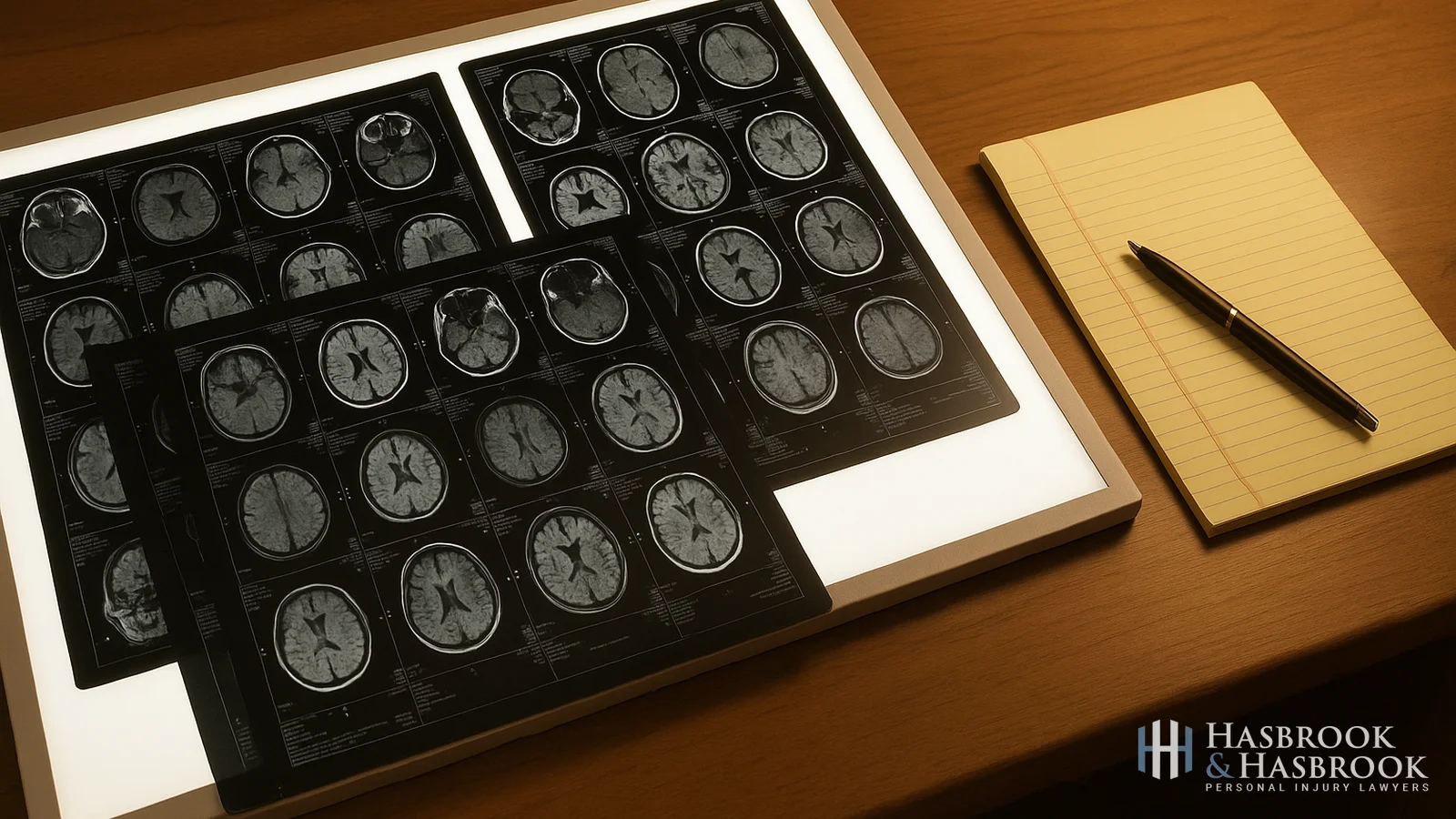
Brain injuries call for attorneys who understand both the medicine and the legal strategy. We work with neurologists, neuropsychologists, life-care planners, and vocational experts. Our firm has represented injured Oklahomans for over two decades.
We accept brain injury cases on contingency: no attorney fees unless we recover. The no-fee-unless-we-recover arrangement means your interests and ours align from the first call. We also handle vertebral-column trauma and paralysis matters and elder-care neglect cases involving fall-related head trauma.
Call (405) 605-2426 or request a free consultation through the contact form to speak with an Oklahoma City brain injury attorney. The consultation is free, and there is no obligation. Let our Hasbrook & Hasbrook team review your file and explain what comes next.