Oklahoma’s two-year clock on car accident lawsuits starts the day of the crash. Miss that window and you lose the right to sue, regardless of how strong your evidence is. The deadline can shift based on who was at fault, what type of claim you have, and whether special tolling rules apply.
At our personal injury attorneys, we help injured Oklahomans identify their exact filing deadline and build their cases before time runs out. Schedule a free consultation before speaking with any insurance adjuster.
Many injured people wait too long to pursue a car accident claim. Waiting until close to the deadline further extends how long the case takes to resolve.
Overview of car accident case deadlines in Oklahoma

Oklahoma deadlines for car accident claims vary based on who you’re suing and what type of claim you have. Personal injury and property damage claims against a private party carry a two-year limit. Claims against government entities run on a shorter, more complex timeline under the Governmental Tort Claims Act. Wrongful death claims carry their own two-year period under a separate statute.
If you’re unsure which deadline applies, don’t wait. Collecting evidence and building a car accident case takes time. Waiting until the final months limits your options and hands leverage to the other side.
Why does Oklahoma have a personal injury statute of limitations?
Statutes of limitations exist in every civil legal system for practical and fairness-based reasons. Oklahoma’s two-year personal injury limit reflects four principles courts apply consistently.
Evidence preservation. Physical evidence degrades quickly. Surveillance footage is often overwritten within 30 to 90 days. Dashcam recordings disappear. A filing deadline forces injured people to act while evidence is still recoverable.
Witness reliability. Witnesses move, lose contact details, and forget specifics. Courts want testimony gathered while memories are reasonably fresh.
Defendant’s right to repose. Oklahoma law recognizes that potential defendants deserve some certainty about open-ended liability. Without a deadline, someone could face a lawsuit years after an accident with no realistic way to reconstruct what happened.
Encouraging timely filing. The law favors parties who act promptly. Delay benefits no one except the side hoping the other party runs out of time. Building an auto accident case case takes months under favorable conditions.
Courts enforce these deadlines strictly. Filing one day late is treated the same as never filing at all.
Statute of limitations for car accident cases in Oklahoma
Personal injury claims
Personal injury claims must be filed within two years of the accident date under 12 O.S. § 95. This covers claims for medical bills, lost wages, pain and suffering, and other losses caused by another driver’s negligence. The deadline runs from the accident date, not from when you hired an attorney or began treatment.
Property damage claims
Property damage claims carry the same two-year period as personal injury claims under 12 O.S. § 95. If you are seeking reimbursement for vehicle repairs, a total loss, or other property losses, you have two years from the accident date.
Wrongful death claims
When a car accident causes a fatality, the surviving family or estate representative can file a wrongful death lawsuit under 12 O.S. § 1053. The two-year clock runs from the date of death. For details on who can file and what damages are recoverable, visit our wrongful death attorney page.
Calculating the starting point of the deadline

For most car accident cases, the two-year clock starts on the date of the collision. Several situations can shift that starting point.
Date of the accident
If the accident occurred on February 1, 2024, your standard filing deadline is February 1, 2026. This applies to the vast majority of car accident cases. Even if insurance negotiations are ongoing or the at-fault driver has not been identified, the clock is still running.
Discovery rule
Oklahoma recognizes a discovery rule in limited circumstances. When an injury is not immediately apparent and could not have been discovered through reasonable diligence, the two-year clock may start from the date of discovery rather than the accident date. This is more common with latent traumatic brain injuries or internal injuries that don’t produce obvious symptoms at the scene. If you delayed seeking medical care, a court may apply the original accident date instead.
Fraud or concealment by the defendant
If the defendant actively concealed evidence or deceived you in a way that prevented you from discovering your legal claim, the clock may pause until the fraud is uncovered. This requires clear, intentional misconduct, not just an uncooperative defendant or delayed insurance response.
Are there exceptions to Oklahoma’s car accident filing deadline?

Oklahoma law allows several tolling rules that pause or delay the two-year clock. These are genuine exceptions, not general escape valves. If you think one applies, confirm it with an attorney before counting on it.
Minors
If the injured person was under 18 at the time of the accident, the two-year clock does not start until the minor’s 18th birthday. Under 12 O.S. § 96, a child injured at age 14 has until age 20 to file, absent a parent or guardian filing earlier. For more on claims involving children, see our page on children injured in Oklahoma car accidents.
Mental incapacity
Oklahoma’s tolling statute (12 O.S. § 96) also applies to people under a legal disability at the time of the accident. If the injured person was mentally incapacitated and unable to manage their own legal affairs, the clock pauses for the duration of that incapacity and resumes when capacity is restored.
Delayed discovery of injury
Some injuries don’t become apparent until days or weeks after a crash. Common examples include traumatic brain injury symptoms, internal bleeding, and herniated discs that only produce noticeable pain after inflammation develops. Our Oklahoma City traumatic brain injury attorneys page covers TBI claims from car accidents in more detail.
Absent or nonresident defendant
If the at-fault driver was not an Oklahoma resident and was absent from the state after the accident, the time of the driver’s absence generally does not count toward the two-year period. This prevents an out-of-state driver from running out the clock by staying away.
Fraudulent concealment
If the defendant or their insurer concealed the cause of your injuries through intentional fraud, the clock may pause until you discovered the deception. This is a high bar requiring intentional misconduct, not just slow claims handling.
Our page on exceptions to Oklahoma’s personal injury statute of limitations covers these tolling doctrines across all personal injury claim types.
Governmental Tort Claims Act deadlines if a government vehicle was involved

If the driver who caused your accident was operating a government-owned vehicle, the standard two-year statute of limitations does not apply. The Governmental Tort Claims Act (GTCA) creates a separate, shorter deadline structure under 51 O.S. § 156. Common scenarios include accidents with OKC Police vehicles, EMBARK buses, fire department vehicles, municipal EMS ambulances, public school buses, and state agency vehicles.
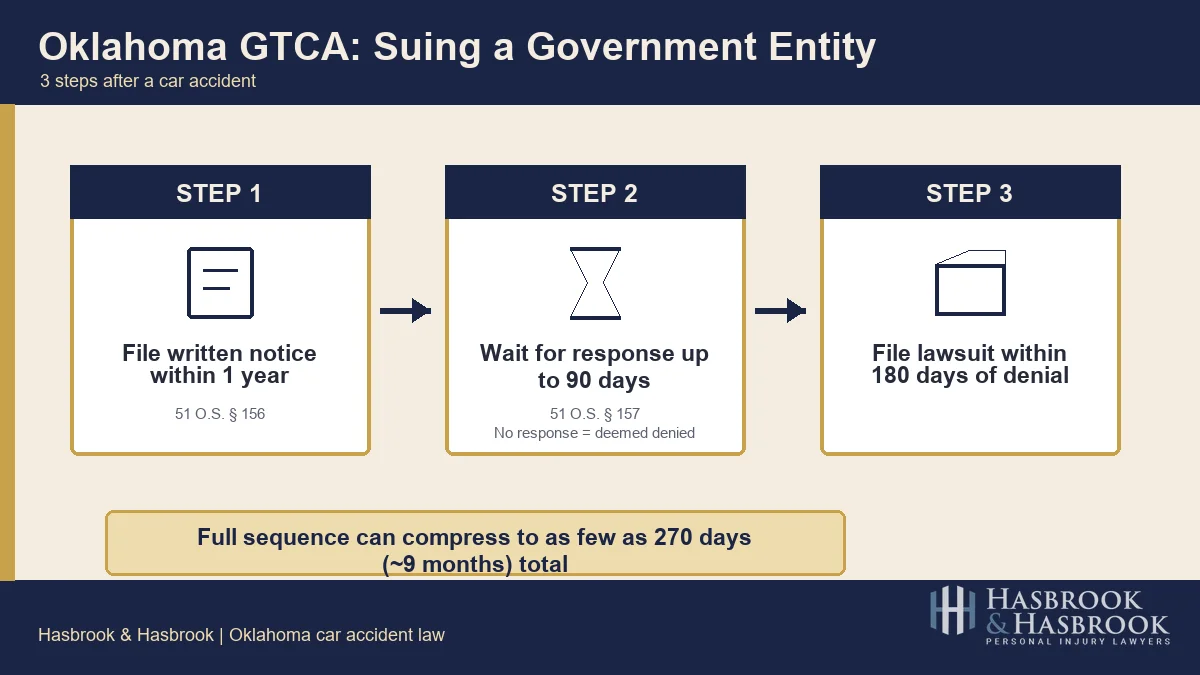
Step 1: File a written notice of claim within one year
Before filing a lawsuit against a government entity, you must submit a written notice of claim to the appropriate governmental entity within one year of the accident. This notice is a prerequisite to any lawsuit under 51 O.S. § 156. Skipping this step bars your claim entirely, regardless of merit.
Step 2: Wait for the government’s response (up to 90 days)
After the notice is filed, the governmental entity has 90 days to approve or deny the claim. Under 51 O.S. § 157, if the entity does not respond within 90 days, the claim is automatically “deemed denied.” Silence at 90 days equals denial; no follow-up is needed.
Step 3: File the lawsuit within 180 days of denial
Once the claim is denied (by explicit response or deemed denial at 90 days), you have 180 days to file a lawsuit. Filing notice on the accident date and getting no government response compresses the entire sequence to 270 days total, less than nine months. An early denial at 30 days shortens it to 210 days.
For a full walkthrough of GTCA claims, see our pages on wrecks involving government vehicles and the Oklahoma tort claims act.
Claim deadlines by case type
| Claim type | Filing deadline | Governing statute |
|---|---|---|
| Personal injury (private party) | 2 years from accident date | 12 O.S. § 95 |
| Property damage (private party) | 2 years from accident date | 12 O.S. § 95(A)(4) |
| Wrongful death from car accident | 2 years from date of death | 12 O.S. § 1053 |
| Claims against government entities (GTCA) | Notice within 1 year; lawsuit within 180 days of denial | 51 O.S. §§ 156, 157 |
| Minor injured in accident (under 18) | Tolled until age 18; 2 years after 18th birthday | 12 O.S. § 96 |
The standard two-year rule covers the most common scenarios. Claims involving a government driver, a minor plaintiff, or an injury discovered after the crash may fall under different deadlines.
Is the insurance claim deadline different from the lawsuit deadline?
Yes. The two-year statute of limitations governs when you can file a lawsuit in court. Your auto insurance policy often imposes a separate, shorter deadline for reporting the accident and opening a claim with your insurer.
Policy prompt-notice requirements. Most auto policies require notification within days to a few weeks of an accident. Failing to meet this requirement may give the insurer grounds to deny coverage. Review your policy’s notice language as soon as possible after any collision.
Missing a policy deadline versus missing the statute of limitations. Missing a policy deadline may result in claim denial or reduced coverage. Missing the two-year lawsuit deadline means the court dismisses your case entirely, with no recourse, regardless of how clear the other driver’s fault was.
The two-year period runs independently of any open insurance negotiations. For a full breakdown, see our breakdown we maintain of how negotiations unfold and our insurance claims process pages.
Why file your Oklahoma car accident claim quickly?
Even with two years on the statutory clock, filing quickly protects your case in ways that waiting cannot.
- Dashcam and surveillance footage. Most businesses overwrite surveillance systems within 30 to 90 days. Preservation letters sent early can secure this evidence before it disappears.
- Witness cooperation. Witnesses are easiest to reach shortly after an accident. The longer the gap, the harder it becomes to get useful statements.
- Medical causation documentation. Proving your injuries resulted from this specific crash requires a documented treatment history without significant gaps. Gaps give insurers grounds to argue injuries are pre-existing.
- Negotiation leverage. Insurance adjusters track your deadline. As the two-year mark approaches, your leverage in settlement talks decreases. If the insurer acts in bad faith, see our bad faith insurance claims page.
- Avoiding tolling disputes. Even when a tolling exception may apply, arguing for it in court is expensive and uncertain. Filing on time is always preferable to litigating whether a deadline was tolled.
The car accident claims begins long before a complaint is filed. Waiting until month 23 leaves almost no time for investigation, demand letters, and pre-suit negotiation.
What happens if you file your claim after the deadline?
Filing after the statute of limitations expires produces one result: dismissal. The defendant’s attorney files a motion to dismiss as the first line of defense. Courts grant it in almost every late-filing case.
Your lawsuit is dismissed
Once the deadline passes, the court has no authority to hear your case on the merits. It does not matter how strong your evidence is or how clear the other driver’s fault was. The case is dismissed before any facts reach a judge or jury. Defendants win on timing, not substance.
Your insurance claim may be denied
An expired statute signals to insurers that you no longer have the threat of litigation behind your demand. Liability insurers and your own uninsured or underinsured motorist carrier may cite the expired deadline to close your file and reject any pending settlement demand.
No meaningful recovery path
After dismissal, the narrow equitable arguments available (fraudulent concealment, mental incapacity) require their own separate litigation to establish. These arguments rarely succeed unless the facts are exceptional. A missed deadline ends the case for most claimants with no realistic path to recovery.
What if the defendant cannot be found?
The lawsuit must still be filed within the deadline. Inability to locate the defendant does not toll the statute of limitations in Oklahoma. Here is how that situation plays out: all negotiations happen with the at-fault driver’s insurance company, but the lawsuit must still name the driver as the defendant. The insurer’s attorneys defend the case on the driver’s behalf.
For example: Pete was waiting at a red light at Northwest Expressway and Bell Isle Blvd in Oklahoma City when Dan rear-ended him after looking at his phone. Pete sought treatment starting at the emergency room at Integris Baptist Medical Center and continued care at Accident Care & Treatment Center. Months of negotiations with Allstate, Dan’s insurer, fell short of Pete’s actual damages, and the two-year deadline approached.
When Pete’s attorney moved to file suit, a new problem emerged: Dan’s contact information was outdated, and Allstate refused to accept service on his behalf. Pete’s attorney used “service by publication,” publishing notice in a local newspaper for three consecutive weeks. Only then did Allstate engage and allow the case to proceed.
The lesson: service-of-process problems and missing defendants take time to resolve. Waiting until weeks before the deadline to involve an attorney eliminates the buffer needed to handle those complications.
Frequently asked questions about car accident deadlines in Oklahoma
What is the deadline for filing a car accident case in Oklahoma?
Oklahoma’s general deadline is two years from the accident date for most car accident lawsuits. This covers personal injury and property damage claims against private parties under 12 O.S. § 95. Claims involving a government vehicle or a minor plaintiff operate under different rules.
What happens if I miss the two-year filing deadline?
Your case will be dismissed. The defendant’s attorney files a motion to dismiss on statute-of-limitations grounds, and courts grant it in almost every case where the deadline was clearly missed. No recovery is available once the deadline passes, except in narrow circumstances where a tolling exception can be proven.
Can the car accident filing deadline be extended in Oklahoma?
Yes, under specific circumstances. Oklahoma tolling rules extend the deadline for minors (clock starts at age 18), people under mental incapacity (clock pauses during incapacity), absent nonresident defendants, and situations involving fraudulent concealment. These exceptions are narrow and require legal support to argue in court.
How long do I have if the accident involved a government vehicle?
You have one year to file a written notice of claim with the government entity. After the claim is denied or deemed denied at 90 days of no response, you have 180 days to file a lawsuit. The entire sequence can compress to as few as 270 days from the accident date.
Is the insurance claim deadline different from the lawsuit deadline?
Yes. Your auto policy typically requires prompt notice of an accident, often within days to weeks of the collision. The Oklahoma lawsuit deadline is two years. Missing a policy notice requirement may result in claim denial. Missing the statutory deadline means you cannot sue at all, regardless of the insurer’s position.
Can my child still file a car accident claim after turning 18?
Yes. Under 12 O.S. § 96, the two-year clock for a minor does not begin until the minor’s 18th birthday. A child injured at age 12 has until age 20 to file, unless a parent or guardian filed on the child’s behalf earlier.
Talk to an Oklahoma car accident lawyer about your deadline
Knowing which deadline applies to your case is the first step. Acting before that deadline is the only step that determines whether you can recover anything. our personal injury attorneys handles car accident cases throughout Oklahoma. We identify your filing deadline, preserve evidence before it disappears, and build your case while options are still available.
Call 405-605-2426 or visit our our accident lawyer Oklahoma City team to schedule a free consultation with schedule a free consultation with our firm.