An Oklahoma City bus accident lawyer identifies every responsible party and preserves bus video and driver records. You generally have two years to sue a private carrier under 12 O.S. § 95, but only one year to give written notice to a public operator such as EMBARK or a school district under 51 O.S. § 156.
Claims after a crash with an OKC transit bus, school bus or charter coach resemble typical car accident claims, but can involve more defendants and records.
Key Takeaways
- The operator decides the law. Transit authorities, school districts and private carriers follow different rules.
- The date counts. The one-year notice period for a public bus runs from the date of the loss, usually the crash, not from the end of treatment.
- Evidence disappears. Bus video, driver logs and onboard data can be overwritten.
Who operated the bus: city transit, a school district, or a private carrier?
| Bus | Usually run by | Rules that govern the claim |
|---|---|---|
| EMBARK city bus | Central Oklahoma Transportation and Parking Authority (COTPA), a public trust of the City | Public: Governmental Tort Claims Act |
| School bus run by a district | A district such as Oklahoma City Public Schools | Public: Governmental Tort Claims Act |
| School or transit bus run by a contractor | A private company | Private: a negligence claim against the contractor; the public entity is generally not liable for an independent contractor’s acts (51 O.S. § 155) |
| Intercity, charter, tour or party bus | A private carrier such as Greyhound or a charter company | Private: negligence, plus federal motor carrier safety rules that generally apply to interstate trips |
A casino, tribal or airport shuttle may be run by a tribe or a public agency with different claim rules.
What deadlines apply to an Oklahoma bus accident claim?
| Situation | What you do | Deadline |
|---|---|---|
| Private carrier, charter company or contractor | File a lawsuit | Two years from the injury |
| Public operator: City, school district or COTPA (EMBARK); State agency or public university, including a shuttle it operates itself | Present a written claim to the clerk of the governing body (for the State, the Risk Management Administrator) | Within one year of the loss (usually the crash), then the sequence below |
| Fatal crash | The personal representative brings the wrongful death action | Private carrier: suit within two years (12 O.S. § 1053). Public operator: written notice within one year after the death (file within one year of the crash to be safe), then the sequence below |
| Injured child | A parent or guardian brings the claim | Private carrier: for the child’s own claim, suit generally by one year after turning 18 (12 O.S. § 96). An older teen hurt close to 18 should not assume that date controls, because the ordinary private-carrier deadline may end after it. Public operator: the one-year notice still applies, and being a minor does not extend it |
After a written claim is presented to a public operator:
- The operator has 90 days to act on the claim.
- A claim not approved in full is generally deemed denied at 90 days, or earlier if the operator denies it (an operator’s request for more information can change when the 90 days begin).
- You then have 180 days from the denial to sue (51 O.S. § 157).
A phone call is not notice. The claim must be in writing under the written notice rules for public entities.
What should you do after a bus accident in Oklahoma City?
- Get medical care the same day, even if you feel fine, because some injuries show up later.
- Call 911 so a police report documents the scene, the bus and the driver.
- Photograph the bus number, route sign, vehicle positions and your injuries, and collect witness contact information.
- Keep your medical bills and pay stubs.
- Do not give another party’s insurance company a recorded statement before you talk to a lawyer.
- If the bus was public, write down the crash date, because the written notice period is already running.



How can a bus accident lawyer help in the first 30 days?
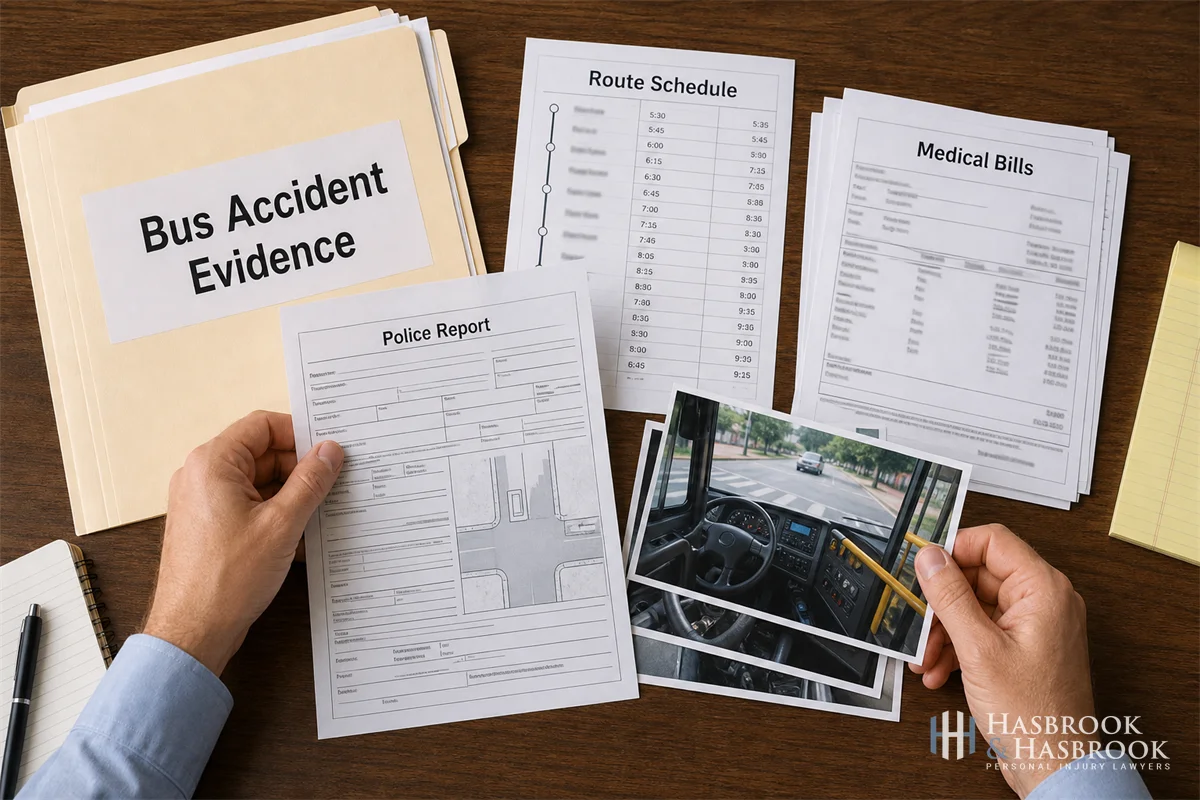
- Evidence preservation. A written preservation letter goes to the operator and any maintenance contractor for driver logs, dispatch records, video and the onboard event data recorder, all of which can be overwritten.
- Insurance coverage. Every policy involved is identified before a demand goes out. For interstate for-hire passenger carriers, federal law generally sets minimum liability coverage at $5,000,000 for vehicles seating 16 or more passengers and $1,500,000 for vehicles seating 15 or fewer (49 U.S.C. § 31138(b)). Those are federal floors, not Oklahoma figures.
Who is liable for a bus accident, and what duty of care applies?
Responsible parties can include:
- The driver: inattention, speed, hours of service
- The bus company or transit authority: hiring, training, maintenance
- A maintenance contractor: brakes, tires, steering
- A manufacturer or parts supplier: a failed component
- A government entity responsible for the road, signs or bus stop: claims over discretionary decisions, sign and signal defects, and weather-related road conditions face exemptions under 51 O.S. § 155
- Another driver: struck the bus or forced it to swerve
- A property owner: poor lighting or boarding conditions
Shared fault. Each defendant is liable only for its own share of fault (23 O.S. § 15), so identifying every responsible party matters, though a carrier generally answers for its driver’s share. You recover if your fault is not more than 50 percent compared with everyone else at fault combined (23 O.S. § 13), and your recovery is reduced by your percentage (23 O.S. § 14).
Duty of care. Private carriers of persons for reward must use the utmost care and diligence for their safe carriage (13 O.S. § 32). A carrier without reward owes ordinary care (13 O.S. § 31), and whether a free ride counts as without reward can depend on the facts. A public operator is answerable under the Governmental Tort Claims Act only where a private person or company would be liable in the same circumstances.
What causes bus accidents in Oklahoma, and what do the numbers show?
Bus crashes can have many causes, including distracted driving, fatigue, poor maintenance, speeding, impaired driving, inadequate hiring or training, and unsafe loading. The counts below give a sense of scale; none of them shows who was at fault.
| Source | Figure |
|---|---|
| Oklahoma Highway Safety Office, 2021 Highway Safety Crash Facts Book, Section 6 | 151 school bus crashes statewide in 2021, none fatal and 5 with serious injury |
| NHTSA, School-Transportation-Related Traffic Crashes: 2015 to 2024 Data (DOT HS 813 819, July 2026) | 1,069 people killed in 962 fatal school-transportation-related crashes nationwide, about 107 a year; 70% were occupants of other vehicles, 15% pedestrians and 11% occupants of the school transportation vehicle |
| FTA National Transit Database, Major Safety and Security Events dataset (safety events only), COTPA, 2025 | 26 major safety events in COTPA bus services, 25 of them collisions, with 22 injuries and 1 death reported; the counts do not show fault |
Most people killed in school-transportation-related crashes were in other vehicles or on foot, so a bus crash can injure people who were never on the bus.
What injuries do bus accidents cause?
- Falls inside the bus and injuries while boarding or leaving it
- Head injuries and concussions, including brain trauma claims
- Spinal cord injuries and herniated discs, including paralyzing spine injuries
- Fractures, including multiple fractures from a bus crash
- Burns and deep lacerations, including burns from a post-crash bus fire
- Internal injuries, whiplash, and shoulder or knee injuries

What compensation can you recover after a bus accident in Oklahoma?
| Damages | Rule |
|---|---|
| Economic: medical bills, lost wages, reduced earning capacity | No limit under 23 O.S. § 61.3 in an ordinary case; against a public operator, the limits described below apply to the total recovery |
| Noneconomic: pain and suffering, mental anguish, disfigurement, lost quality of life | Capped in many cases for injuries on or after September 1, 2025; see below |
| Punitive: reckless disregard for the rights of others, or intentional and malicious conduct; never against public entities | Clear and convincing evidence; for reckless disregard, no more than the greater of $100,000 or the actual damages (23 O.S. § 9.1) |
At trial, the amounts actually paid for treatment, not the amounts billed, are what is admissible, with exceptions for provider liens and where nothing has been paid (12 O.S. § 3009.1).
For injuries on or after September 1, 2025, a jury can award up to $500,000 in noneconomic damages in most Oklahoma personal injury cases (23 O.S. § 61.3). The cap does not apply in at least four situations:
- The jury finds permanent and severe physical injury, such as substantial disfigurement or loss of use of a limb.
- The judge and jury find by clear and convincing evidence that the defendant acted in reckless disregard for the rights of others, was grossly negligent, or acted fraudulently, intentionally or with malice.
- The case is a wrongful death action (the statute exempts actions brought under Article XXIII, Section 7 of the Oklahoma Constitution).
- The claim is against a public entity under the Governmental Tort Claims Act, which has its own limits (below).
If the jury finds a permanent mental injury that itself severely impairs the ability to be employed or to enjoy a reasonable standard of living, noneconomic damages are capped at $1,000,000 (23 O.S. § 61.3(D)), unless the conduct exception above applies.
The statute is new and has not yet been tested in the Oklahoma appellate courts. In 2019 the Oklahoma Supreme Court struck down the earlier $350,000 cap as an unconstitutional special law in Beason v. I.E. Miller Services, 2019 OK 28.
Under 51 O.S. § 154, claims against Oklahoma public entities are capped. For injury and most other losses the limits are:
- $250,000 per claimant
- $375,000 per claimant where the defendant is the State, a city or county of 150,000 or more people, or certain regional planning bodies
- $2,000,000 in total for all claims from one occurrence
The $375,000 tier is written for those entities; it does not name school districts or public trusts created for a city. Loss of property is capped separately at $75,000.
For injury claims, a claimant is the injured person or, in a death, the personal representative, and derivative claims by other people count inside that one claim.
These limits apply to losses on or after November 1, 2025. If your crash was earlier, an earlier version of the limits may apply, so have a lawyer check which one before you rely on any figure.
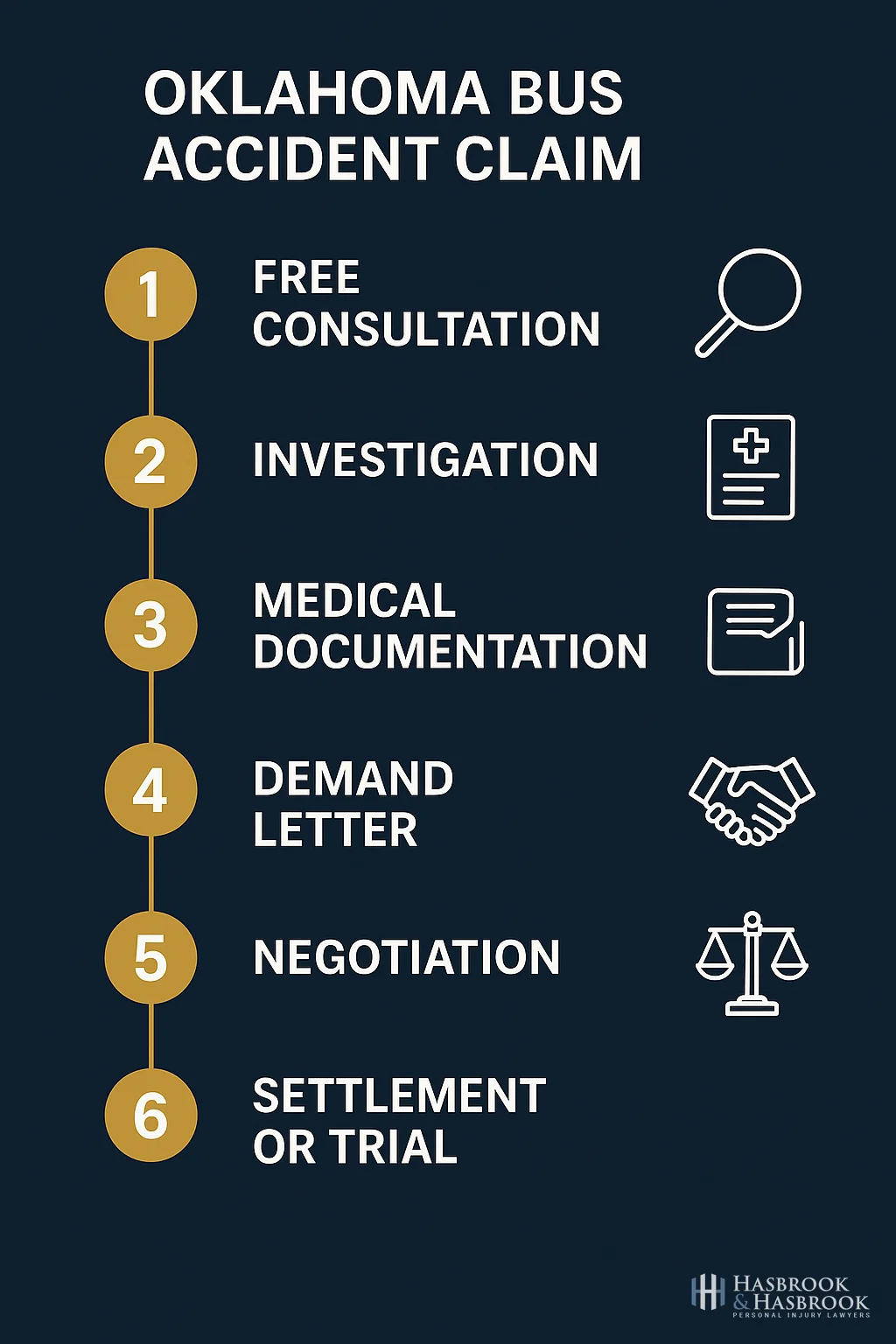
The six-step claim process below does not show the written notice that a claim against a public operator requires.
Why choose Hasbrook & Hasbrook for your bus accident case?
We are a family-run Oklahoma City firm with two generations of Hasbrooks, and we have represented injured Oklahomans for decades. Our bus accident work covers claims against city transit, school districts, public universities and private carriers. Read more about Clayton T. Hasbrook, or see how we approach a bus crash in Midwest City.
How much does a bus accident lawyer cost in Oklahoma City?
Our contingency fee is 25% when your case settles before a lawsuit is filed, and on any settlement our fee is never more than what you take home after medical bills and case costs are paid. You pay nothing up front, and you owe no fees and no case costs unless we recover money for you.
Frequently asked questions about Oklahoma bus accidents
How long do I have to file a bus accident claim in Oklahoma?
It depends on who ran the bus. Against a private carrier you generally have two years to file suit under Oklahoma law. Against a public operator such as EMBARK or a school district, a written notice of claim is due within one year of the loss, so identify the operator first.
Can I sue EMBARK or the City after a bus accident?
Yes, through the Governmental Tort Claims Act. A claim over the bus itself is generally brought against the Central Oklahoma Transportation and Parking Authority, which governs EMBARK; because EMBARK also functions as a City department, a careful claimant files notice with both. A claim over road or signal conditions depends on the City’s own conduct; either way, notice and suit steps apply, damages are limited, and punitive damages are not available.
What if my child was hurt on a school bus?
If a district runs the bus, a written notice of claim is still due within one year and being a minor does not extend that. If a private contractor runs the bus, the claim is generally against the contractor. A child generally has until one year after turning 18 to sue a private carrier, but an older teen hurt close to 18 should not assume that date controls, because the ordinary private-carrier deadline may end after it.
What if a bus hit me at a bus stop or in a crosswalk?
You can have a claim even if you were not a passenger. If a bus driver fails to yield or strikes you at a bus stop or in a crosswalk, the operator can be responsible for the driver’s negligence. If the bus is public, the one-year written notice applies to you too.
Can I still recover if I was partly at fault?
Yes, if your fault is not more than 50 percent compared with everyone else at fault combined; above that you recover nothing. Your recovery is reduced by your percentage of fault; for example, on a $200,000 award, a person found 20 percent at fault recovers $160,000.


Ready to talk to an Oklahoma City bus accident attorney?
Call (405) 605-2426 or reach out about your bus accident online for a free consultation about your legal options. Video and driver records can be overwritten, and if the bus was public, your notice period may already be running.