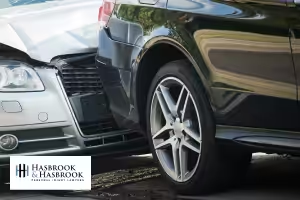
Being at fault for a car accident in Oklahoma means you are financially responsible for the other driver’s vehicle damage and injuries, up to your policy limits. Your insurance premiums will likely increase, you may face a lawsuit for damages beyond your coverage, and you could receive a traffic citation depending on how the crash happened.
This guide walks through what actually happens after you are found at fault for a car accident in Oklahoma: the legal duties you have right after the crash, how your insurance responds, when a citation or a lawsuit becomes a real possibility, and what you can still do to protect yourself going forward.
Is Oklahoma an At-Fault State for Car Accidents?
Oklahoma is a “fault,” or tort, state, not a no-fault state. The driver who caused the crash, not each driver’s own insurer, is legally responsible for the resulting damage and injuries. That is why every Oklahoma vehicle owner and operator has to carry liability insurance: 47 O.S. § 7-601 requires you to maintain security for bodily injury, death, and property damage claims that arise from your car’s operation.
If you cause a wreck, the other driver typically files a claim against your policy first. Your insurer investigates, and once you are found responsible, it pays the other driver’s damages up to your policy limits. Our page on why every Oklahoma driver has to carry liability coverage covers the minimum amounts the state requires, and the Oklahoma Insurance Department’s consumer guide to auto coverage is a good outside reference on how the requirement works statewide. This system is what decides who pays first, and how much of your own money is at risk once damages run past your coverage.
How Fault Gets Determined After a Crash
Fault is rarely decided on the spot. Insurance adjusters look at the police report, the damage pattern on both vehicles, witness statements, and the traffic laws in play to work out who breached a duty to drive safely. Our breakdown of the legal elements that establish fault in a crash covers what a claimant actually has to prove: a duty to drive reasonably, a breach of that duty, a crash caused by the breach, and real damages that followed.
Fault is often split rather than assigned entirely to one driver. Running a red light, following too closely, or texting behind the wheel are common findings that put most or all of the responsibility on one side. A citation at the scene is evidence of fault, but it is not the final word. Insurers and, if it goes that far, courts can reach a different conclusion once all the evidence is in.
Your Duties at the Scene and to Your Insurer
Oklahoma law spells out what you owe the other driver immediately after a crash. When anyone is hurt or a vehicle is damaged, 47 O.S. § 10-104 requires you to give your name, address, and vehicle registration, show your license and proof of insurance on request, and help arrange medical care for anyone who needs it. When the crash caused an injury or death, 47 O.S. § 10-107 requires you to notify the local police, the county sheriff, or the Highway Patrol right away.
Beyond what the law requires at the scene, you also need to notify your own insurer promptly. Most policies treat quick notice as a condition of coverage, and delaying can create problems later. Report the facts plainly: date, time, location, and what happened. Include the police report number and the other driver’s contact and insurance information. Getting your notice to the insurer right the first time keeps the claim moving; the Insurance Information Institute’s overview of how auto claims work is a useful outside reference for what happens after you report a loss. Let the adjusters investigate. You do not need to volunteer an opinion about who was at fault.



How an At-Fault Accident Affects Your Insurance Premiums
An at-fault accident almost always raises your premium at your next renewal. Insurers treat an at-fault claim as evidence that you are a higher risk to insure, and the size of the increase depends on your carrier, your driving history, and how much the claim paid out. Our page on just how much a single at-fault claim can raise your rate breaks down what drives the size of that increase.
One at-fault accident usually will not trigger non-renewal by itself, but a second at-fault claim within a few years can. If your rate jumps sharply, it is worth shopping other carriers before your renewal date. Be upfront about the accident when you apply. Insurers check claims history databases, and an unreported accident can void a new policy.
Traffic Citations and Other Legal Penalties
Depending on what caused the crash, you may also receive a citation, separate from any insurance claim. Common examples include following too closely, failure to yield, speeding, and improper lane changes. Our page on what a citation at the scene can mean down the road goes through how these violations play out. Fines and points on your license follow the underlying violation, not the accident itself.
Citations carry more weight in a civil claim than most drivers expect. A ticket for the violation that caused the wreck can be used as evidence of negligence in the insurance claim, or the lawsuit, that follows. In cases involving serious injury, death, or impairment, prosecutors can pursue criminal charges entirely separate from the civil side. That exposure exists whether or not the other driver ever sues.
Comparative Negligence: Why Your Share of Fault Still Matters
Oklahoma abandoned the old all-or-nothing contributory negligence rule decades ago. Under the state’s comparative negligence statute, 23 O.S. § 13, you can recover as long as you were not more than 50% at fault, with your damages reduced by your own percentage of fault. Recovery is barred only if your fault exceeds 50%.
That rule applies to you as the driver primarily blamed for the crash, too. If you caused more than half the wreck, the other driver can still recover from you, reduced by their own share of the blame, but you would not be able to recover your own damages from them. If your own share of fault is 50% or less, you keep that right, reduced by your percentage. The Cornell Legal Information Institute’s explanation of comparative negligence is a good plain-language reference for how this differs from a straight contributory-negligence rule. Our page on why the size of your own share of fault matters so much goes further into how Oklahoma juries actually split fault.
What You May Owe: Covering the Other Driver’s Damages
As the at-fault driver, you are generally responsible for the other driver’s vehicle repairs, medical bills, and related losses, up to your policy limits. Your insurer handles the negotiation and pays covered claims on your behalf, so you typically are not writing a check yourself unless the claim exceeds your coverage. Our page on what you may owe for repairs to the other vehicle walks through how that side of the claim is handled.
If the other driver’s damages turn out to be larger than your liability limits, which a serious injury claim can do quickly, you become personally responsible for the difference. That gap is one of the strongest reasons to carry more than Oklahoma’s state minimums: a bigger cushion between the claim and your own bank account.



Could the Other Driver Sue You?
Most at-fault accidents settle through the insurance claims process without ever reaching a courtroom. But the other driver can file a personal injury lawsuit against you directly, especially if your insurer disputes the claim, your policy limits fall short of their damages, or settlement talks stall. In Oklahoma, the general deadline for that kind of lawsuit is two years from the date of the crash, under 12 O.S. § 95. Our page on how long the other driver has to bring a claim against you covers the exceptions that can extend or shorten that window.
If you are named in a lawsuit, your policy typically obligates your insurer to provide a defense attorney at no separate cost to you, as long as the claim falls within your coverage. In rare cases involving especially reckless conduct, such as driving under the influence, a jury’s award can include punitive damages on top of the plaintiff’s actual losses.
Talking to the Other Driver, Witnesses, and Insurance Adjusters
What you say at the scene and afterward can shape the whole claim. Exchange your name, insurance, and registration information calmly, and get the same from the other driver, but avoid guessing out loud about who was at fault or apologizing in a way that reads as an admission. Our list of small missteps that can expand what you owe covers the phrases and habits that tend to backfire later.
Write down what you remember while it is fresh: where each vehicle was, the traffic signals, the weather, and anything the other driver said. If police respond, cooperate and answer factual questions, but let the report reflect the officer’s own findings rather than your theory of who was at fault. When the other driver’s insurance adjuster calls, giving basic facts is fine, but you are not required to sit for a recorded statement analyzing fault. Our page on why you can decline a recorded statement to their insurer explains your rights on that call in more detail.
Do You Need a Lawyer If You’re At Fault?
Not every at-fault accident calls for an attorney. If the damage is minor, both drivers agree on what happened, and your insurer is handling the claim smoothly within your policy limits, the process can often run its course on its own. Our page on why most at-fault drivers still loop in an attorney lays out when that changes.
An attorney becomes more valuable once the stakes rise: a serious injury, a lawsuit naming you personally, a dispute over how much fault you actually bear, or a demand that approaches or exceeds your policy limits. In that last situation, an attorney can push your own insurer to settle within limits and help protect you from being personally on the hook for a judgment beyond your coverage.
Protecting Your Driving Record Going Forward
A few practical steps limit the long-term impact of an at-fault accident. Many insurers offer a defensive driving course that can trim points from your record or soften a premium increase; ask your carrier which courses qualify before you sign up for one. A dash cam will not undo this accident, but it can protect you if fault is ever disputed again down the road.
Staying violation-free for the next few years matters more than almost anything else you can do. Insurers weight recent driving history heavily, and a clean record after the accident is the fastest way to bring your premium back down.

Talk to Hasbrook & Hasbrook About Your At-Fault Accident
Being at fault for a crash does not mean you are on your own. The team at Hasbrook & Hasbrook can review your policy, help you respond to the other driver’s insurance claim, and step in if a lawsuit gets filed against you personally. We handle car accident cases across the Oklahoma City area, from routine property-damage claims to serious personal injury lawsuits.
Call (405) 605-2426 or tell us what happened in your at-fault accident for a free consultation. There is no charge to talk through what happened and figure out your next step.