Violating federal trucking laws exposes a carrier to FMCSA civil penalties of $1,000 to $16,000 per violation, and more for hazardous-materials violations, Oklahoma criminal charges up to manslaughter under 21 O.S. § 711, and civil liability for the resulting crash. A documented violation can also support punitive damages under 23 O.S. § 9.1 when the carrier acted with reckless disregard for others’ safety.



Federal Penalties for Trucking Violations
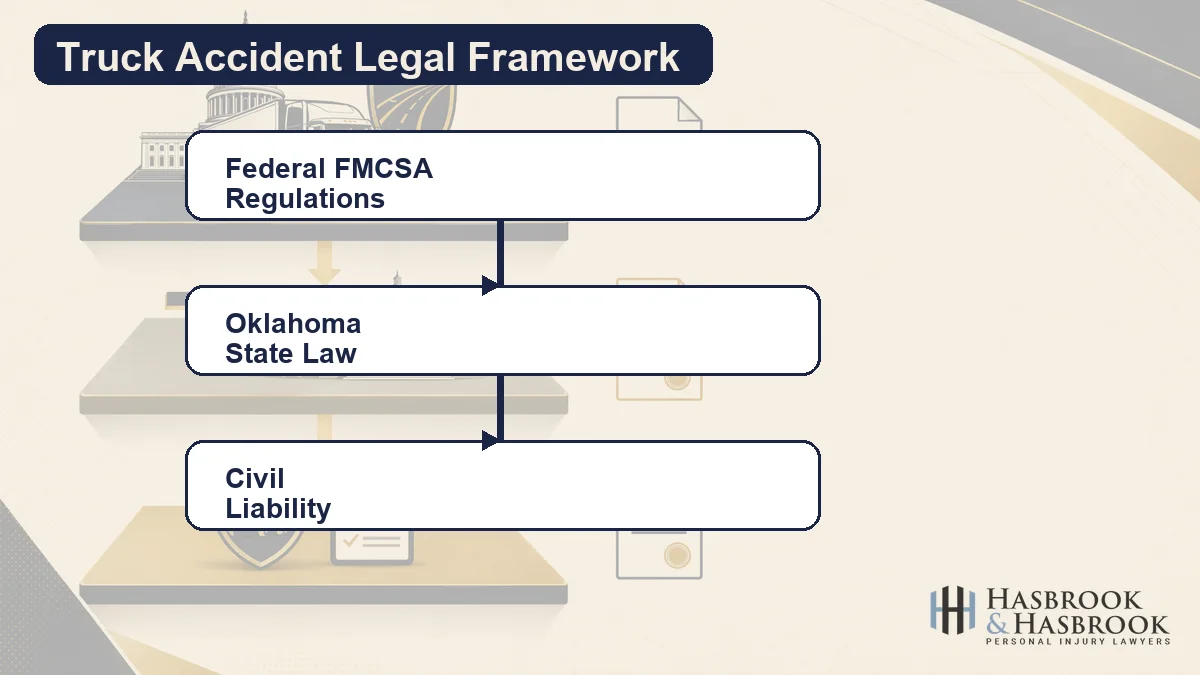
The Federal Motor Carrier Safety Administration enforces trucking safety through a civil penalty schedule under 49 CFR Part 386. Hours-of-service violations, including falsified logs, run $1,000 to $16,000 per offense. Driver-qualification failures and equipment or maintenance defects fall in that same range, and drug and alcohol testing violations can reach $25,000. Hazardous-materials violations can reach $87,007 per violation, or $197,566 when the violation caused or could have caused death or serious injury. Operating without FMCSA authority costs up to $16,000 per day. A carrier with repeated violations can also receive an Unsatisfactory safety rating through the FMCSA’s Compliance, Safety, Accountability program, which can trigger an out-of-service order halting all operations.
Oklahoma Penalties Under Title 47
Oklahoma enforces its own motor carrier rules under Title 47. A carrier operating without proper intrastate authority faces civil penalties and possible suspension, and Oklahoma applies a graduated fine structure to overweight loads. A truck or trailer with equipment out of order, or in a mechanical condition unsafe for the highway, violates 47 O.S. § 13-101. Drivers without a valid Commercial Driver’s License, and carriers that knowingly employ unlicensed or disqualified drivers, face fines, license suspension, and direct civil liability. The Oklahoma Corporation Commission and the Department of Public Safety keep public enforcement records, and a documented violation history is admissible evidence in a resulting civil case.

Criminal Penalties When a Crash Causes Serious Harm
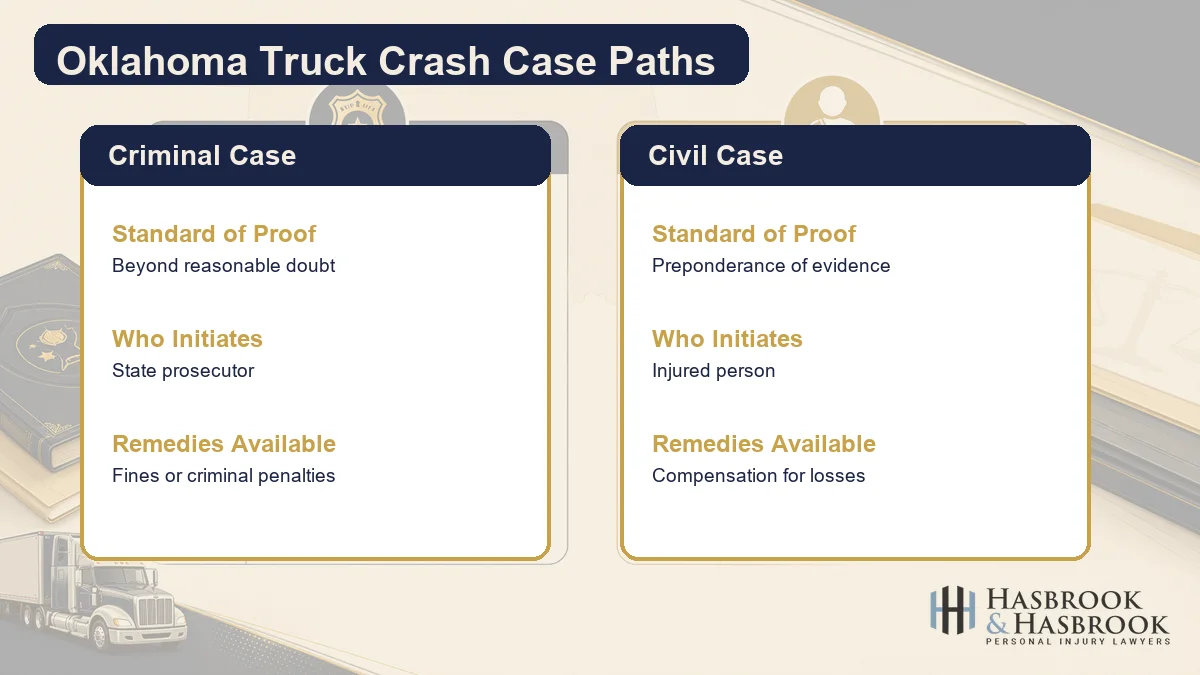
When a truck driver causes death through grossly negligent or reckless conduct, Oklahoma law allows criminal prosecution alongside a civil claim. First-degree manslaughter, 21 O.S. § 711, can apply when hours-of-service violations contribute to a fatal, fatigue-related crash. Second-degree manslaughter, 21 O.S. § 716, covers deaths from culpable negligence, such as operating with a known mechanical failure. Oklahoma also applies the federal 0.04% commercial BAC threshold, and a first commercial-vehicle DUI carries a mandatory one-year CDL disqualification. A criminal conviction is not required to win a civil case, but the record it creates, including witness testimony and investigative findings, can strengthen one.
How These Violations Prove Your Civil Case
An FMCSA or Oklahoma safety violation is not just an administrative matter. In Oklahoma civil litigation, violating a safety regulation can establish negligence per se: the violation itself is evidence of a breach of the duty of care, so the injured person does not have to separately prove the conduct was unreasonable. The violations behind most serious truck crashes include falsified hours-of-service logs, deferred brake or tire maintenance, overloaded or improperly secured cargo, and carriers that never checked the FMCSA’s Drug and Alcohol Clearinghouse before dispatching a driver. Electronic logging device data, dispatch records, and the FMCSA’s public SAFER database often document these patterns. Hasbrook & Hasbrook sends preservation demands for this evidence early, because a carrier that lets it disappear after a crash can face sanctions under 12 O.S. § 3237.

What Violations Mean for Your Compensation
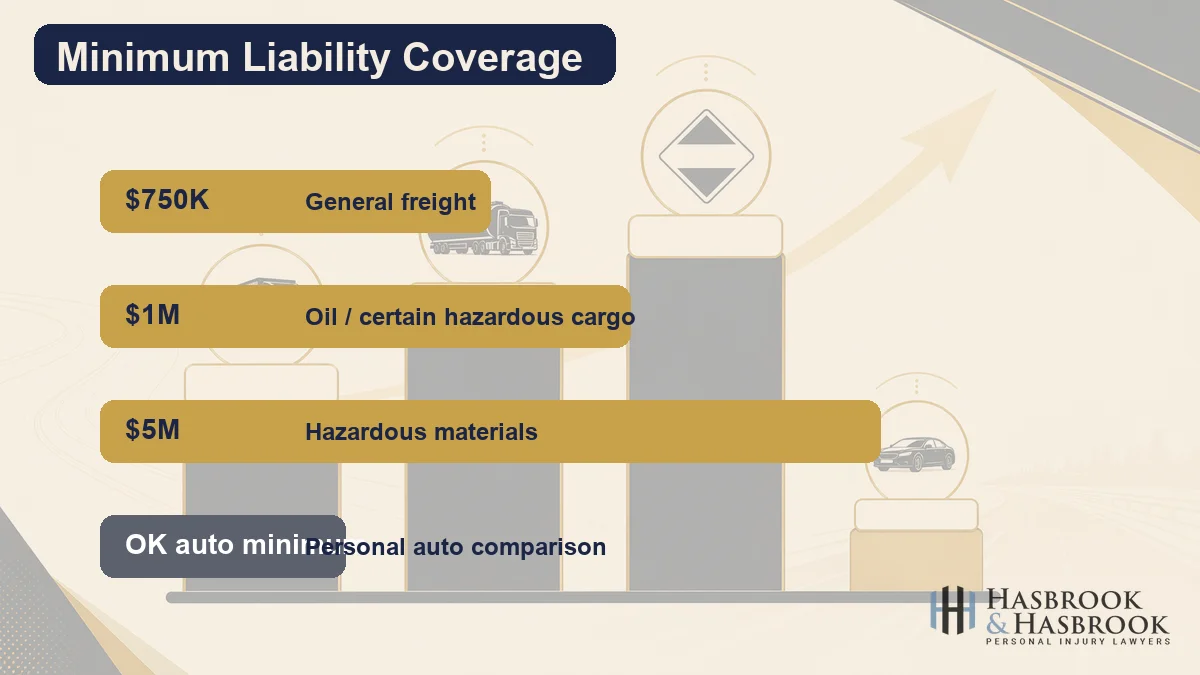
A documented violation cuts both ways in your favor. Oklahoma follows a modified comparative negligence rule under 23 O.S. § 13: your recovery is reduced by your own share of fault, but barred only if your fault is greater than the combined fault of everyone else responsible. A clear regulatory violation by the carrier makes that comparative-fault fight harder for the defense. Where the violation reflects reckless disregard for others’ safety, such as a pattern of falsified logs or ignored positive drug tests, a jury may also award punitive damages against the carrier under 23 O.S. § 9.1, up to the greater of $100,000 or the actual damages awarded. Commercial carriers must also carry far more insurance than a personal auto policy, generally at least $750,000 for general freight and up to $5,000,000 for certain hazardous-materials haulers, coverage that matters when weighing what a violation-driven truck claim is worth.
Frequently Asked Questions
What FMCSA penalties apply to hours-of-service violations?
Civil penalties range from $1,000 to $16,000 per violation, with falsified records drawing the highest amounts. Repeated violations can also trigger an Unsatisfactory safety rating and an out-of-service order.
Can a trucking company lose its Oklahoma operating authority for safety violations?
Yes. The FMCSA can suspend or revoke operating authority after an Unsatisfactory rating, and the Oklahoma Corporation Commission can separately suspend intrastate authority. Either action can support a negligent-hiring or negligent-entrustment claim.
What does negligence per se mean in a truck accident case?
It means a regulatory violation is itself proof of a breach of duty. The injured person does not have to separately show the carrier or driver acted unreasonably; the violation establishes that as a matter of law.
Can I recover punitive damages from a trucking company in Oklahoma?
Yes, when the carrier acted with reckless disregard for the rights of others, such as a pattern of falsified logs or ignored safety violations. Whether the facts support that standard shapes what goes into a settlement demand.


Talk to an Oklahoma City Truck Accident Lawyer
Hasbrook & Hasbrook represents people injured by trucking violations across the metro, as part of our broader Oklahoma City truck accident practice, including our Tulsa truck accident practice and Midwest City truck accident team. There is no charge to speak with our office, and you owe nothing unless we put money in your pocket.
Call (405) 605-2426 or talk with us about a trucking-violation claim.