An underride crash is one of the most catastrophic outcomes possible on an Oklahoma highway. A passenger car strikes the side or rear of a tractor-trailer and slides under the trailer’s deck, with the trailer sweeping across the windshield and roof line of the smaller vehicle. Federal regulators have studied this crash mechanism for decades and the engineering fixes are well understood, but many trailers still lack the equipment that would prevent the worst outcomes. If your family has been hurt in an underride collision, the legal claim turns on equipment standards, federal trucking rules, and Oklahoma negligence law.
What is an underride truck accident?
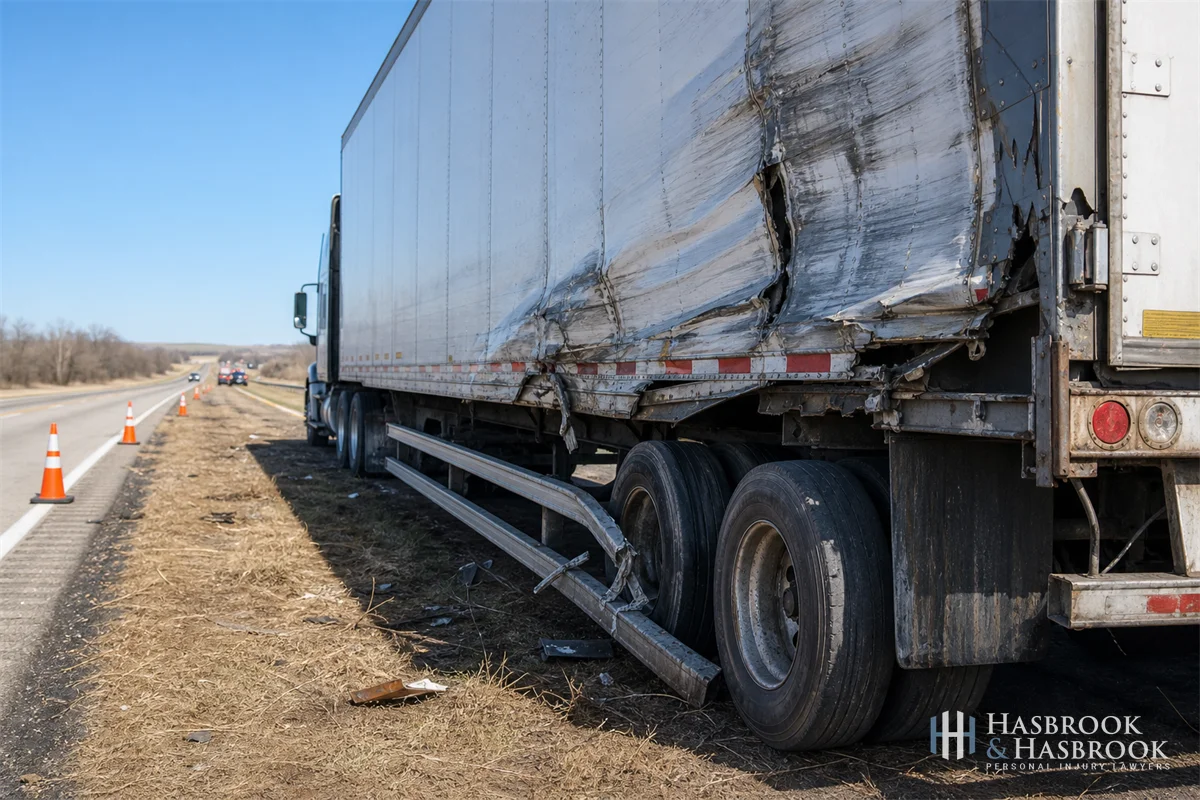
An underride accident occurs when a smaller vehicle slides under the body of a commercial trailer on impact. Because semi-trailers ride higher than the hood line of most cars and SUVs, the trailer’s deck and frame rail strike the passenger compartment directly rather than the bumper. The bumper, crumple zones, and airbags are bypassed entirely, and front-seat occupants take the full force of the trailer at head and chest level.
The federal Insurance Institute for Highway Safety classifies underride crashes into three categories based on which side of the trailer is struck:
- Rear underride. A car following or stopped behind a trailer is struck from behind by the trailer or rolls under the rear of a slowing or stopped trailer.
- Side underride. A car strikes the long side of a trailer, often during a left turn at an intersection or when a trailer is backing across a roadway.
- Front underride. A car is pushed under the front of a tractor-trailer in a head-on or angled collision.
Side and rear underride collisions are the most common variants on Oklahoma’s interstate corridors. The injury pattern is consistent and devastating: traumatic brain injury, cervical spine injury, decapitation, and burn injuries from fuel ignition. Survivors face lifelong rehabilitation; see our discussions of paralysis after a spinal cord injury and concussion vs. traumatic brain injury.
Why underride collisions are so deadly
Three structural factors make an underride strike worse than a typical rear-end or side-impact crash:
- The trailer deck height bypasses crash-absorbing structure. A typical trailer rides 42 to 60 inches off the pavement. A car’s reinforced A-pillars, crumple zone, and front airbags are designed to absorb a horizontal collision into the bumper, not a strike at windshield height.
- The intrusion is into the occupant compartment. When a car wedges under the trailer, the trailer’s deck and rail intrude through the windshield and roof. There is no structural buffer between the trailer and the driver’s head and chest.
- Fuel system rupture risk is elevated. A car compressed under a trailer can shear the fuel tank, and post-crash fires multiply the harm.
The Federal Motor Carrier Safety Administration’s Large Truck and Bus Crash Facts publication has tracked underride fatalities for decades, and NHTSA’s crash data publications show that many crashes officially recorded as “rear-end into a truck” or “side impact with truck” are underride events. Investigators do not always code the mechanism on the police report, which makes accurate national totals difficult to compile.
Underride guards and what federal law requires
The engineering solution is straightforward. A reinforced steel guard mounted under the rear and along the sides of a trailer prevents a smaller vehicle from sliding under the deck: the car hits the guard, the bumper and airbags do their job, and the compartment stays intact.
Federal Motor Vehicle Safety Standards 223 and 224, codified at 49 C.F.R. § 571.223 and § 571.224, set the design and performance standards for rear impact protection on most trailers built since 1998. NHTSA strengthened the rear underride standard in 2022 to eliminate dimensional weak points at the corners of the guard. The current rule is in NHTSA’s final rule on rear impact protection.
Side underride guards are still not required by federal law. The federal Stop Underrides Act, reintroduced multiple times in Congress, would mandate side and front guards along with stronger rear-guard standards. As of this drafting, the bill has not been enacted. Some carriers have voluntarily added side guards on portions of their fleets; most have not.



Common causes of underride truck accidents in Oklahoma
A combination of equipment failure, driver conduct, and carrier policy produces the conditions for an underride strike. The most common contributing factors:
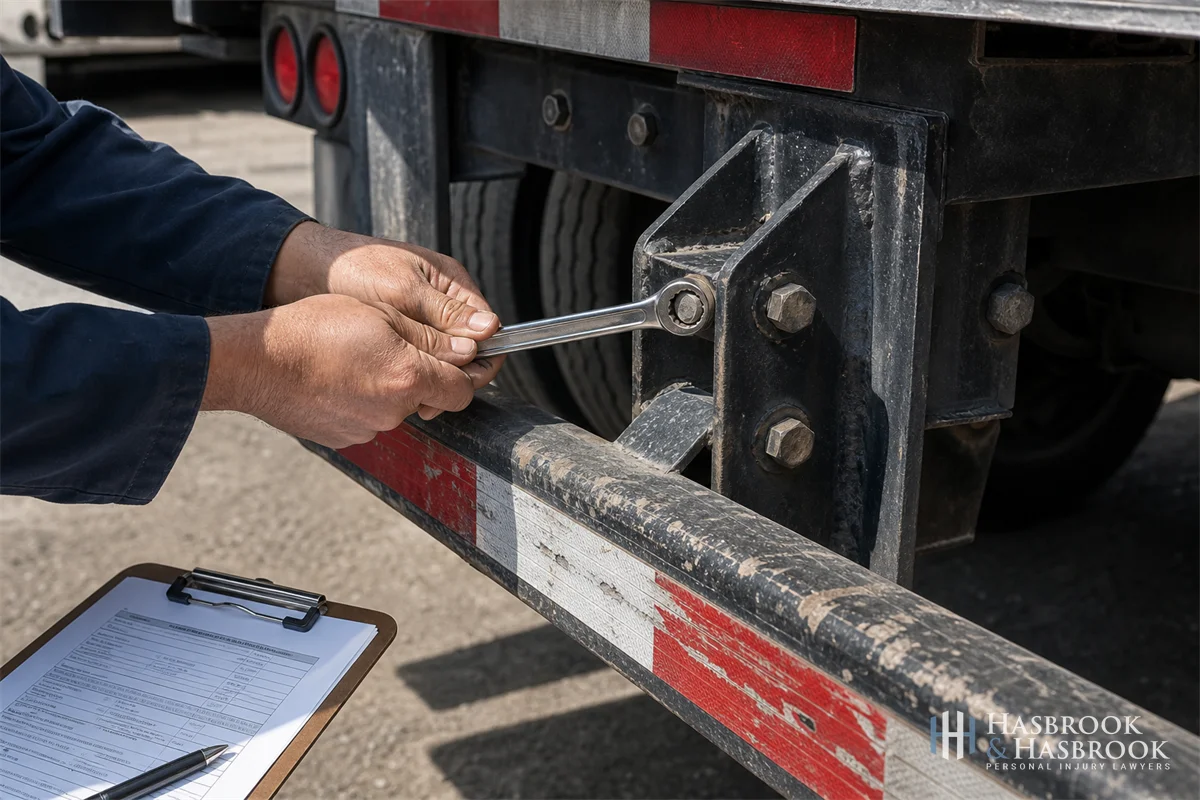
- Faulty, damaged, or missing rear underride guards. A bent guard from a prior incident, corroded mounting bolts, or no rear guard at all lets the car slide right under.
- No side underride guards. Most U.S. trailers carry no side guards, so any side impact at speed risks underride.
- Inadequate trailer conspicuity. A trailer disabled on the shoulder or backing across a road at night with missing reflective tape or burned-out marker lights is hard to see in time.
- Driver fatigue and hours-of-service violations. A drowsy driver who decelerates abruptly creates the closing-speed differential that produces a rear underride. The FMCSA hours-of-service rules are a direct response to fatigue crashes; see our FAQ on the civil and criminal penalties for HOS violations.
- Distracted driving. A driver looking at a phone for several seconds at highway speed covers the length of a football field without watching the road.
- Improper lane changes and wide turns. A trailer changing lanes without a full mirror sweep, or executing a wide right turn that swings the trailer across an adjacent lane, creates side-impact opportunities. Our breakdown of wide-turn truck crashes and liability walks through the geometry.
- Inadequate trailer maintenance. Brake imbalance, worn tires, and damaged suspensions extend stopping distance.
Federal vs. Oklahoma trucking regulations
Two regulatory frameworks govern commercial trucks on Oklahoma roads, and each plays a different role in an underride case.
| Source | What it covers | Role in an underride case |
|---|---|---|
| Federal Motor Carrier Safety Regulations (49 C.F.R. Parts 350-399) | Driver qualifications, hours of service, drug and alcohol testing, vehicle inspection, equipment standards, and accident recordkeeping. | Standard of care for driver conduct and equipment condition. A violation supports negligence per se in many Oklahoma courts. |
| FMVSS 223 and 224 | Rear impact protection design and performance requirements for trailers. | Baseline equipment standard. Missing or non-conforming guards support a defective-equipment theory. |
| Oklahoma Vehicle Equipment Code, including 47 O.S. § 12-609 | State equipment requirements for vehicles on Oklahoma roads. | Parallel state-law equipment requirement alongside the federal standard. |
| Oklahoma negligence law plus comparative fault under 23 O.S. § 13 | Fault, damages, and comparative fault. | Federal rules supply the standard of care; Oklahoma law decides the outcome. |
For the broader picture on responsibility, see who is at fault in a truck accident and how to compare fault between drivers. Oklahoma allows recovery as long as a plaintiff’s fault does not exceed 50% under 23 O.S. § 13.
Liability theories in underride cases
An underride claim rarely lands on a single defendant. The case typically involves several overlapping theories of liability:
- Driver negligence: failure to keep a proper lookout, fatigue, distraction, illegal lane changes, or excessive speed. Direct claim against the driver and, through respondeat superior, the carrier.
- Carrier negligence: negligent hiring of a driver with a documented violation history, negligent supervision of hours-of-service compliance, or negligent maintenance of the trailer’s underride guard. The carrier’s the driver qualification file and maintenance records often expose this.
- Negligent maintenance contractor: a third-party shop that inspected and certified a damaged or non-conforming guard.
- Product defect against the trailer or guard manufacturer: a guard that met FMVSS 223 on paper but failed in a foreseeable real-world impact, or a trailer model with documented underride performance defects.
- Negligent loading or shipper liability: an overloaded or improperly secured trailer can extend stopping distance.
Sorting which defendants belong in the case is one of the first jobs after we are retained. See our companion FAQ on when both the driver and the carrier belong on the petition versus driver-only filings for the practical division between driver-only and combined-defendant cases.
How to prove liability in an underride crash
Proving an underride case is engineering-heavy. The key evidence has a short shelf life and falls into three groups:
- Vehicle-side: the trailer itself with measurements of the guard mounting brackets and the deck height, photographs of deformation consistent with prior impact, maintenance and inspection records, and the manufacturer’s FMVSS 223 and 224 compliance documentation.
- Driver and carrier: electronic logging device data showing hours of service, engine control module data on speed and braking in the seconds before impact, dashcam footage if installed, cell-phone records, and the driver’s qualification file. Our overview of the truck’s electronic logging device readout explains how investigators read both.
- Scene: skid marks, gouges, and debris field; witness statements collected within days; and traffic-camera or business-camera footage retrieved before the recording loop overwrites.
For preservation strategy and the early-stage roadmap, see evidence-preservation steps unique to trucking cases and the critical first 48 hours after a truck wreck.

Damages in an Oklahoma underride case
The catastrophic injury profile of an underride collision pushes case values toward the upper end of the truck accident range. Recoverable damages under Oklahoma law include:
- Past and future medical expenses, including emergency care, surgery, rehabilitation, durable medical equipment, in-home care, and life-care planning.
- Past and future lost income and lost earning capacity for a survivor whose injury prevents return to prior employment.
- Pain and suffering and loss of enjoyment of life.
- Punitive damages in cases of egregious carrier conduct, such as falsified hours-of-service logs or knowingly running trailers with non-conforming guards.
- Wrongful death damages when the crash is fatal, governed by Oklahoma’s wrongful death statute, 12 O.S. § 1053.
Background on settlement ranges is at typical Oklahoma commercial-truck settlement ranges and the factors that move them. The personal-injury filing deadline is two years from the crash date under 12 O.S. § 95, with a separate filing deadline for wrongful death claims under § 1053. The evidence preservation window is measured in days, not years.
Steps to take after an underride truck crash in Oklahoma
If you or a family member was in an underride collision in Oklahoma, the early actions matter:
- Call 911 and accept emergency medical evaluation, even without obvious symptoms.
- Do not give a recorded statement to the carrier’s insurer.
- Photograph the trailer’s underride guard (or the place where one should be), the vehicle damage pattern, and the position of both vehicles before they are moved.
- Collect names and contact information for every witness on scene.
- Get the trailer’s identifying information: DOT number, trailer number, and license plate.
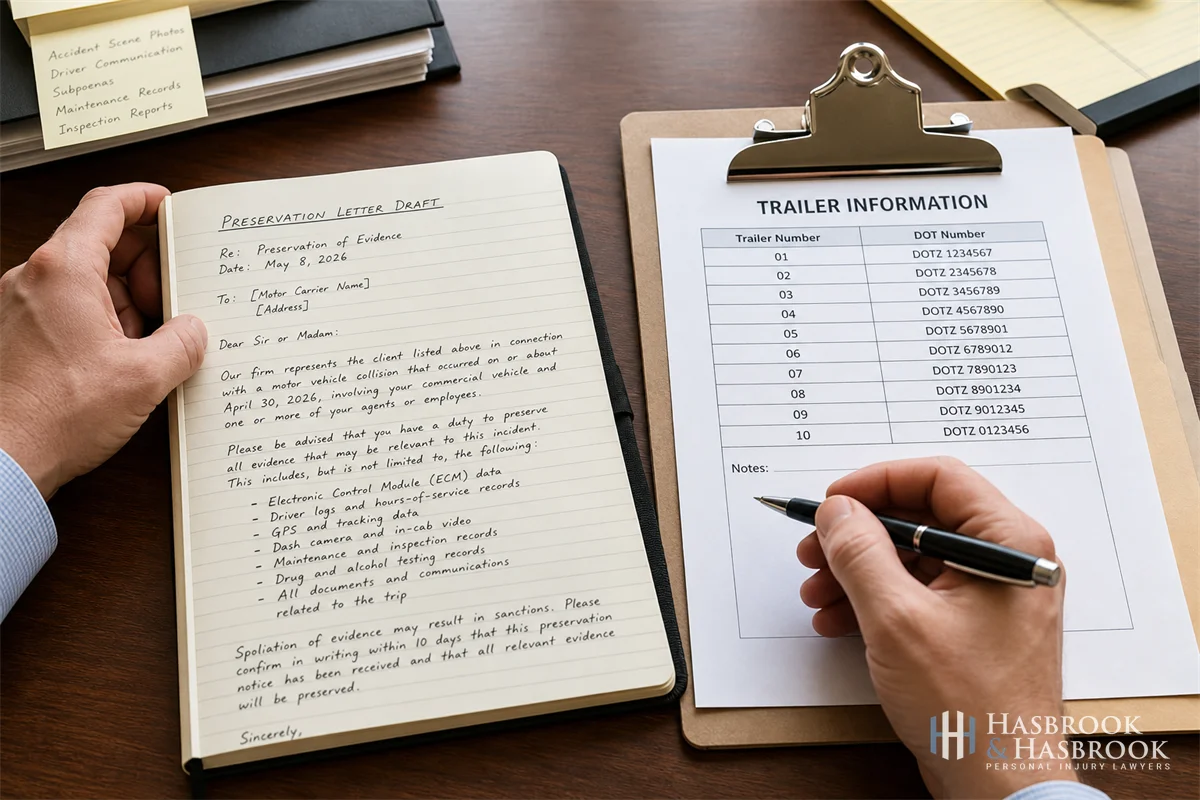
- Contact a truck accident attorney before 48 hours pass so a preservation letter can reach the carrier before electronic records overwrite.
- Follow every medical referral and document every appointment, prescription, and symptom in a daily log.
See also how counsel coordinates evidence preservation, expert retention, and the carrier’s records request on day one and the day-to-day responsibilities counsel takes on across the life of a commercial-truck file.
The carrier’s rapid response and how to counter it
Within hours of a serious underride crash, the carrier’s insurer dispatches a rapid-response team that often includes an adjuster, a reconstructionist, and sometimes counsel. Their job is to lock down the carrier’s evidence and take statements before the family has retained a lawyer. Two practical responses help: decline to give a recorded statement, and send the preservation letter early so the carrier’s duty to retain ELD data, ECM downloads, dashcam footage, and maintenance records is formal. Failure to retain after notice supports spoliation sanctions.
For more on dealing with the other side’s adjuster, see why a recorded statement to the other driver’s carrier almost always cuts against the claimant and how an adjuster’s tactics shift between liability investigation and damages negotiation. Coverage gaps are covered at truck insurance coverage gaps.
Frequently asked questions about underride truck accidents in Oklahoma
Is a missing rear underride guard automatic liability?
It is strong evidence of a violation of federal trailer-equipment standards, but it is not automatic liability. The plaintiff still has to show the missing or non-conforming guard caused the injuries the standard was designed to prevent. In a rear underride at low closing speed, that proof is straightforward; in a side or front underride, the analysis differs because no federal guard is currently required on those sides.
What is the deadline to file an underride truck accident lawsuit in Oklahoma?
Two years from the crash date for personal injury under 12 O.S. § 95, and a separate filing deadline for wrongful death claims under 12 O.S. § 1053. The evidence preservation window is far shorter: ELD data, dashcam footage, and traffic-camera recordings can disappear within days.
Who can be sued in an underride case?
Possible defendants include the truck driver, the motor carrier, the trailer’s owner if separate from the carrier, a third-party maintenance contractor, the trailer or guard manufacturer, and the shipper if loading practices contributed. The companion FAQ linked earlier covers the practical division between driver-only and combined-defendant cases.
Does Oklahoma’s comparative fault rule affect an underride claim?
Yes. Under 23 O.S. § 13, an injured person can recover as long as their share of fault does not exceed 50%. A jury that finds the carrier 80% at fault and the injured driver 20% at fault would reduce the verdict by 20%. The carrier’s insurer will push as much fault as possible onto the injured person, which is why complete scene evidence and reconstruction matter.
What is the Stop Underrides Act?
A federal bill that would mandate side and front underride guards on all trailers and strengthen the rear-guard standard. It has been introduced in multiple sessions of Congress and has not been enacted. Until it is, side guards remain a voluntary safety upgrade.
How long does an underride truck accident lawsuit take in Oklahoma?
The arc varies with case complexity, the number of defendants, and whether the case settles or tries. The general range is covered at how long a truck accident lawsuit takes in Oklahoma.


Talk to an Oklahoma truck accident attorney
An underride case rewards early, organized work. The preservation letter, the trailer inspection, the engineer’s measurements of guard height and mounting condition, and the discovery requests all need to land before the carrier’s records and the trailer itself disappear from view.
Hasbrook & Hasbrook Personal Injury Lawyers handle commercial trucking cases across Oklahoma, including underride collisions. Call (405) 605-2426 or reach the intake team through the contact form for a free case evaluation. Our firm pulls the carrier’s records, retains the reconstructionist, and builds the engineering case while you focus on recovery.
Related coverage: our Oklahoma City commercial-truck practice hub, our Tulsa-area truck wreck practice page, and Oklahoma truck accident statistics and trends.