Slip-and-fall cases are won or lost at intake. By the time a client reaches your office, the most important evidence windows in the case are already closing: surveillance footage overwrites on rolling cycles, witnesses scatter, and the property owner’s insurer has already begun building a file. This checklist is a working intake reference for Oklahoma premises liability matters that originate with a fall on someone else’s property. It covers what the client needs to have done before the first meeting, what you need to verify before the file opens, and the notice and fault issues that will define settlement value and litigation risk throughout the case. For background on the full range of duty categories and property types, see the firm’s Oklahoma City premises liability lawyer page.
Report the Slip-and-Fall Accident
The incident report is the first contested document in a slip-and-fall case. Businesses generate it for their own purposes: to defend a claim, not to help one. Your client needs to act before that document is drafted without their input.
Tell the client to report the fall to the store manager or property supervisor before leaving the premises. Request a copy of the incident report at that time. Many businesses will refuse, citing internal policy. Document the refusal: note the employee’s name and the time of the request. If the business later produces a report that differs from the client’s account, that refusal is a useful credibility point.
Several other actions matter in the immediate aftermath:
- Ask the manager to preserve surveillance footage covering the area and the 24 to 48 hours before the fall. Frame it as a formal request. Follow up with a written preservation demand as soon as you are retained.
- Get names and contact information from any witnesses before leaving. Bystanders who saw the fall or the condition beforehand are your best corroboration.
- Photograph the hazard, the surrounding area, and any signage or its absence before leaving the premises. If a wet floor sign was present, photograph its position relative to the hazard. If none was present, photograph that too.
- Photograph the clothing and footwear worn at the time. Defense counsel will raise improper footwear arguments. Preserve the shoes in a sealed bag without washing them.
Our guide on steps to take after a slip-and-fall accident covers the client-facing version of these immediate steps.
Invitee Status and the Duty of Care
Before you assess notice, pin down the visitor status. Oklahoma recognizes the traditional premises liability hierarchy: invitees receive the highest duty, licensees a more limited one, and trespassers the least. A business customer is a classic invitee, someone present for a purpose connected to the property owner’s commercial activity. A social guest at a private residence is typically a licensee, not an invitee.
The duty owed to an invitee in Oklahoma is not merely reactive. It requires the owner or occupier to inspect the premises, discover dangerous conditions, and either repair the hazard or provide adequate warning. A defense that the owner did not know about the condition is not a complete defense if the condition was discoverable through reasonable inspection. This is the foundation of the constructive notice argument, and it turns on how long the hazard existed before the fall.
Confirming invitee status at intake also matters for claim value. A licensee case is a harder case. An invitee case, such as a customer slipping in a grocery store or a tenant’s visitor falling in an apartment complex’s common area, starts with the highest duty squarely in play.
For a parallel framework covering the full range of premises liability scenarios, see the premises liability intake checklist in the attorney resources library.



Document the Scene

The scene documentation window closes fast. Businesses clean up hazards, complete repairs, and remove evidence as quickly as possible after a reported fall. The client needs to act before leaving the property.
Practical checklist for scene documentation:
- Photograph the hazard from multiple angles, including a wide shot that shows surrounding signage or the absence of it, and a close-up of the exact condition that caused the fall.
- Photograph the floor surface beyond the immediate hazard to show whether the contamination was isolated or extended across a wider area. A pattern of contamination suggests the condition had been developing for some time.
- Note and photograph the lighting conditions and any obstructions that may have prevented the client from seeing the hazard. Poor lighting is an independent liability argument in some cases.
- Check the area for prior markings: worn flooring, discoloration consistent with recurring moisture, or drain areas that repeatedly overflow. These support a pattern-of-notice argument.
- Return to the scene promptly if the client did not document before leaving. Photograph the repaired or changed condition and note the date of the return visit. A before-and-after comparison is useful when defense counsel argues the hazard was not as described.
For the parallel steps on preserving your client’s medical records and injury documentation, see our guide on documenting injuries for a personal injury claim.
The Notice Element: Actual vs. Constructive
Notice is the element that determines whether most slip-and-fall cases settle, try, or are disposed of on summary judgment. You need to identify your notice theory before you take the file, not after you have spent money on discovery.
Actual notice is the cleaner path. If an employee created the hazard, that is actual notice. A worker who tracked liquid from a stock room into a shopping aisle without addressing it gave the store actual notice. Prior complaints about the same condition, incident reports from earlier falls at that location, and maintenance records showing prior repairs to the area all establish it. Ask at intake whether the client saw any employees near the hazard before the fall.
Constructive notice is about time. A condition that existed long enough that a reasonable inspection would have discovered it is treated as known to the property owner. In practice, this means you need to establish when the hazard appeared, not when the client fell. Surveillance footage from the hours before the incident is the most direct evidence of this. A spill sitting untreated for 45 minutes in a busy retail aisle is constructive notice in most judges’ frameworks. A condition that appeared two minutes before the fall is much harder to attribute to the property owner.
Your initial intake questions on notice should include: Was there anything suggesting the hazard had been there for some time? Was it dry around the edges? Were there footprints through it? Had the client seen it on a prior visit? Any one of these details can anchor the constructive notice argument.
For the full evidence-building protocol, see the notice proof documentation guide in the attorney resources library.
Collecting Evidence for Your Case
Send the preservation demand the same day you are retained. Surveillance systems overwrite on rolling cycles, commonly 30 to 90 days, and sometimes as few as two weeks in smaller facilities. Once footage is gone, no court order retrieves it. What you can get, if the business destroyed footage after receiving a preservation demand, is a spoliation argument. But that argument is a fallback, not a plan.
The preservation demand should specify:
- The date, time, and exact location of the incident
- All footage covering that location from 24 to 48 hours before the fall through the time of the incident
- All maintenance logs, inspection records, and cleaning schedules for the area for a reasonable period before the fall
- All prior incident reports for that location within a three-to-five-year look-back period
- The identity and contact information of any employees listed in the incident report
Witnesses are the second priority. Bystander witnesses disappear quickly. Get signed or recorded statements before defense counsel does. If employees were nearby, note their names from the incident report and consider early written statements or depositions before they leave the employer.
For the complete preservation protocol, including the legal framework for a spoliation argument if footage is later missing, see the dedicated slip-and-fall evidence preservation checklist. Our FAQ on security camera footage in premises cases addresses the same preservation steps for clients who need a plain-language explanation.


Before Your Consultation
Walk the client through this before the first meeting. It takes a few minutes and prevents hours of remedial work later.
- Seek medical treatment immediately and continue treatment as directed by providers. A gap in treatment gives the defense an argument that the injuries are not as serious as claimed, or that a separate event caused the condition at issue.
- Do not give a recorded statement to the property owner’s insurer. The adjuster asking for a recorded statement is not conducting a neutral fact-finding exercise. The questions are designed to elicit statements that reduce or eliminate the claim’s value.
- Do not sign any release or authorization from the property owner or its insurer. Some businesses send broad medical or records authorizations shortly after a reported fall. These are not routine paperwork.
- Preserve clothing and footwear worn at the time of the fall in a sealed bag without washing them.
- Write a detailed account of the fall while memory is still fresh: what the client saw, how they landed, what the condition looked like, and what employees said at the scene. Include any statements made by store personnel about the condition.
- Stay off social media entirely regarding the incident. Posts, photographs, and check-ins are obtained through discovery and routinely used to contradict injury claims.
Personal Injury Consultation Checklist: Essential Documents to Bring
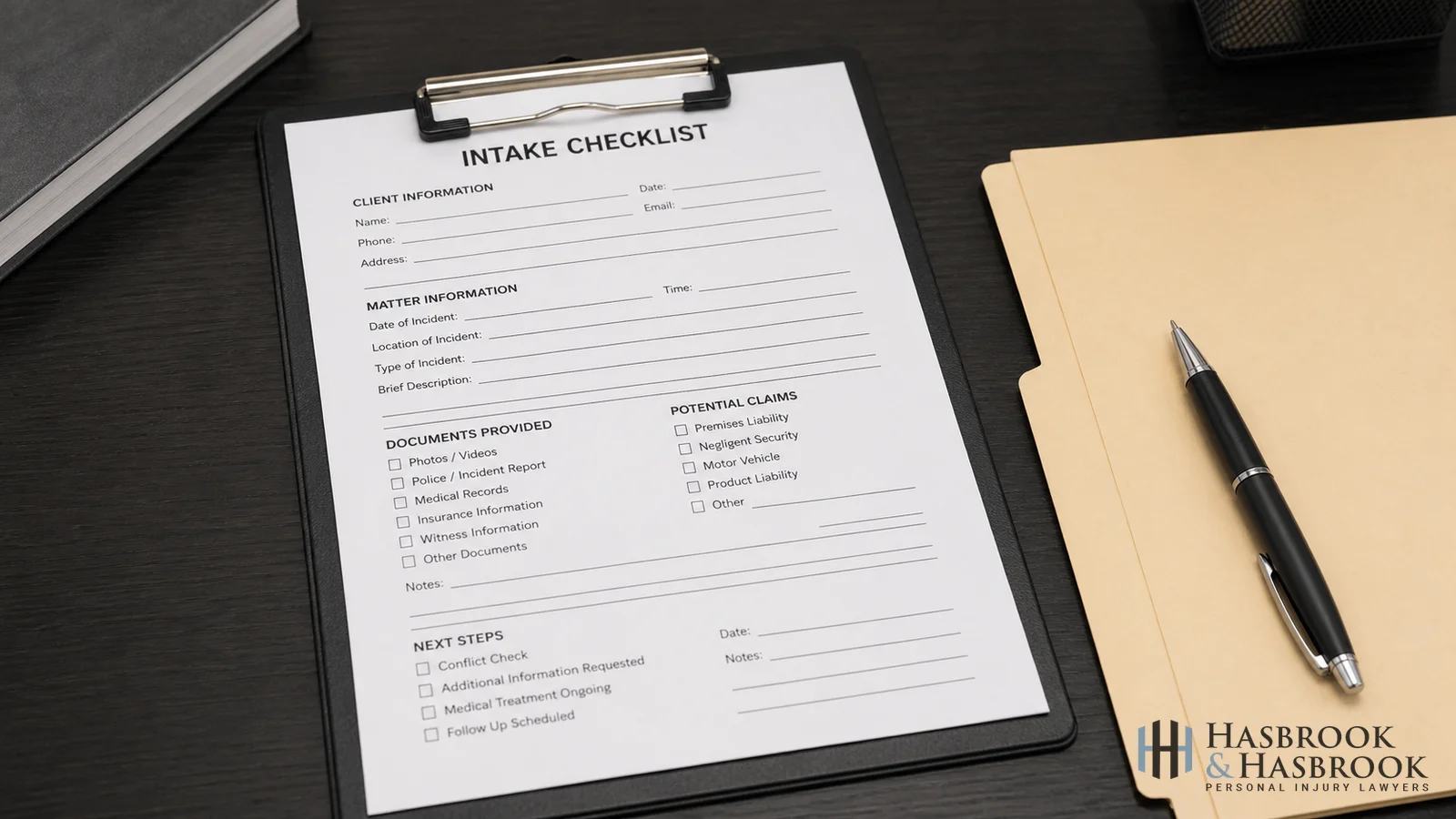
The first consultation is more productive when the client arrives with organized materials. Request these before the meeting:
- Incident report obtained at the scene, or a written account of what happened when they requested one and were denied, including the name of the employee who declined.
- All photographs from the scene, their injuries immediately after the fall, and their clothing and footwear.
- Medical records and bills from all treatment following the fall, including emergency room visits, urgent care, follow-up appointments, physical therapy, imaging, and prescription records.
- Health insurance card and policy information. You need this at intake to identify lien holders, assess subrogation exposure, and determine whether the insurer’s paid-versus-incurred posture is likely to be an issue.
- Employment and wage records if the client missed work. Pay stubs from the period before and after the fall, employer contact information, and any documentation from the employer regarding lost time are all useful.
- Contact information for any witnesses gathered at or near the scene.
- A written timeline of events from the date of the fall through the date of the consultation, including all medical treatment received and any communications with the property owner, its insurer, or any adjuster.
- Prior medical records for the same body parts injured in the fall. Be proactive about identifying pre-existing conditions before defense counsel locates them through their own discovery. A prior knee surgery documented in your file, with a clear explanation of how the fall aggravated it, is a manageable fact. A prior knee surgery surfaced by the defense for the first time in deposition is a problem.
For context on how these documents affect settlement value and what gaps in the record tend to cost, see our FAQ on how to maximize the value of a slip-and-fall case.
Comparative Fault and Settlement Valuation Drivers
Oklahoma applies modified comparative fault under 23 O.S. § 13. A plaintiff who bears fault exceeding 50 percent cannot recover. Insurers raise comparative fault arguments aggressively in slip-and-fall cases, particularly through the open and obvious hazard defense and allegations of distracted walking or inappropriate footwear. See our detailed analysis of the open and obvious defense in Oklahoma and our FAQ on what happens when a client was partially at fault for a fall.
At intake, the key comparative fault questions to evaluate are: Was the hazard plainly visible under ordinary conditions? Was the client distracted at the time? Was the footwear reasonable for the location and circumstances? Would a warning sign, if present, have been sufficient to discharge the property owner’s duty? These questions drive how the insurer opens negotiations and what comparative fault allocation a jury might assign.
Settlement valuation in these cases tracks a predictable set of factors. Injury severity and total medical costs lead the analysis. Documented wage loss adds significant value where the employment records support it. Notice strength is the largest single liability variable: cases where the hazard was documented on surveillance for an extended period, where prior complaints were on record, or where employees were observed walking past the condition without acting, settle at substantially higher values than cases where notice is contested or absent.
For a baseline on value ranges across injury types, see our page on how much a slip-and-fall case is worth in Oklahoma. Our full analysis of comparative fault in Oklahoma slip-and-fall cases covers how fault allocation arguments are built and rebutted at trial.

Statute of Limitations
Under 12 O.S. § 95, the general personal injury statute of limitations in Oklahoma is two years from the date of the injury. Most slip-and-fall claims fall within this window, and the clock begins running on the day of the fall.
The exception that comes up regularly is claims against government entities. If the client fell on property owned or maintained by a city, county, or state agency, the Governmental Tort Claims Act governs and imposes a notice requirement that runs on a much shorter schedule: typically 90 days to file a written notice of claim with the appropriate governmental body. Missing that window effectively bars recovery regardless of how strong the liability facts are. Ask at intake whether the property was government-owned, and if there is any question about ownership, confirm it before assuming the standard two-year period applies.
See our page on how long after a slip-and-fall you can sue in Oklahoma for the full limitations analysis, including government-owned properties operated by private concessionaires.
Slip-and-fall intake is front-loaded work. The decisions made in the first 24 to 72 hours after the accident, whether an incident report exists, whether surveillance footage was preserved, whether notice evidence was captured before the property cleaned up the hazard, shape everything that follows. Clients who work through this checklist before the first meeting give you something to build on. our personal injury lawyers handle slip-and-fall and premises liability matters throughout Oklahoma. The full library of practice guides for these cases is available in our attorney resources section.