When someone you love dies because of another person’s carelessness, Oklahoma law gives your family the right to hold the responsible party accountable and recover the financial support your loved one would have provided. At Hasbrook & Hasbrook, we are a family-run Oklahoma City personal injury firm that has represented injured Oklahomans for decades, and we handle wrongful death cases personally from intake through trial when the insurer will not pay fairly.

Key takeaways
- A wrongful death claim is filed by the personal representative. Under 12 O.S. § 1053, the lawsuit is filed by the personal representative of the decedent’s estate for the benefit of the surviving spouse, children, parents, or next of kin in the order set by statute.
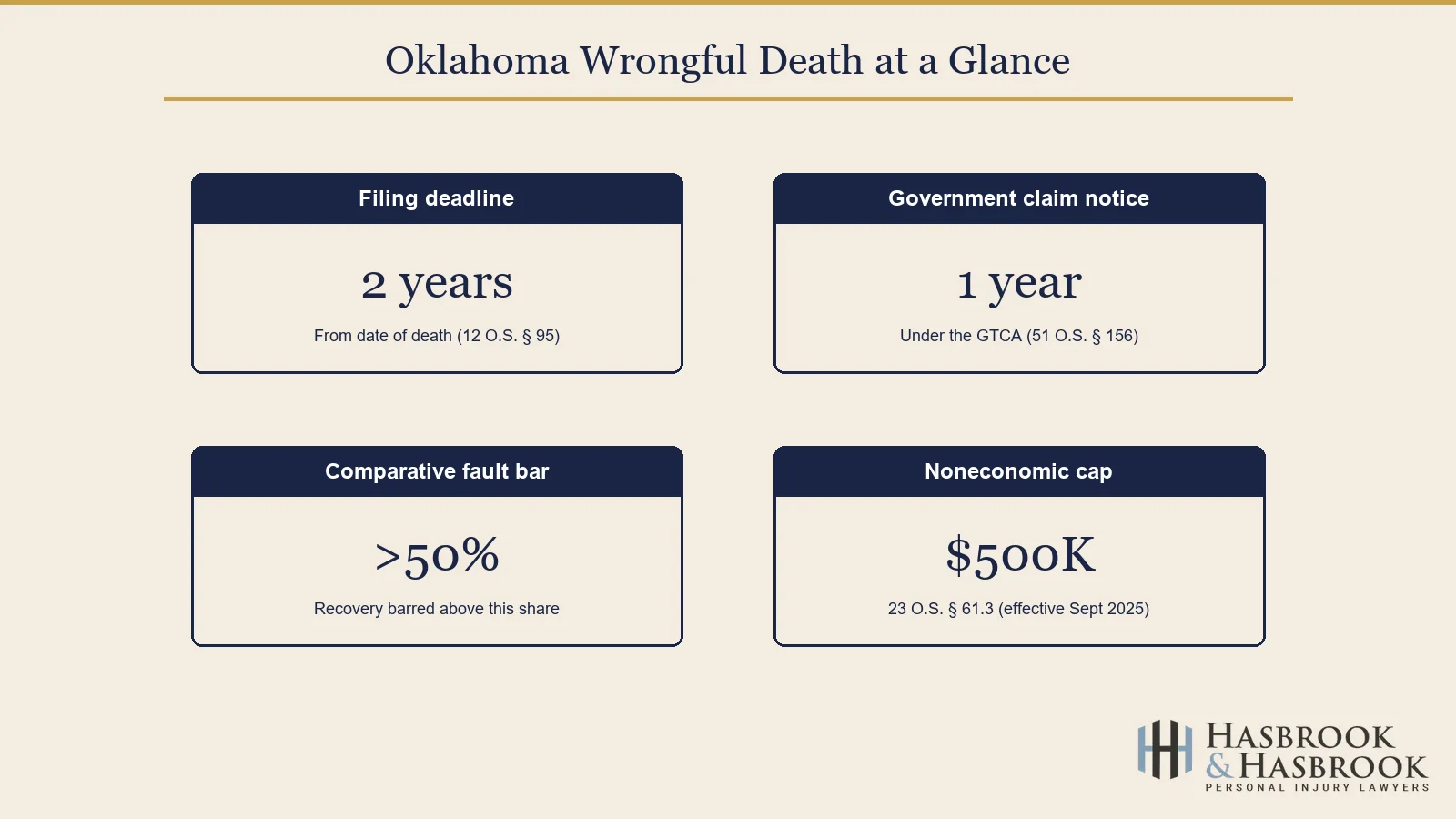
- The standard deadline is two years; government claims require earlier notice. 12 O.S. § 95 gives families two years from the date of death. If a government employee or entity is involved, 51 O.S. § 156 requires written notice within one year. Missing either deadline ends the claim.
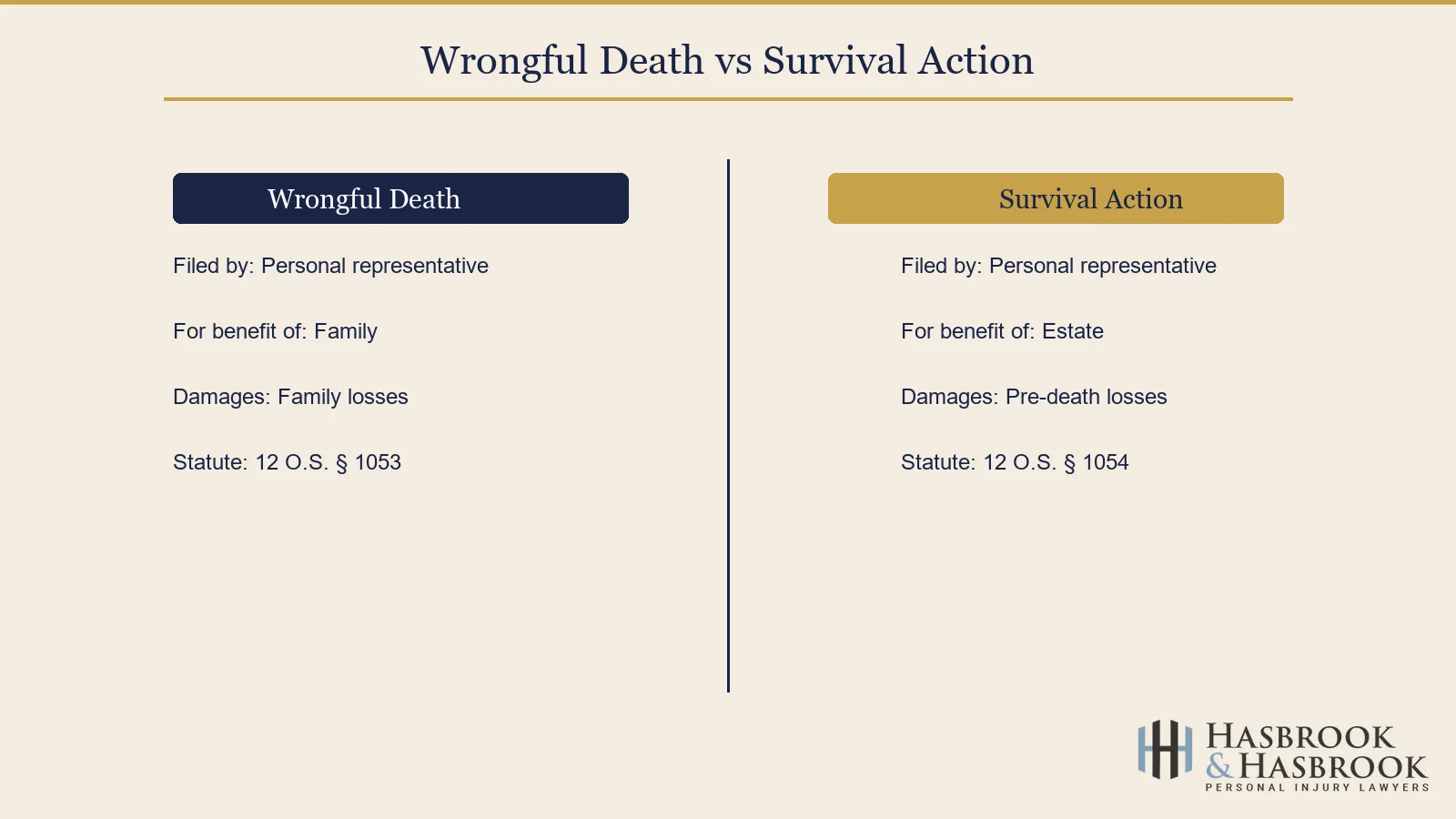
- Oklahoma allows two parallel claims from the same death. The wrongful death action compensates surviving family members. The survival action compensates the estate for the decedent’s own losses before death. Both should be filed together to capture the full recovery.
- Comparative fault reduces or bars recovery. Under 23 O.S. § 13, your family’s recovery is reduced by any fault assigned to the decedent and eliminated entirely if the decedent’s share of fault is greater than 50%.
- Early representation changes the outcome. Insurance companies dispatch investigators within hours of a fatal crash. Evidence disappears quickly, so the first job of a wrongful death lawyer is to lock down the proof before the defense controls the narrative.
Wrongful death cases we handle in Oklahoma City
The case type controls what evidence has to be preserved first, who the proper defendants are, and how quickly notice has to go out. We handle the following Oklahoma City metro wrongful death matters:
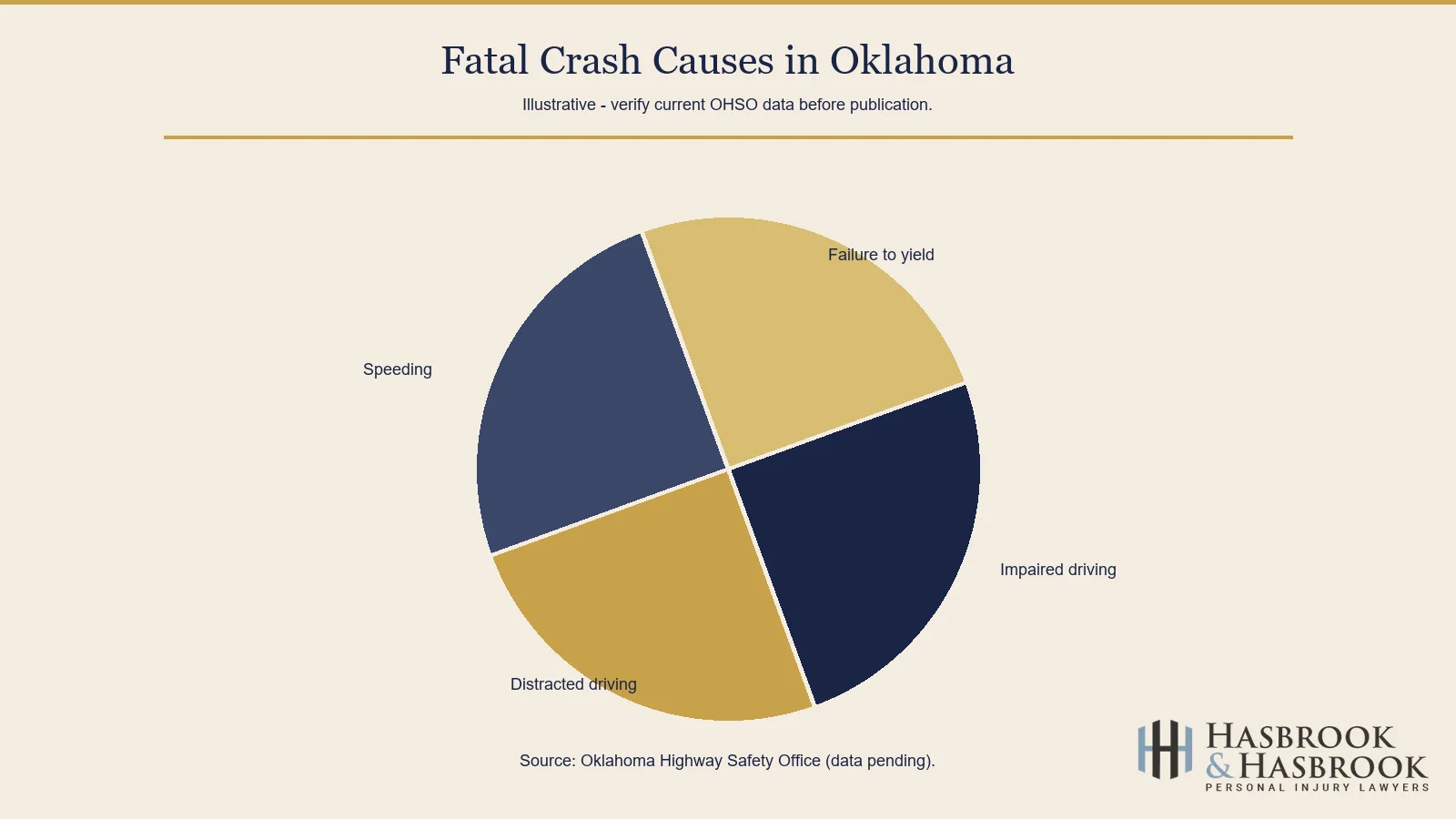
- Fatal car crashes. Distracted driving, impaired driving, speeding, and failure to yield cause fatal collisions across Oklahoma every week. See our overview of our Oklahoma City auto-collision practice page and the dedicated guide on what families face after a fatal car crash.
- Commercial truck collisions. Trucking companies and their insurers send rapid-response teams to fatal crash scenes within hours. We send commercial-truck fatality spoliation letters the same day so electronic logging device data, dashcam files, and driver qualification files cannot quietly disappear. See also federal motor-carrier violations and the penalty framework.
- Motorcycle and bicycle fatalities. Oklahoma motorcyclists and people on bikes have almost no structural protection. Fatal crashes typically involve closed-head injury or cord-level injury; biomechanical proof matters early.
- Pedestrian and rideshare fatalities. Pedestrian fatalities at OKC intersections cluster downtown and near transit stops. Fatal rideshare collisions add a second insurance layer; the layer that applies depends on which trip phase was active at the moment of impact.
- Drunk-driving deaths. A fatal alcohol-related collision often supports a punitive damages claim in addition to compensatory damages.
- Bus and public-transportation deaths. Fatal city-bus and motorcoach crashes and incidents involving transit-system vehicles may trigger Governmental Tort Claims Act notice rules when a city or transit authority is involved.
- Workplace and oil field deaths. Workers’ compensation may cover some benefits, but a separate claim against a negligent third party often produces far greater recovery.
- Premises liability. When unsafe conditions cause a fatal injury, the property owner can be held liable. Severe life-altering injury proof often carries into wrongful death cases, and fatal falls can also raise premises-fall fatality issues. Fatal thermal and chemical burn injuries from defective products or unsafe premises follow similar rules.
- Nursing home neglect. Understaffing, medication errors, and fall-prevention failures can give a family both a wrongful death and a survival claim. See our long-term care neglect cases guide and the page on vetting an Oklahoma memory-care provider.
- Fatal dog attacks and rollover crashes. Deadly dog attacks under strict liability are rare but follow Oklahoma’s strict-liability statute. SUV rollover fatality cases involving SUVs raise their own evidence challenges.
Oklahoma wrongful death law: who can file and what deadlines apply
Oklahoma’s wrongful death statutes are short but procedurally strict. Three rules control most cases: who has standing to file, how long the family has to act, and what notice is required when a government defendant is involved.
- Who can file. Under 12 O.S. § 1053, the action is brought by the personal representative of the decedent’s estate for the benefit of the surviving spouse, children, parents, or next of kin. If no representative has been appointed, certain family members can petition the probate court for that authority. The statute also recognizes a wrongful death claim when prenatal negligence causes the death of an unborn person. See our dedicated pages on which family members have standing under section 1053 and the broader Oklahoma wrongful death claimant priority list guide.
- Statute of limitations. 12 O.S. § 95 gives the family two years from the date of death. Limited tolling rules exist (for example, when the cause of death is concealed), but they are narrow. Read more in our overview of the two-year clock for Oklahoma injury suits.
- Government defendants. When a state or municipal employee is responsible (for example a state highway worker, a city refuse truck driver, or a public school bus operator), the Governmental Tort Claims Act controls. 51 O.S. § 156 requires written notice of claim to the correct entity within one year. Missing the GTCA notice deadline ends the claim regardless of the two-year statute.
- Comparative fault. Oklahoma applies a modified comparative fault rule under 23 O.S. § 13. Recovery is reduced by the decedent’s percentage of fault and barred entirely when the decedent’s share is greater than 50%. The defense will work hard to push that number across the line, which is why early scene investigation matters. See our overview of the comparative fault framework Oklahoma applies and the explainer at the distinction between contributory and comparative fault states.



Wrongful death claim vs. survival action in Oklahoma
Oklahoma recognizes two distinct claims that arise from the same death. They are filed in the same lawsuit but compensate different people for different losses. Choosing only one (or pleading the wrong one) can leave money on the table.
| Element | Wrongful death action | Survival action |
|---|---|---|
| Statute | 12 O.S. § 1053 | 12 O.S. § 1054 |
| Who recovers | Surviving spouse, children, parents, next of kin | The estate (then distributed under the will or intestacy rules) |
| What is recovered | Lost financial support, loss of companionship, loss of parental guidance, grief and loss of consortium, funeral expenses | The decedent’s own pre-death pain and suffering, medical bills, and lost earnings between injury and death |
| Deadline | Two years from date of death (12 O.S. § 95) | Two years from date of death (runs together with the wrongful death claim) |
Both claims should be pursued together. The estate’s pre-death medical bills and the decedent’s conscious pain and suffering are often a major component of total recovery, especially when the decedent survived for hours or days after the injury. For a deeper comparison, see our page on how the two parallel claims operate side by side.
Wrongful death claim vs. criminal homicide case
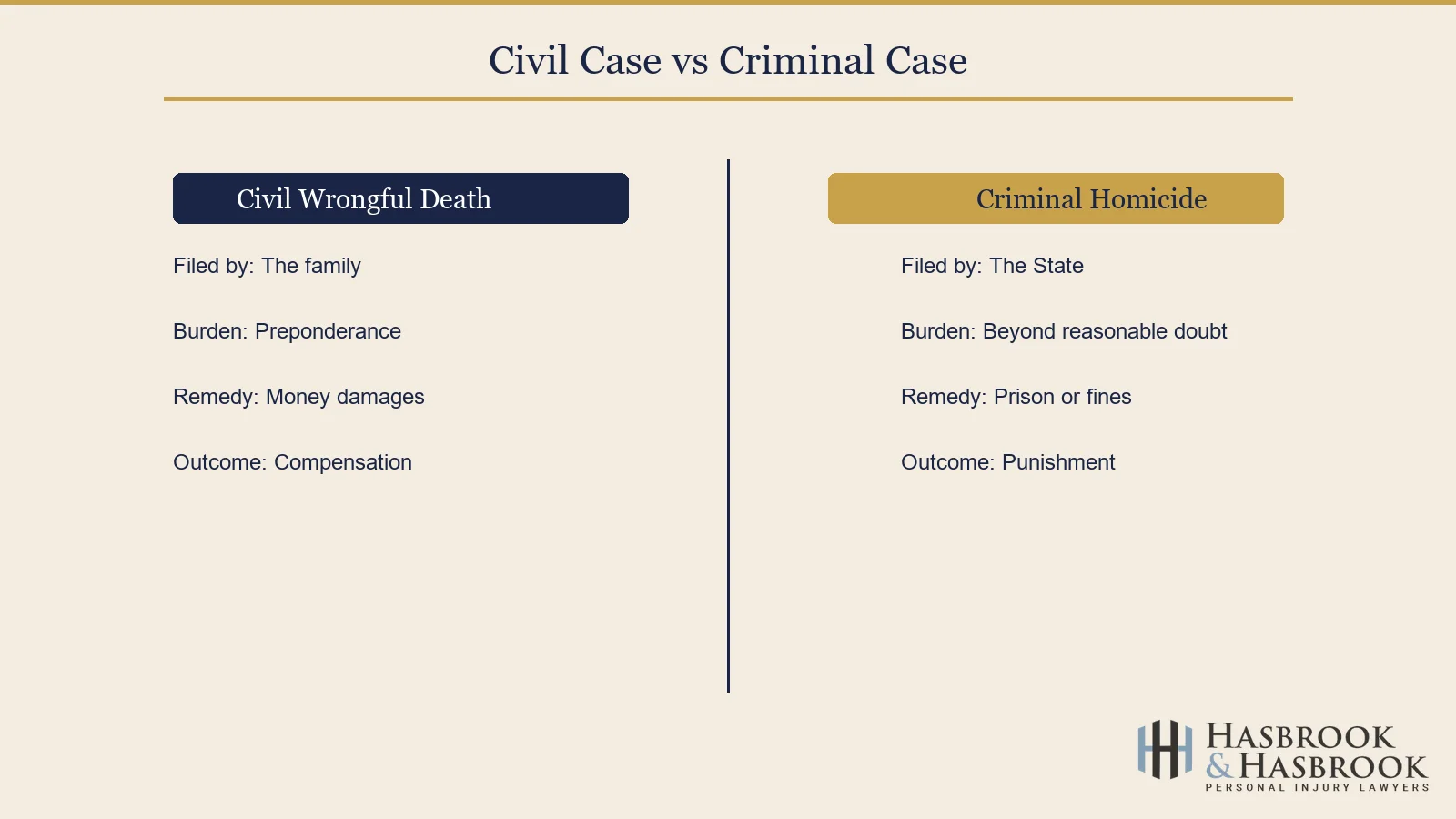
A wrongful death lawsuit is a civil case brought by the family for money damages. A criminal homicide case is brought by the State of Oklahoma to punish the person responsible. The two proceedings are independent.
- Different parties. The civil case is filed by the personal representative for the family; the criminal case is filed by the district attorney for the public.
- Different burdens of proof. Civil claims must be proven by a preponderance of the evidence; criminal charges must be proven beyond a reasonable doubt.
- Different remedies. Civil cases result in money judgments; criminal cases result in incarceration, probation, fines, or restitution.
- Independent outcomes. A defendant acquitted criminally can still be held civilly liable because the civil burden is lower. A criminal conviction is usually admissible in the civil case.
You do not need a criminal conviction, an arrest, or even criminal charges to file a wrongful death claim.
Compensation available in an Oklahoma wrongful death case
Oklahoma wrongful death damages fall into three categories: economic damages, noneconomic damages, and in qualifying cases, punitive damages.
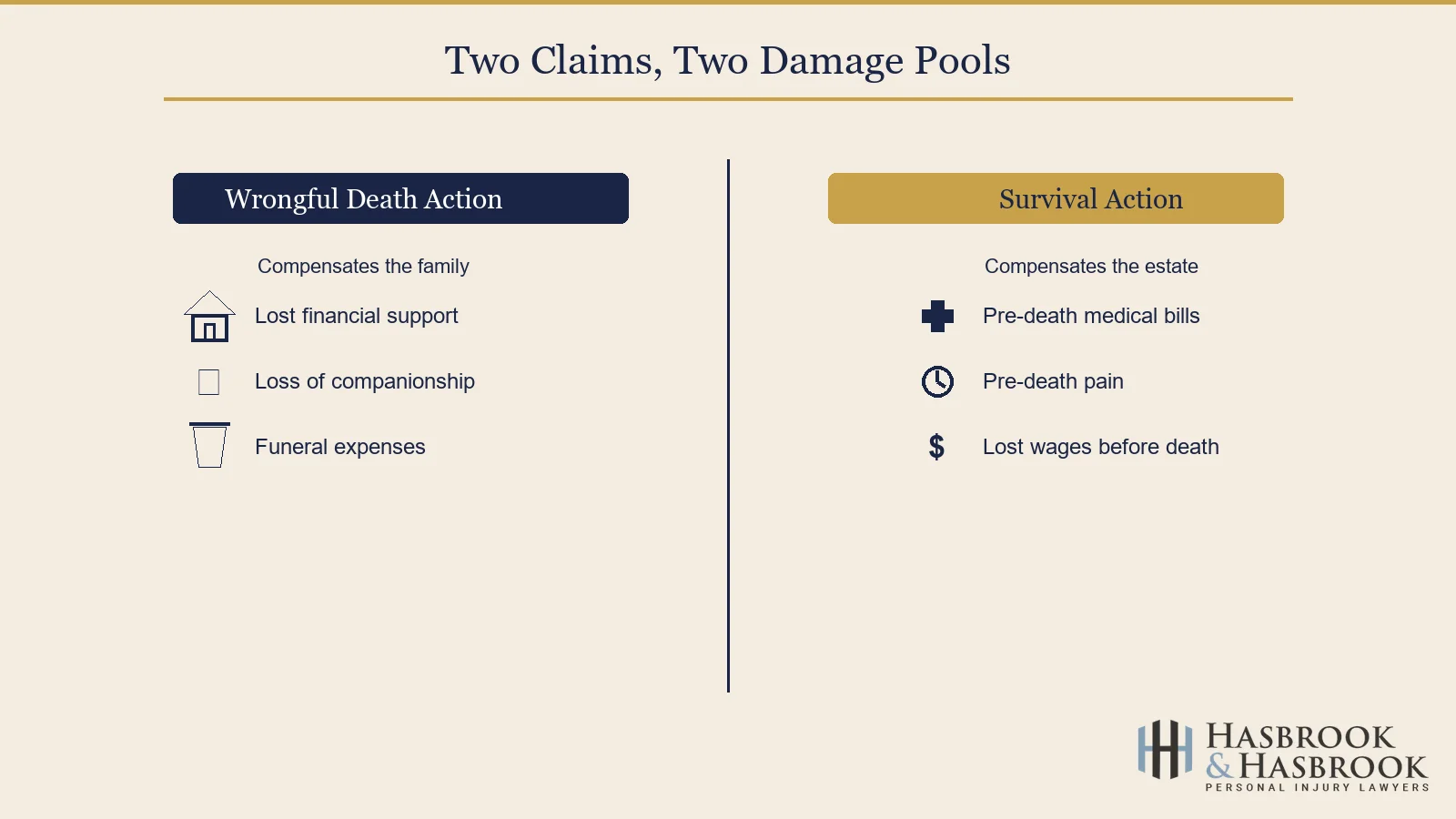
- Lost future income and benefits. Wages, salary, and employment benefits the decedent would have earned over their working life. A forensic economist projects the loss after inflation and personal-consumption offsets.
- Loss of companionship, consortium, and parental guidance. The relational value of the lost spouse, parent, or child.
- Funeral and burial expenses. Reasonable costs of the funeral, burial or cremation, and related services.
- Pre-death medical bills (survival action). Emergency, hospital, ambulance, and treatment costs incurred between injury and death. Oklahoma limits proof to amounts actually paid or still owed under 12 O.S. § 3009.1. See the paid-amount-only evidentiary rule under 12 O.S. section 3009.1.
- Pre-death pain and suffering (survival action). Physical pain and mental anguish before death.
- Punitive damages. Under 23 O.S. § 9.1, punitive damages require clear and convincing evidence of reckless disregard or intentional misconduct. First-tier cap is generally the greater of $100,000 or the compensatory award; higher tiers apply for proven intentional or malicious conduct. See how Oklahoma juries have awarded reckless-disregard damages.
Noneconomic damages cap. Oklahoma’s noneconomic damages cap is currently an open question. The prior cap was struck down in Beason v. I.E. Miller Services, 2019 OK 28, and a new $500,000 cap under 23 O.S. § 61.3 took effect September 1, 2025; the Oklahoma Supreme Court has not yet ruled on it. Statutory exceptions apply for severe physical injury, reckless disregard, intentional or malicious conduct, gross negligence, and fraud.
How long does a wrongful death lawsuit take in Oklahoma?
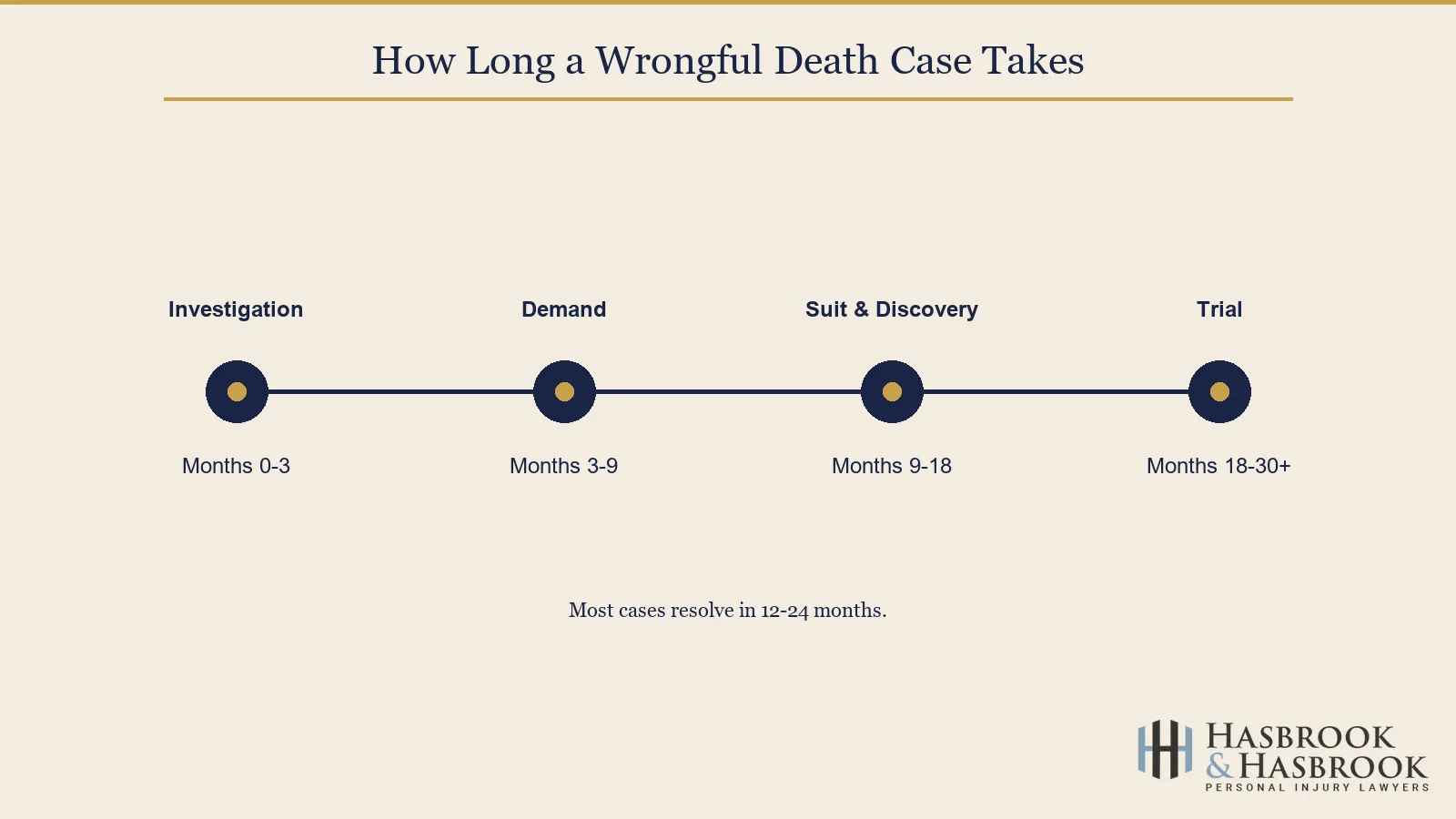
Most Oklahoma wrongful death cases resolve in 12 to 24 months. Pre-suit settlements on clear-liability facts can finish in six months. Cases that go through full discovery and trial can take three years or more.
The timeline is driven by how quickly probate appoints a personal representative, how complex the liability investigation is, how many insurers are involved, and whether suit has to be filed.
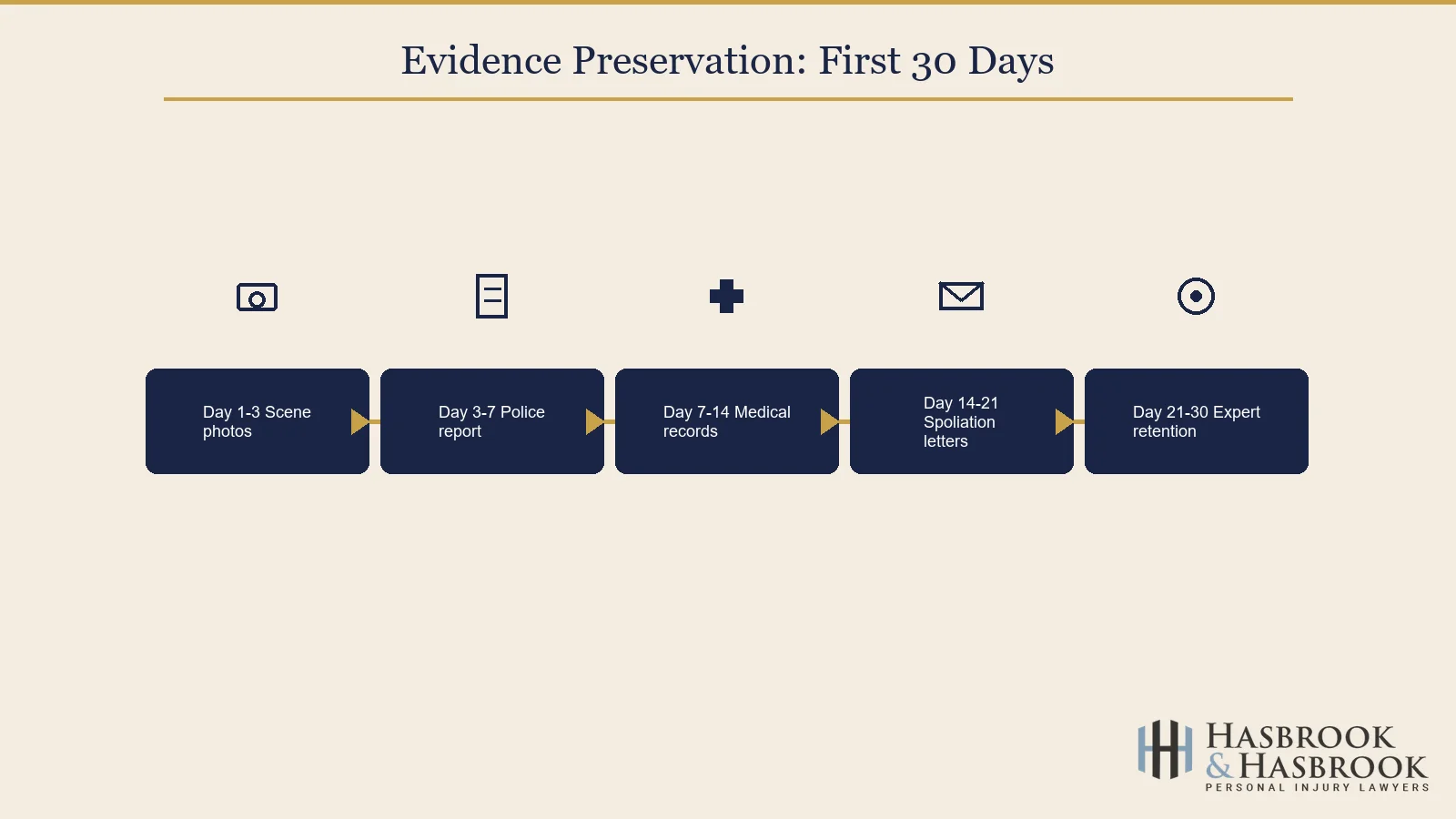
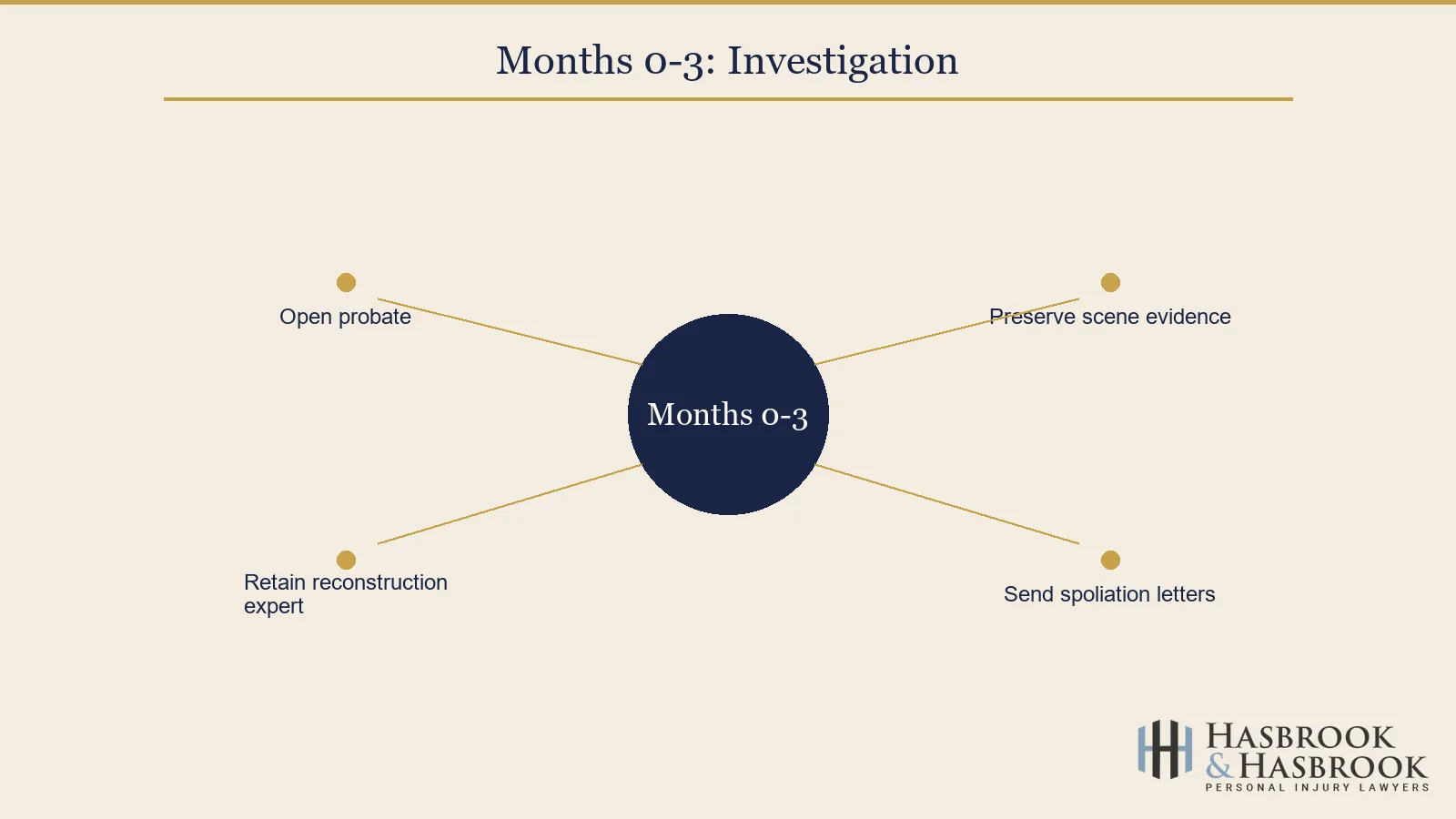
- Months 0 to 3: investigation and probate setup. Open probate, gather the police report, secure dashcam, body-cam, and surveillance before it overwrites, retain crash-scene reconstruction analysts or medical experts, request the decedent’s records. Trucking spoliation letters go out within days.
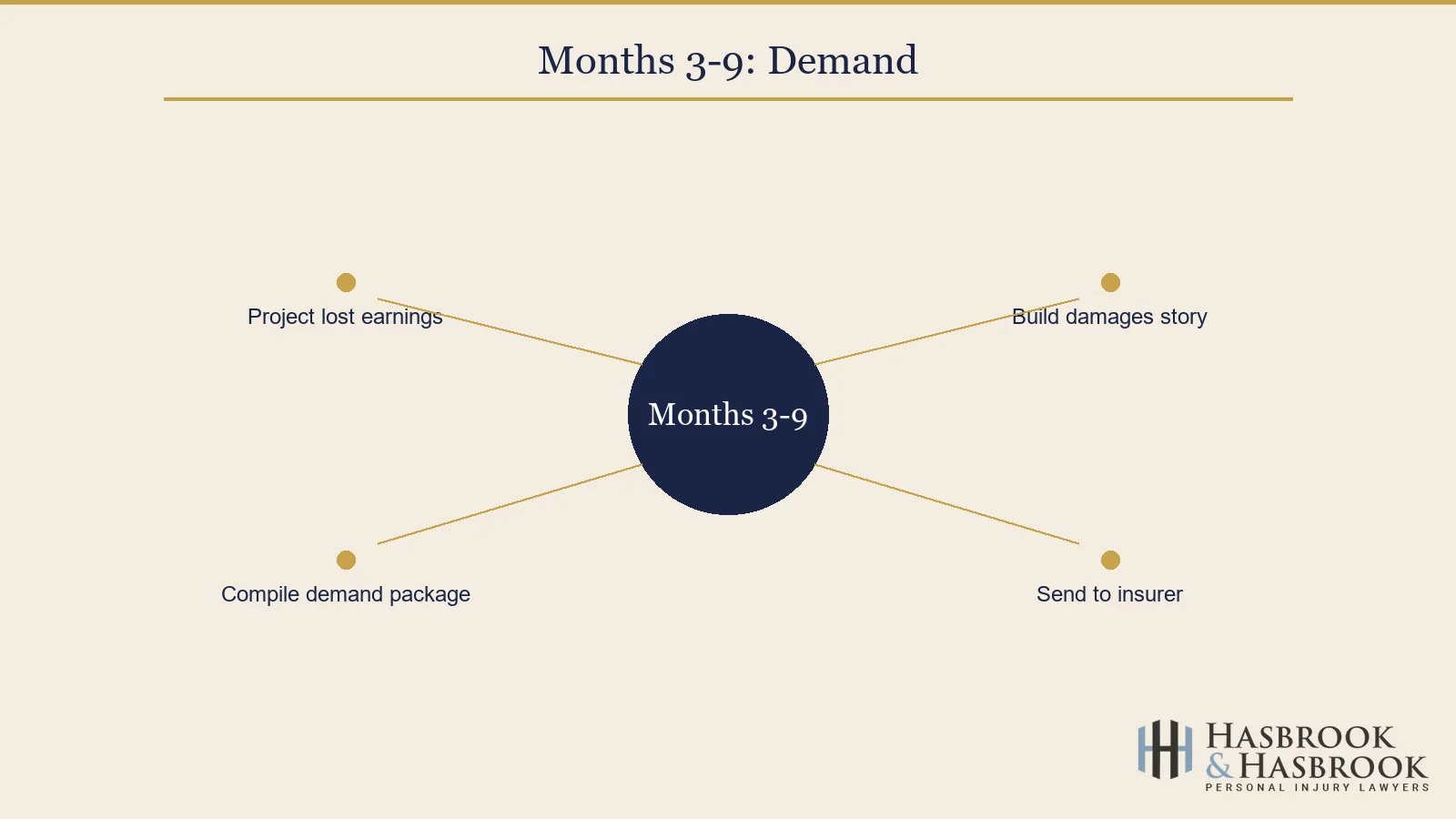
- Months 3 to 9: damages workup and demand. A forensic economist projects lost earnings. We compile the noneconomic damages story, then send a comprehensive demand to the insurer.
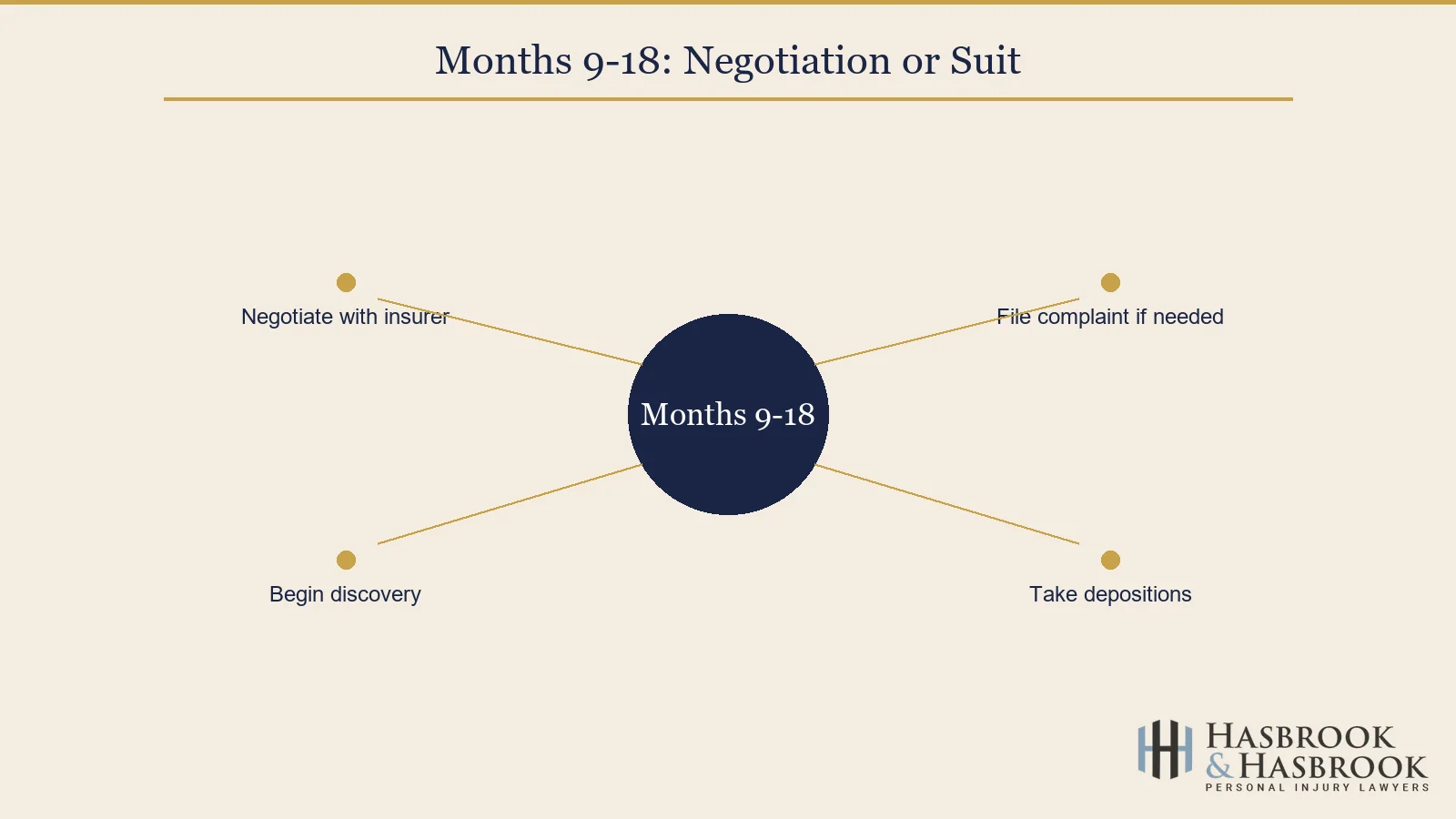
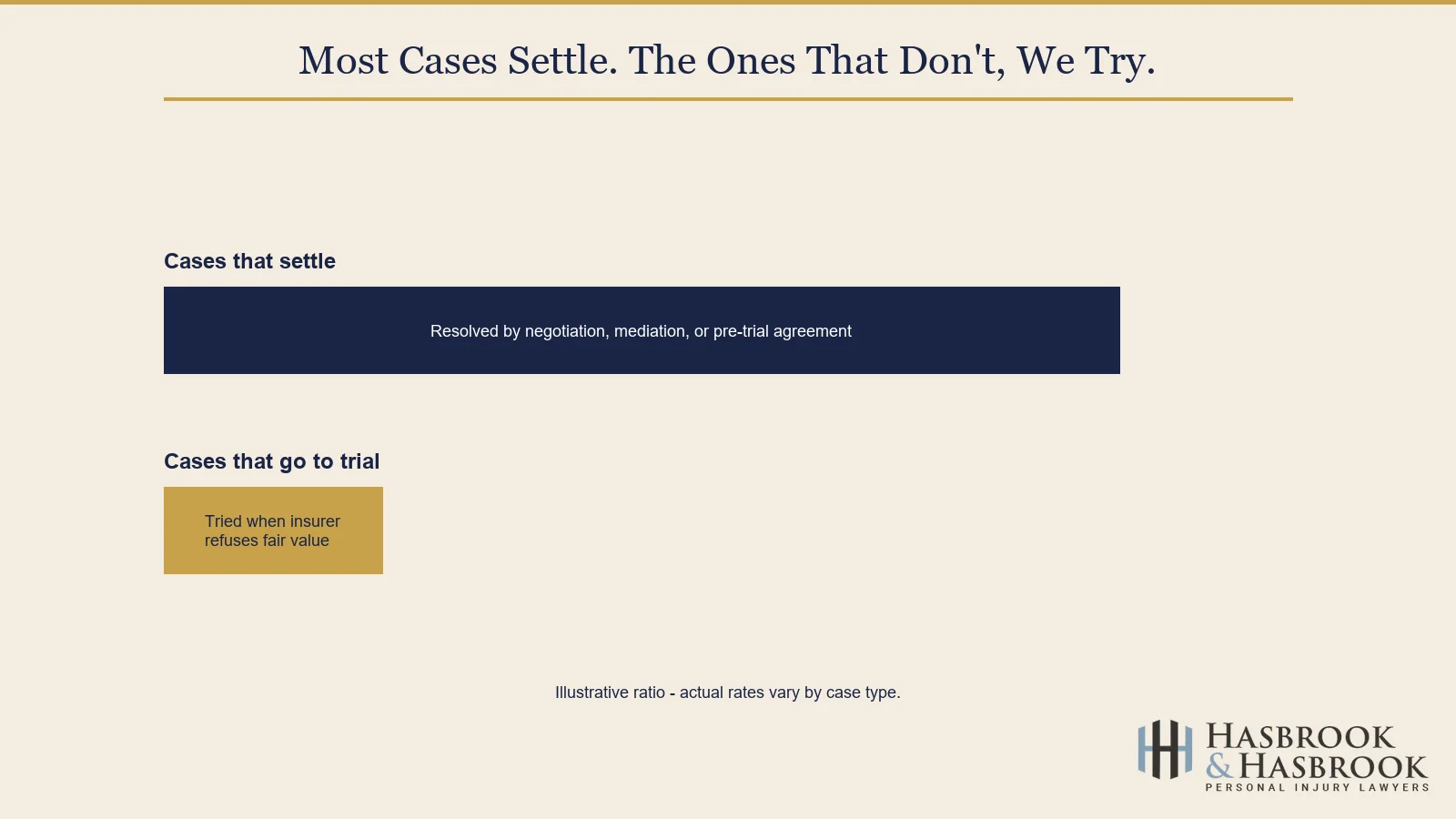
- Months 9 to 18: negotiation or filing suit. Many cases resolve here. If the insurer refuses to negotiate fairly, we file suit in Oklahoma district court and discovery begins.
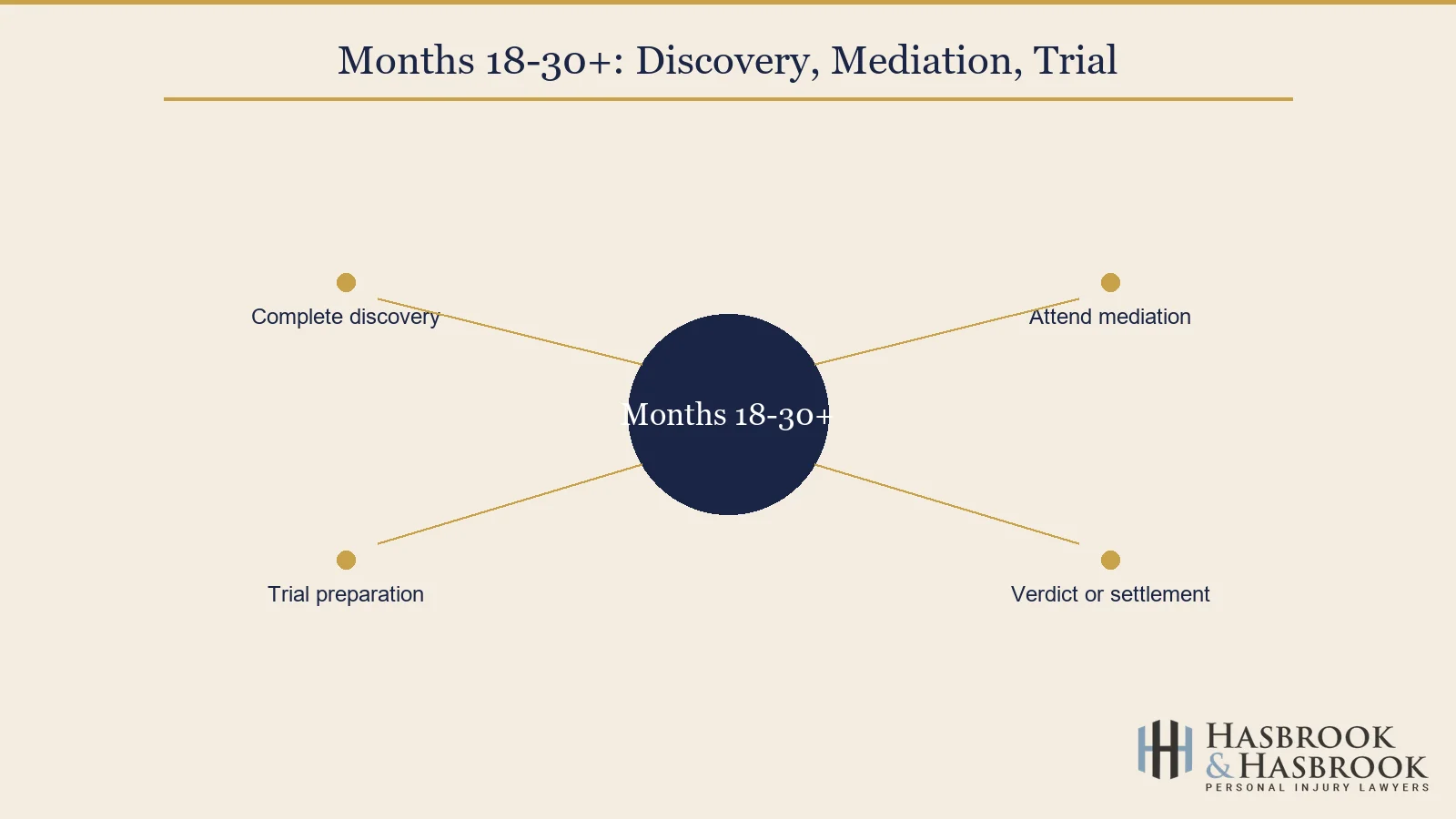
- Months 18 to 30+: discovery, mediation, and trial. Most filed cases settle after depositions or at mediation. The cases that reach trial are usually the ones with genuinely disputed liability.

How insurance companies handle wrongful death claims
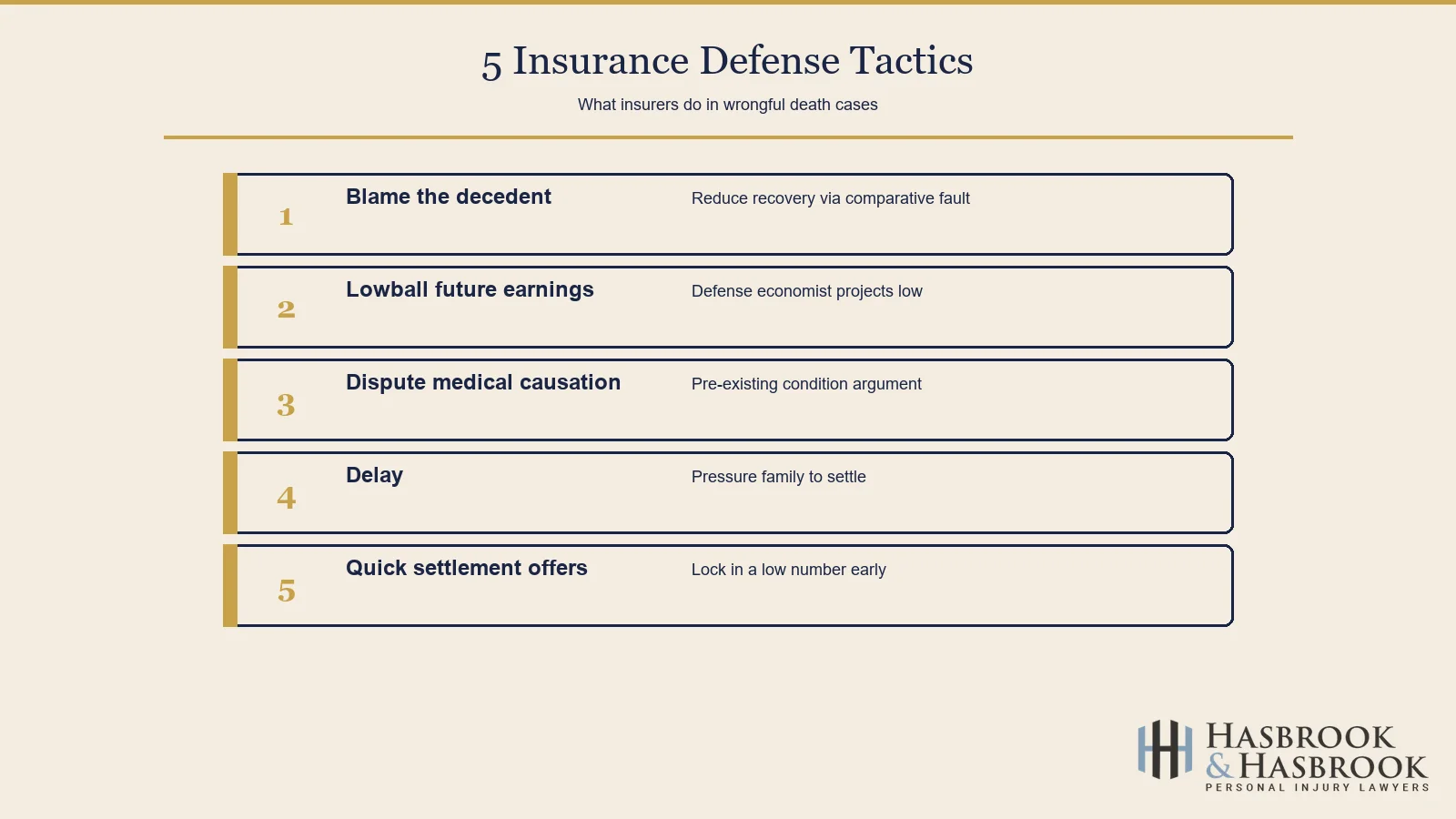
Insurance companies treat wrongful death claims as high-exposure files and assign them to senior adjusters and defense counsel from day one. Common tactics include:
- Blaming the decedent. Any fault assigned to the decedent reduces the recovery under 23 O.S. § 13. Insurers investigate driving history, social media, and medical records to build a fault narrative.
- Lowballing future earnings. Defense economists routinely produce artificially low projections of lifetime earnings and benefits.
- Disputing medical causation. If the decedent had a pre-existing condition, the insurer will argue that condition caused the death.
- Delay. Financial pressure climbs the longer the claim takes. Insurers know that a stressed family settles for less.
- Quick settlement offers. An adjuster may call within days, express sympathy, and offer money “to help with funeral costs.” Accepting almost always extinguishes the claim.
Do not give a recorded statement to the at-fault party’s insurer. Direct all communications through your attorney.
What to do if a family member suffered a wrongful death
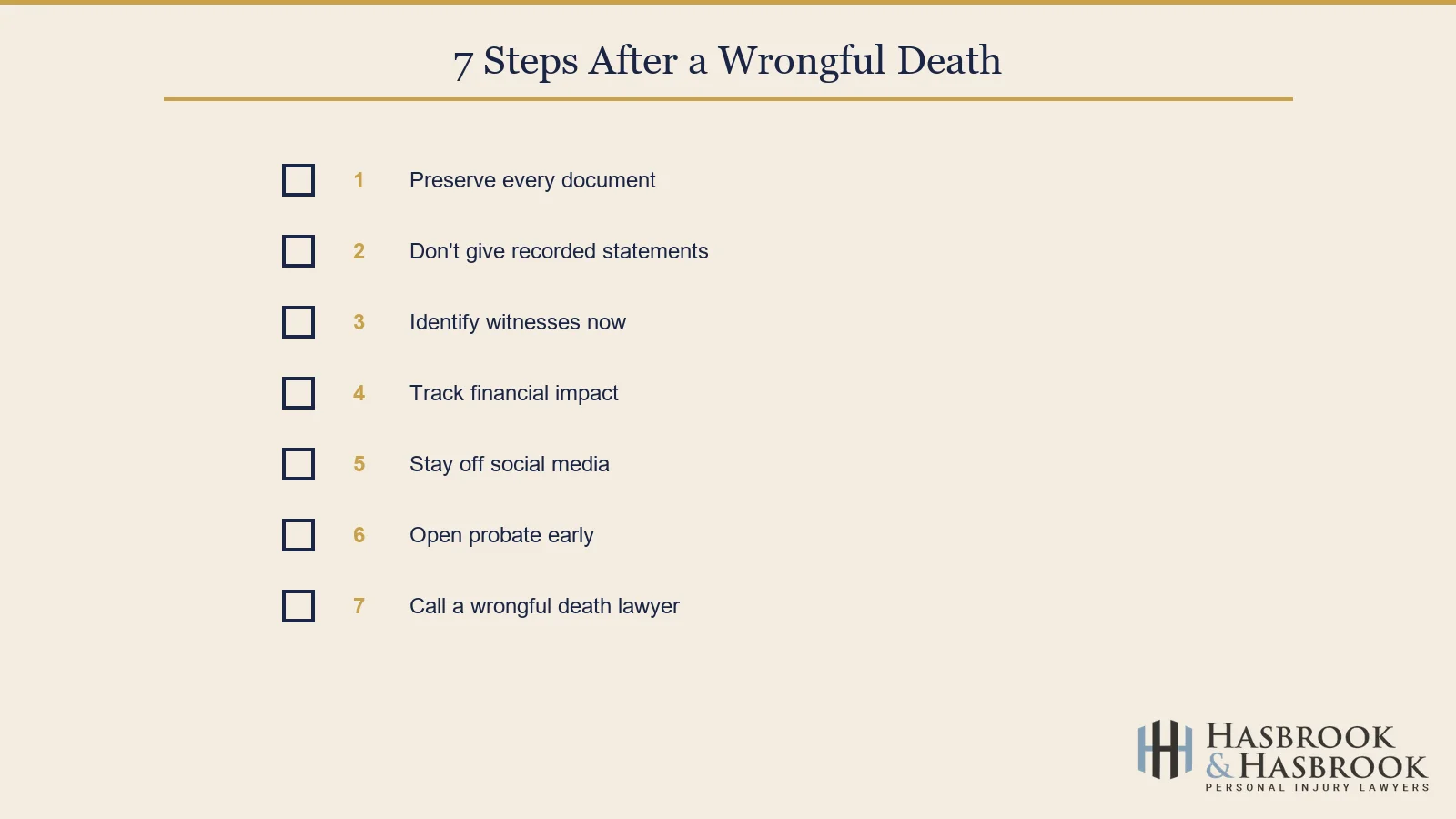
The first weeks after a fatal accident set the ceiling on what your family can recover later. A few practical steps protect the case while you grieve.
- Preserve every document. Death certificate, medical records and bills, police or incident report, autopsy when applicable, insurance correspondence, and any scene photos or video.
- Do not give recorded statements. Politely decline and direct the adjuster to your lawyer.
- Identify witnesses now. Names and phone numbers fade fast.
- Track financial impact. Lost income, terminated benefits, childcare costs, funeral expenses, and any out-of-pocket bills tied to the death.
- Stay off social media. Insurers monitor claimants and surviving family.
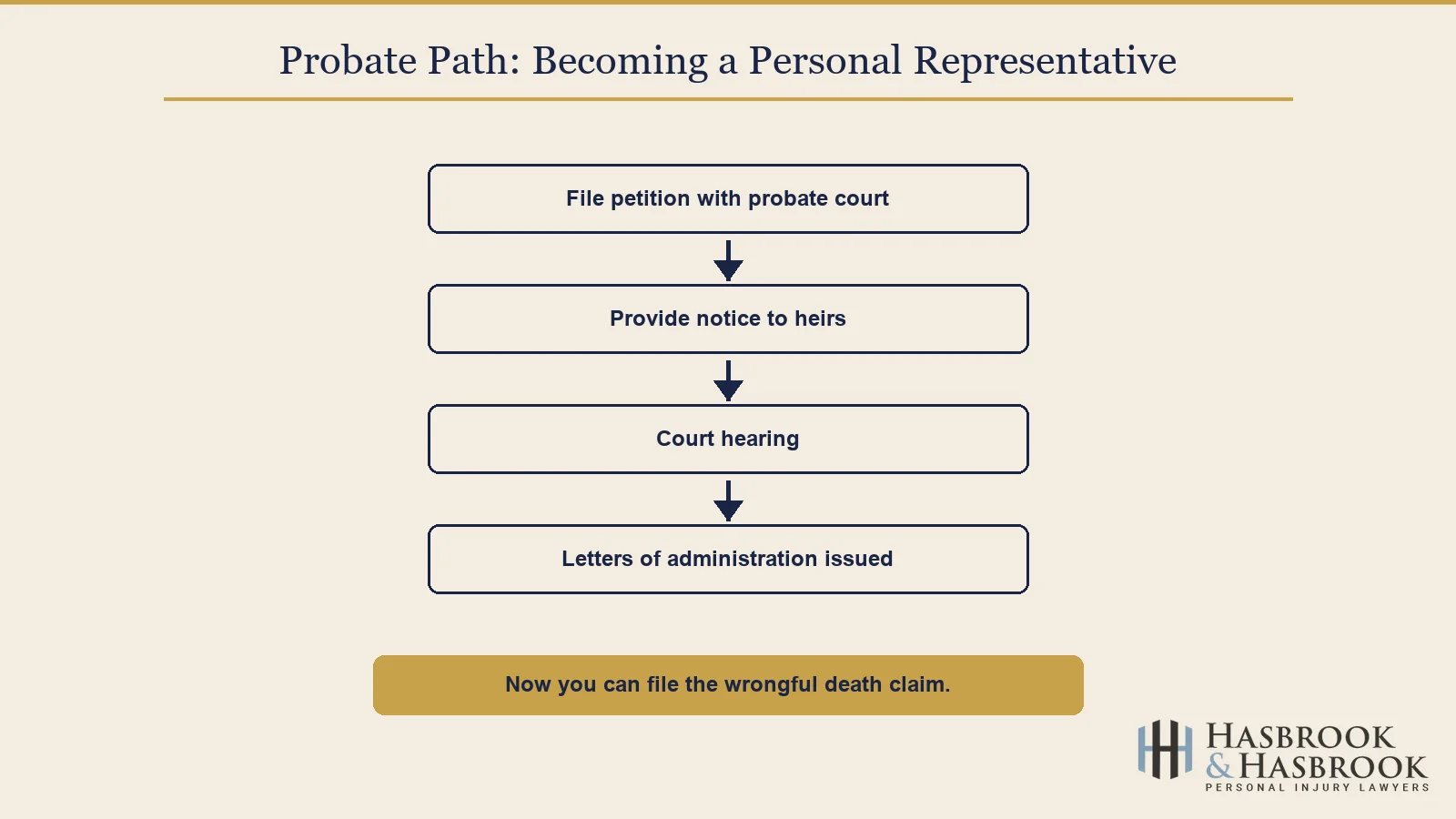
- Open probate early. Filing requires a personal representative; probate can run in parallel.
- Call a wrongful death lawyer. Evidence degrades within weeks. Earlier representation produces stronger cases.
How our firm helps your family recover the loss of a loved one
Hasbrook & Hasbrook is a family-run Oklahoma City personal injury firm. The lawyer leading our firm handles wrongful death cases personally from intake through trial. We are not a billboard intake mill; when you call the office, you reach a real attorney or a paralegal who knows your case.
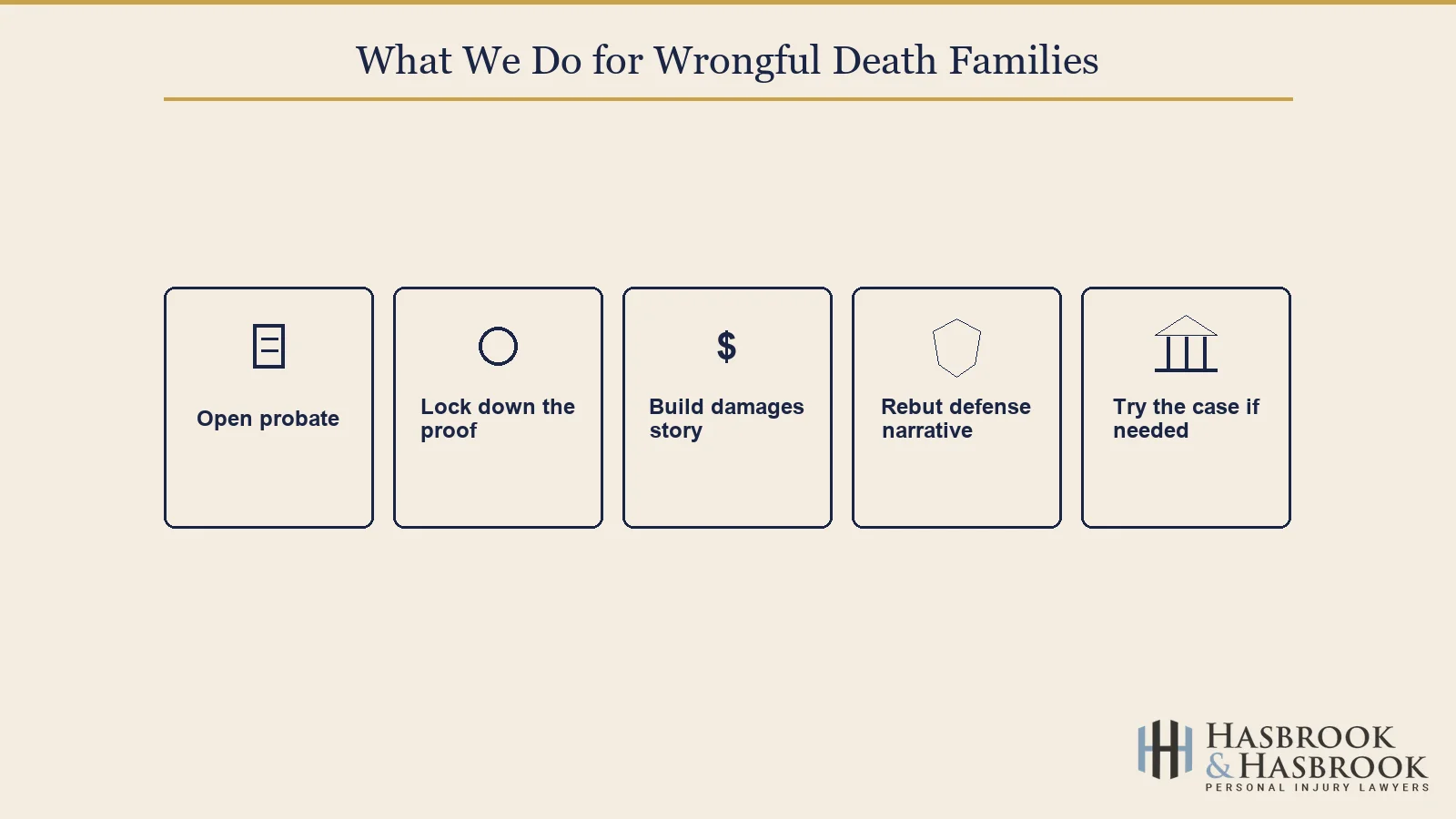
What we do for wrongful death families:
- Open probate and get the personal representative appointed.
- Lock down the proof: scene photos, dashcam, surveillance, ELD data in trucking cases, employment files, reconstruction.
- Build the damages story with forensic economists, vocational experts, and medical specialists.
- Push back on the defense fault narrative early so it does not harden into the insurer’s settlement number.
- Try the case when the insurer refuses to be reasonable. Many cases settle precisely because the defense knows we will. See verdicts and settlements achieved for prior clients.
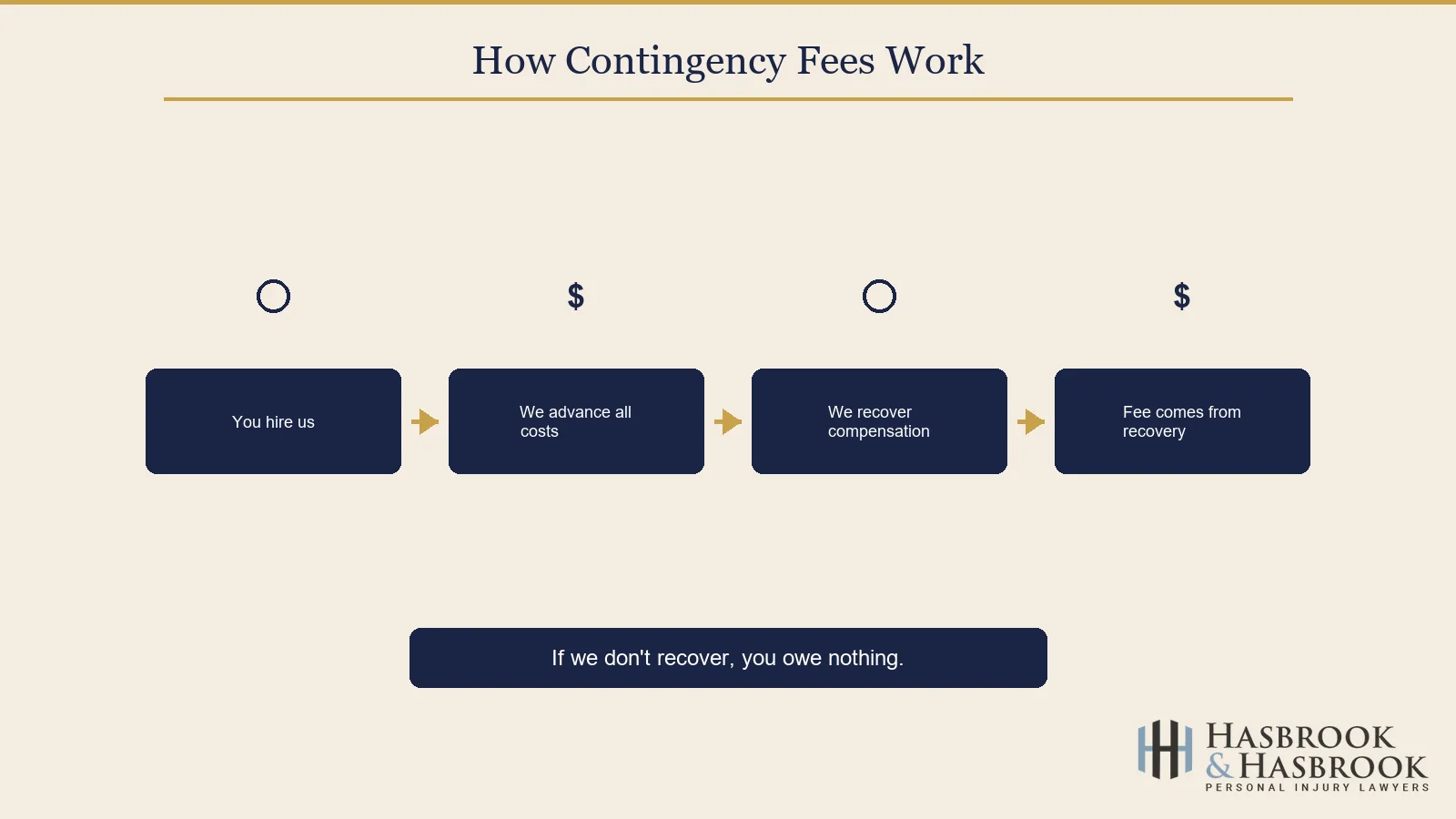
How our fees work. Wrongful death cases are handled on a contingency fee. You pay nothing upfront, nothing out of pocket during the case, and nothing if we do not recover compensation. We advance the costs of investigators, experts, court fees, and depositions. Fee terms are explained in writing at the free consultation.
Frequently asked questions about wrongful death in Oklahoma
How much is a wrongful death case worth in Oklahoma?
Value depends on the decedent’s age, earning capacity, and life expectancy; the nature and length of any pre-death suffering; the number and relationship of surviving dependents; and the strength of the liability proof. Cases with high earners, young dependents, and clear liability tend to produce the largest recoveries.
How long do I have to file a wrongful death lawsuit in Oklahoma?
Oklahoma’s filing window runs two years from the date of death under 12 O.S. § 95. If the death involves a state or local government defendant, written notice of claim is due within one year under 51 O.S. § 156. Missing either deadline almost always ends the claim permanently.
Who qualifies as the personal representative for a wrongful death claim?
The personal representative is appointed by the probate court to administer the decedent’s estate. That is usually the surviving spouse, an adult child, or the executor named in the will. If no representative has been appointed, certain family members can petition for the role.
What does it cost to hire a wrongful death attorney in Oklahoma City?
Nothing upfront. We handle wrongful death cases on a contingency fee. We advance all case costs and our fee comes from the recovery. If we do not recover compensation, you owe us nothing.
Can my family still recover damages if my loved one was partially at fault?
Yes, as long as the decedent’s share of fault is not greater than 50% under 23 O.S. § 13. If the decedent is found 30% at fault, the family’s recovery is reduced by 30%. At exactly 50% fault, the family can still recover. Recovery is barred only when the decedent’s share is greater than 50%.
Are punitive damages available in Oklahoma wrongful death cases?
Yes, in cases involving reckless disregard, intentional, or malicious conduct. Under 23 O.S. § 9.1, punitive damages require clear and convincing evidence and are tiered, with the first tier generally capped at the greater of $100,000 or the amount of compensatory damages.
Does Oklahoma’s $500,000 noneconomic damages cap apply to wrongful death?
The new 23 O.S. § 61.3 cap took effect September 1, 2025. It is currently an open question because the Oklahoma Supreme Court has not yet ruled on the new statute. The prior cap under former 23 O.S. § 61.2 was struck down in Beason v. I.E. Miller Services, 2019 OK 28. Statutory exceptions for severe physical injury, reckless disregard, intentional or malicious conduct, gross negligence, and fraud apply.
What evidence does our firm preserve immediately after we are retained?
Police and incident reports, scene photographs, dashcam and body-camera video, surveillance footage, vehicle event data recorders, the decedent’s medical and employment records, and witness statements. In trucking cases, we also send a spoliation letter for ELD data, dashcam files, driver logs, and maintenance records.


Talk to an Oklahoma wrongful death attorney

Your family has been through enough. The first conversation with our firm is free, confidential, and without pressure. We will listen, explain your options under Oklahoma law, and answer every question.
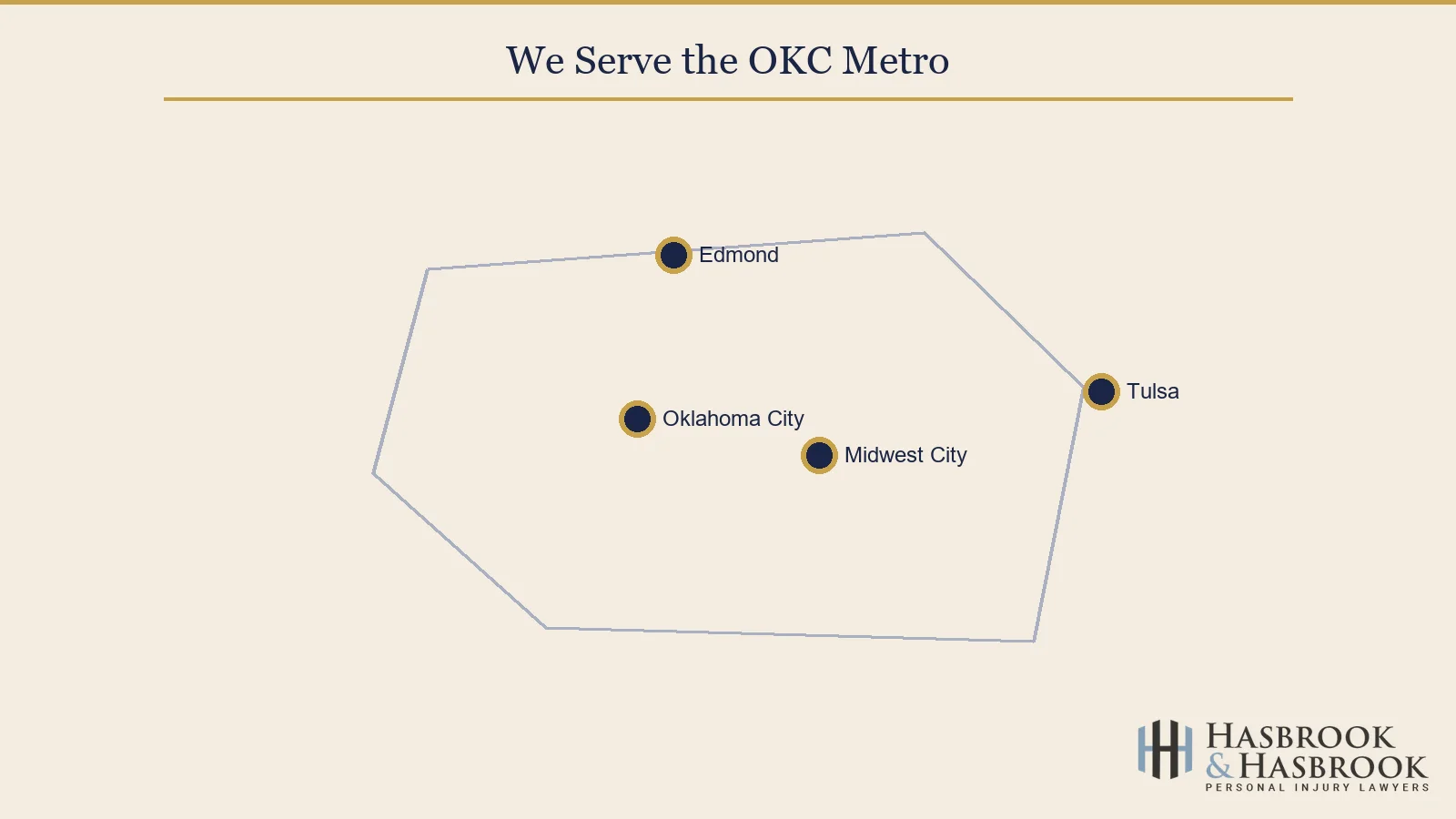
Call (405) 605-2426 directly or reach us through our secure online intake request. We respond to every inquiry within one business day. Hasbrook & Hasbrook serves wrongful death clients throughout the Oklahoma City metro, including Edmond fatal-accident representation, Midwest City wrongful death representation, and Tulsa fatal-accident representation.