Miss the one-year notice deadline, and your case disappears. When a city employee, county vehicle, or state agency causes your injury in Oklahoma, ordinary personal injury rules do not apply. The Oklahoma Governmental Tort Claims Act (OGTCA) imposes strict notice requirements, shorter deadlines, and updated damage caps that can destroy your case before it begins. The Oklahoma City governmental tort claims lawyers at Hasbrook & Hasbrook Personal Injury Lawyers know these rules and fight to recover fair compensation within the statutory framework the law requires.
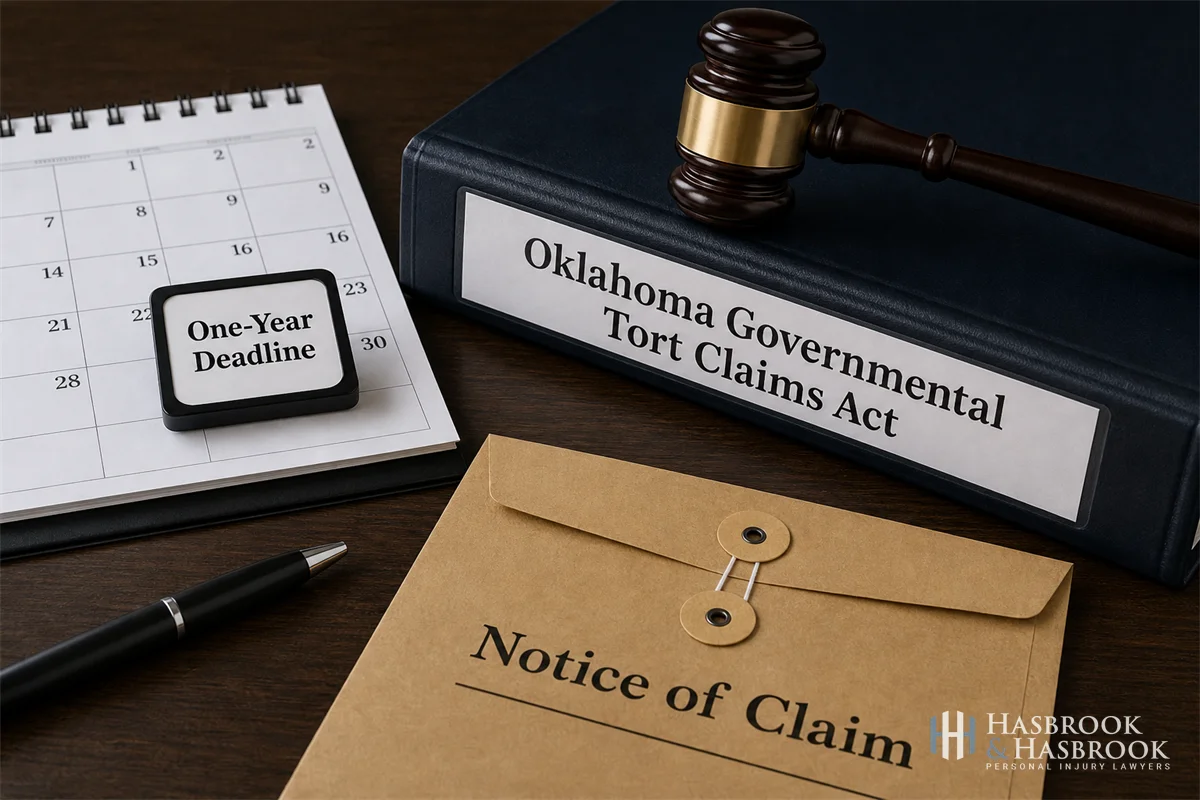



The Oklahoma Governmental Tort Claims Act: An Overview
The Oklahoma Governmental Tort Claims Act, codified at 51 O.S. § 151 et seq., is the exclusive path for suing the State of Oklahoma, its political subdivisions, and their employees for negligence. The Act was enacted in 1978 to replace the older common-law rule that barred almost every claim against the government, and it has been amended multiple times since, most recently by SB 1168 (effective November 1, 2025), which raised the per-person damage cap.
Under the OGTCA, sovereign immunity is the default. The Cornell Legal Information Institute defines sovereign immunity as a doctrine that prevents the government from being sued without its consent. Oklahoma consents only on the narrow terms set out in the Act. If your claim falls outside those terms, the case is dismissed regardless of how clearly the government was at fault.
The Act has four moving parts that decide whether a claim survives:
- Whether the conduct fits inside a waived category. Operation of a motor vehicle, maintenance of public roads or buildings, and similar functions are waived under 51 O.S. § 153.
- Whether the conduct fits inside a retained immunity. Discretionary policy decisions, judicial acts, and certain law enforcement functions remain immune (51 O.S. § 155).
- Whether you served a written notice of claim within one year (51 O.S. § 156).
- Whether you filed suit within 180 days of the denial (51 O.S. § 157).
A claim that clears all four gates can recover up to the SB 1168 cap. A claim that misses any one of them fails as a matter of law. Sibling pieces in this cluster discuss adjacent issues that often surface alongside an OGTCA claim, including admissibility of medical bills and paid versus incurred evidence, working with adjusters in non-governmental claims, and uninsured-coverage gaps when a private driver shares fault with the government entity.
Why Do You Need a Governmental Tort Claims Lawyer in Oklahoma City?
Governmental tort claims in Oklahoma differ from standard injury cases because the State, cities, counties, and their agencies have special legal protections that limit when, how, and for how much they can be sued. An experienced governmental tort claims attorney handles the procedural sequence, meets every deadline, and pursues the maximum recovery within the statutory damage caps.
The most critical difference is the notice requirement: a written notice of claim must be filed with the appropriate government entity within one year of the injury (51 O.S. § 156). In standard personal injury cases, the deadline is two years. That shorter window catches many people off guard, especially while they are focused on medical treatment.
Government entities also enjoy damage caps that do not apply in private-party cases. Under SB 1168, total liability under 51 O.S. § 154 is now capped at $250,000 per person in political subdivisions with populations under 150,000, $375,000 per person in subdivisions with populations of 150,000 or more (which includes Oklahoma City), $75,000 for property damage, and $2,000,000 in the aggregate per occurrence. Oklahoma City’s population exceeds 695,000, so the $375,000 per-person cap controls most City of Oklahoma City claims. Within those limits, our firm works to recover every available dollar, and we identify any claims against non-governmental parties (private contractors, equipment manufacturers, third parties) that are not subject to the caps.
What Are the Most Common Causes of Government-Related Injuries in Oklahoma?
Government agencies in Oklahoma operate schools, roads, transit systems, law enforcement agencies, parks, public buildings, and more. Injuries caused by government negligence span a wide range of scenarios, each governed by the OGTCA’s specific waiver provisions. Many of these incidents overlap with other practice areas; an EMBARK bus crash, for example, involves both the motor vehicle waiver and a layered analysis very similar to a private truck accident case, while a slip on a courthouse stair involves comparative-fault analysis familiar from any premises case.
| Type of Government Injury | Common Scenarios | OGTCA Waiver Provision |
|---|---|---|
| Government vehicle accidents | Police car collisions, EMBARK bus crashes, city truck accidents, school bus wrecks | 51 O.S. § 155(10), operation of motor vehicles by government employees |
| Dangerous road conditions | Potholes, missing guardrails, defective traffic signals, inadequate signage, road construction hazards | 51 O.S. § 155(4), condition or maintenance of roads and highways |
| Public building hazards | Slip and fall in a courthouse, government office, or public facility; structural defects; inadequate security | 51 O.S. § 155(4), condition or maintenance of public buildings |
| Law enforcement misconduct | Excessive force, wrongful arrest, police vehicle pursuit injuries | Limited waiver, many law enforcement functions retain immunity |
| Public school injuries | Playground accidents, sports injuries from negligent supervision, school bus accidents | 51 O.S. § 155, varies by activity and supervision duty |
| Public park and recreation | Injuries at city parks, swimming pools, recreation centers due to defective equipment or inadequate maintenance | 51 O.S. § 155(4), condition of public property |
| Government contractor negligence | Road construction injuries, public works accidents involving private contractors working for the government | Contractor often outside OGTCA, separate negligence rules apply |
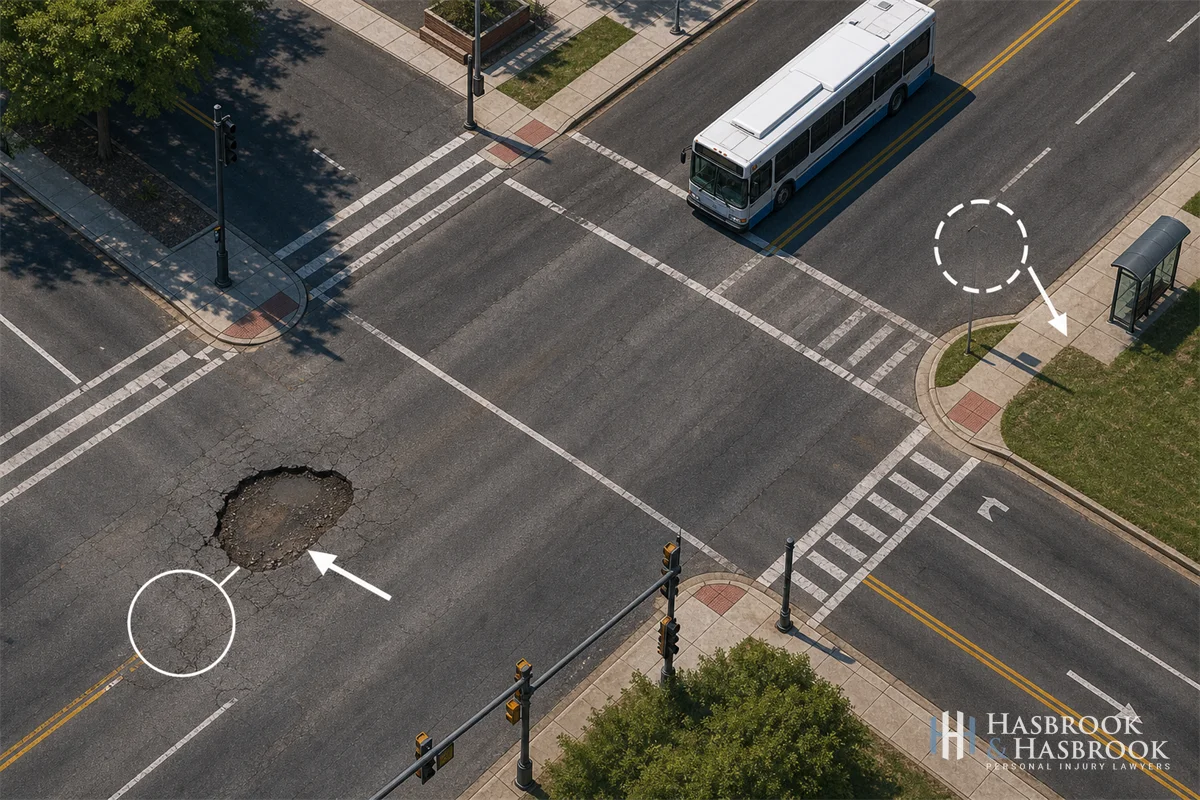
Not every injury involving a government entity falls under a waiver. The Act retains immunity for numerous categories including discretionary functions, judicial and legislative acts, and certain law enforcement activities (51 O.S. § 155). Our firm analyzes the specific facts to determine which waiver provisions apply and whether additional non-governmental defendants should be pursued. The State of Oklahoma’s Office of Management and Enterprise Services Risk Management Department handles state-level claims, and each city or county designates its own clerk’s office or risk manager to receive notices. When the dangerous condition is on private property leased by a public entity, the analysis can shift to standard private-property hazard rules in Oklahoma City, including the duty owed to invitees and licensees discussed in our negligent security claims overview.
Proving Liability Under the OGTCA
A governmental tort claim requires the same four negligence elements as any private-party case (duty, breach, causation, damages), but with three additional layers that do not apply in private litigation.
Layer 1: Scope of employment. Under 51 O.S. § 152, the government is liable only for acts of an employee within the scope of employment. The government’s liability is vicarious, and an employee acting outside that scope (a clear personal frolic, an intentional crime unrelated to job duties) takes the entity off the hook for that conduct.
Layer 2: A waiver category fits. The conduct must fall inside one of the categories listed in 51 O.S. § 153 and must not be retained as immune under 51 O.S. § 155. For example, a city is liable when its sanitation truck rear-ends a passenger car (motor vehicle waiver under § 155(10)) but is not liable for a discretionary policy decision about whether to staff a fire station overnight (retained discretionary-function immunity under § 155(5)).
Layer 3: Notice was timely and complete. The written notice must be filed within one year and must contain every element required by 51 O.S. § 156: the date, time, place, and circumstances; the names of any officers or employees involved; the amount of compensation claimed; and the claimant’s address. A notice that misses a required element, or lands a single day past the one-year mark, is a jurisdictional bar even when the underlying facts establish clear liability.
The plaintiff bears the burden on every layer. A defendant municipality almost always raises immunity in a motion to dismiss before any factual discovery, which is why retaining counsel before the notice deadline and well before suit is filed is critical to the case surviving its first procedural test. Counsel can also use our public-property hazard intake worksheet when the OGTCA claim arises from a defective government building or sidewalk, since the documentation overlap is substantial.

What Compensation Can You Recover in a Governmental Tort Claim in Oklahoma?
Oklahoma’s governmental tort claim damage caps are the single largest limitation on a claimant’s recovery. Under SB 1168, 51 O.S. § 154 caps total liability at $250,000 per person against political subdivisions with populations under 150,000, $375,000 per person against political subdivisions with populations of 150,000 or greater (which includes Oklahoma City, Tulsa, Norman, Edmond, Lawton, Broken Arrow, and Moore), $75,000 for property damage, and $2,000,000 in the aggregate per occurrence. Within these limits, the same categories of damages available in any personal injury case can be recovered.
| Damage Category | What It Covers | OGTCA Cap Impact |
|---|---|---|
| Medical expenses | Emergency care, surgery, hospitalization, rehabilitation, ongoing medical treatment | Included within the per-person cap (admissibility per 12 O.S. § 3009.1, paid-not-incurred) |
| Lost wages | Income lost during recovery and future earning capacity reductions | Included within the per-person cap |
| Pain and suffering | Physical pain, emotional distress, anxiety, post-traumatic stress disorder, loss of enjoyment of life | Included within the per-person cap |
| Property damage | Vehicle damage and personal property destroyed in the incident | Capped at $75,000 separately for property loss |
| Wrongful death | Funeral expenses, loss of financial support, loss of companionship (see our Oklahoma City wrongful death page) | Included within the per-person cap |
| Punitive damages | Not available against government entities | Expressly prohibited under 51 O.S. § 154 |
The per-person cap is the ceiling for all damages combined, including medical bills, lost wages, and pain and suffering. When injuries are severe and damages clearly exceed the cap, we look for additional liable parties outside the government who are not subject to OGTCA limits. If a city vehicle accident was caused partly by a defective tire, road design by a private engineering firm, or maintenance failure by a private contractor, the private party can be sued separately with no governmental cap. Insurance recovery against a private third party often follows the standards described in the Insurance Information Institute’s coverage primers.
Punitive damages are never available against Oklahoma government entities. This is a significant contrast to claims against private defendants, where punitive damages can substantially increase the recovery. The prohibition on punitive damages makes identifying any non-governmental defendants who may share fault even more important. The same paid-not-incurred admissibility rules that apply in private cases also apply against the government, and our step-by-step medical-bill admissibility flowchart walks through the evidentiary path.
What Does Oklahoma Law Say About Governmental Tort Claims?
The OGTCA is the comprehensive legal framework governing every injury claim against the State, its political subdivisions, and their employees. Every governmental tort claim in Oklahoma must comply with the Act, with no exceptions or workarounds.
Sovereign immunity and its waiver (51 O.S. § 152.1, § 153): Oklahoma governments are immune from suit by default. The OGTCA waives this immunity only for the categories of conduct listed in 51 O.S. § 155. If a claim does not fit a waiver category, the government cannot be sued regardless of how clearly it was at fault.
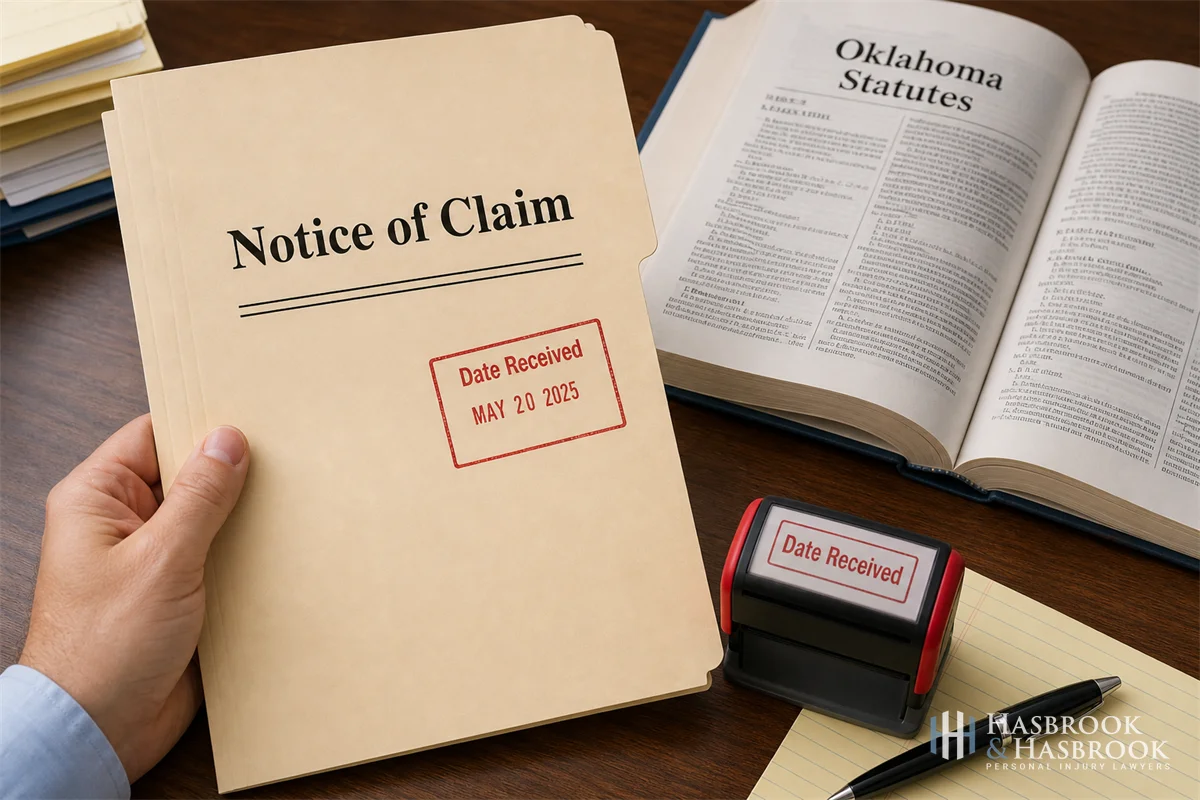
Mandatory notice requirement (51 O.S. § 156): A written notice of claim must be filed with the Office of Risk Management (for state claims) or the clerk of the governing body (for city or county claims) within one year of the date of loss. The notice must include specific information: the date, time, and place of the incident; the circumstances of the claim; the amount of damages claimed; the names of any officers or employees involved; and the claimant’s address. Failure to file proper notice within one year is a jurisdictional bar; the court loses the power to hear the case.
Damage caps (51 O.S. § 154, as amended by SB 1168): $250,000 per person in subdivisions under 150,000 population; $375,000 per person in subdivisions of 150,000 or more (including Oklahoma City); $75,000 property damage; $2,000,000 aggregate per occurrence. No punitive damages are allowed against government entities.
Retained immunities (51 O.S. § 155): The OGTCA retains government immunity for numerous categories including discretionary functions and policy decisions; legislative and judicial acts; execution of statutes; assessment and collection of taxes; adoption or enforcement of law; participation in or conduct of judicial proceedings; certain law enforcement activities; and natural conditions of unimproved property.
Comparative negligence (23 O.S. § 13): Oklahoma’s modified comparative negligence rule applies to governmental tort claims. The recovery is reduced by the claimant’s percentage of fault, and the recovery is barred entirely if the claimant’s fault exceeds 50%. At exactly 50%, a claimant can still recover, but every percentage above that bars the claim under Oklahoma’s fixed-number rule.
No jury trial for state claims: Claims against the State of Oklahoma (as opposed to cities and counties) are tried to the court; there is no right to a jury trial under the OGTCA for state-level claims. City and county claims can be tried to a jury.
How Do Government Entities Handle Tort Claims?
Government entities and their insurance administrators handle tort claims differently than private insurance companies. Understanding their approach helps set realistic expectations and avoid common pitfalls. The Oklahoma Insurance Department’s consumer auto coverage guide explains the broader insurance landscape that surrounds these claims when a private liability policy is also in play. Our walkthrough of the auto-carrier playbook in injury claims covers many of the same delay tactics municipalities use.
Administrative review process: After a notice of claim is filed, the government entity has 90 days to approve, deny, or make a settlement offer (51 O.S. § 157). Many entities use this period to investigate the claim and make a liability determination. If the entity denies the claim or fails to respond within 90 days, the claimant is free to file a lawsuit.
Reliance on immunity defenses: Government defense attorneys almost always raise immunity as a threshold defense. Before arguing the facts, they will argue that the OGTCA does not waive immunity for the type of conduct at issue. These motions to dismiss can end a case early if the immunity analysis goes against the plaintiff, which is why hiring an attorney who understands the waiver categories is essential.
Damage cap leverage: Government entities know that the per-person cap limits the maximum recovery. In serious injury cases where damages clearly exceed the cap, they may use this fact as leverage to offer substantially less than the cap, knowing the claimant cannot recover more regardless of any verdict.
Delay within statutory deadlines: Government claims adjusters may take the full 90 days to respond to a notice, then request extensions, then challenge procedural technicalities. The pattern is designed to delay resolution and increase pressure on a claimant to accept a low offer.
Challenging notice compliance: One of the government’s most common defenses is that the notice of claim was deficient: filed a day late, sent to the wrong office, or missing required information. The notice requirements under 51 O.S. § 156 are strict, and Oklahoma courts enforce them. This is why an attorney preparing and filing the notice is critical.
What Should You Expect During Your Governmental Tort Claim?
A governmental tort claim follows a specific statutory procedure that differs from a typical personal injury lawsuit. The timeline below is the path our firm uses on every OGTCA case.
Step 1: Case evaluation. We review the facts of the case, identify the responsible government entity, and determine which OGTCA waiver provisions apply. If the claim falls within a waiver category, we proceed. If not, we identify alternative theories and any non-governmental defendants.
Step 2: Notice of claim (within 1 year). We prepare and file a formal written notice of claim with the appropriate government entity’s clerk or the Office of Risk Management. The notice contains every element required by 51 O.S. § 156, and we file it well before the one-year deadline to eliminate any procedural risk. Investigators and counsel can use the timing rules described in our notice and proof documentation guide to confirm what the file should contain when the notice is served.
Step 3: Administrative response (90 days). The government entity has 90 days to approve, deny, or settle the claim. During this period, we continue investigating, gathering evidence, and building the case.
Step 4: Lawsuit filing (within 180 days of denial). If the claim is denied or the 90 days expire without a satisfactory response, we file a lawsuit in the appropriate Oklahoma district court. The lawsuit must be filed within 180 days after the denial under 51 O.S. § 157. The 180-day window is the deadline for filing suit after a denial, not the deadline for the original notice; the original notice deadline is one year.
Step 5: Discovery and litigation. We conduct discovery, including depositions, document requests, and interrogatories, to build the evidentiary record. Government defendants often raise immunity defenses through motions to dismiss, which we brief and argue. Filing-cost questions in OGTCA cases mirror those in any Oklahoma County case; see our overview of costs to file a personal injury lawsuit in Oklahoma City.
Step 6: Settlement or trial. Many governmental tort claims settle after discovery demonstrates clear liability. If the case goes to trial, we present the evidence to a jury (for city or county claims) or to the judge (for state claims).


What Steps Should You Take After Being Injured by a Government Entity?
The one-year notice deadline makes speed essential. After an injury caused by a government employee, vehicle, or property, take these steps immediately to protect the right to compensation.
- Get medical attention. Document the injuries with medical records that establish a clear connection between the government entity’s negligence and the resulting harm.
- Identify the government entity responsible. Was it a city employee, county vehicle, state highway department, school district, or state agency? The entity’s identity determines where the notice is filed and which rules apply.
- Document everything at the scene. Photograph the conditions that caused the injury: the pothole, the defective guardrail, the government vehicle, the broken sidewalk. Note the date, time, location, and any witness information.
- Report the incident. File an incident report with the relevant government agency and request a copy.
- Do not give recorded statements. Government risk management departments and their insurers will request statements just like private insurers. Decline until counsel reviews the request.
- Contact a governmental tort claims lawyer immediately. The one-year notice deadline under 51 O.S. § 156 is absolute. Our firm prepares and files the notice quickly, preserving the right to sue while medical recovery is ongoing.
Why Choose Hasbrook & Hasbrook for Your Governmental Tort Claim?
Our firm is a family-run Oklahoma personal injury practice with specific experience handling claims against government entities. Clayton T. Hasbrook grew up in this firm and became a lawyer to continue his parents’ work fighting for Oklahomans who are hurt by negligence, including government negligence. We understand the OGTCA’s procedural requirements, immunity provisions, and updated SB 1168 damage caps, and we know how to maximize recovery within this system.
Governmental tort claims require a different approach than standard personal injury cases. You need attorneys who understand administrative law, who can identify the correct government entity and waiver provision, and who can handle the strict procedural requirements that trip up less experienced firms. Our team has handled claims against Oklahoma City, the State of Oklahoma, school districts, EMBARK, and other government agencies throughout the state, and our attorneys have written extensively about recent Oklahoma tort reform changes that affect how these claims are valued. Read more about Clayton T. Hasbrook’s background and our verdicts and settlements summary.
Relevant case results:
- $175,000 recovery (full per-person cap under prior law). Passenger injured on an EMBARK bus due to driver negligence; secured the maximum statutory per-person recovery available at the time.
- $145,000 settlement. Motorcyclist injured by a county road maintenance vehicle that failed to yield on a rural highway.
- $125,000 settlement. Pedestrian tripped on a broken sidewalk outside a city-owned building in downtown Oklahoma City.
How Do Our Fees Work?
At our firm, governmental tort claims are handled on a contingency fee basis. There is nothing to pay upfront and nothing at all if we do not win. The fee is a percentage of the compensation recovered, 25% for pre-litigation settlements, lower than the 33% industry standard charged by most Oklahoma City firms. Common questions about contingency fees are answered on our FAQ page.
We advance all case expenses, including filing fees, expert witnesses, government record requests, and deposition costs, and only recover those expenses from a settlement or verdict. Before anything is signed, we explain the fee structure clearly so there are no surprises. This billing model means the cost of hiring a lawyer is never a barrier to pursuing a governmental tort claim.
Frequently Asked Questions About Oklahoma Governmental Tort Claims
How much is a governmental tort claim worth in Oklahoma?
Under SB 1168, the OGTCA caps total recovery at $250,000 per person against political subdivisions with populations under 150,000, $375,000 per person against subdivisions of 150,000 or more (including Oklahoma City), $75,000 for property damage, and $2,000,000 in the aggregate per occurrence (51 O.S. § 154). Within those limits, the same types of damages available in any personal injury case can be recovered: medical expenses, lost wages, pain and suffering, and property damage. No punitive damages are allowed against government entities. If damages exceed the cap, we look for additional non-governmental defendants who are not subject to OGTCA limits.
How long do I have to file a governmental tort claim in Oklahoma?
A written notice of claim must be filed within one year of the date of injury (51 O.S. § 156). The deadline is strict and jurisdictional; if it is missed, the court cannot hear the case. After filing the notice, the government entity has 90 days to respond. If the claim is denied, suit must be filed within 180 days of the denial (51 O.S. § 157). These deadlines are shorter than the standard two-year statute of limitations, which is why consulting a lawyer immediately matters.
What is sovereign immunity and how does it affect my claim?
Sovereign immunity is a legal doctrine that prevents the government from being sued without its consent. In Oklahoma, the OGTCA provides limited waivers of this immunity for specific categories of government conduct, such as motor vehicle operations, maintenance of roads and buildings, and certain other activities. If a claim does not fall within a waiver category listed in 51 O.S. § 155, the government retains immunity and cannot be sued regardless of fault.
What does it cost to hire a governmental tort claims lawyer in Oklahoma City?
Nothing upfront. We work on a no-recovery, no-fee basis: 25% for pre-litigation settlements, lower than the 33% industry standard. We advance all case costs and only get paid if we recover compensation. If we do not win, the client owes nothing.
What should I do after being injured by a government entity or employee?
Get medical attention immediately, identify which government entity is responsible (city, county, state, school district, or other agency), photograph the scene and conditions that caused the injury, file an incident report with the relevant agency, and contact a governmental tort claims lawyer as quickly as possible. The one-year notice deadline under 51 O.S. § 156 is absolute; missing it means losing the right to sue entirely.
What types of incidents can I file a governmental tort claim for?
A governmental tort claim can be filed for injuries caused by government vehicle accidents (police cars, city buses, school buses, maintenance trucks), dangerous road conditions (potholes, missing guardrails, defective signals), hazardous conditions in public buildings and parks, government contractor negligence, and other situations where the OGTCA waives immunity under 51 O.S. § 155. The key is that the specific type of government conduct must fit one of the Act’s waiver provisions.
Can I sue the City of Oklahoma City directly?
Yes, but only through the OGTCA process. A written notice of claim must first be filed with the Oklahoma City Clerk’s office within one year of the injury. The City then has 90 days to respond. If the claim is denied or no response is provided, suit can be filed in Oklahoma County District Court within 180 days. Because Oklahoma City has a population of more than 150,000, the $375,000 per-person damage cap controls. City claims can be tried to a jury, unlike state-level claims, which are tried to a judge.
What if a private contractor working for the government caused my injury?
Private contractors are generally not protected by the OGTCA’s sovereign immunity. If a road construction company, building maintenance firm, or other private contractor working under a government contract caused the injury, the contractor can usually be sued directly under standard negligence principles without the OGTCA’s damage caps or notice requirements. This is often the best path to full compensation when damages exceed the governmental cap. We investigate whether private contractors share liability in every governmental tort case.
Does the Governmental Tort Claims Act apply to police misconduct?
Some police-conduct claims fall under the OGTCA, and some are filed instead under federal civil rights law (42 U.S.C. § 1983). Routine vehicle accidents involving a police cruiser typically come in under the motor-vehicle waiver in § 155(10). Claims involving constitutional violations (excessive force, false arrest, unlawful search) are usually filed in federal court under § 1983, where damage caps and the OGTCA notice deadline do not apply. Many cases include both state-law and federal claims, and we review every fact pattern to determine which path or combination of paths protects the recovery.
How is fault allocated when I share some responsibility for the incident?
Oklahoma’s modified comparative negligence rule (23 O.S. § 13) applies to governmental tort claims. Recovery is reduced by the claimant’s percentage of fault, and recovery is barred only when fault exceeds 50%. At exactly 50%, the claimant can still recover. For example, if a jury finds total damages of $300,000 against the City of Oklahoma City and assigns 30% fault to the claimant, the recoverable verdict before applying the cap would be $210,000, well within the $375,000 per-person ceiling.

Ready to Talk to an Oklahoma City Governmental Tort Claims Lawyer?
The one-year notice deadline is not negotiable. Every day waiting is a day closer to losing the right to file forever. Call (405) 605-2426 for a free consultation with Clayton Hasbrook. We will review the facts of the case, identify the responsible government entity, and file the required notice, all at no cost unless we recover compensation. Our firm also helps clients in nearby practice areas, including slip-and-fall work on private property, crashes on Oklahoma City roads, Oklahoma City bus accident, Oklahoma City bicycle accident, and fatal-injury claims, plus regional support across Edmond personal injury lawyer, Moore injury attorney representation, Norman personal injury lawyer, and Ardmore personal injury lawyer matters.
Questions? Call Clayton at (405) 605-2426. The conversation is free, and it could save the case. Or reach our intake team online to get started today.